

Best AI Tools for Freelance Writers in 2026: Research, Drafting, Editing, SEO, and Clients
The best AI tools for freelance writers help with research, outlines, drafts, editing, SEO briefs, proposals, client notes, and project delivery. The right tools do not replace a freelancer’s judgment. They reduce repetitive work so writers can spend more time on clarity, originality, client strategy, examples, and final polish.
In Simple Terms
AI tools for freelance writers are apps that help writers plan, write, revise, optimize, and manage client work.
Some tools create drafts. Some improve grammar and style. Others help with SEO research, client briefs, brand voice, project notes, or content repurposing. The best freelance writer AI stack is usually a mix of tools, not one app trying to do everything.
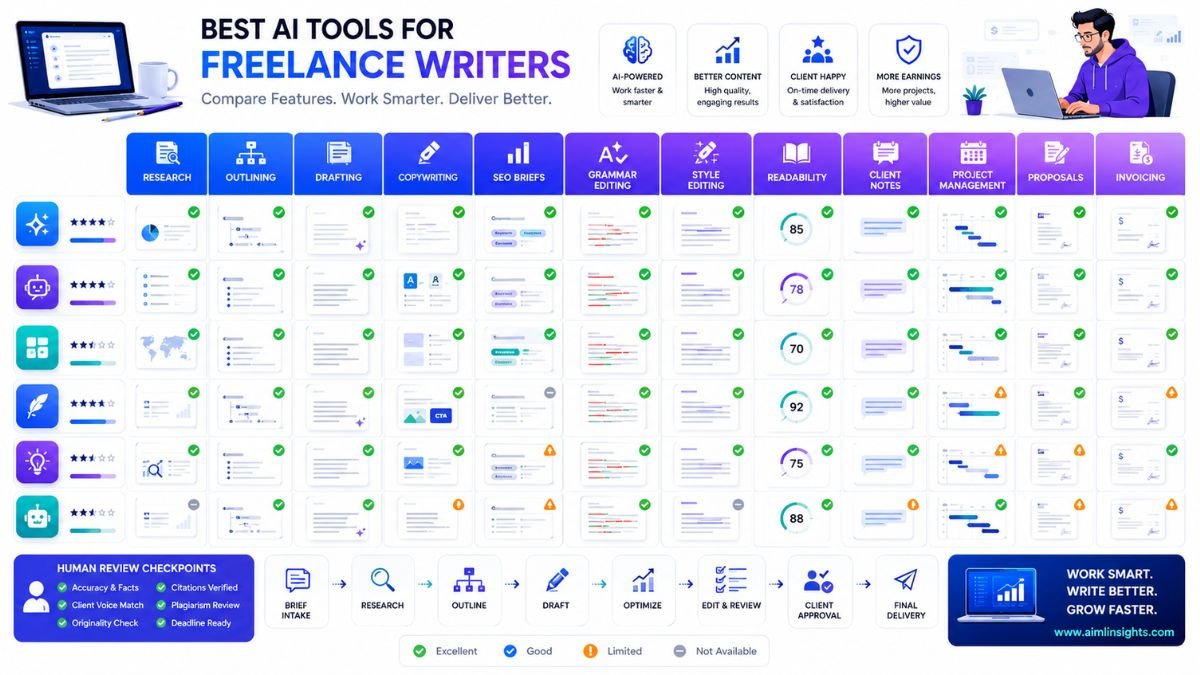
Best AI Tools for Freelance Writers: Quick Comparison
| Tool | Best For | Freelance Writing Use Case | Main Limitation |
| ChatGPT | Flexible writing assistant | Ideas, outlines, briefs, drafts, rewrites | Needs strong prompts and fact-checking |
| Claude | Long-form editing | Structure, tone, clarity, client-ready revisions | Not a dedicated SEO platform |
| Jasper | Marketing and brand voice | Client campaigns, landing pages, blog copy | Better for marketing writers than all niches |
| Grammarly | Grammar and polish | Emails, client drafts, tone, clarity | Can over-smooth personal voice |
| ProWritingAid | Style and deeper editing | Long-form editing, reports, manuscripts | More detailed than some quick jobs need |
| Frase | SEO content briefs | SERP research, outlines, topic coverage | Writers must avoid copying SERP structure |
| Surfer | SEO optimization | Content scoring, keywords, content refreshes | Can encourage over-optimization |
| Perplexity | Research | Source discovery and quick topic exploration | Sources still need manual verification |
| Notion AI | Client and project organization | Briefs, notes, drafts, project knowledge | Requires workspace discipline |
| Hemingway Editor | Readability | Shorter, clearer, cleaner writing | Not a full AI writing platform |
ChatGPT: Best Flexible AI Assistant for Freelance Writers
ChatGPT is useful for almost every stage of freelance writing: brainstorming angles, turning client notes into briefs, creating outlines, drafting introductions, generating FAQs, repurposing content, and rewriting sections for different audiences.
The best way to use it is with context. Include the client’s audience, goal, tone, product details, examples, and must-avoid claims. Without that, it can produce generic copy that sounds polished but weak.
Best for: planning, drafting, repurposing, content variations.
Use carefully for: factual claims, current data, citations, and client-sensitive information.
Claude: Best for Long-Form Editing and Structure
Claude is strong for revising longer drafts. Freelance writers can use it to check whether an article flows, whether a section is repetitive, whether the conclusion is strong, or whether a draft matches a client’s tone.
It is especially useful for turning messy client notes into a clearer structure. Use it after you have your own draft, not as a replacement for thinking.
Best for: editing, structure, tone, revision, article flow.
Use carefully for: live facts, product details, and SEO scoring.
Jasper: Best for Freelance Copywriters and Marketing Writers
Jasper is useful for freelance writers who serve marketing teams. Its brand voice page says teams can tune voice, tone, style, and visual guidelines so outputs sound more aligned with the brand.
Use Jasper for landing pages, email campaigns, ad copy, product announcements, social posts, and blog-to-campaign repurposing. It is strongest when the client cares about brand consistency across many deliverables.
Best for: copywriting, campaigns, brand voice, marketing content.
Use carefully for: strategy work that needs customer research and differentiation.
Grammarly: Best for Final Polish and Client Communication
Grammarly is useful for freelance writers because a freelancer’s writing is not limited to articles. Emails, proposals, revision notes, briefs, and client messages also need to be clear. Grammarly’s plans page shows AI writing assistance across its plans, while its business page emphasizes communication support, integrations, privacy, and security features.
Use Grammarly near the final stage to catch grammar, clarity, punctuation, and tone issues.
Best for: grammar, tone, client emails, final proofreading.
Use carefully for: preserving your own writing voice.
ProWritingAid: Best for Deeper Editing
ProWritingAid is useful when freelance writers need more than a quick grammar check. It positions itself as a grammar checker, style editor, and writing mentor in one package. Its writing style report helps identify readability issues, verbs, voice, clauses, emotion tells, and repetition.
Use it for long-form articles, ghostwriting, ebooks, white papers, case studies, and polished client deliverables.
Best for: long-form editing, style analysis, repetition checks.
Use carefully for: quick-turnaround projects where deep reports may slow you down.
Frase: Best for SEO Briefs and SERP Research
Frase is useful for freelance SEO writers who need to understand search intent before drafting. Its Research Agent runs SERP analysis, People Also Ask discovery, competitor breakdowns, keyword intelligence, topic clusters, and content brief creation. Use Frase to build content briefs, compare SERP patterns, and identify missing subtopics. Then write an original article that improves on the SERP instead of copying it.
Best for: SEO briefs, search intent, outlines, topic coverage.
Use carefully for: overfitting competitor headings.
Surfer: Best for SEO Optimization and Content Refreshes
Surfer is useful when clients expect SEO deliverables. Its Content Editor helps writers optimize content with real-time metrics for structure, word count, NLP-ready keywords, and images.
Use Surfer after drafting to check whether the article covers the right terms and structure. Do not chase a score at the cost of readability.
Best for: SEO optimization, content refreshes, client SEO work.
Use carefully for: keyword stuffing and unnatural writing.
Perplexity: Best for Fast Research and Source Discovery
Perplexity helps freelance writers explore unfamiliar topics quickly. It is useful for source discovery, definitions, market context, product comparisons, and follow-up questions.
Use it at the research stage, then verify important claims from original sources. Freelance writers should never treat AI summaries as final evidence.
Best for: research discovery, topic scanning, source leads.
Use carefully for: factual accuracy and source quality.
Notion AI: Best for Client Notes and Project Organization
Notion AI helps writers organize briefs, content calendars, interview notes, research, outlines, drafts, and revision histories. Notion’s help guide says its AI can summarize and edit documents, extract key points, translate, rewrite sections, and suggest improvements. Notion’s AI product page also highlights AI blocks for drafts, databases, meeting notes, Research Mode, and workflow automation.
Best for: client workspaces, briefs, research notes, revision tracking.
Use carefully for: messy databases that make information harder to find.
Hemingway Editor: Best for Readability
Hemingway Editor helps freelance writers make drafts clearer and more direct. It is especially useful for blog posts, newsletters, landing pages, and beginner-friendly explainers.
Use it to reduce long sentences, simplify dense sections, and make content easier to scan. This matters because clients often want content that reads clearly, not just content that sounds polished.
Best for: readability, clarity, simple language, short paragraphs.
Use carefully for: technical or persuasive sections that need nuance.
How Freelance Writers Should Use AI Without Losing Originality
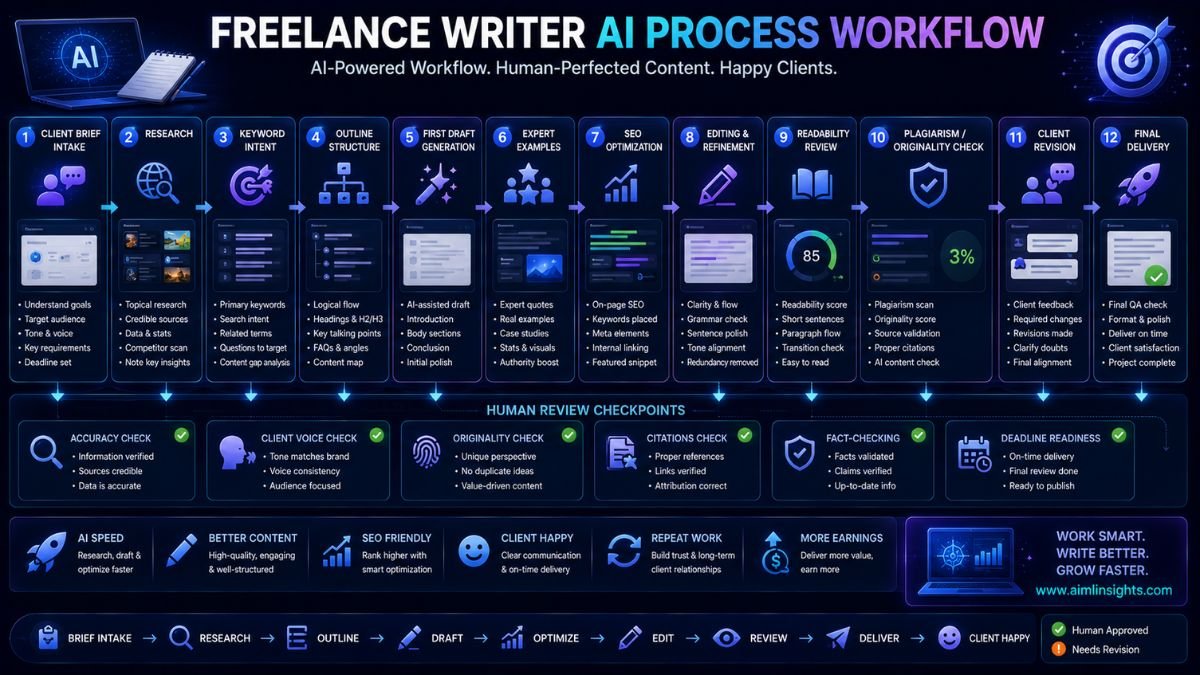
Use AI to support your process, not replace your thinking. A strong freelance workflow looks like this: collect client context, research the topic, create your own angle, use AI for outline options, draft with human judgment, optimize for SEO, edit manually, and check final quality.
Research on human-AI co-writing suggests professional writers care about preserving authentic voice and using personalization for growth, not just text production. That is a useful lesson for freelancers: your value is not just output speed. It is judgment, voice, clarity, and client understanding.
Common Mistakes to Avoid
The first mistake is sending raw AI drafts to clients. They often sound smooth but lack insight.
The second mistake is using the same AI tone for every client. Freelancers must adapt to brand voice.
The third mistake is ignoring confidentiality. Do not upload sensitive client documents, unpublished strategies, or private customer data without permission.
The fourth mistake is underpricing AI-assisted work. Faster drafting does not remove the value of research, positioning, editing, and client management.
Suggested Read:
- Best AI Tools for Beginners in 2026
- Best AI Tools for Writers
- Best AI Tools for Bloggers and Content Writers
- Best AI Tools for Blog Writing
- Best AI Tools for Blogging and Humanize AI
- ChatGPT vs Perplexity vs Claude for Research Tasks
- Prompt Engineering for Beginners: A Practical Guide
- AI Tools With Free Plans Worth Using in 2026
FAQ: Best AI Writing Tools for Freelancers
What are the best AI tools for freelance writers?
The best AI tools for freelance writers include ChatGPT, Claude, Jasper, Grammarly, ProWritingAid, Frase, Surfer, Perplexity, Notion AI, and Hemingway Editor.
Which AI writing tool is best for freelancers?
ChatGPT and Claude are strong general assistants. Jasper is better for marketing copywriters, Grammarly is best for polish, and Frase or Surfer is better for SEO freelance writers.
Can freelance writers use AI without losing originality?
Yes. Use AI for brainstorming, structure, editing, and repurposing, but keep control of research, examples, voice, judgment, and final edits.
What AI tools help freelance writers edit faster?
Grammarly, ProWritingAid, Claude, and Hemingway Editor help with grammar, style, tone, readability, and structure.
Which AI tools help with SEO writing?
Frase and Surfer are strong SEO writing tools. Frase helps with research and briefs, while Surfer helps optimize drafts and refresh existing content.
Are AI writing tools worth it for freelancers?
AI writing tools are worth it when they save time, improve quality, help with client workflows, and reduce repetitive tasks. They are not worth it if they create generic writing or weaken your voice.
Final Takeaway
The best AI tools for freelance writers depend on the work you sell. Use ChatGPT or Claude for planning and drafting, Jasper for marketing copy, Grammarly and ProWritingAid for editing, Frase and Surfer for SEO, Perplexity for research discovery, Notion AI for client organization, and Hemingway for readability.
AI can make freelance writing faster, but the freelancer still owns the brief, the voice, the accuracy, the examples, and the final quality.