

The best AI tools for blogging and humanize AI help writers research topics, create outlines, draft posts, optimize SEO, improve readability, check facts, and edit AI-assisted content so it sounds more natural. The goal is not to disguise weak AI writing. The goal is to publish useful, original, reader-friendly blog posts with human judgment.
In Simple Terms
AI blogging tools help you write and optimize blog posts faster.
AI humanizer tools help improve tone, flow, sentence variety, readability, and natural phrasing. But humanizing AI content should not mean bypassing detection systems or publishing generic rewrites. A good blog still needs real examples, accurate information, useful structure, and a clear editorial voice.
Best AI Tools for Blogging and Humanize AI: Quick Comparison
| Tool | Best For | Strong Use Case | Main Limitation |
| ChatGPT | Flexible blog drafting | Ideas, outlines, drafts, FAQs, rewrites | Needs fact-checking |
| Claude | Long-form editing | Structure, flow, tone, deep revision | Not a dedicated SEO tool |
| Jasper | Brand-focused blogging | Marketing blogs, campaign content, brand voice | Better for teams than casual users |
| Surfer | SEO optimization and humanizing | Content scoring, optimization, AI humanizer | Can encourage over-optimization |
| Writesonic | SEO-aware blog drafts | Article generation and AI search workflows | Output still needs editing |
| Frase | Content briefs | SERP research, outlines, topic coverage | Can mirror competitor structures |
| Grammarly | Editing and tone | Grammar, clarity, tone, brand polish | Not a full blog strategy tool |
| QuillBot | Rewriting and humanizing | Paraphrasing, grammar, natural wording | Can weaken voice if overused |
| Hemingway Editor | Readability | Shorter, clearer, bolder writing | Not a full AI blogging platform |
| Originality.ai | Quality checks | AI humanizer, readability, plagiarism, fact checks | Should not replace human review |
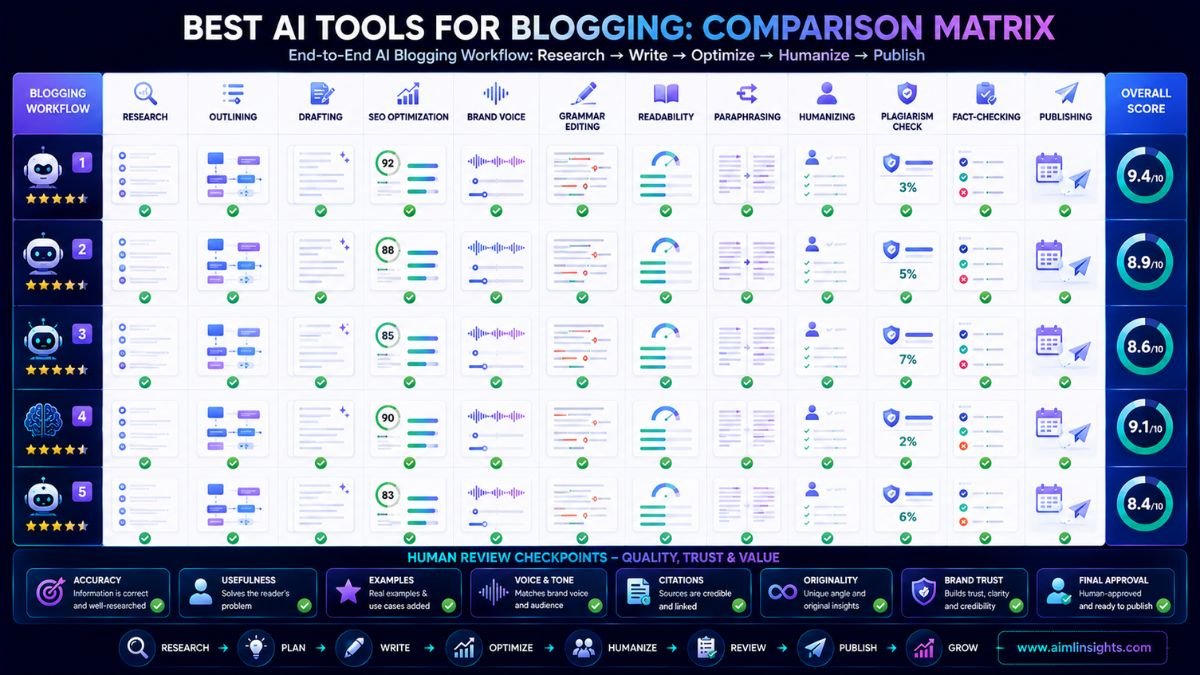
1. ChatGPT: Best Flexible AI Tool for Blogging
ChatGPT is useful across the blogging workflow: topic ideas, outlines, introductions, FAQ drafts, summaries, examples, rewrites, and content repurposing. It works best when you provide a detailed brief, target audience, primary keyword, search intent, tone, and sources.
Use ChatGPT for first drafts, but do not publish the first output. Add real examples, original insight, internal links, and fact-checked details.
Best for: brainstorming, outlines, drafts, rewrites, FAQs.
Use carefully for: product claims, statistics, citations, and current facts.
2. Claude: Best for Human-Like Blog Editing
Claude is strong for long-form editing and structure. It can help identify repetitive sections, weak transitions, unclear arguments, and paragraphs that sound too generic.
Use Claude after drafting. Ask it to improve flow, remove robotic phrasing, vary sentence rhythm, and make the article clearer for a specific reader. This is one of the safest ways to humanize AI content because it improves the writing rather than hiding its origin.
Best for: long-form revision, clarity, tone, structure.
Use carefully for: live facts and SEO-specific scoring.
3. Jasper: Best for Brand Voice and Marketing Blogs
Jasper is useful for teams that need blog content to match a consistent brand voice. Its official brand voice page says teams can tune voice, tone, style, and visual guidelines so outputs better match the brand.
Use Jasper for product blogs, SaaS content, campaign posts, landing-page copy, and blog-to-email repurposing. It is especially helpful when multiple writers need consistent tone.
Best for: brand voice, marketing blogs, campaign content.
Use carefully for: personal blogs where voice should feel more individual.
4. Surfer: Best for SEO Optimization and AI Humanizing
Surfer is useful for bloggers who want SEO guidance and content optimization. Surfer also offers a free AI humanizer that rewrites AI-generated text into more humanized writing.
Use Surfer to identify missing subtopics, improve topical coverage, and review optimization. But do not chase scores blindly. A post can be optimized and still be boring if it lacks examples, perspective, and helpful structure.
Best for: SEO optimization, topic coverage, AI-assisted rewriting.
Use carefully for: over-optimization and detection-bypass framing.
5. Writesonic: Best for SEO-Aware Drafting
Writesonic is useful when you need AI-assisted blog drafts with SEO workflows. It works best for writers who already understand search intent and can edit the draft into something more specific and useful.
Use it for first drafts, product roundups, list posts, and article outlines. Then add original commentary, examples, sources, and human editing.
Best for: SEO drafts, article generation, content velocity.
Use carefully for: generic output and factual claims.
6. Frase: Best for Content Briefs and SERP Research
Frase helps bloggers plan posts by researching SERP patterns, questions, competitor coverage, and outline structure. It is strongest before writing.
Use Frase to understand what the article should cover. Then write a better version with clearer examples, stronger subheadings, and less repetition than competing pages.
Best for: SERP research, outlines, content briefs.
Use carefully for: copying competitor structure too closely.
7. Grammarly: Best for Grammar, Tone, and Polish
Grammarly helps with grammar, spelling, punctuation, tone, and AI writing assistance. Its current plan information says free users can see tone and generate limited AI prompts, while paid tiers add full-sentence rewrites, tone adjustment, brand support, and more AI prompts.
Use Grammarly near the final editing stage. It helps clean up the article without changing the whole structure.
Best for: grammar, clarity, tone, professional polish.
Use carefully for: over-smoothing your natural voice.
8. QuillBot: Best for Rewriting and Natural Phrasing
QuillBot offers grammar checking, paraphrasing, translation, summarization, and an AI humanizer. Its AI humanizer page says it can make AI text more natural, engaging, and impactful.
Use QuillBot for sentence-level rewrites, not full article replacement. It is useful when a paragraph sounds stiff, repetitive, or unnatural.
Best for: paraphrasing, sentence variation, grammar, natural phrasing.
Use carefully for: meaning drift and over-rewritten text.
9. Hemingway Editor: Best for Readability
Hemingway Editor is useful when AI text feels long, dense, or over-explained. Its readability checker highlights hard-to-read sentences and gives a grade-level view of the text.
Use it to shorten sentences, reduce clutter, and improve pacing. This is especially helpful for beginner-friendly blogs.
Best for: readability, clarity, direct writing.
Use carefully for: creative or technical sections that need nuance.
10. Originality.ai: Best for Content Quality Checks
Originality.ai offers tools for AI detection, plagiarism checking, readability, fact-checking, grammar, and AI humanizing.
Use it as a quality-control layer before publishing. A blogger can check originality, readability, and possible factual issues, then revise manually. Do not use any checker as the only judge of quality.
Best for: plagiarism checks, readability checks, fact-checking support.
Use carefully for: treating detector scores as absolute truth.
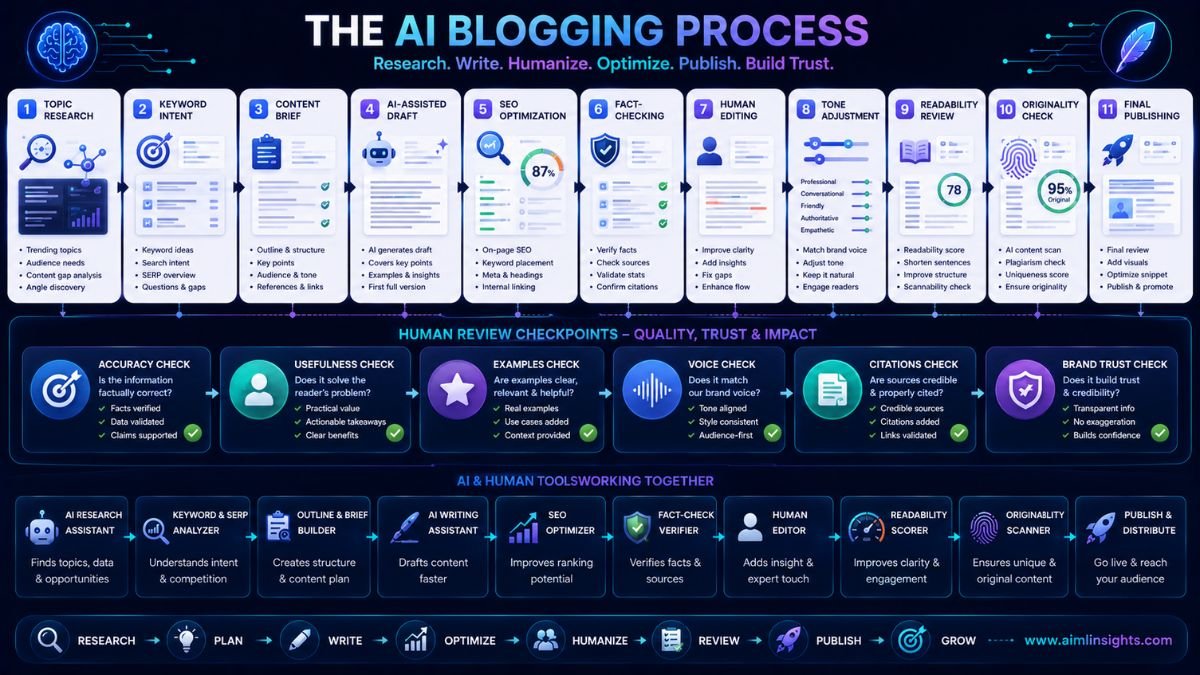
How to Humanize AI Blog Content the Right Way
Humanizing AI content means improving the article for real readers.
Add personal examples, product screenshots, workflow details, original comparisons, current sources, better transitions, stronger opinions, and clearer conclusions. Replace generic lines with specific observations. Remove repeated claims. Add context that only a human editor would know.
Avoid using AI humanizer tools only to bypass AI detectors. Some tools market themselves around detection bypass, but that is a weak editorial goal. Detection tools can be imperfect, and readers care more about whether the post is useful, accurate, and trustworthy.
Common Mistakes to Avoid
The first mistake is publishing raw AI drafts. They often sound polished but thin.
The second mistake is using humanizer tools after doing no real editing. Better wording cannot fix weak research.
The third mistake is copying SERP structures too closely. Use competitors for gap analysis, not imitation.
The fourth mistake is mimicking real writers without consent. Recent reporting around Grammarly’s discontinued “Expert Review” feature shows why AI writing tools must handle voice, identity, and consent carefully.
Suggested Read:
- Best AI Tools for Beginners in 2026
- Best AI Tools for Bloggers and Content Writers
- Best AI Tools for Blog Writing
- AI Tools With Free Plans Worth Using in 2026
- ChatGPT vs Perplexity vs Claude for Research Tasks
- Best Prompt Templates for Summarization and Research
- Prompt Engineering for Beginners: A Practical Guide
- Why LLMs Hallucinate and How to Reduce It
FAQ: Best AI Tools for Blogging and Humanize AI
What are the best AI tools for blogging and humanize AI?
The best tools include ChatGPT, Claude, Jasper, Surfer, Writesonic, Frase, Grammarly, QuillBot, Hemingway Editor, and Originality.ai.
Which AI tool is best for writing blog posts?
ChatGPT and Claude are strong for flexible drafting and editing. Jasper is better for brand-focused marketing blogs, while Writesonic supports SEO-aware drafts.
What AI tool can humanize AI content?
QuillBot, Surfer, Originality.ai, Hemingway Editor, Grammarly, and Claude can help improve tone, readability, and natural phrasing. Use them for quality improvement, not deception.
Can AI-written blogs rank on Google?
AI-assisted blogs can rank if they are useful, accurate, original, well-structured, and aligned with search intent. Thin AI-generated content without editing is unlikely to perform well.
Are AI humanizer tools worth it?
They are worth it when they improve clarity, rhythm, tone, and readability. They are not worth it if they only rewrite generic content without adding substance.
How do bloggers avoid robotic AI writing?
Use detailed briefs, add real examples, verify facts, write for one audience, vary sentence structure, remove filler, and edit the final draft manually.
Final Takeaway
The best AI tools for blogging and humanize AI are not one-click publishing tools. Use ChatGPT or Claude for planning and drafting, Jasper for brand voice, Surfer or Frase for SEO, Grammarly and Hemingway for clarity, QuillBot for sentence-level rewrites, and Originality.ai for quality checks.
AI can speed up blogging, but human judgment still decides whether the post is useful, original, accurate, and worth reading.