

The best AI tools for blog writing help you research topics, create outlines, draft posts, optimize for SEO, improve readability, and polish content before publishing. The strongest tool is not always the one that writes the most words. It is the one that helps you produce accurate, useful, original blog posts faster.
In Simple Terms
AI blog writing tools are writing assistants.
They can help you turn a topic into an outline, expand rough notes into a draft, rewrite weak paragraphs, suggest headlines, improve SEO coverage, and edit grammar. But they should not replace your expertise, examples, fact-checking, or final judgment. Good blog writing still needs a human editor.
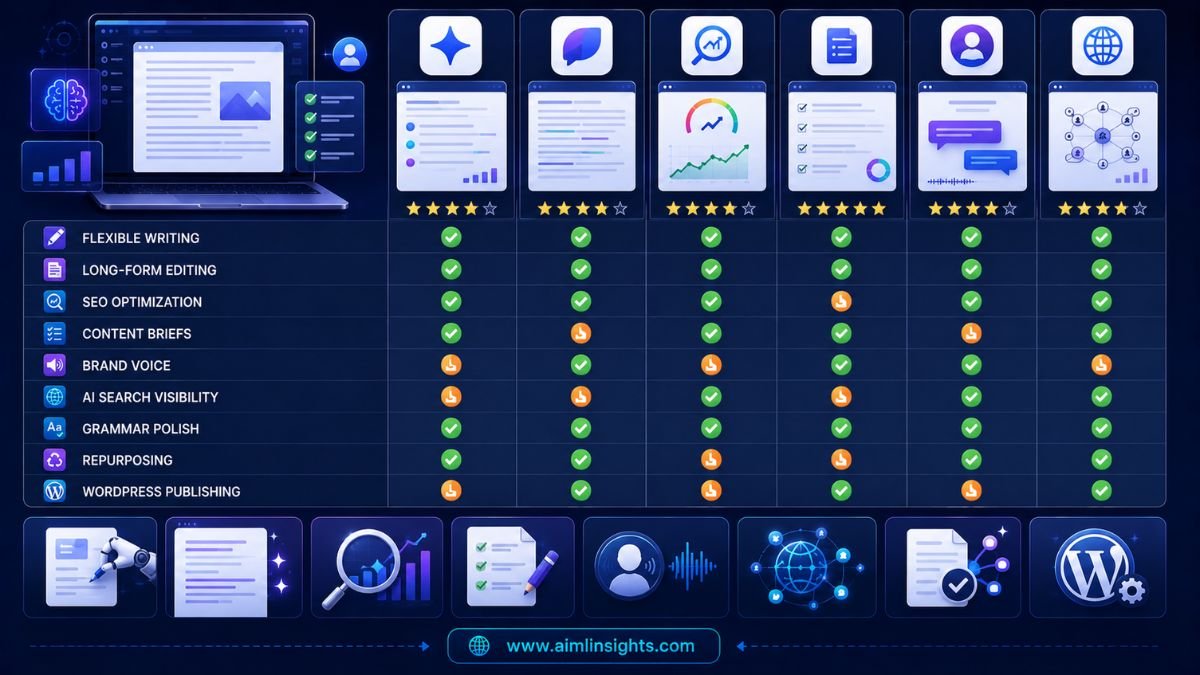
Best AI Tools for Blog Writing: Quick Comparison
| Tool | Best For | Strong Blog Writing Use Case | Main Limitation |
| ChatGPT | Flexible writing support | Ideas, outlines, drafts, FAQs, rewrites | Needs fact-checking |
| Claude | Long-form editing | Structure, clarity, tone, deep revision | Not a dedicated SEO tool |
| Jasper | Brand-focused content teams | Campaign blogs, brand voice, marketing assets | Better for teams than casual users |
| Writesonic | SEO-aware article generation | Blog drafts, research-backed article workflows | Output still needs editing |
| Surfer | SEO optimization | Content scoring, SERP terms, topic coverage | Can encourage over-optimization |
| Semrush Content Toolkit | SEO-led content workflows | Briefs, writing, optimization, repurposing | More advanced than some beginners need |
| Frase | SEO and GEO content planning | Research, outlines, optimized content, AI visibility | Best for SEO-focused writers |
| Grammarly | Editing and polish | Grammar, tone, clarity, readability | Not a blog strategy tool |
| Copy.ai | Marketing repurposing | Blog-to-email, blog-to-social, GTM workflows | Less focused on pure blogging now |
| Perplexity | Research before writing | Source discovery, topic exploration, competitor scan | Requires source verification |
1. ChatGPT: Best Flexible AI Tool for Blog Writing
ChatGPT is one of the best AI tools for blog writing because it can support almost every writing stage. You can use it to brainstorm topics, create outlines, draft introductions, rewrite paragraphs, generate FAQ ideas, summarize research, and repurpose a blog into social posts.
For best results, do not ask it to “write a blog post” with no context. Give it the audience, keyword, search intent, tone, outline, sources, and examples. ChatGPT works best when it has a strong brief and a human editor guiding the output.
Best for: ideas, outlines, drafts, rewrites, FAQs, content repurposing.
Use carefully for: statistics, product details, pricing, and recent claims.
2. Claude: Best for Long-Form Blog Editing
Claude is especially useful for writers who already have a draft but need better structure, clarity, and flow. It can identify repetitive sections, weak transitions, unclear arguments, and places where a post needs stronger examples.
Use Claude like an editor. Ask it to review the draft against search intent, check if the article answers the reader’s main question, and suggest where to add examples or simplify explanations.
Best for: long-form editing, tone improvement, structure, readability.
Use carefully for: live facts, SEO scoring, and current tool comparisons.
3. Jasper: Best for Brand-Focused Blog Writing
Jasper is built for marketing teams and content workflows. Its official site highlights content lifecycle automation, campaign scaling, and consistent brand voice. Jasper also offers brand voice controls that help teams tune voice, tone, style, and visual guidelines.
This makes Jasper useful for businesses, agencies, SaaS blogs, and content teams that need consistent blog content across campaigns. It is stronger when you already have defined messaging, audience profiles, and brand guidelines.
Best for: marketing blogs, brand voice, campaign content, content teams.
Use carefully for: personal blogs where voice should feel more individual.
4. Writesonic: Best for SEO-Aware AI Article Drafts
Writesonic is useful for writers who want AI drafts with SEO and AI search visibility in mind. Its AI Article Writer page says it can analyze competitors and web sources to create SEO-optimized articles, while its broader platform focuses on AI search growth workflows.
This makes Writesonic a practical option for bloggers, marketers, and agencies publishing frequently. Still, AI-generated drafts should be edited for originality, source accuracy, depth, and voice.
Best for: SEO article drafts, content velocity, AI search-focused workflows.
Use carefully for: expert content that needs firsthand experience.
5. Surfer: Best AI SEO Tool for Blog Optimization
Surfer is not only a writing tool; it is mainly useful for optimizing blog posts for search. Surfer positions itself around visibility across Google and AI search engines, and its Content Editor features include importing content, optimizing terms, building outlines, and sharing drafts.
Use Surfer after you have a draft or outline. It can help identify missing subtopics, related terms, and structural gaps. The risk is writing only to satisfy a score. Use its recommendations, but keep the content natural and useful.
Best for: SEO optimization, topical coverage, content briefs, SERP alignment.
Use carefully for: keyword stuffing and generic content.
6. Semrush Content Toolkit: Best for SEO-Led Blog Writing
Semrush Content Toolkit is useful when blog writing is part of a serious SEO strategy. Semrush says the toolkit combines AI writing capabilities with real-time SEO data, and its knowledge base describes topic research, drafting, optimization, and publishing in one workflow.
This makes it valuable for content teams, niche site owners, agencies, and businesses that want blog posts informed by search data rather than only prompts.
Best for: SEO briefs, content planning, writing, optimization, repurposing.
Use carefully for: beginners who may not need a full SEO platform yet.
7. Frase: Best for Content Briefs and SEO Research
Frase is useful for writers who want research, outlining, optimization, and AI visibility tracking in one place. Frase describes itself as an SEO and GEO platform that researches markets, creates optimized content, tracks visibility across Google and AI search engines, and recommends next actions.
For blog writing, Frase is strongest before and during drafting. It helps writers understand what a post should cover, which questions matter, and how to structure a stronger article.
Best for: content briefs, SERP research, SEO outlines, AI search visibility.
Use carefully for: relying too heavily on competitor structure.
8. Grammarly: Best for Final Blog Editing
Grammarly is one of the best AI tools for blog writing polish. Its official site says it provides AI writing assistance, personalized guidance, and text generation across apps and websites.
Use Grammarly after your draft is structurally strong. It can help improve grammar, clarity, tone, and readability. For bloggers, this matters because even useful content can lose trust if it feels messy.
Best for: grammar, tone, clarity, readability, final polish.
Use carefully for: over-editing your natural voice.
9. Copy.ai: Best for Repurposing Blog Content
Copy.ai is now positioned more as a GTM AI platform than only a simple writing tool. Its official site focuses on automating repetitive go-to-market tasks, and its GTM AI page highlights workflow automation, unified data, and repeatable processes.
For blog writing, Copy.ai is helpful after the article is written. It can support repurposing a blog into sales emails, LinkedIn posts, newsletters, landing-page copy, or campaign assets.
Best for: blog repurposing, marketing workflows, campaign content.
Use carefully for: pure editorial blogging with no GTM workflow.
10. Perplexity: Best for Research Before Writing
Perplexity is useful before the writing stage because it helps writers explore a topic and find sources quickly. Use it to understand the SERP, compare viewpoints, identify current sources, and collect research notes.
The important rule is verification. Do not copy summaries directly. Open the original sources, check facts, and then write in your own voice.
Best for: source discovery, topic research, competitor scanning.
Use carefully for: final factual claims without source review.
How to Choose the Best AI Blog Writing Tool
Choose based on your weakest writing stage.
If you struggle with ideas and outlines, start with ChatGPT or Claude. If you need SEO help, use Surfer, Frase, or Semrush Content Toolkit. If you publish at scale, consider Writesonic or Jasper. If your writing is rough, add Grammarly. If you turn blogs into campaigns, Copy.ai can help.

A strong beginner stack could be ChatGPT, Grammarly, and Surfer. A stronger SEO-focused stack could be Semrush Content Toolkit, Frase, Claude, and Surfer. A marketing-team stack could include Jasper, Writesonic, Grammarly, and Copy.ai.
Common Mistakes to Avoid
The first mistake is publishing AI drafts without adding original insight. AI can create a readable article, but readers need examples, judgment, experience, and useful detail.
The second mistake is ignoring accuracy. AI tools can invent facts, outdated features, or weak claims.
The third mistake is over-optimizing for SEO. A blog post should answer the reader first and satisfy the algorithm second.
The fourth mistake is using the same structure repeatedly. If every article has the same rhythm, headings, and examples, your site will feel generic.
Suggested Read:
- Best AI Tools for Beginners in 2026
- Best AI Tools for Bloggers and Content Writers
- Best AI Tool for Blogging
- AI Tools With Free Plans Worth Using in 2026
- Best AI Workflow Automation Tools for Teams
- ChatGPT vs Perplexity vs Claude for Research Tasks
- Best Prompt Templates for Summarization and Research
- Prompt Engineering for Beginners: A Practical Guide
FAQ: Best AI Tools for Blog Writing in 2026
What are the best AI tools for blog writing?
The best AI tools for blog writing include ChatGPT, Claude, Jasper, Writesonic, Surfer, Semrush Content Toolkit, Frase, Grammarly, Copy.ai, and Perplexity. Each tool supports a different stage of the writing workflow.
Which AI tool is best for writing blog posts?
ChatGPT is best for flexible writing, Claude is strong for long-form editing, Jasper is useful for brand-focused teams, and Writesonic is helpful for SEO-aware article drafts.
Can AI tools write SEO blog posts?
Yes, AI tools can help create SEO blog posts by supporting keyword research, outlines, drafts, content briefs, optimization, and editing. They still need human review for accuracy, usefulness, and originality.
What is the best AI blog post generator?
Writesonic, Jasper, and Koala-style article writers are strong for generating blog drafts, while Surfer, Frase, and Semrush Content Toolkit are better for SEO structure and optimization.
Are AI blog writing tools worth it?
AI blog writing tools are worth it when they save time and improve quality. They are not worth it if they produce generic drafts that still need complete rewriting.
Can AI-written blogs rank on Google?
AI-assisted blogs can rank if they are useful, accurate, original, well-structured, and aligned with search intent. Thin AI-generated content without expertise or editing is unlikely to perform well over time.
Final Takeaway
The best AI tools for blog writing are not just text generators. They help with research, outlines, drafts, SEO optimization, editing, brand voice, and repurposing.
For most writers, the best setup is simple: use ChatGPT or Claude for planning and drafting, Surfer or Frase for SEO, Grammarly for editing, and Jasper or Writesonic when you need scalable marketing content. Keep human judgment at the center, and AI becomes a writing accelerator instead of a shortcut to generic content.