

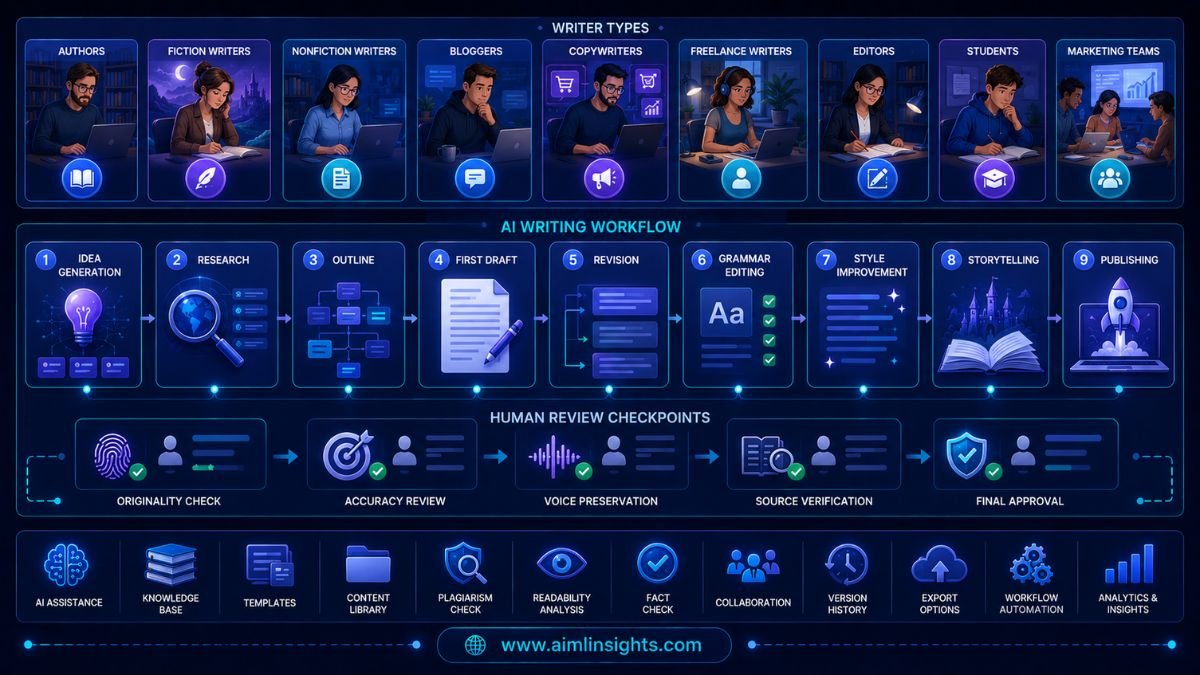
The best AI tools for writers help with ideas, outlines, research, drafting, rewriting, grammar, style, storytelling, and publishing preparation. The right tool depends on the type of writer you are. A novelist, blogger, copywriter, academic writer, and freelance editor all need different support from AI.
In Simple Terms
AI writing tools are assistants for the writing process.
They can help you brainstorm, organize notes, rewrite weak sentences, summarize research, improve tone, check grammar, develop characters, or polish a manuscript. They should not replace your voice, judgment, experience, or originality. Good writers use AI to reduce friction, not to outsource the whole craft.
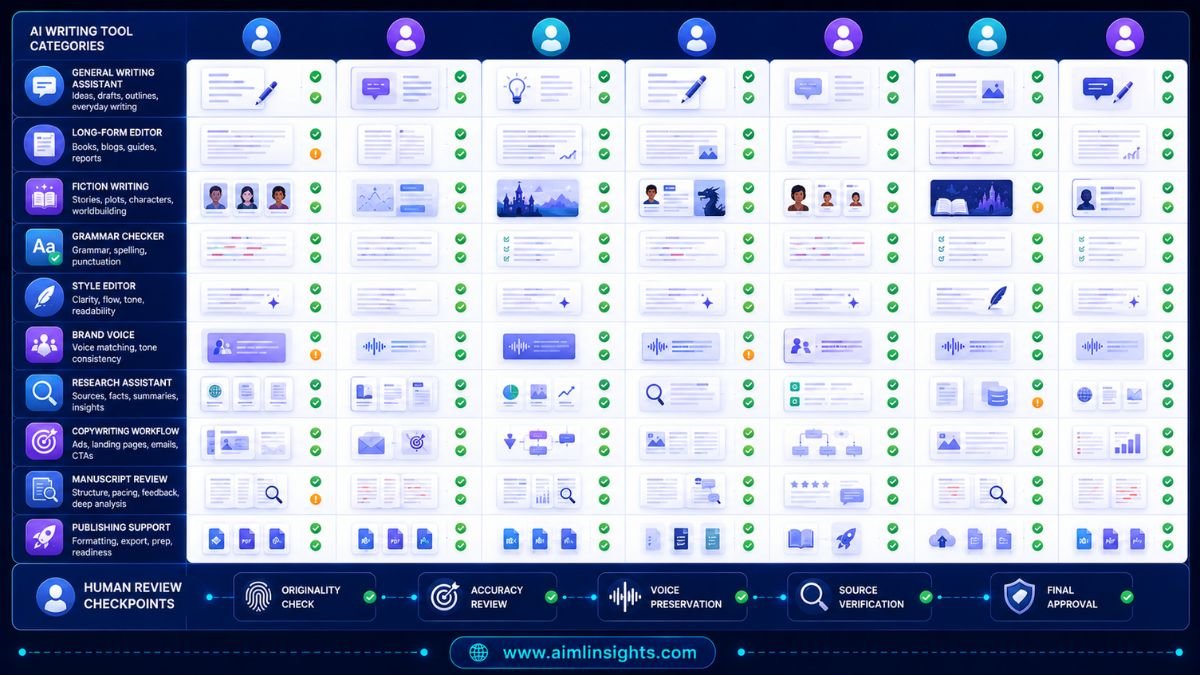
Best AI Tools for Writers: Quick Comparison
| Tool | Best For | Strong Writing Use Case | Main Limitation |
| ChatGPT | Flexible writing help | Ideas, outlines, drafts, rewrites, summaries | Needs fact-checking |
| Claude | Long-form editing | Structure, clarity, deep revision, document review | Not a dedicated fiction tool |
| Sudowrite | Fiction writers | Story ideas, scenes, rewrite, character and plot support | Needs author control |
| ProWritingAid | Authors and editors | Style reports, manuscript critique, sentence improvement | Can feel detailed for beginners |
| Grammarly | Everyday writing polish | Grammar, tone, clarity, professional writing | Not enough for story structure |
| Jasper | Marketing writers | Brand voice, campaigns, content teams | Better for business writing |
| Copy.ai | Copywriters and GTM teams | Blog-to-email, social, landing-page copy | Less focused on literary writing |
| Notion AI | Writing organization | Notes, outlines, project planning, research folders | Needs organized workspace |
| Perplexity | Research before writing | Source discovery, quick topic exploration | Sources still need checking |
| Hemingway Editor | Readability | Shorter, clearer sentences | Not a full AI writing system |
1. ChatGPT: Best Flexible AI Tool for Writers
ChatGPT is one of the best AI tools for writers who need a general assistant. It can help with brainstorming, outlines, title ideas, summaries, draft sections, dialogue alternatives, FAQ ideas, and content repurposing.
Writers should use ChatGPT with clear context. Instead of asking it to “write an article” or “write a chapter,” give it your audience, goal, tone, structure, notes, and constraints. This keeps the output closer to your intent.
Best for: brainstorming, outlines, rewrites, summaries, content planning.
Use carefully for: facts, citations, current information, and final voice.
2. Claude: Best for Long-Form Editing and Revision
Claude is strong for writers who work with long drafts, essays, reports, chapters, and complex arguments. It can review structure, identify repetition, improve flow, and suggest clearer ways to explain ideas.
Use Claude as a revision partner. Ask it what is confusing, where the argument weakens, which sections repeat, and whether the piece matches the intended reader. It is especially useful for nonfiction writers, bloggers, editors, and technical writers.
Best for: long-form editing, clarity, structure, tone, document review.
Use carefully for: source-heavy research and final factual claims.
3. Sudowrite: Best AI Tool for Fiction Writers
Sudowrite is built specifically for fiction and creative writing. Its site describes it as an AI writing partner for fiction, with support for rewriting, story planning, brainstorming, and manuscript-style revision workflows.
Fiction writers can use Sudowrite to explore scene alternatives, expand sensory description, break through writer’s block, test character reactions, or revise dull passages. The key is not to accept everything it generates. Use it to create options, then choose what fits your story.
Best for: fiction, scenes, character ideas, rewriting, story development.
Use carefully for: preserving originality and avoiding generic plot choices.
4. ProWritingAid: Best for Manuscript Editing
ProWritingAid is useful for authors and editors who want deeper writing feedback than basic grammar checks. Its official site highlights sentence improvement, sensory detail, weak-word removal, manuscript analysis, chapter critique, and virtual beta-reader-style features.
This makes it valuable for novelists, nonfiction authors, editors, and serious long-form writers. It helps identify style problems, pacing issues, repeated words, readability concerns, and weak sentences.
Best for: manuscript editing, style reports, chapter critique, author revision.
Use carefully for: over-editing your voice.
5. Grammarly: Best for Everyday Writing Polish
Grammarly is one of the most practical AI tools for writers who produce emails, posts, essays, proposals, reports, and professional messages. It helps with grammar, clarity, tone, and readability.
It is best used near the end of the writing workflow. First build the idea, structure, and argument. Then use Grammarly to clean up sentences and reduce avoidable mistakes.
Best for: grammar, tone, clarity, professional writing, final polish.
Use carefully for: keeping personal style intact.
6. Jasper: Best for Marketing Writers and Content Teams
Jasper is a strong fit for marketing writers, content teams, SaaS blogs, agencies, and brand-led writing workflows. Its official site focuses on marketing AI, campaign workflows, and brand voice support.
Use Jasper when writing must match brand tone across blogs, emails, landing pages, ads, product pages, and social campaigns. It is less necessary for a novelist or personal essayist, but useful for teams publishing at scale.
Best for: marketing content, brand voice, campaign writing, content teams.
Use carefully for: personal writing that should sound less polished and more human.
7. Copy.ai: Best for Copywriters and Repurposing
Copy.ai is useful for writers who create marketing copy and need to turn one idea into multiple assets. A blog post can become a newsletter, product description, landing page, LinkedIn post, ad variation, or sales email.
This makes it practical for freelance copywriters, growth teams, and businesses that need repeatable content workflows.
Best for: copywriting, repurposing, sales content, campaign workflows.
Use carefully for: long-form editorial writing that needs nuance.
8. Notion AI: Best for Organizing Writing Projects
Notion AI is useful when your problem is not sentence writing but organization. Writers often have scattered notes, outlines, research links, character sketches, source lists, and revision plans. Notion AI can help summarize notes, structure ideas, and turn messy planning into organized pages.
Best for: notes, outlines, research folders, writing calendars, project planning.
Use carefully for: outdated or messy source material.
9. Perplexity: Best for Research Before Writing
Perplexity is useful for writers who need source discovery before drafting. It can help explore a topic, compare viewpoints, identify useful sources, and find current context.
Use it at the research stage, not as the final authority. Open the original sources, verify key claims, and write the final explanation in your own words.
Best for: research, source discovery, topic exploration.
Use carefully for: final claims without checking original sources.
10. Hemingway Editor: Best for Clearer Sentences
Hemingway Editor is useful for writers who want shorter, clearer, more direct prose. It highlights dense sentences, passive voice, and readability issues.
It is not a complete AI writing assistant, but it is helpful for essays, blog posts, newsletters, and business writing where clarity matters more than ornate style.
Best for: readability, concise writing, sentence cleanup.
Use carefully for: creative prose where rhythm and complexity are intentional.
How Writers Should Choose an AI Tool
Start with your writing type.
Fiction writers should try Sudowrite and ProWritingAid. Bloggers and nonfiction writers may prefer ChatGPT, Claude, Grammarly, Perplexity, and Notion AI. Copywriters and marketers should consider Jasper and Copy.ai. Editors may combine Claude, ProWritingAid, Grammarly, and Hemingway Editor.
A strong beginner stack is simple: ChatGPT or Claude for ideas, Perplexity for research, Grammarly for polish, and Notion AI for organization. Authors can add Sudowrite or ProWritingAid when they need deeper manuscript support.
Common Mistakes Writers Should Avoid
The first mistake is letting AI flatten your voice. AI often produces safe, tidy, predictable wording unless you guide it carefully.
The second mistake is using AI-generated facts without checking. Writers remain responsible for accuracy.
The third mistake is accepting the first output. Good writing comes from selection, revision, and taste.
The fourth mistake is using AI to avoid hard creative decisions. Recent AI-fiction research suggests AI stories can show more predictable narrative patterns than human writing, so writers should protect complexity, ambiguity, and personal style.
Suggested Read:
- Best AI Tools for Beginners in 2026
- Best AI Tools for Bloggers and Content Writers
- Best AI Tools for Blog Writing
- AI Tools With Free Plans Worth Using in 2026
- ChatGPT vs Perplexity vs Claude for Research Tasks
- Best Prompt Templates for Summarization and Research
- Prompt Engineering for Beginners: A Practical Guide
- Why LLMs Hallucinate and How to Reduce It
FAQ: Best AI Tools for Writers in 2026
What are the best AI tools for writers?
The best AI tools for writers include ChatGPT, Claude, Sudowrite, ProWritingAid, Grammarly, Jasper, Copy.ai, Notion AI, Perplexity, and Hemingway Editor.
Which AI tool is best for authors?
Sudowrite is strong for fiction authors, while ProWritingAid is useful for manuscript editing. Nonfiction authors may prefer Claude, ChatGPT, Grammarly, Notion AI, and Perplexity.
Which AI tool is best for content writers?
Content writers usually benefit from ChatGPT, Claude, Jasper, Grammarly, Perplexity, and Notion AI. Marketing-focused writers may also use Copy.ai.
Can AI tools help with creative writing?
Yes. AI tools can help with prompts, scenes, character ideas, sensory description, rewriting, and writer’s block. Writers should still control plot, voice, theme, and final prose.
Are AI writing tools worth it?
AI writing tools are worth it when they save time, improve clarity, or help you revise better. They are not worth it if they make your writing generic or reduce your control.
Can AI replace writers?
AI can assist writers, but it should not replace human voice, judgment, lived experience, taste, ethics, and creative direction.
Final Takeaway
The best AI tools for writers are not just text generators. They support different parts of the writing process: planning, drafting, editing, research, storytelling, organization, and publishing preparation.
For most writers, start with one flexible assistant, one research tool, one editing tool, and one organization tool. Add specialized tools only when your work needs them. AI can speed up writing, but the strongest work still depends on human voice, judgment, and revision.