
RAG Cost Optimization: How to Reduce AI Retrieval Costs Without Losing Quality
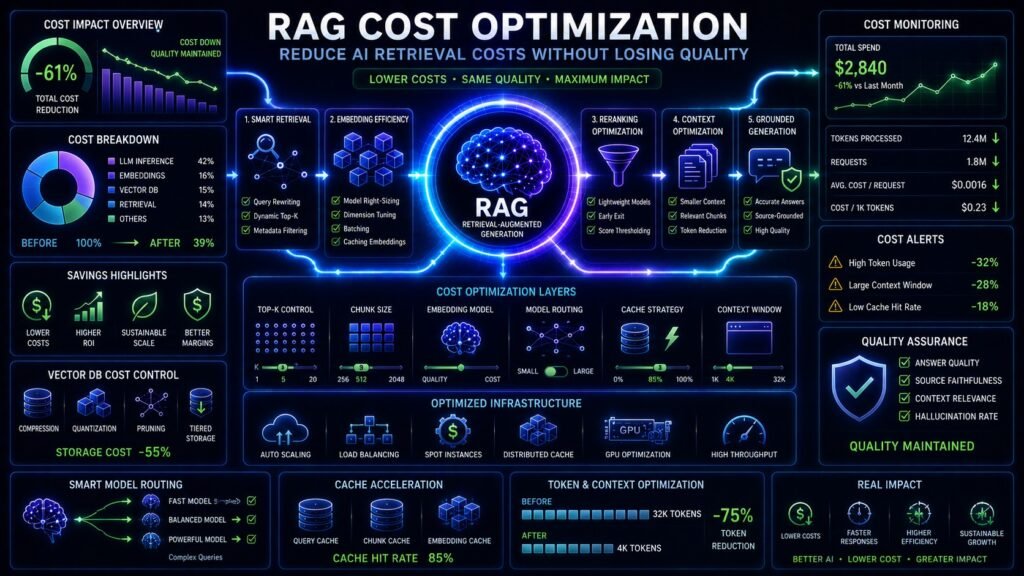
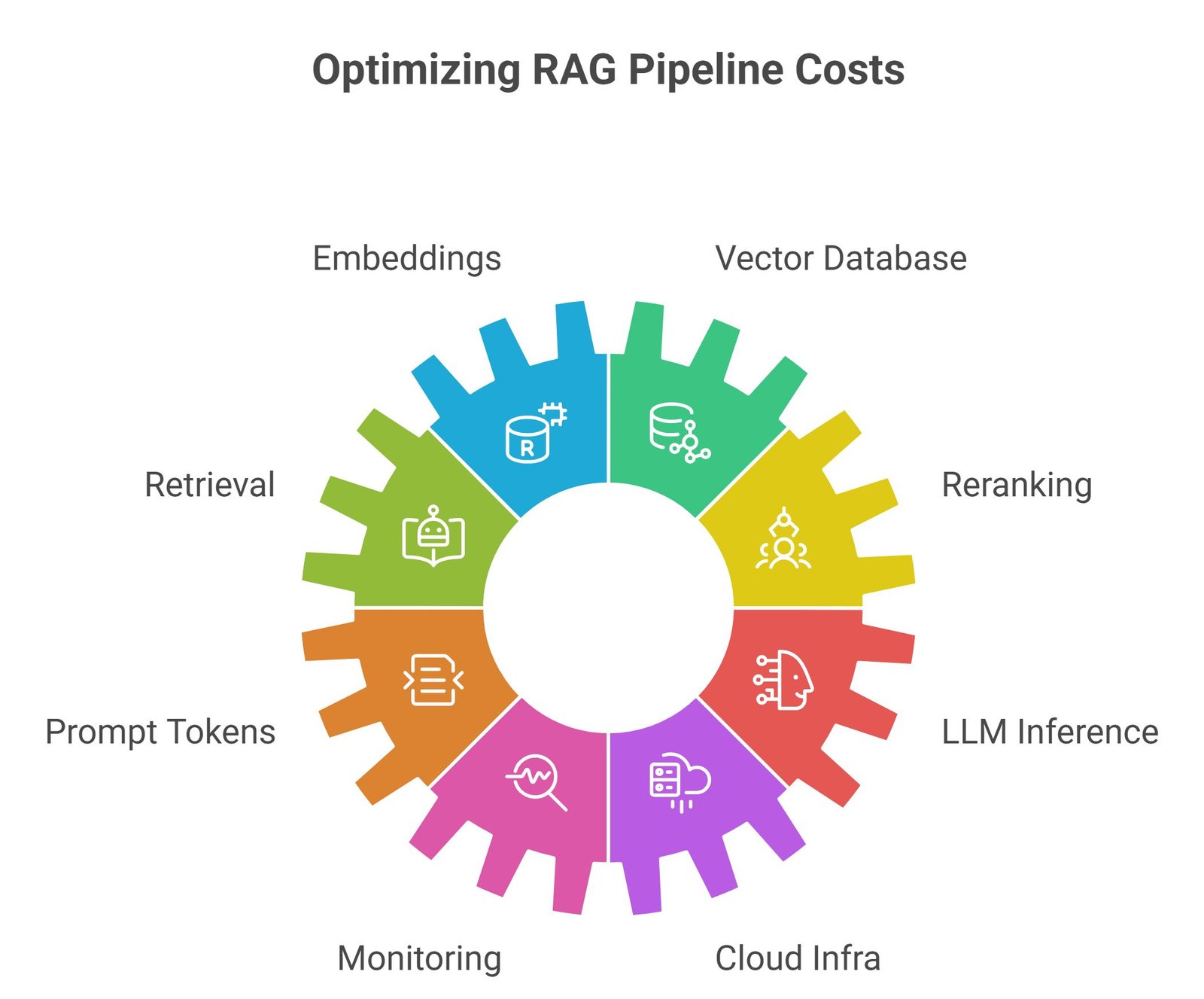
Retrieval-Augmented Generation is powerful, but production RAG systems can become expensive quickly. Costs come from embeddings, vector databases, reranking, storage, retrieval calls, context tokens, LLM inference, monitoring, and cloud infrastructure. RAG cost optimization helps teams reduce waste while keeping retrieval quality, answer faithfulness, and user experience strong.
In Simple Terms
RAG cost optimization means making a Retrieval-Augmented Generation system cheaper to run without making the answers worse. A RAG pipeline usually retrieves relevant information from documents, databases, or knowledge bases before sending that context to a language model. That improves grounding, but every extra chunk, token, reranking call, vector lookup, and model request adds cost.
The goal is not to make the cheapest possible RAG system. The goal is to make the most efficient system for the required quality level. A customer support bot may need fast, low-cost answers. A legal assistant may need higher retrieval depth and stronger verification. A good optimization plan balances cost, latency, accuracy, and risk instead of cutting infrastructure blindly.
Why RAG Systems Become Expensive
RAG systems are more complex than simple LLM chatbots because they contain multiple cost layers. A typical production system may include document ingestion, text extraction, chunking, embedding generation, vector storage, semantic retrieval, metadata filtering, reranking, prompt assembly, LLM inference, evaluation, monitoring, and logging. Each layer has its own pricing model and scaling behavior.
The biggest cost mistake is treating RAG as only an LLM expense. In production, a large share of spend may come from retrieval infrastructure, repeated embedding calls, excessive context tokens, oversized vector indexes, unnecessary reranking, high-volume logs, and inefficient orchestration. Cost optimization works best when teams measure the full pipeline rather than only the final model call.
Main Cost Drivers in a RAG Pipeline
| Cost Area | What Increases Cost | Optimization Direction |
| Embeddings | Re-embedding unchanged data | Cache and incremental indexing |
| Vector database | Large indexes and high query volume | Better chunking and index tuning |
| Retrieval | Too many candidate chunks | Limit retrieval depth intelligently |
| Reranking | Expensive reranker calls | Use reranking selectively |
| Prompt tokens | Too much retrieved context | Compress and filter context |
| LLM inference | Large models for every query | Route by query difficulty |
| Monitoring | Excessive logs and traces | Sample intelligently |
| Cloud infra | Overprovisioned services | Autoscale and right-size |
Start With Cost Visibility
The first step in RAG cost optimization is measurement. Teams should track the cost of each pipeline stage separately: ingestion, embeddings, vector storage, retrieval, reranking, LLM inference, logging, and evaluation. Without this breakdown, optimization becomes guesswork. A system may appear expensive because of the LLM, but the real issue may be repeated embedding generation or an oversized vector database.
Useful production metrics include cost per query, average retrieved chunks, average prompt tokens, reranker usage rate, cache hit rate, vector query latency, model selection distribution, and failed query rate. These metrics help teams find waste. For example, if 70% of queries are simple FAQ-style questions, routing all of them to the largest model with full retrieval depth is usually unnecessary.
Optimize Chunking to Reduce Waste
Chunking has a direct impact on RAG cost. Very small chunks increase the number of embeddings, vector records, retrieval candidates, and reranking operations. Very large chunks reduce record count but increase prompt token usage and retrieval noise. Both extremes can raise cost in different ways.
A practical approach is to test chunk sizes against real user queries. For many enterprise document systems, medium-sized semantic chunks with limited overlap are more efficient than blindly using fixed tiny chunks. Teams should also avoid excessive overlap, because it duplicates content across the index and increases storage, retrieval, and prompt costs. Good chunking improves both retrieval quality and cost efficiency because the system retrieves fewer, better pieces of context.
Reduce Embedding Costs
Embedding costs can grow quickly when teams repeatedly process the same documents. A production RAG system should avoid re-embedding unchanged content. Instead, use incremental indexing, document hashing, version tracking, and batch processing. If a document has not changed, its existing embeddings should usually be reused.
Embedding model choice also matters. Larger embedding models may improve retrieval quality, but they may not always justify the extra cost. Teams should compare embedding models using retrieval precision, context recall, latency, and cost per indexed document. For some use cases, a smaller embedding model with better chunking and metadata filtering can outperform a larger model used inefficiently.
Control Vector Database Costs
Vector database costs usually depend on storage size, index type, query volume, memory requirements, replication, metadata filtering, and performance tier. A bloated vector index increases both cost and latency. Teams should remove duplicate chunks, archive outdated content, delete unused embeddings, and separate hot and cold data.
Another useful tactic is index segmentation. Instead of searching one massive index for every query, route queries to smaller collections based on department, customer, product, language, region, or document type. Metadata filtering can reduce the search space before semantic retrieval begins. This lowers compute usage and improves retrieval precision at the same time.
Use Retrieval Depth Carefully
Many RAG systems retrieve too many chunks by default. Retrieving top 50 chunks and reranking all of them may improve quality for complex research tasks, but it is wasteful for simple questions. Retrieval depth should depend on query complexity, risk level, and use case.
A low-risk FAQ answer may need only a few high-confidence chunks. A legal or compliance query may require broader retrieval and reranking. Production systems can use adaptive retrieval: simple queries use shallow retrieval, while complex queries trigger deeper search. This reduces average cost without weakening high-stakes answers.
Use Reranking Selectively
Reranking improves retrieval quality, but it can become expensive when applied to every query. Cross-encoder rerankers, LLM-based rerankers, and multi-stage ranking systems add latency and compute cost. The right question is not “Should we use reranking?” but “When is reranking worth the cost?”
A practical strategy is selective reranking. Use reranking when initial retrieval confidence is low, when the query is complex, when documents are similar, or when answer quality matters more than speed. Skip reranking for simple, high-confidence queries. This keeps the quality benefits of reranking while avoiding unnecessary spend.
Reduce Prompt Token Costs
Prompt tokens are one of the most visible RAG costs. Every retrieved chunk added to the prompt increases inference cost and latency. Many teams waste money by sending too much context to the LLM. More context does not always mean better answers. In fact, too much context can introduce noise and reduce faithfulness.
To reduce token cost, send only the most useful retrieved context. Use metadata filtering, deduplication, reranking, contextual compression, and answer-focused prompt construction. Instead of inserting five long chunks, the system may insert two precise chunks plus source metadata. The best RAG prompts are not necessarily the longest. They are the most relevant.
Route Queries to the Right Model
Using the largest available model for every RAG query is usually expensive. Many production systems can reduce cost through model routing. Simple queries can go to smaller or cheaper models. Complex reasoning, legal interpretation, long-context synthesis, or high-risk answers can be routed to stronger models.
Model routing works best when paired with query classification. The system can classify queries by difficulty, domain, required reasoning depth, and risk level. This creates a tiered architecture: small models handle routine retrieval answers, mid-sized models handle standard enterprise questions, and premium models handle complex or sensitive tasks. This is often one of the highest-impact RAG cost optimization techniques.
Add Caching Where It Actually Helps
Caching can reduce repeated computation across embeddings, retrieval, reranking, and final responses. Many enterprise users ask recurring questions: policy lookups, onboarding steps, refund rules, support procedures, product limits, and internal process questions. These are excellent candidates for caching.
However, caching must be handled carefully. Stale cached answers can create risk when policies or data change. A good caching strategy includes expiration rules, document-version awareness, permission checks, and cache invalidation. Response caching is useful for stable content. Retrieval caching is useful when many users ask similar questions. Embedding caching is almost always useful for repeated queries and unchanged documents.
Optimize Ingestion and Indexing
RAG cost optimization is not only about user queries. Ingestion can also become expensive, especially when systems process large document collections frequently. Teams should avoid full re-indexing unless necessary. Incremental indexing, change detection, document fingerprints, and scheduled batch jobs can reduce unnecessary processing.
Indexing frequency should match business needs. A customer support knowledge base may need frequent updates. A historical research archive may only need periodic refreshes. Real-time indexing sounds attractive, but it can be expensive and unnecessary for many use cases. Matching update frequency to actual freshness requirements is a simple way to reduce infrastructure spend.
Use Hybrid Search to Avoid Overusing Vector Retrieval
Vector search is powerful, but not every query needs it. Some queries are better handled by keyword search, metadata filtering, SQL lookup, or exact matching. For example, invoice numbers, product IDs, customer IDs, policy codes, and SKU lookups often work better with deterministic search than semantic retrieval.
Hybrid search helps reduce unnecessary vector database usage while improving accuracy. A production RAG system can route exact-match queries to keyword or database lookup, semantic questions to vector retrieval, and complex enterprise queries to combined retrieval. This reduces cost and improves reliability because each query uses the retrieval method that fits it best.
Compress Context Before Generation
Context compression reduces the amount of retrieved material sent to the LLM. This can be done through extractive selection, sentence filtering, summarization, deduplication, or structured context assembly. The goal is to preserve useful evidence while removing irrelevant text.
Context compression is especially useful for long documents, policy manuals, legal contracts, technical documentation, and customer support archives. Instead of passing entire chunks into the model, the pipeline can pass only the relevant paragraphs, clauses, rows, or snippets. This reduces token cost and often improves answer quality because the model receives cleaner evidence.
Monitor Cost and Quality Together
Cost optimization should never be separated from quality evaluation. A cheaper RAG system that gives wrong answers is not optimized. It is broken. Teams should monitor cost metrics together with retrieval precision, context recall, answer faithfulness, latency, hallucination rate, and user satisfaction.
For example, reducing retrieved chunks may lower cost but harm context recall. Switching to a smaller model may reduce inference cost but weaken reasoning. Removing reranking may lower latency but reduce answer faithfulness. The best optimization process tests cost changes against quality benchmarks before rollout.
Common RAG Cost Optimization Mistakes
A common mistake is reducing cost by shrinking everything at once: fewer chunks, cheaper model, no reranking, less monitoring, and lower retrieval depth. This may reduce spend, but it often creates poor answers. Another mistake is assuming vector database cost is the only infrastructure issue. In many systems, LLM inference, prompt tokens, orchestration, monitoring, and repeated embedding jobs may be larger cost drivers.
Teams also overpay when they use one pipeline for every query. A production RAG system should not treat simple FAQ questions, legal research, spreadsheet analytics, and customer support escalation the same way. Adaptive routing, caching, query classification, and tiered retrieval usually produce better cost-performance balance.
Practical RAG Cost Optimization Checklist
Before scaling a RAG system, teams should review the full cost stack. Start by measuring cost per query and identifying the largest cost driver. Then optimize chunking, reduce duplicate embeddings, clean vector indexes, lower unnecessary retrieval depth, apply reranking selectively, compress context, route models by query difficulty, and add caching where answers are stable.
The goal is controlled efficiency. A strong production RAG system should know when to spend more and when to spend less. High-risk queries deserve stronger retrieval and better models. Routine queries should be handled cheaply and quickly. This is how teams reduce RAG costs without damaging trust.
Future of RAG Cost Optimization
RAG cost optimization is moving toward adaptive systems. Future RAG architectures will increasingly use dynamic retrieval depth, cost-aware model routing, retrieval-aware inference, smaller specialized models, agentic orchestration, automatic prompt compression, and real-time cost observability.
As RAG systems become more common in enterprise AI, cost will become a product requirement rather than only an infrastructure concern. Teams will not ask only “Does the answer look good?” They will ask: “How much did this answer cost, how trustworthy is it, and could we generate the same quality with fewer resources?”
Suggested Read:
- What Is RAG in AI
- RAG Deployment Basics
- RAG Latency Optimization
- Vector Database for RAG
- RAG Evaluation Metrics
- RAG Monitoring
- Reranking in RAG
- Chunking Strategies for RAG
FAQ: RAG Cost Optimization
How do you reduce RAG costs?
Reduce RAG costs by optimizing chunking, caching embeddings and retrieval results, limiting unnecessary retrieval depth, using reranking selectively, compressing prompt context, routing simple queries to smaller models, and monitoring cost per query.
Why are RAG systems expensive?
RAG systems become expensive because they combine embedding generation, vector databases, semantic retrieval, reranking, LLM inference, monitoring, storage, and orchestration. Costs increase when systems retrieve too much context or use large models for every query.
Is RAG cheaper than fine-tuning?
RAG is often cheaper for systems that need frequently updated knowledge because teams can update the retrieval layer instead of retraining the model. Fine-tuning may be better for stable behavior or style adaptation, but it does not replace retrieval for changing enterprise knowledge.
How can vector database costs be reduced?
Vector database costs can be reduced by removing duplicate chunks, deleting outdated embeddings, segmenting indexes, using metadata filters, choosing the right performance tier, and avoiding overly small chunks that create unnecessary vector records.
Does lowering RAG cost reduce answer quality?
It can, if done carelessly. Good RAG cost optimization reduces waste while preserving retrieval precision, context recall, answer faithfulness, and user usefulness.
Final Takeaway
RAG cost optimization is about building a smarter retrieval system, not just a cheaper one. The most effective teams reduce waste across embeddings, vector databases, retrieval depth, reranking, prompt tokens, model routing, caching, and monitoring while continuously measuring answer quality.
A production RAG system should spend more only when the query truly needs it. That balance is what makes enterprise AI scalable, reliable, and economically sustainable.