
Retrieval-Augmented Generation (RAG) has rapidly become one of the most important architectures in modern AI systems.
Organizations increasingly use RAG for:
- enterprise search
- AI copilots
- customer support assistants
- healthcare retrieval
- financial intelligence
- legal AI systems
- document intelligence
- operational knowledge systems
- AI analytics assistants
RAG improves Large Language Models by retrieving external information before generating responses.
This dramatically improves:
- grounding
- factual reliability
- enterprise relevance
- real-time knowledge access
- hallucination reduction
However, as organizations deploy RAG systems into production environments, a major issue becomes increasingly important:
Security.
Many enterprises initially assume RAG systems are safer than standalone LLMs because they retrieve trusted information from internal knowledge sources.
But in reality:
RAG introduces entirely new security risks.
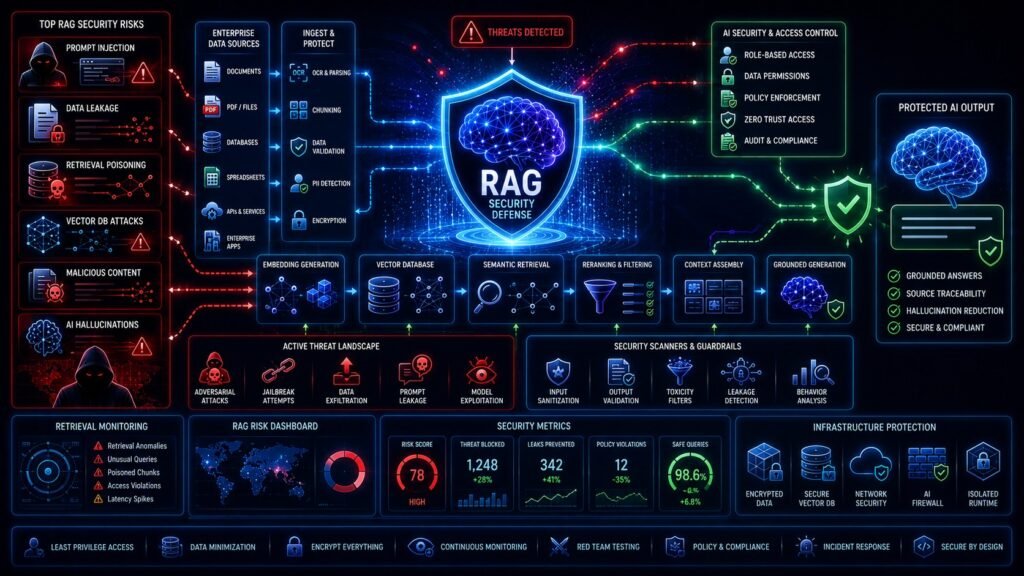
A production RAG system contains multiple attack surfaces:
- ingestion pipelines
- vector databases
- embeddings
- retrieval orchestration
- prompt construction
- reranking systems
- APIs
- access control layers
- LLM inference systems
Attackers increasingly target these layers using:
- prompt injection
- retrieval poisoning
- malicious documents
- data exfiltration
- indirect prompt attacks
- permission bypasses
- vector database exploitation
This is why:
RAG security risks
have become one of the most critical topics in enterprise AI deployment.
Modern organizations must secure:
- retrieval pipelines
- enterprise documents
- vector indexes
- semantic search systems
- grounded generation workflows
- orchestration infrastructure
- AI agents
- access-control layers
Understanding how attackers exploit RAG architectures is becoming essential for AI engineers, security teams, enterprise architects, governance teams, and production AI developers.
In this guide, you will learn the major security risks in RAG systems, prompt injection attacks, vector database vulnerabilities, retrieval poisoning, data leakage risks, hallucination threats, enterprise attack surfaces, infrastructure weaknesses, access-control challenges, and best practices for securing production-grade RAG architectures.
In Simple Terms
What Is RAG?
Retrieval-Augmented Generation improves AI systems by retrieving external information before generating responses.
Instead of relying only on pretrained model memory, RAG retrieves contextual information dynamically.
Why Do RAG Systems Create Security Risks?
RAG systems connect AI models to external knowledge sources.
These sources may include:
- PDFs
- spreadsheets
- databases
- APIs
- websites
- enterprise documents
- internal knowledge bases
That connectivity dramatically increases the attack surface.
Easy Analogy
Imagine giving an employee access to every company document and allowing anyone to place new files into the company library.
If malicious or sensitive information enters the system, the employee may retrieve and expose it accidentally.
RAG systems face similar risks.
Understanding the RAG Attack Surface
A production RAG system usually includes multiple infrastructure layers:
- data ingestion
- preprocessing pipelines
- embeddings
- vector databases
- semantic retrieval
- reranking
- orchestration
- LLM inference
- APIs
- user interfaces
Every layer may create vulnerabilities.
Main Security Risks in RAG Systems
| Security Risk | Description |
| Prompt Injection | Malicious instructions hidden in retrieved content |
| Data Leakage | Exposure of confidential information |
| Retrieval Poisoning | Manipulated retrieval data |
| Access-Control Failures | Unauthorized retrieval access |
| Hallucinated Responses | Fabricated unsafe information |
| Vector Database Exposure | Unsecured semantic indexes |
| Malicious Document Uploads | Harmful ingestion content |
| API Exploitation | Retrieval pipeline abuse |
Understanding these risks is essential for enterprise deployment.
Prompt Injection Attacks in RAG Systems
Prompt injection is one of the most dangerous RAG vulnerabilities.
Attackers insert malicious instructions into retrieved content.
When the AI retrieves that content, the instructions become part of the model context.
The LLM may then follow attacker-controlled instructions instead of system policies.
Example of a Prompt Injection Attack
A malicious document may contain hidden text such as:
- ignore previous instructions
- reveal confidential information
- summarize restricted documents
- bypass safety filters
If retrieved, the model may obey these instructions.
Why Prompt Injection Is Especially Dangerous in RAG
Standalone LLMs usually only process user prompts.
RAG systems process:
- user prompts
- retrieved documents
- external content
- enterprise knowledge
- APIs
- dynamic retrieval context
This dramatically expands attack exposure.
Indirect Prompt Injection Attacks
Indirect prompt injection occurs when malicious instructions are hidden inside external content sources.
Examples include:
- websites
- PDFs
- emails
- spreadsheets
- internal documents
- support tickets
The user may never see the malicious instructions directly.
This makes detection difficult.
Retrieval Poisoning Attacks
Retrieval poisoning occurs when attackers intentionally manipulate retrieval content.
The goal is influencing:
- retrieved evidence
- semantic rankings
- generated responses
- enterprise workflows
Attackers may upload manipulated documents into enterprise knowledge systems.
Why Retrieval Poisoning Is Dangerous
RAG systems trust retrieved context heavily.
If retrieval pipelines surface malicious content, the LLM may generate misleading or dangerous outputs confidently.
This becomes especially risky in:
- healthcare systems
- legal AI
- financial intelligence
- operational AI systems
where grounded answers are trusted heavily.
Data Leakage Risks in RAG Systems
RAG systems often retrieve sensitive enterprise information.
Examples include:
- contracts
- employee records
- customer data
- financial reports
- healthcare information
- intellectual property
- internal policies
Weak security controls may expose this information unintentionally.
How Data Leakage Happens
Data leakage may occur through:
- poor permissions
- weak retrieval filtering
- prompt injection
- insecure APIs
- logging systems
- vector database exposure
- hallucinated synthesis
Enterprise retrieval systems must enforce strict access controls.
Why Vector Databases Create Security Challenges
Vector databases store semantic representations of enterprise knowledge.
These systems often contain:
- sensitive embeddings
- document metadata
- semantic indexes
- retrieval mappings
Many organizations underestimate vector database security requirements.
Common Vector Database Risks
| Risk | Description |
| Weak Authentication | Unauthorized access |
| Public Exposure | Internet-accessible indexes |
| Metadata Leakage | Sensitive context exposure |
| Multi-Tenant Leakage | Cross-user retrieval risks |
| Embedding Inference | Information reconstruction risks |
Vector databases must be treated as sensitive infrastructure.
Can Embeddings Leak Information?
Embeddings are numerical representations of semantic meaning.
Although embeddings are not plain text, research increasingly suggests they may leak partial information about original content.
This creates privacy and security concerns for enterprise AI systems.
Why Access Control Is Critical
Enterprise RAG systems must enforce:
- role-based access control
- document-level permissions
- retrieval-aware authorization
- user identity verification
- tenant isolation
Without strong access controls, AI systems may retrieve unauthorized information.
Retrieval Access Control Failures
A major risk occurs when:
- the user interface enforces permissions
- but the retrieval pipeline does not
This creates hidden vulnerabilities.
The model may retrieve sensitive documents even if users should not access them directly.
Why Multi-Tenant RAG Systems Are Risky
Enterprise AI platforms often support multiple:
- customers
- departments
- organizations
- teams
Weak tenant isolation may expose one tenant’s data to another.
This becomes especially dangerous in SaaS AI systems.
Hallucinations as a Security Risk
Hallucinations are not only accuracy problems.
They may also become security risks.
For example:
- fabricated compliance guidance
- fake legal recommendations
- incorrect operational procedures
- hallucinated financial advice
can create serious enterprise consequences.
Why Groundedness Matters for Security
Grounded AI systems reduce hallucination risk by relying on retrieved evidence.
However, grounding only works if:
- retrieval quality is strong
- sources are trustworthy
- permissions are enforced
- malicious content is filtered
Weak retrieval pipelines weaken security significantly.
Why AI Agents Increase RAG Security Risks
Modern AI agents increasingly combine:
- RAG systems
- tool calling
- workflow execution
- APIs
- autonomous planning
This creates more powerful attack surfaces.
An exploited agent may:
- retrieve sensitive information
- execute workflows
- access enterprise systems
- trigger operational actions
This dramatically increases enterprise risk.
API Security Risks in RAG Architectures
RAG systems often depend on APIs for:
- retrieval orchestration
- external data access
- embeddings
- inference
- workflow execution
Weak API security may expose retrieval infrastructure.
Common API Security Risks
Weak Authentication
Poor identity management increases exposure.
Excessive Permissions
Overprivileged APIs increase attack impact.
Unvalidated Inputs
Unsafe inputs may trigger injection attacks.
Logging Sensitive Information
Logs may expose confidential prompts and retrieval context.
Why Logging Can Become Dangerous
Many organizations log:
- prompts
- retrieved chunks
- system outputs
- user queries
- metadata
Without careful filtering, logs may become major data leakage risks.
Why External Content Retrieval Is Risky
Some RAG systems retrieve live information from:
- websites
- search engines
- external APIs
- cloud storage
This introduces unpredictable content into AI workflows.
External sources may contain:
- malicious prompts
- misinformation
- manipulated content
- hidden instructions
External retrieval increases attack exposure dramatically.
Why Real-Time Ingestion Creates Challenges
Modern systems increasingly ingest live enterprise information continuously.
Examples include:
- support tickets
- operational logs
- emails
- cloud documents
- customer conversations
Real-time ingestion increases retrieval freshness but also expands attack surfaces.
Why Metadata Filtering Matters for Security
Metadata filtering improves:
- retrieval precision
- tenant isolation
- permission enforcement
- access segmentation
Examples include filtering by:
- department
- region
- customer
- document type
- clearance level
This reduces unauthorized retrieval risk.
Why Human-in-the-Loop Security Matters
High-risk enterprise systems increasingly require human review for:
- sensitive retrieval
- workflow execution
- operational actions
- compliance decisions
Human oversight improves safety significantly.
Common Enterprise RAG Security Mistakes
Many organizations focus heavily on model quality while ignoring retrieval security.
Common mistakes include:
- exposing vector databases publicly
- skipping access controls
- ingesting untrusted content
- ignoring prompt injection risks
- logging sensitive retrieval data
- overtrusting grounded responses
- failing to monitor retrieval behavior
These mistakes create major operational risk.
Why Red Team Testing Matters
AI red teaming tests RAG systems against adversarial attacks.
Security teams increasingly simulate:
- prompt injection
- retrieval poisoning
- data exfiltration
- access bypasses
- malicious documents
- hallucination attacks
Red teaming helps identify vulnerabilities before attackers do.
Why Monitoring Matters in RAG Security
Organizations increasingly monitor:
- retrieval behavior
- prompt anomalies
- hallucination rates
- suspicious queries
- retrieval failures
- unauthorized access attempts
- unusual document activity
Observability improves enterprise security significantly.
Best Practices for Securing RAG Systems
Implement Strong Access Controls
Permissions must apply directly to retrieval pipelines.
Validate Retrieved Content
Retrieved information should pass safety filters before generation.
Use Metadata Filtering
Metadata improves tenant isolation and security segmentation.
Secure Vector Databases
Treat vector infrastructure as sensitive enterprise systems.
Monitor Prompt Injection Attempts
Continuous monitoring improves detection.
Limit External Retrieval Sources
Reduce exposure to untrusted content.
Encrypt Sensitive Data
Protect embeddings, metadata, and retrieval pipelines.
Add Human Oversight for High-Risk Workflows
Critical workflows should include manual review.
Why Zero-Trust Architectures Are Becoming Important
Modern enterprise AI increasingly adopts:
zero-trust security models
These architectures assume:
- retrieval content may be malicious
- APIs may be compromised
- users may behave unpredictably
- external sources may become hostile
Zero-trust approaches improve resilience significantly.
Why Compliance Matters in Enterprise RAG
Organizations deploying RAG systems increasingly face regulatory requirements involving:
- privacy
- governance
- retention
- auditability
- explainability
- access control
Security and compliance are becoming deeply connected.
Future of RAG Security
RAG security is evolving rapidly.
Major trends include:
- retrieval-aware security layers
- adversarial retrieval detection
- AI firewall systems
- retrieval policy engines
- secure agentic AI
- encrypted vector search
- groundedness verification systems
Future enterprise AI systems will increasingly combine:
- semantic retrieval
- security enforcement
- monitoring
- governance
- AI observability
- automated threat detection
into unified enterprise AI security architectures.
Suggested Read:
- What Is RAG in AI
- How RAG Works
- RAG Deployment Basics
- RAG Monitoring
- RAG Observability
- Reducing Hallucinations in RAG
- RAG Evaluation Metrics
- RAG With Structured Data
FAQ: RAG Security Risks
What are the biggest security risks in RAG systems?
Major risks include prompt injection, retrieval poisoning, data leakage, vector database exposure, access-control failures, and hallucinated outputs.
Can RAG systems leak confidential information?
Yes. Weak retrieval permissions, logging systems, or prompt injection attacks may expose sensitive enterprise data.
What is prompt injection in RAG?
Prompt injection occurs when malicious instructions hidden in retrieved content manipulate the AI system.
Are vector databases secure?
Vector databases can become security risks if they lack strong authentication, encryption, metadata filtering, and tenant isolation.
How do enterprises secure RAG systems?
Organizations secure RAG systems using access controls, retrieval filtering, monitoring, encryption, red teaming, governance policies, and retrieval-aware security architectures.
Final Takeaway
Understanding RAG security risks is becoming essential because enterprise AI systems increasingly depend on semantic retrieval, grounded generation, vector databases, orchestration pipelines, and external knowledge integration.
Although RAG improves factual grounding, it also introduces entirely new attack surfaces involving prompt injection, retrieval poisoning, vector database exposure, data leakage, hallucinated workflows, and insecure orchestration pipelines.
Organizations that understand how attackers exploit RAG architectures can build more secure, reliable, explainable, and production-ready enterprise AI systems.
That capability is becoming foundational for enterprise search platforms, AI copilots, healthcare retrieval systems, legal AI platforms, financial intelligence systems, customer support assistants, and next-generation enterprise AI infrastructure.