
Modern enterprises generate enormous volumes of structured data every day.
This data exists across:
- SQL databases
- CRM systems
- ERP platforms
- analytics warehouses
- APIs
- spreadsheets
- transactional systems
- customer records
- operational dashboards
- financial reporting systems
As organizations adopt AI systems, a major challenge quickly appears:
Large Language Models cannot reliably reason over structured enterprise data on their own.
Standalone LLMs struggle because:
- they lack direct database access
- enterprise data changes constantly
- structured records exceed context windows
- hallucinations create operational risks
- enterprise systems require grounded retrieval
This is why:
RAG with structured data
became one of the most important enterprise AI architecture patterns.
Retrieval-Augmented Generation allows AI systems to retrieve structured enterprise information dynamically before generating responses.
This enables organizations to build AI systems capable of:
- enterprise analytics assistants
- AI-powered dashboards
- conversational business intelligence
- customer support copilots
- financial AI systems
- operational intelligence platforms
- AI SQL assistants
- enterprise automation workflows
Understanding how RAG works with structured data is becoming essential because enterprise AI increasingly depends on grounded access to live operational systems.
In this guide, you will learn how RAG with structured data works, architecture design, SQL retrieval, APIs, embeddings, vector databases, semantic querying, hybrid retrieval, hallucination reduction, enterprise use cases, implementation workflows, optimization strategies, and why structured-data retrieval systems are rapidly becoming foundational for enterprise AI platforms.
In Simple Terms
What Is RAG?
Retrieval-Augmented Generation improves AI systems by retrieving external information before generating responses.
Instead of relying only on pretrained model memory, RAG retrieves contextual enterprise data dynamically.
What Does “RAG With Structured Data” Mean?
RAG with structured data means connecting AI systems to structured enterprise information sources such as:
- SQL databases
- APIs
- spreadsheets
- analytics platforms
- CRM systems
- operational databases
The system retrieves relevant structured information before generating responses.
Easy Analogy
Imagine asking an employee:
“What were last quarter’s top-selling products?”
A standalone LLM guesses based on general knowledge.
A structured-data RAG system queries enterprise databases before answering.
This dramatically improves factual reliability.
Why Enterprises Need RAG With Structured Data
Modern organizations increasingly depend on AI systems capable of:
- business intelligence retrieval
- operational analytics
- grounded reporting
- real-time enterprise search
- conversational querying
- enterprise automation
Traditional LLMs cannot reliably access live structured systems.
RAG solves this problem.
The Core Problem With Structured Enterprise Data
Enterprise data is often:
- fragmented across systems
- continuously updated
- highly relational
- permission-controlled
- operationally sensitive
- too large for prompts
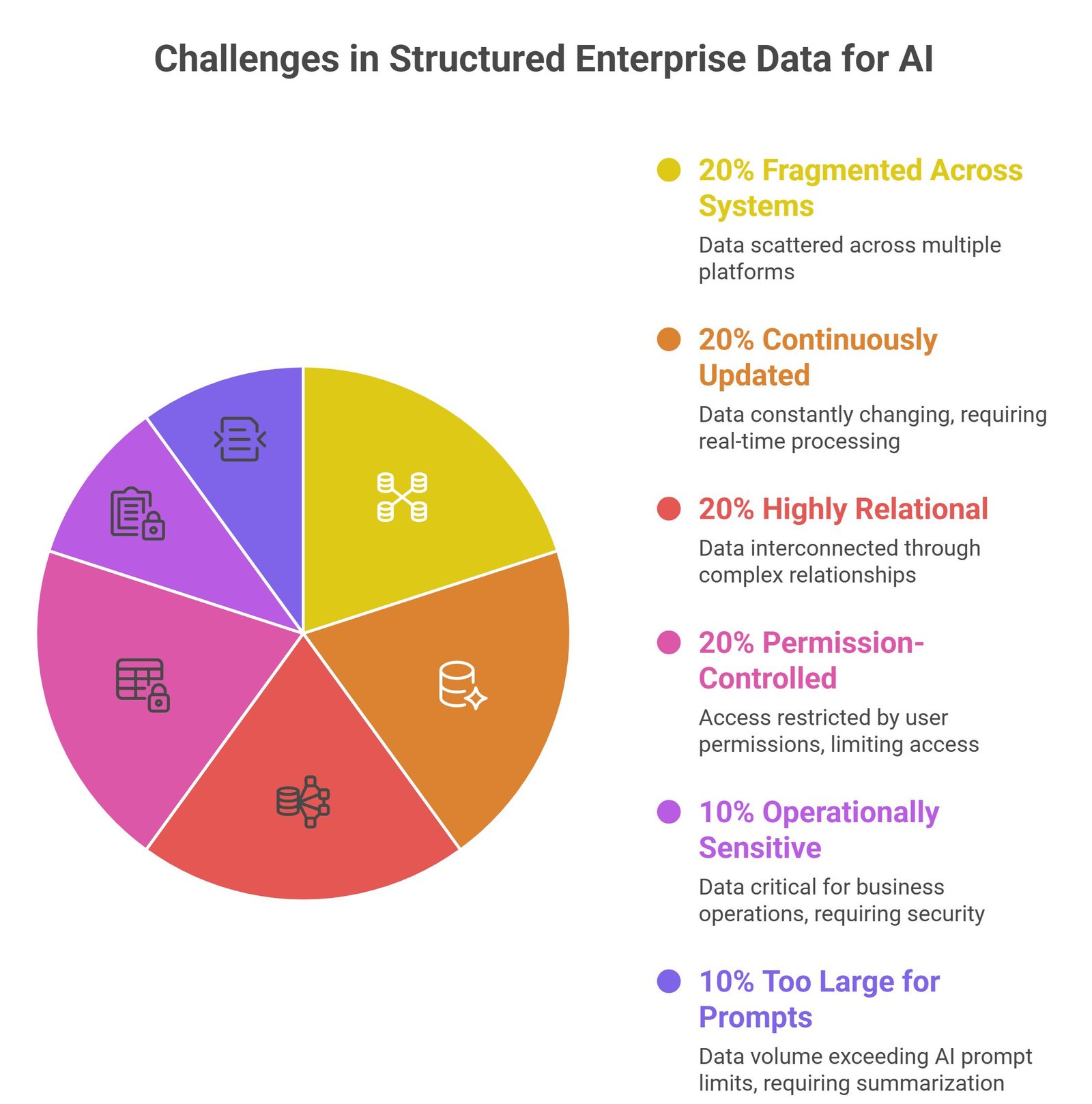
This creates major limitations for standalone AI systems.
Understanding Structured Data in AI Systems
Structured data refers to organized information stored in predefined formats.
Examples include:
| Type | Example |
| SQL Tables | Customer databases |
| ERP Records | Inventory systems |
| CRM Data | Sales pipelines |
| Analytics Warehouses | Reporting dashboards |
| APIs | External enterprise services |
| Spreadsheet Systems | Financial models |
Structured data differs significantly from unstructured documents.
Structured Data vs Unstructured Data
| Category | Structured Data | Unstructured Data |
| Format | Organized tables | Free-form documents |
| Storage | Databases | PDFs, text files |
| Querying | SQL queries | Semantic retrieval |
| Examples | Transactions, records | Contracts, reports |
| Retrieval Method | Structured querying | Embedding search |
Modern enterprise AI often combines both.
Understanding How RAG With Structured Data Works
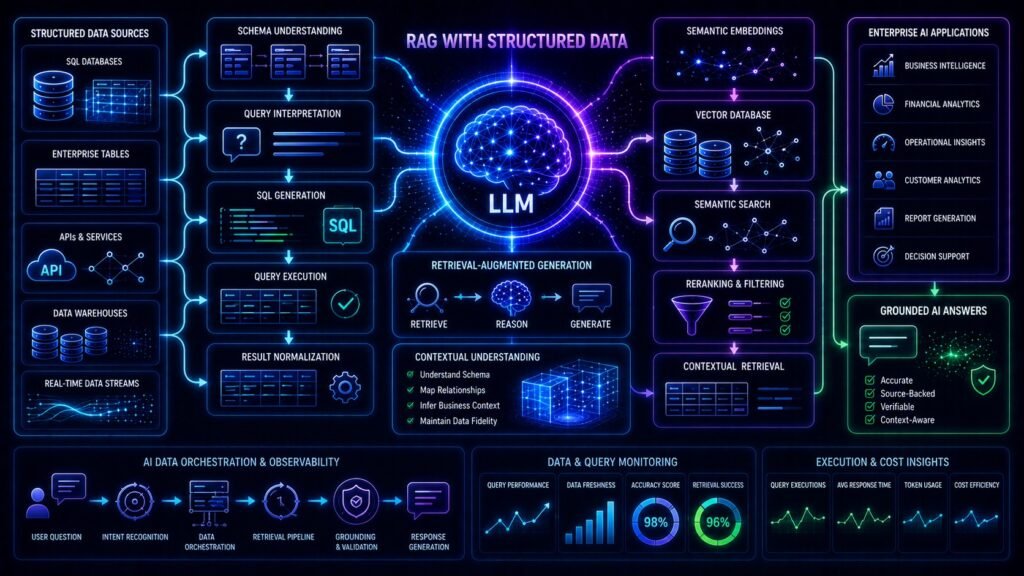
A structured-data RAG pipeline usually includes:
- query understanding
- semantic intent analysis
- retrieval orchestration
- SQL/API execution
- contextual grounding
- response generation
The system retrieves live enterprise information before generating answers.
Step 1: User Query Interpretation
The AI first interprets user intent.
For example:
“Show revenue growth for Q2 in Europe.”
The system identifies:
- metrics
- regions
- time ranges
- database requirements
This improves retrieval accuracy.
Step 2: Query Planning
The orchestration layer determines how data should be retrieved.
This may involve:
- SQL generation
- API selection
- metadata filtering
- semantic retrieval routing
Modern AI agents increasingly automate this stage.
Step 3: Structured Retrieval
The system retrieves data from:
- SQL databases
- APIs
- data warehouses
- spreadsheets
- operational systems
Unlike traditional RAG, retrieval often involves executable queries.
Step 4: Context Construction
Retrieved data becomes contextual grounding for the LLM.
This may include:
- rows
- summaries
- analytics outputs
- filtered datasets
- aggregation results
The model uses this information for grounded reasoning.
Step 5: Grounded AI Generation
The LLM generates responses using retrieved enterprise data.
This reduces hallucinations dramatically.
Why Structured Data RAG Is Different From Traditional RAG
Traditional RAG focuses heavily on semantic retrieval from unstructured content such as:
- PDFs
- documents
- articles
- manuals
Structured-data RAG often combines:
- SQL querying
- APIs
- semantic routing
- hybrid retrieval
- operational systems
This creates more dynamic enterprise architectures.
Why Semantic Retrieval Still Matters
Even structured systems benefit from semantic understanding.
Users often ask questions conversationally instead of writing SQL.
For example:
“Which products are underperforming in Asia?”
The AI system must translate conversational intent into structured retrieval logic.
Why Embeddings Matter for Structured Data
Embeddings help AI systems understand semantic relationships between structured records.
This improves:
- contextual retrieval
- recommendation systems
- semantic filtering
- intelligent search
Embeddings are increasingly used alongside SQL retrieval.
Why Hybrid Retrieval Is Becoming Common
Modern enterprise AI systems increasingly combine:
- SQL querying
- vector search
- metadata filtering
- semantic retrieval
- keyword search
- APIs
This creates more flexible enterprise architectures.
Example Hybrid Structured RAG Workflow
A user asks:
“Which customers had delayed shipments last month?”
The system may:
- query SQL databases
- retrieve logistics records
- apply semantic filters
- retrieve contextual support tickets
- generate grounded summaries
This combines structured and semantic retrieval.
Why RAG With Structured Data Reduces Hallucinations
Standalone LLMs generate responses probabilistically.
Without grounded enterprise retrieval, they may hallucinate operational information.
Structured retrieval improves:
- factual reliability
- operational accuracy
- contextual grounding
- enterprise trustworthiness
This becomes critical in enterprise AI systems.
Enterprise Use Cases for Structured Data RAG
Business Intelligence Assistants
Executives query analytics conversationally.
Financial AI Systems
AI retrieves grounded reporting data dynamically.
Customer Support Platforms
Support agents retrieve account records and ticket history.
Ecommerce Intelligence Systems
AI analyzes inventory and sales performance.
Healthcare Operations
AI systems retrieve operational healthcare data securely.
Supply Chain Intelligence
AI systems analyze logistics and operational workflows.
AI SQL Assistants
Natural language converts into executable SQL queries.
Why AI SQL Assistants Are Growing Rapidly
Organizations increasingly want conversational access to enterprise databases.
Instead of writing SQL manually, users ask questions naturally.
Examples include:
- “Which products generated the highest revenue?”
- “Show churn trends by region.”
- “What inventory is below safety threshold?”
Structured-data RAG systems enable these workflows.
Why Metadata Filtering Matters
Structured retrieval improves when metadata is used effectively.
Useful metadata includes:
- departments
- regions
- permissions
- timestamps
- business categories
- operational status
Metadata filtering improves retrieval precision significantly.
Why Access Control Is Critical
Enterprise structured data often contains sensitive information.
Production systems must support:
- role-based access control
- permission-aware retrieval
- compliance enforcement
- query restrictions
- audit logging
Security becomes essential in enterprise AI deployments.
Common Challenges in Structured Data RAG Systems
Despite their advantages, structured-data RAG systems introduce operational challenges.
SQL Generation Errors
AI-generated SQL may become inaccurate.
Complex Schema Understanding
Large enterprise schemas are difficult to interpret.
Data Freshness Problems
Real-time synchronization becomes critical.
Retrieval Complexity
Hybrid retrieval pipelines increase orchestration complexity.
Security Risks
Improper permissions may expose sensitive information.
Why Query Routing Matters
Modern enterprise systems contain multiple databases and APIs.
AI systems must determine:
- where data exists
- which retrieval method to use
- which APIs should execute
- how workflows should orchestrate
Query routing becomes increasingly important.
Why Agentic AI Is Changing Structured Retrieval
Modern AI agents increasingly combine:
- structured retrieval
- semantic search
- workflow automation
- tool calling
- autonomous orchestration
This creates intelligent enterprise systems capable of dynamic reasoning and execution.
RAG With Structured Data vs Traditional SQL Dashboards
| Category | SQL Dashboards | Structured RAG |
| Query Method | Manual SQL | Conversational AI |
| Semantic Understanding | Weak | Strong |
| Natural Language Queries | Limited | Excellent |
| Contextual Reasoning | Weak | Strong |
| Enterprise Search | Moderate | Excellent |
| AI Grounding | Weak | Strong |
| Dynamic Orchestration | Weak | Strong |
Structured-data RAG dramatically improves accessibility for nontechnical users.
Why Evaluation Matters for Structured Data RAG
Organizations increasingly benchmark:
- retrieval precision
- SQL accuracy
- groundedness
- hallucination rates
- operational correctness
- query latency
- semantic relevance
Continuous evaluation improves reliability significantly.
Best Practices for Building Structured Data RAG Systems
Use Strong Schema Documentation
Schema clarity improves retrieval quality.
Add Semantic Layers
Semantic abstraction improves conversational querying.
Combine SQL and Vector Retrieval
Hybrid architectures improve flexibility.
Monitor Hallucination Rates
Grounded evaluation remains essential.
Implement Strict Access Controls
Enterprise security must remain a priority.
Use Query Validation Layers
Validation reduces dangerous query generation risks.
Why Hybrid Enterprise AI Architectures Are the Future
Modern enterprise AI increasingly combines:
- structured retrieval
- semantic retrieval
- vector databases
- SQL execution
- AI agents
- workflow orchestration
- grounded generation
This creates scalable enterprise intelligence systems.
Future of RAG With Structured Data
Structured enterprise AI systems are evolving rapidly.
Major trends include:
- agentic enterprise AI
- autonomous SQL agents
- GraphRAG architectures
- multimodal enterprise retrieval
- retrieval-aware orchestration
- enterprise memory systems
- real-time AI analytics
Future enterprise AI systems will increasingly combine:
- semantic reasoning
- structured retrieval
- workflow execution
- contextual grounding
- autonomous orchestration
into unified enterprise intelligence architectures.
Suggested Read:
- What Is RAG in AI
- How RAG Works
- RAG Pipeline Explained
- RAG With PDFs
- Vector Database for RAG
- Query Rewriting for RAG
- RAG Evaluation Metrics
- RAG Monitoring
FAQ: RAG With Structured Data
What is RAG with structured data?
RAG with structured data connects AI systems to databases, APIs, and tabular systems for grounded retrieval before generating responses.
Can RAG query SQL databases?
Yes. Many enterprise RAG systems dynamically generate and execute SQL queries.
Why is structured-data RAG important?
It improves enterprise AI reliability, groundedness, analytics, and conversational access to operational systems.
Does RAG reduce hallucinations in enterprise databases?
Yes. Retrieved structured data grounds AI responses using live operational information.
Can RAG combine structured and unstructured data?
Yes. Modern enterprise AI systems increasingly combine both retrieval methods together.
Final Takeaway
Understanding RAG with structured data is becoming essential because enterprise AI systems increasingly depend on grounded access to operational databases, APIs, analytics systems, and structured enterprise knowledge.
Traditional LLMs struggle with live enterprise retrieval, while structured-data RAG systems enable conversational analytics, grounded business intelligence, semantic querying, and contextual enterprise reasoning.
Organizations that understand how to build scalable structured-data RAG architectures can create more reliable, intelligent, explainable, and production-ready enterprise AI systems.
That capability is becoming foundational for enterprise analytics assistants, AI-powered dashboards, customer intelligence systems, operational copilots, financial AI platforms, and next-generation enterprise intelligence architectures.