
The 50 Best AI Tools in 2025: A Practical List by Use Case
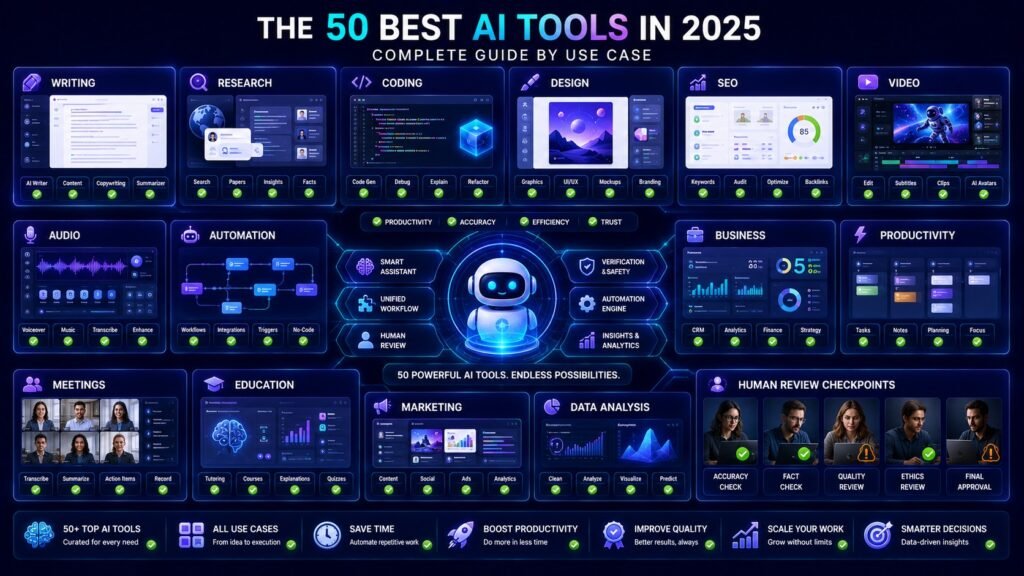
The 50 best AI tools in 2025 help with writing, research, coding, design, video, meetings, automation, business, education, and productivity. The smartest choice is not the longest tool list. It is choosing a small stack that solves your actual workflow problems without creating more subscriptions, noise, or unchecked AI output.
In Simple Terms
AI tools are apps that use artificial intelligence to help people create, summarize, search, write, design, code, analyze, automate, and communicate.
Some AI tools are general assistants. Others solve narrow problems, such as editing podcasts, generating images, summarizing meetings, writing code, creating presentations, or automating customer workflows. The best AI tool depends on the task, not the trend.
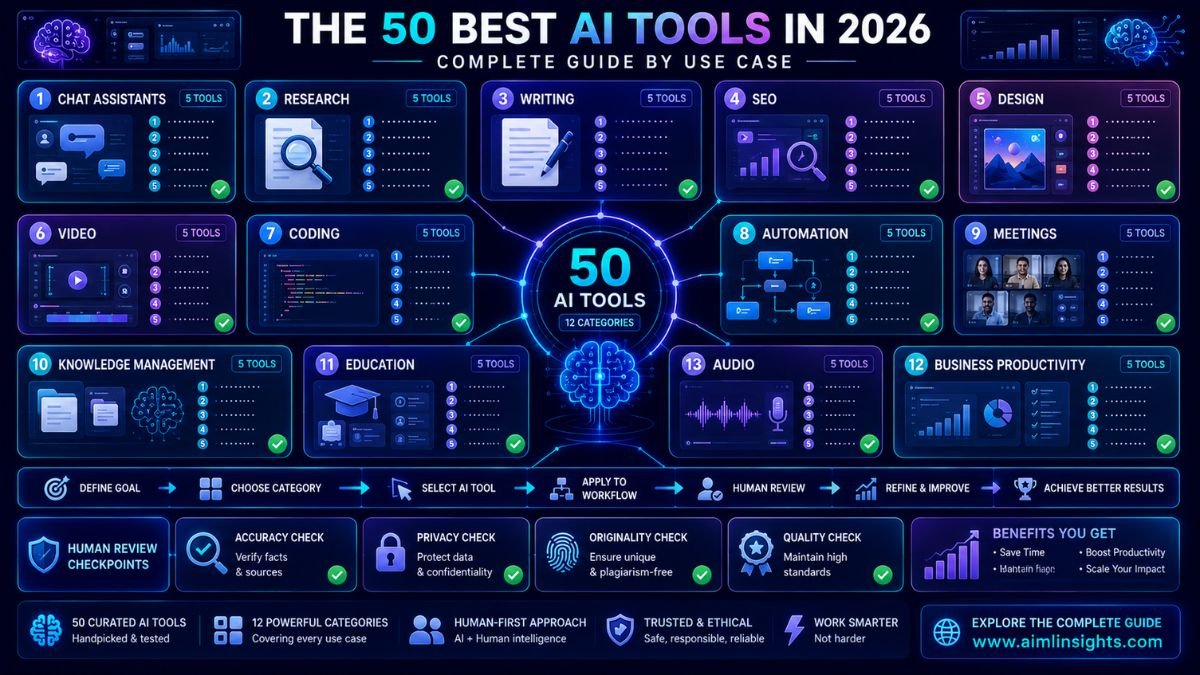
The 50 Best AI Tools in 2025: Quick Comparison
| # | Tool | Best For |
| 1 | ChatGPT | General AI assistant, writing, analysis, brainstorming |
| 2 | Claude | Long-form writing, reasoning, editing, document review |
| 3 | Gemini | Google ecosystem productivity and multimodal help |
| 4 | Microsoft Copilot | Microsoft 365 documents, meetings, email, spreadsheets |
| 5 | Perplexity | Research, source discovery, fast answers |
| 6 | NotebookLM | Source-grounded notes and study workflows |
| 7 | Elicit | Academic research and literature review |
| 8 | Consensus | Evidence-based research questions |
| 9 | SciSpace | Reading and understanding research papers |
| 10 | Semantic Scholar | Scientific literature discovery |
| 11 | Grammarly | Grammar, tone, clarity, professional writing |
| 12 | ProWritingAid | Manuscript editing and style improvement |
| 13 | Jasper | Marketing content and brand voice |
| 14 | Copy.ai | GTM copy and content repurposing |
| 15 | Writesonic | AI writing and SEO-aware article workflows |
| 16 | Sudowrite | Fiction writing and storytelling |
| 17 | Surfer | SEO content optimization |
| 18 | Semrush Content Toolkit | SEO briefs, writing, optimization, repurposing |
| 19 | Frase | SERP research, content briefs, AI visibility |
| 20 | Ahrefs | SEO research and content opportunities |
| 21 | Canva AI | Design, presentations, social graphics |
| 22 | Adobe Firefly | AI image generation and creative assets |
| 23 | Midjourney | Artistic image generation |
| 24 | Ideogram | Text-heavy image and design concepts |
| 25 | Leonardo AI | Illustration, gaming, fantasy, creative visuals |
| 26 | Runway | AI video generation and editing |
| 27 | Descript | Podcast and video editing by transcript |
| 28 | Synthesia | AI avatar videos |
| 29 | HeyGen | AI avatar videos and localization |
| 30 | Pika | Creative AI video generation |
| 31 | ElevenLabs | AI voice generation |
| 32 | Suno | AI music generation |
| 33 | Udio | AI music and song creation |
| 34 | Otter.ai | Meeting transcription and notes |
| 35 | Fireflies.ai | Meeting summaries and searchable calls |
| 36 | Fathom | Meeting recording and summaries |
| 37 | Notion AI | Notes, documents, projects, knowledge management |
| 38 | Mem | AI note organization |
| 39 | Reclaim | AI scheduling and calendar planning |
| 40 | Zapier | No-code automation across apps |
| 41 | Make | Visual workflow automation |
| 42 | n8n | Technical and self-hostable automation |
| 43 | Airtable AI | Database workflows and operations |
| 44 | HubSpot Breeze | CRM, sales, marketing, and service AI |
| 45 | Salesforce Einstein | Enterprise CRM AI |
| 46 | GitHub Copilot | AI coding assistant |
| 47 | Cursor | AI code editor |
| 48 | Replit AI | Browser-based coding and app building |
| 49 | Tabnine | AI code completion |
| 50 | Khanmigo | AI tutoring and education support |
Best AI Assistants for Daily Work
ChatGPT, Claude, Gemini, and Microsoft Copilot are the most useful starting points for everyday work. ChatGPT is strong for brainstorming, drafting, summarizing, planning, analysis, and general questions. OpenAI’s help documentation describes ChatGPT as useful for explaining concepts, drafting and rewriting content, summarizing, generating ideas, reasoning, and translation.
Claude is a strong fit for long-form writing, document review, and careful editing. Gemini makes sense for users already inside Google’s ecosystem, while Microsoft Copilot is best for people who live in Word, Excel, PowerPoint, Outlook, and Teams.
Best AI Tools for Research and Learning
Perplexity, NotebookLM, Elicit, Consensus, SciSpace, and Semantic Scholar are useful when the problem is not writing but understanding. They help users find sources, read papers, summarize documents, compare evidence, and organize research.
Use Perplexity for quick source discovery, NotebookLM for your own uploaded sources, Elicit for literature-review workflows, Consensus for evidence-style questions, SciSpace for reading dense papers, and Semantic Scholar for academic discovery.
Best AI Tools for Writing and SEO
Grammarly, ProWritingAid, Jasper, Copy.ai, Writesonic, Sudowrite, Surfer, Semrush Content Toolkit, Frase, and Ahrefs support different writing workflows.
Writers should use Grammarly for polish, ProWritingAid for manuscript-level editing, Jasper for brand-led marketing content, Copy.ai for repurposing, and Writesonic for SEO-aware drafts. SEO teams can use Surfer, Semrush, Frase, and Ahrefs for briefs, keyword opportunities, optimization, and content refreshes.
The mistake is treating AI writing as one-click publishing. Strong content still needs expertise, examples, fact-checking, structure, and original judgment.
Best AI Tools for Design, Video, and Audio
Canva AI, Adobe Firefly, Midjourney, Ideogram, and Leonardo AI help with images, visuals, graphics, and creative concepts. Canva is especially useful for beginners because it combines templates, design, and AI assistance in one workflow.
Runway, Descript, Synthesia, HeyGen, and Pika help with video. Descript is strong for editing talking-head videos and podcasts from transcripts, while Runway and Pika fit more creative AI video workflows. ElevenLabs, Suno, and Udio support voice and music creation. Always check commercial-use rules before publishing or selling AI-generated media.
Best AI Tools for Meetings, Notes, and Productivity
Otter.ai, Fireflies.ai, Fathom, Notion AI, Mem, and Reclaim reduce admin friction. They help record meetings, summarize discussions, create action items, organize notes, and schedule work.
These tools are useful for teams, founders, consultants, teachers, and remote workers. The privacy risk is real, though. Avoid recording sensitive meetings or uploading private information without checking settings and company policy.
Best AI Tools for Automation and Business
Zapier, Make, n8n, Airtable AI, HubSpot Breeze, and Salesforce Einstein are best when AI needs to connect to business systems. Zapier’s AI productivity coverage highlights AI tools across automation, chatbots, search, agents, and productivity workflows, showing how automation has become one of the core AI tool categories.
Use these tools for CRM updates, lead routing, reporting, support workflows, content operations, and internal processes. Start with one clear workflow before building complex automations.
Best AI Tools for Coding
GitHub Copilot, Cursor, Replit AI, and Tabnine help developers write, understand, and revise code. They are useful for boilerplate, code completion, debugging support, explanations, and prototype building.
But AI coding tools are not automatic productivity machines. A 2025 randomized study of experienced open-source developers found that AI tools did not always reduce completion time and could slow users down in some real-codebase settings. Developers should still review architecture, tests, security, and maintainability.
How to Choose the Right AI Tool
Start with your bottleneck.
If you need one assistant, choose ChatGPT, Claude, or Gemini. If you need research, use Perplexity or NotebookLM. If you write, add Grammarly or Jasper. If you design, use Canva or Firefly. If you edit videos, use Descript or Runway. If you code, use GitHub Copilot or Cursor. If you automate work, use Zapier, Make, or n8n.
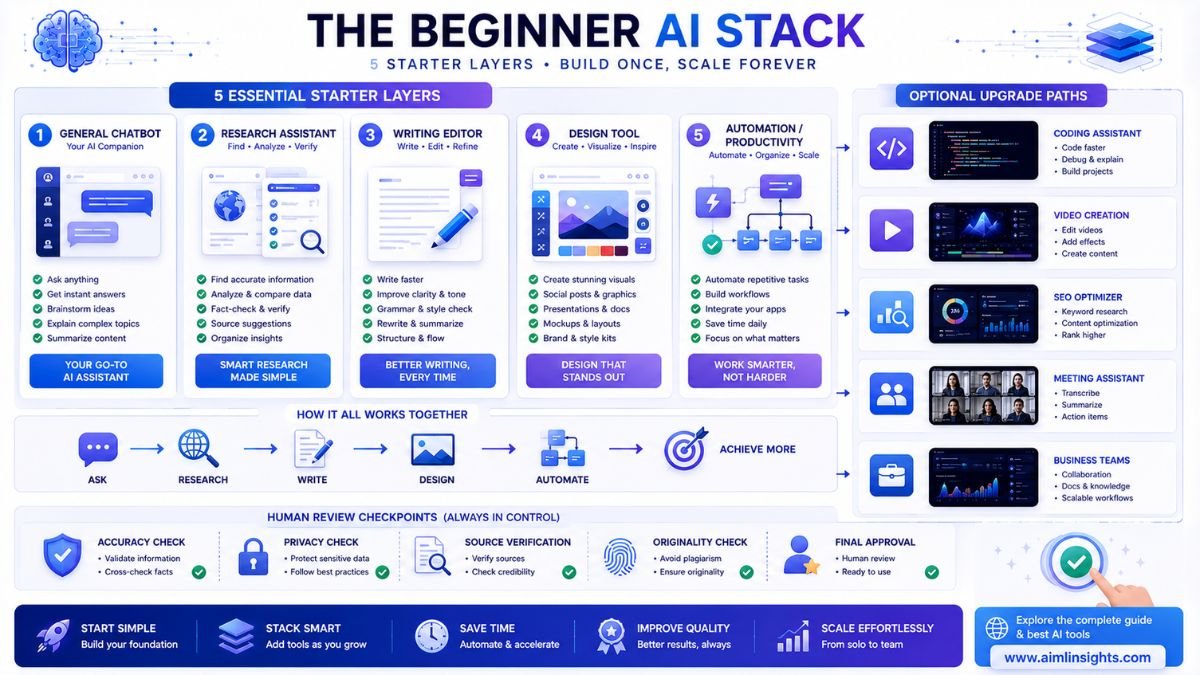
Beginners should not try all 50 tools. Start with five: one chatbot, one research tool, one writing editor, one design tool, and one automation tool.
Common Mistakes to Avoid
The first mistake is buying overlapping subscriptions. Many tools solve similar problems.
The second mistake is trusting AI output without review. AI can make factual, legal, design, code, and citation errors.
The third mistake is ignoring privacy. Do not upload client data, confidential documents, passwords, or unpublished work unless you understand the tool’s data policy.
The fourth mistake is choosing tools by popularity instead of workflow fit.
Suggested Read:
- Best AI Tools for Beginners in 2026
- AI Tools With Free Plans Worth Using in 2026
- Best AI Tools for Students
- Best AI Tools for Bloggers and Content Writers
- Best AI Workflow Automation Tools for Teams
- ChatGPT vs Perplexity vs Claude for Research Tasks
- Best AI Tools for Business
- Prompt Engineering for Beginners: A Practical Guide
FAQ: 50 Best AI Tools in 2025
What are the 50 best AI tools in 2025?
The 50 best AI tools in 2025 include ChatGPT, Claude, Gemini, Copilot, Perplexity, NotebookLM, Grammarly, Jasper, Canva AI, Firefly, Midjourney, Runway, Descript, Zapier, Notion AI, GitHub Copilot, Cursor, Khanmigo, and more.
Which AI tool should beginners use first?
Most beginners should start with ChatGPT, Claude, or Gemini. Then add Perplexity for research, Grammarly for writing polish, Canva AI for visuals, and Zapier only when automation becomes useful.
What are the best AI tools for productivity?
The best AI productivity tools include ChatGPT, Claude, Gemini, Microsoft Copilot, Notion AI, Otter.ai, Fireflies.ai, Fathom, Reclaim, Zapier, and Airtable AI.
What are the best AI tools for content creation?
Strong content creation tools include ChatGPT, Claude, Jasper, Writesonic, Copy.ai, Grammarly, Canva AI, Adobe Firefly, Midjourney, Runway, Descript, and ElevenLabs.
Are paid AI tools worth it?
Paid AI tools are worth it when they save time, improve output quality, or support work you do often. They are not worth it if a free plan already solves your problem.
Can AI tools replace human work?
AI tools can speed up tasks, but they should not replace human judgment. The strongest workflows use AI for drafts, summaries, suggestions, automation, and analysis while humans handle strategy, ethics, review, and final decisions.
Final Takeaway
The 50 best AI tools in 2025 cover many workflows, but the best stack is usually small. Choose one general assistant, one research tool, one writing editor, one design tool, and one automation tool first.
AI tools are most useful when they reduce friction. They are least useful when they create more subscriptions, more unchecked output, and more decisions than they solve.