
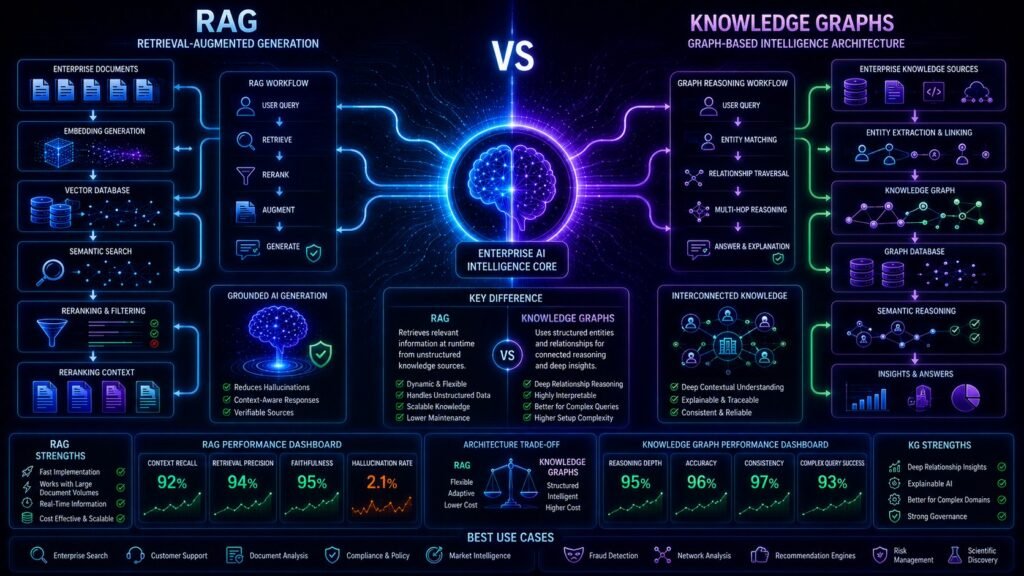
RAG vs Knowledge Graphs: Which AI Architecture Is Better for Enterprise AI?
Modern enterprise AI systems are evolving rapidly beyond traditional search engines and standalone Large Language Models. Organizations increasingly deploy advanced AI architectures across:
- enterprise knowledge systems
- semantic search platforms
- AI assistants
- customer support copilots
- healthcare AI systems
- legal intelligence platforms
- research automation systems
- intelligent document retrieval systems
However, as enterprise AI becomes more sophisticated, organizations encounter a major architectural decision:
Should you use Retrieval-Augmented Generation (RAG) or knowledge graphs?
This became one of the most important debates in enterprise AI infrastructure design.
Both technologies help AI systems work with enterprise knowledge, but they solve very different problems.
RAG focuses heavily on:
- semantic retrieval
- grounded generation
- contextual AI answers
- retrieval pipelines
- vector databases
Knowledge graphs focus on:
- structured relationships
- entity connections
- graph reasoning
- semantic understanding
- relationship intelligence
Many enterprises incorrectly treat them as competing systems.
In reality, they are often complementary technologies.
Today, modern AI architectures increasingly combine:
- RAG pipelines
- semantic retrieval
- knowledge graphs
- graph reasoning systems
to create more intelligent enterprise AI systems.
Understanding the differences between RAG and knowledge graphs is essential for designing scalable, reliable, and grounded AI platforms.
In this guide, you will learn how RAG and knowledge graphs work, their strengths and weaknesses, enterprise use cases, hallucination implications, scalability trade-offs, and why hybrid GraphRAG architectures are becoming increasingly important.
In Simple Terms
What Is RAG?
Retrieval-Augmented Generation (RAG) retrieves external information before generating answers.
A RAG system:
- searches enterprise knowledge sources
- retrieves relevant documents
- passes relevant context into a Large Language Model
- generates grounded responses
RAG focuses heavily on retrieval and generation workflows.
What Is a Knowledge Graph?
A knowledge graph organizes information using entities and relationships.
Instead of storing information as isolated documents, knowledge graphs connect concepts together.
For example:
- a customer belongs to a company
- a doctor works at a hospital
- a regulation applies to a legal policy
These relationships become structured semantic connections.
Easy Analogy
Imagine a library.
RAG works like a librarian finding relevant books before answering your question.
Knowledge graphs work like a detailed relationship map showing how every concept inside the library connects together.
RAG retrieves information dynamically.
Knowledge graphs structure knowledge intelligently.
Why Enterprises Compare RAG and Knowledge Graphs
Modern organizations increasingly need AI systems capable of:
- understanding relationships
- retrieving enterprise knowledge
- answering grounded questions
- reducing hallucinations
- supporting reasoning workflows
- scaling across massive datasets
This created a major enterprise AI debate:
Should AI systems prioritize retrieval or structured reasoning?
The answer depends heavily on:
- business requirements
- knowledge complexity
- reasoning requirements
- scalability needs
- infrastructure strategy
- enterprise workflows
Understanding How RAG Works
Modern RAG systems combine retrieval systems with Large Language Models.
A typical RAG architecture includes:
- embeddings
- vector databases
- semantic retrieval systems
- reranking pipelines
- prompt orchestration layers
- grounded generation systems
The retriever finds relevant information dynamically before generation begins.
Core Components of a RAG System
| Component | Purpose |
| Embeddings | Represent semantic meaning |
| Vector Database | Stores searchable embeddings |
| Retriever | Finds relevant context |
| Reranker | Improves retrieval quality |
| LLM | Generates grounded answers |
This architecture improves factual grounding significantly.
Understanding How Knowledge Graphs Work
Knowledge graphs organize information using structured entities and relationships.
Instead of relying mainly on semantic similarity, knowledge graphs model how concepts connect together.
A knowledge graph may contain:
- entities
- nodes
- relationships
- semantic properties
- ontologies
- graph traversal systems
This enables relationship-aware reasoning.
Core Components of Knowledge Graphs
| Component | Purpose |
| Entities | Represent concepts |
| Nodes | Store graph objects |
| Relationships | Connect entities |
| Ontologies | Define semantic meaning |
| Graph Database | Stores graph structure |
Knowledge graphs focus heavily on structured semantic relationships.
Why RAG Became So Popular
RAG solved one of the biggest weaknesses of standalone Large Language Models:
lack of grounding
Traditional LLMs generate answers using pretrained memory only.
RAG improves factual reliability using external retrieval systems.
Major Advantages of RAG
Dynamic Knowledge Retrieval
RAG retrieves updated information in real time.
Better Grounded Generation
Retrieved evidence improves factual accuracy.
Reduced Hallucinations
Grounded retrieval reduces unsupported outputs.
Strong Enterprise Search Integration
RAG works naturally with enterprise documents and knowledge bases.
Faster Enterprise Deployment
Organizations can deploy RAG pipelines quickly.
Better Scalability for Large Document Collections
RAG handles massive document repositories efficiently.
Major Limitations of RAG
Despite its strengths, RAG also introduces challenges.
Weak Relationship Understanding
RAG retrieves documents but may not fully understand structured relationships.
Retrieval Dependency
Weak retrieval weakens grounded generation.
Retrieval Noise Problems
Irrelevant retrieval reduces contextual quality.
Infrastructure Complexity
RAG systems require orchestration and monitoring infrastructure.
Multi-Hop Reasoning Challenges
Complex relationship reasoning remains difficult.
Why Knowledge Graphs Became Important
Knowledge graphs solve problems that retrieval systems alone struggle with.
They provide:
- relationship intelligence
- entity reasoning
- structured semantics
- graph traversal capabilities
- explainable knowledge connections
This became extremely valuable in enterprise AI systems.
Major Advantages of Knowledge Graphs
Structured Relationship Modeling
Knowledge graphs understand how concepts connect.
Better Multi-Hop Reasoning
Graphs support relationship traversal across multiple entities.
Strong Explainability
Relationship paths improve transparency.
Better Domain Intelligence
Knowledge graphs encode domain-specific semantics effectively.
Improved Entity Understanding
Graphs improve contextual understanding of organizations, people, products, and concepts.
Major Limitations of Knowledge Graphs
Knowledge graphs also introduce major operational challenges.
High Construction Complexity
Building knowledge graphs is difficult and expensive.
Manual Ontology Design
Many graph systems require extensive schema planning.
Difficult Maintenance
Enterprise relationships constantly evolve.
Weak Unstructured Document Handling
Knowledge graphs struggle with massive unstructured text repositories.
Limited Generative Capabilities
Knowledge graphs alone do not generate conversational answers effectively.
RAG vs Knowledge Graphs: Key Differences
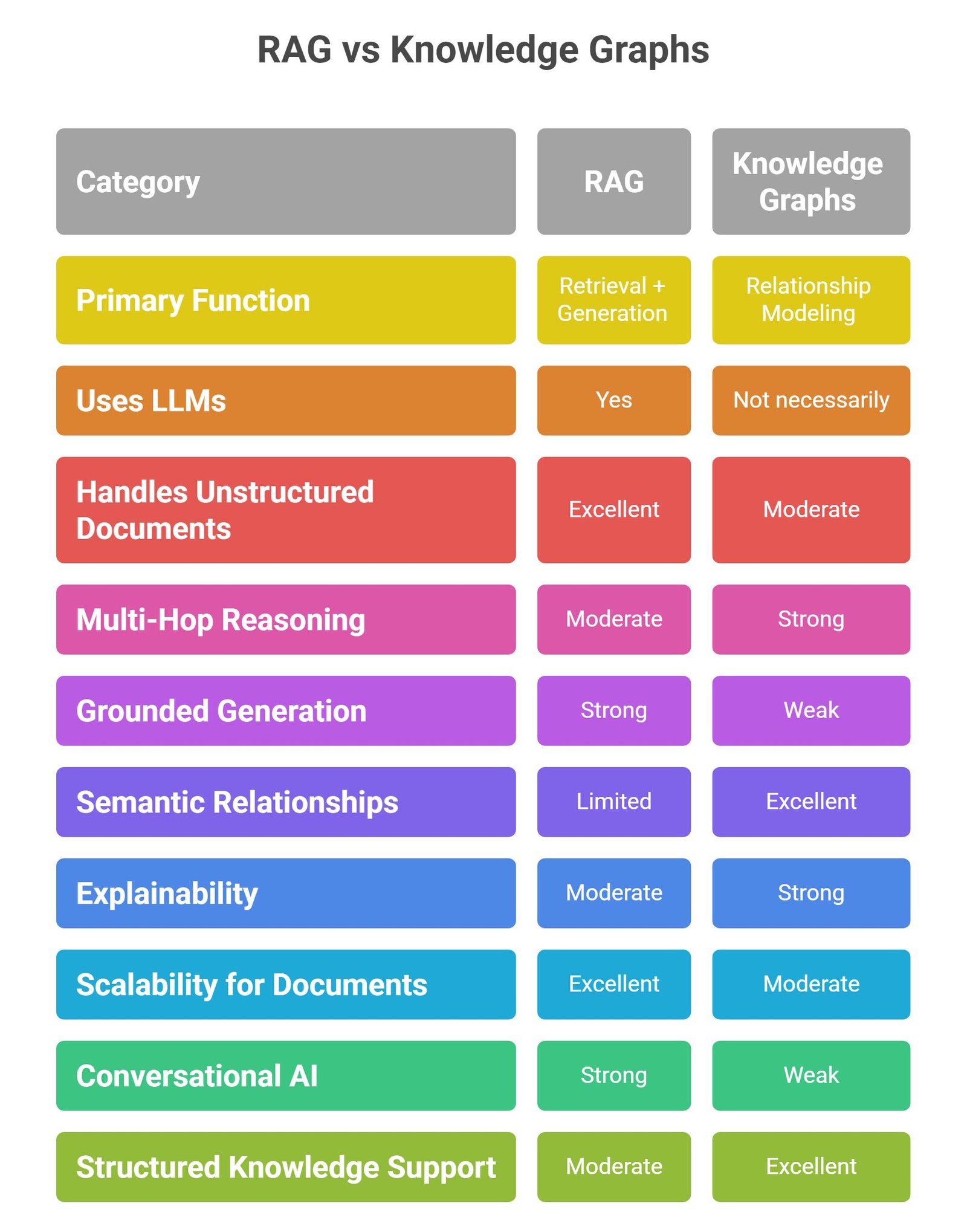
| Category | RAG | Knowledge Graphs |
| Primary Function | Retrieval + Generation | Relationship Modeling |
| Uses LLMs | Yes | Not necessarily |
| Handles Unstructured Documents | Excellent | Moderate |
| Multi-Hop Reasoning | Moderate | Strong |
| Grounded Generation | Strong | Weak |
| Semantic Relationships | Limited | Excellent |
| Explainability | Moderate | Strong |
| Scalability for Documents | Excellent | Moderate |
| Conversational AI | Strong | Weak |
| Structured Knowledge Support | Moderate | Excellent |
Why Knowledge Graphs Do Not Replace RAG
One of the biggest misconceptions in enterprise AI is:
“Knowledge graphs eliminate the need for RAG.”
In practice, this is rarely true.
Knowledge graphs excel at structured relationships, but enterprises also manage:
- PDFs
- reports
- emails
- policies
- research papers
- support documentation
- contracts
Much of this information remains unstructured.
RAG handles unstructured retrieval much more effectively.
Why RAG Does Not Replace Knowledge Graphs
RAG also has limitations.
Semantic retrieval alone may struggle with:
- relationship-heavy reasoning
- entity linking
- hierarchical structures
- multi-hop reasoning
- explainable semantic paths
Knowledge graphs solve many of these problems effectively.
What Is GraphRAG?
One of the most important trends in enterprise AI today is:
GraphRAG
GraphRAG combines:
- knowledge graphs
- semantic retrieval
- RAG pipelines
- graph reasoning systems
This enables AI systems to retrieve both:
- semantic context
- structured relationship intelligence
GraphRAG architectures are becoming increasingly important for enterprise AI systems.
How GraphRAG Works
GraphRAG systems combine multiple retrieval layers together.
Semantic Retrieval Layer
Retrieves contextually relevant documents.
Knowledge Graph Layer
Provides relationship-aware reasoning.
LLM Layer
Generates grounded responses using both retrieval and graph context.
Why GraphRAG Reduces Hallucinations
Graph relationships improve contextual consistency.
Structured reasoning paths help reduce unsupported generation.
This strengthens grounded AI generation significantly.
When to Use RAG
RAG works best when organizations need:
- enterprise search systems
- grounded AI assistants
- document retrieval
- dynamic knowledge access
- scalable semantic search
- conversational AI systems
Best RAG Use Cases
Enterprise AI Assistants
Employees retrieve internal company knowledge dynamically.
Customer Support AI
Support copilots retrieve troubleshooting workflows efficiently.
Healthcare AI Systems
Medical assistants retrieve updated clinical guidance.
Legal AI Systems
Legal retrieval systems search contracts and regulations dynamically.
Research Assistants
Scientific AI systems retrieve relevant research papers.
When to Use Knowledge Graphs
Knowledge graphs work best when organizations need:
- relationship intelligence
- entity reasoning
- semantic relationship mapping
- explainable AI systems
- structured domain modeling
Best Knowledge Graph Use Cases
Fraud Detection
Relationship networks identify suspicious patterns.
Supply Chain Intelligence
Graphs model supplier relationships and dependencies.
Healthcare Knowledge Systems
Medical entities and relationships improve diagnosis reasoning.
Recommendation Systems
Graphs improve relationship-based recommendations.
Enterprise Data Integration
Knowledge graphs unify fragmented enterprise information.
Why Hybrid Architectures Are Becoming the Future
Modern enterprises increasingly combine:
- RAG pipelines
- semantic search
- knowledge graphs
- graph reasoning systems
This creates hybrid enterprise AI architectures capable of:
- grounded generation
- structured reasoning
- semantic retrieval
- relationship intelligence
- explainable AI workflows
Example Hybrid Enterprise Architecture
| Layer | Purpose |
| Semantic Retriever | Finds contextual documents |
| Knowledge Graph | Provides relationship reasoning |
| Reranker | Improves retrieval quality |
| LLM | Generates grounded answers |
| Evaluation Layer | Detects hallucinations |
This architecture is becoming increasingly common across enterprise AI systems.
Cost Comparison: RAG vs Knowledge Graphs
Cost remains one of the most important enterprise decision factors.
RAG Cost Structure
RAG costs usually include:
- embeddings generation
- vector databases
- retrieval infrastructure
- orchestration systems
Knowledge Graph Cost Structure
Knowledge graph costs often include:
- ontology design
- graph databases
- entity extraction systems
- graph maintenance workflows
- relationship modeling infrastructure
Knowledge graphs may become expensive to maintain at scale.
Common Enterprise Mistakes
Many organizations misunderstand how these architectures work.
Assuming Knowledge Graphs Replace Retrieval
Graphs alone cannot handle large unstructured document collections effectively.
Ignoring Relationship Intelligence
Pure retrieval systems struggle with complex semantic relationships.
Underestimating Graph Maintenance Complexity
Knowledge graphs require ongoing relationship updates.
Ignoring Retrieval Quality
Weak retrieval weakens grounded generation significantly.
Why Evaluation Matters for Both Architectures
Organizations increasingly benchmark:
- groundedness
- semantic relevance
- hallucination rates
- relationship reasoning quality
- retrieval precision
- context recall
- explainability
Continuous evaluation improves enterprise AI reliability significantly.
Future of RAG and Knowledge Graphs
Enterprise AI architectures are evolving rapidly.
Major trends include:
- GraphRAG systems
- agentic retrieval architectures
- reasoning-aware retrieval
- multimodal knowledge graphs
- autonomous graph construction
- semantic reasoning pipelines
- adaptive enterprise AI systems
Future enterprise AI platforms will increasingly combine semantic retrieval with structured relationship intelligence.
Suggested
- What Is RAG in AI
- How RAG Works
- RAG vs Semantic Search
- Vector Database for RAG
- Embeddings for RAG
- Reducing Hallucinations in RAG
- Context Recall in RAG
- RAG Evaluation Metrics
FAQ: RAG vs Knowledge Graphs
What is the difference between RAG and knowledge graphs?
RAG focuses on retrieval and grounded generation. Knowledge graphs focus on structured relationships and semantic reasoning.
Can knowledge graphs replace RAG?
No. Knowledge graphs struggle with large unstructured document collections and conversational AI generation.
What is GraphRAG?
GraphRAG combines semantic retrieval, knowledge graphs, and Large Language Models to improve grounded reasoning.
Which approach reduces hallucinations better?
Hybrid GraphRAG systems often reduce hallucinations more effectively because they combine grounding with structured reasoning.
When should enterprises use knowledge graphs?
Knowledge graphs work best for relationship-heavy reasoning and structured semantic intelligence.
Final Takeaway
Understanding RAG vs knowledge graphs is essential because enterprise AI architecture directly affects grounded generation quality, semantic reasoning, hallucination reduction, explainability, and scalability.
RAG excels at semantic retrieval and grounded conversational AI generation, while knowledge graphs excel at relationship intelligence and structured semantic reasoning.
Organizations that understand how both architectures complement each other can build more scalable, reliable, explainable, and production-ready AI systems.
That capability is becoming foundational for enterprise AI assistants, semantic search systems, healthcare AI platforms, legal retrieval systems, customer support copilots, and intelligent enterprise knowledge architectures across industries.