
Modern enterprise AI systems are evolving rapidly beyond traditional chatbots and standalone Large Language Models. Organizations increasingly deploy advanced AI architectures across:
- enterprise search systems
- AI assistants
- customer support copilots
- legal intelligence platforms
- healthcare AI systems
- research automation tools
- document intelligence systems
- enterprise knowledge management platforms
However, as AI systems scale, organizations encounter a major challenge:
Traditional RAG systems sometimes struggle with complex reasoning and relationship understanding.
Basic Retrieval-Augmented Generation (RAG) systems work well for retrieving semantically relevant documents, but they may struggle when questions require:
- relationship understanding
- multi-hop reasoning
- entity connections
- contextual reasoning across documents
- structured enterprise knowledge
This limitation led to the rise of:
GraphRAG
GraphRAG is becoming one of the most important innovations in enterprise AI retrieval systems because it combines:
- semantic retrieval
- knowledge graphs
- graph reasoning
- Large Language Models
- grounded AI generation
into a unified architecture.
Today, organizations increasingly adopt GraphRAG to improve:
- factual grounding
- explainability
- contextual reasoning
- hallucination reduction
- enterprise knowledge retrieval
- relationship-aware AI systems
Understanding GraphRAG is essential because graph-enhanced retrieval architectures are rapidly becoming foundational for next-generation enterprise AI systems.
In this guide, you will learn what GraphRAG is, how it works, why it matters, how it differs from traditional RAG systems, enterprise use cases, architecture design, advantages, limitations, and why GraphRAG may become one of the most important AI infrastructure patterns in the coming years.
In Simple Terms
What Is Traditional RAG?
Retrieval-Augmented Generation (RAG) retrieves relevant information before generating answers.
A typical RAG system:
- converts documents into embeddings
- stores them inside vector databases
- retrieves semantically relevant chunks
- passes retrieved context into an LLM
- generates grounded responses
Traditional RAG focuses heavily on semantic similarity.
What Is GraphRAG?
GraphRAG extends traditional RAG using knowledge graphs and graph reasoning systems.
Instead of relying only on semantic similarity, GraphRAG understands:
- entities
- relationships
- hierarchical connections
- semantic structures
- graph traversal paths
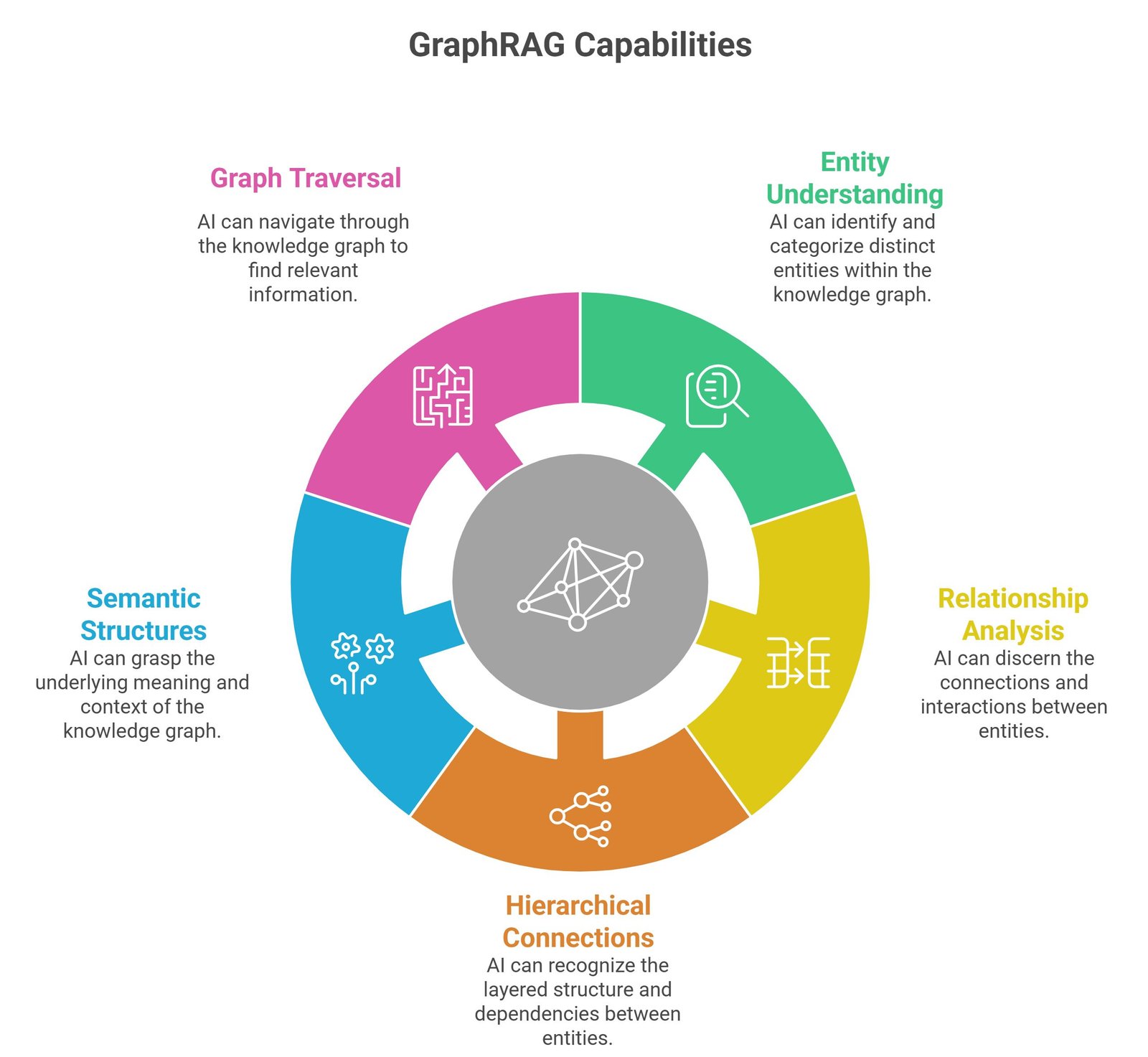
This allows AI systems to retrieve context more intelligently.
Easy Analogy
Imagine a normal RAG system as a librarian finding books related to your question.
GraphRAG works differently.
It behaves like a librarian who not only finds relevant books but also understands how people, concepts, events, organizations, and ideas inside those books connect together.
That relationship intelligence dramatically improves contextual reasoning.
Why GraphRAG Became Important
Traditional RAG systems solve many problems in enterprise AI, including:
- hallucination reduction
- grounded generation
- dynamic knowledge retrieval
- semantic search integration
However, traditional retrieval systems often struggle with:
- fragmented context
- disconnected information
- entity ambiguity
- complex relationship reasoning
- multi-step semantic inference
Enterprise AI systems increasingly require deeper reasoning capabilities.
This created the need for graph-enhanced retrieval architectures.
The Core Problem With Traditional RAG
Traditional semantic retrieval systems retrieve information based mainly on similarity scores.
For example, if a user asks:
“Which suppliers connected to Company A were affected by Regulation X?”
a traditional RAG system may retrieve documents mentioning:
- Company A
- suppliers
- Regulation X
But it may fail to reason across connected relationships effectively.
GraphRAG improves this dramatically by modeling entity relationships explicitly.
Understanding How GraphRAG Works
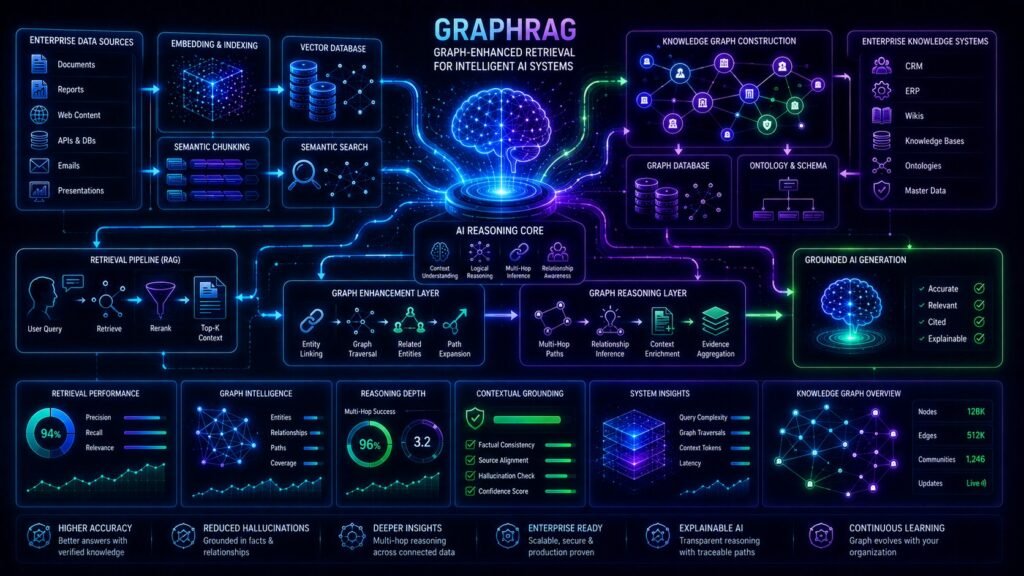
GraphRAG combines several AI infrastructure layers together.
A modern GraphRAG architecture usually includes:
- embeddings
- vector databases
- semantic retrieval systems
- knowledge graphs
- graph traversal engines
- reranking pipelines
- Large Language Models
These layers work together to improve contextual reasoning.
Core Components of GraphRAG
| Component | Purpose |
| Embeddings | Represent semantic meaning |
| Vector Database | Stores searchable embeddings |
| Knowledge Graph | Stores entity relationships |
| Graph Database | Enables graph traversal |
| Retriever | Finds contextual information |
| LLM | Generates grounded answers |
This architecture combines semantic retrieval with structured reasoning.
How Knowledge Graphs Work in GraphRAG
Knowledge graphs organize information as:
- entities
- nodes
- relationships
- semantic connections
For example:
| Entity | Relationship | Entity |
| Customer | Purchased | Product |
| Doctor | Works At | Hospital |
| Regulation | Applies To | Company |
These structured relationships improve reasoning quality significantly.
How GraphRAG Improves Retrieval
Traditional RAG retrieves documents primarily using semantic similarity.
GraphRAG adds relationship-aware retrieval.
This means retrieval considers:
- entity relationships
- graph connections
- semantic hierarchies
- linked concepts
- contextual dependencies
This produces more intelligent retrieval behavior.
Why GraphRAG Reduces Hallucinations
Hallucinations occur when AI systems generate unsupported or incorrect information.
Traditional RAG reduces hallucinations by grounding generation using retrieved documents.
GraphRAG improves this further by adding:
- structured reasoning
- entity validation
- relationship consistency
- graph-based context verification
This strengthens contextual grounding significantly.
Why GraphRAG Improves Multi-Hop Reasoning
Multi-hop reasoning requires connecting multiple pieces of information together.
For example:
- identifying relationships across departments
- tracing supply chain dependencies
- connecting medical symptoms with treatments
- linking legal entities across documents
Traditional retrieval may struggle with these workflows.
Graph reasoning improves them dramatically.
GraphRAG vs Traditional RAG
One of the most important concepts to understand is:
GraphRAG does not replace RAG.
GraphRAG extends RAG.
Traditional RAG focuses on semantic retrieval.
GraphRAG combines semantic retrieval with relationship intelligence.
Key Differences Between RAG and GraphRAG
| Category | Traditional RAG | GraphRAG |
| Retrieval Method | Semantic Similarity | Semantic + Relationship Retrieval |
| Entity Understanding | Moderate | Strong |
| Multi-Hop Reasoning | Limited | Excellent |
| Explainability | Moderate | Strong |
| Hallucination Reduction | Strong | Stronger |
| Knowledge Representation | Documents | Documents + Graphs |
| Enterprise Reasoning | Moderate | Excellent |
| Infrastructure Complexity | Moderate | Higher |
Why Enterprises Are Interested in GraphRAG
Modern enterprises increasingly manage extremely complex knowledge systems.
Examples include:
- healthcare networks
- legal systems
- supply chains
- enterprise workflows
- customer ecosystems
- cybersecurity relationships
- financial networks
Pure semantic retrieval often becomes insufficient for these environments.
GraphRAG enables deeper relationship reasoning.
Major Advantages of GraphRAG
Better Relationship Understanding
GraphRAG understands how concepts connect together.
Improved Multi-Hop Reasoning
The system reasons across connected entities more effectively.
Stronger Contextual Grounding
Relationship-aware retrieval improves grounded generation.
Better Explainability
Graph paths improve reasoning transparency.
Improved Enterprise Intelligence
Graph-enhanced retrieval improves enterprise knowledge systems.
Better Entity Disambiguation
Graphs reduce ambiguity across similar concepts.
Major Limitations of GraphRAG
Despite its advantages, GraphRAG introduces significant challenges.
Higher Infrastructure Complexity
GraphRAG systems require multiple infrastructure layers.
Graph Construction Difficulty
Building knowledge graphs can be expensive and time-consuming.
Ontology Design Challenges
Enterprises must define semantic relationships carefully.
Maintenance Complexity
Graphs require continuous updates as enterprise knowledge evolves.
Higher Engineering Requirements
GraphRAG systems require specialized expertise.
Why GraphRAG Matters for Enterprise AI
Enterprise AI increasingly depends on:
- grounded reasoning
- contextual retrieval
- explainable AI systems
- relationship-aware intelligence
- semantic orchestration
GraphRAG improves all these capabilities.
This is why many enterprises view GraphRAG as a major next-generation AI architecture.
Enterprise Use Cases for GraphRAG
Healthcare AI Systems
GraphRAG connects:
- symptoms
- treatments
- medications
- diseases
- patient histories
to improve contextual medical reasoning.
Legal AI Platforms
Graph-enhanced retrieval connects:
- contracts
- regulations
- legal entities
- case law
- compliance rules
for better legal reasoning.
Supply Chain Intelligence
GraphRAG identifies dependencies across:
- suppliers
- logistics systems
- manufacturers
- regulations
- operational risks
Cybersecurity Systems
Graph relationships improve threat intelligence analysis significantly.
Financial Intelligence
Graph reasoning improves fraud detection and risk analysis workflows.
GraphRAG and Agentic AI Systems
GraphRAG is becoming increasingly important for AI agents.
Why?
Because autonomous AI systems require:
- contextual memory
- relationship awareness
- reasoning continuity
- structured semantic understanding
Graph-enhanced retrieval supports these capabilities effectively.
Why GraphRAG Is Better for Complex Enterprise Queries
Enterprise questions often involve:
- multiple entities
- layered relationships
- hierarchical reasoning
- contextual dependencies
Traditional retrieval systems may retrieve disconnected documents.
GraphRAG improves connected reasoning across these entities.
Why GraphRAG Improves Explainability
One major challenge in AI systems is explainability.
Graph reasoning improves transparency because systems can show:
- relationship paths
- entity connections
- reasoning chains
- contextual dependencies
This becomes extremely valuable for regulated industries.
Cost Comparison: Traditional RAG vs GraphRAG
GraphRAG introduces additional infrastructure costs.
Traditional RAG Costs
Traditional RAG usually requires:
- embeddings generation
- vector databases
- retrieval pipelines
- orchestration systems
GraphRAG Costs
GraphRAG additionally requires:
- graph databases
- ontology systems
- entity extraction pipelines
- graph traversal infrastructure
- relationship maintenance workflows
This increases operational complexity significantly.
Common Enterprise Mistakes
Many organizations misunderstand GraphRAG implementations.
Assuming Graphs Replace Semantic Retrieval
Graphs and semantic retrieval solve different problems.
Ignoring Ontology Design
Poor graph structure weakens reasoning quality.
Overcomplicating Early Architectures
Not every enterprise AI system requires GraphRAG immediately.
Ignoring Retrieval Evaluation
Weak retrieval pipelines reduce GraphRAG effectiveness significantly.
Why Evaluation Matters for GraphRAG
Organizations increasingly benchmark:
- retrieval precision
- context recall
- graph reasoning quality
- answer faithfulness
- hallucination rates
- entity consistency
- semantic relevance
Continuous evaluation improves enterprise AI reliability significantly.
Future of GraphRAG
GraphRAG is evolving rapidly.
Major trends include:
- multimodal graph retrieval
- autonomous graph generation
- agentic graph reasoning
- adaptive semantic graphs
- retrieval-aware reasoning systems
- dynamic ontology generation
- graph-enhanced AI memory systems
Future enterprise AI systems will increasingly combine:
- semantic retrieval
- graph reasoning
- grounded generation
- autonomous orchestration
into unified intelligence architectures.
Suggested
- What Is RAG in AI
- How RAG Works
- Vector Database for RAG
- Embeddings for RAG
- Reducing Hallucinations in RAG
- Context Recall in RAG
- RAG Evaluation Metrics
FAQ: GraphRAG Explained
What is GraphRAG?
GraphRAG is a retrieval architecture that combines traditional RAG systems with knowledge graphs and graph reasoning.
How does GraphRAG work?
GraphRAG retrieves information using both semantic similarity and structured entity relationships before generating grounded answers.
What is the difference between RAG and GraphRAG?
Traditional RAG focuses mainly on semantic retrieval, while GraphRAG adds relationship-aware reasoning using knowledge graphs.
Does GraphRAG reduce hallucinations?
Yes. Graph-enhanced retrieval improves contextual grounding and relationship consistency.
Why is GraphRAG important for enterprise AI?
Enterprise systems often require complex relationship reasoning and explainable AI workflows that traditional retrieval systems struggle to support.
Final Takeaway
Understanding GraphRAG is becoming increasingly important because enterprise AI systems now require more than basic semantic retrieval.
Modern AI platforms increasingly depend on:
- grounded reasoning
- relationship intelligence
- explainable AI
- contextual orchestration
- semantic graph traversal
- enterprise knowledge reasoning
GraphRAG improves traditional Retrieval-Augmented Generation by combining semantic retrieval with structured graph intelligence.
Organizations that understand GraphRAG architectures can build more scalable, explainable, grounded, and production-ready enterprise AI systems.
That capability is becoming foundational for healthcare AI platforms, legal intelligence systems, enterprise search architectures, customer support copilots, cybersecurity systems, and next-generation autonomous AI agents.