
LLM vs Fine Tuning: What’s the Difference and Which Should You Use in 2026?
As businesses adopt AI, two terms appear often: LLM and fine tuning.
Many beginners confuse them or assume they are competing options. They are related, but not the same.
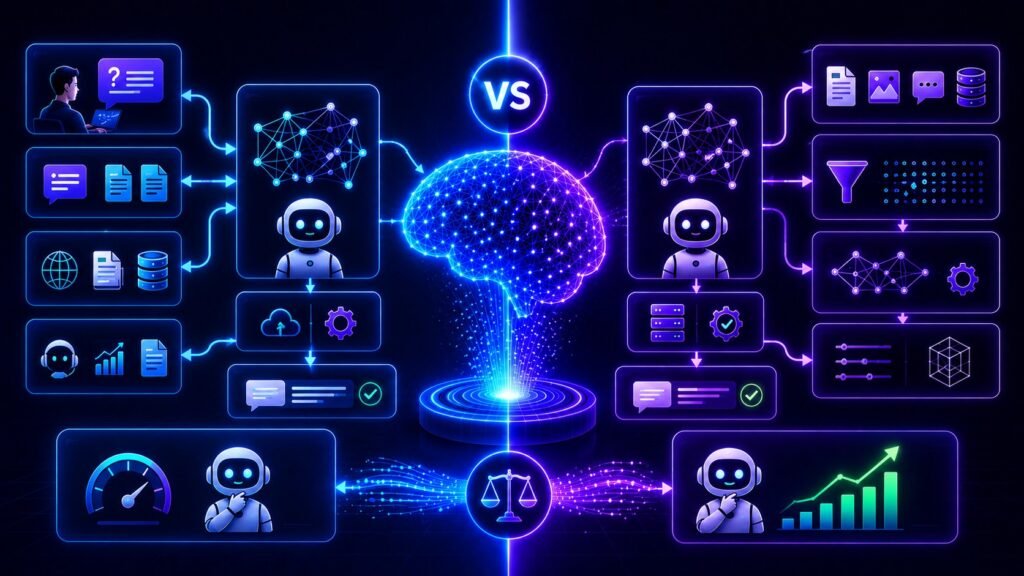
An LLM is the foundation model. Fine tuning is one method used to customize that model for specific tasks.
This guide explains LLM vs fine tuning in simple language, including differences, benefits, costs, and how to choose the right approach.
In simple terms
What is an LLM?
A Large Language Model (LLM) is a model trained on massive text datasets to understand and generate language.
It can perform tasks like:
- writing
- summarization
- coding help
- translation
- question answering
What is Fine Tuning?
Fine tuning means training an existing model further on targeted data so it performs better for a specific use case.
Examples:
- legal document drafting
- medical terminology support
- brand voice writing
- domain-specific chatbots
- industry classification tasks
Fine tuning is customization, not a separate model category.
Easy analogy
Think of buying a car.
LLM
The standard factory model.
Fine Tuning
Customizing that car for racing, off-road use, or luxury comfort.
Same base vehicle, different specialization.
Why People Compare LLM vs Fine Tuning
Businesses often ask:
- Should we use a base model directly?
- Should we customize it?
- Can prompting alone solve our needs?
- Is fine tuning worth the cost?
The answer depends on goals.
Popular AI ecosystems offering customization options
Many organizations experiment with systems from:
Capabilities and workflows vary by platform.
Core Difference: LLM vs Fine Tuning
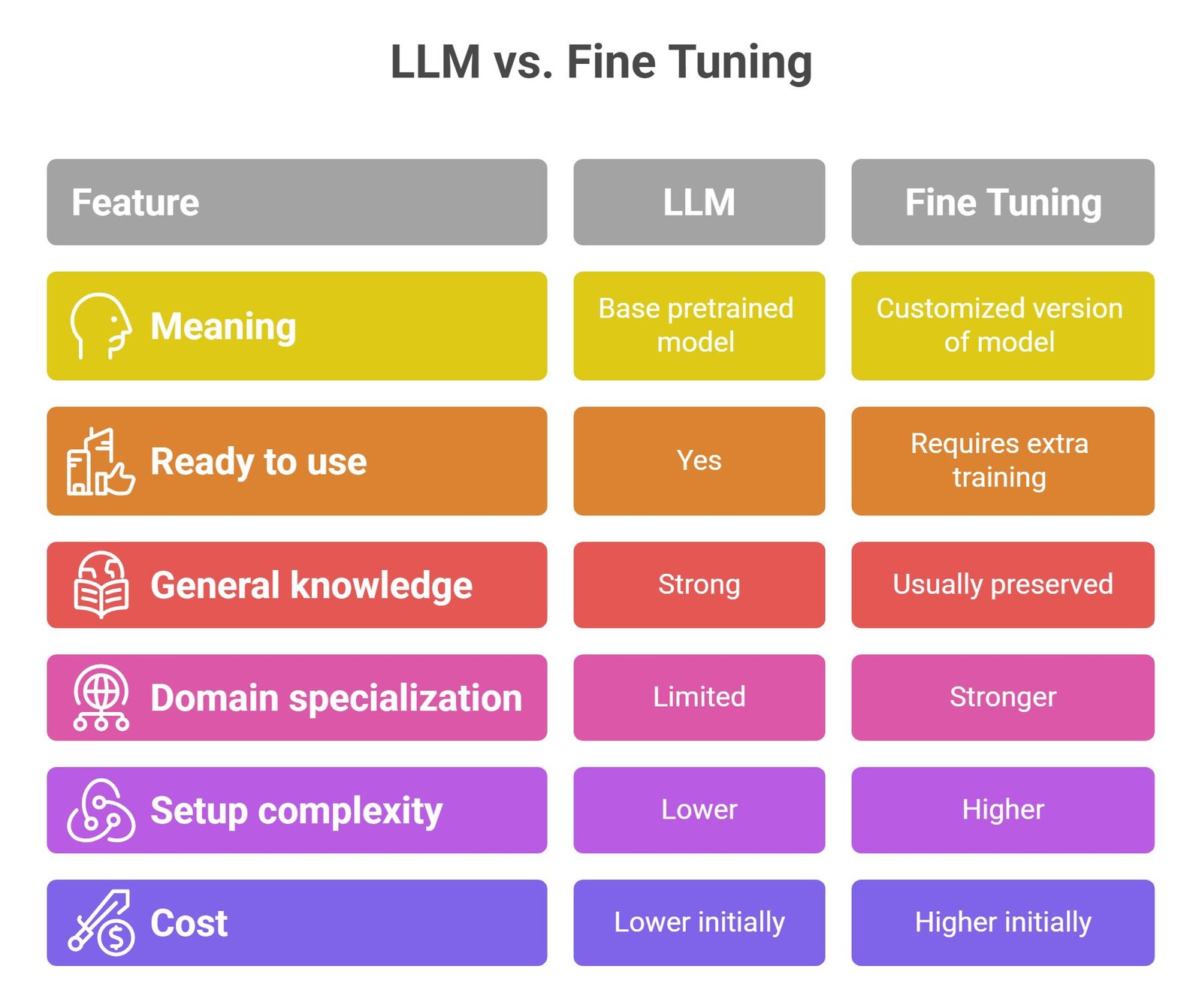
| Feature | LLM | Fine Tuning |
| Meaning | Base pretrained model | Customized version of model |
| Ready to use | Yes | Requires extra training |
| General knowledge | Strong | Usually preserved |
| Domain specialization | Limited | Stronger |
| Setup complexity | Lower | Higher |
| Cost | Lower initially | Higher initially |
When to use a base LLM only
Choose a base model when you need:
General Content Tasks
Blogs, summaries, brainstorming.
Fast Launches
Prototype quickly.
Low Volume Usage
No need for heavy customization.
Flexible Use Cases
Many changing tasks.
Good Prompting Results Already
Sometimes prompts are enough.
When Fine Tuning Makes Sense
Choose fine tuning when you need:
Consistent Brand Voice
Specific tone and style.
Domain Language Expertise
Legal, finance, healthcare terminology.
Structured Outputs at Scale
Reliable formatting.
Repetitive Specialized Tasks
High-volume predictable workflows.
Lower Prompt Dependence
Reduce long prompt engineering complexity.
LLM vs Fine Tuning: Real Business Examples
SaaS Company
Fine tune for support style and product terminology.
Law Firm
Fine tune for contract language patterns.
Ecommerce Brand
Fine tune for product description tone.
Healthcare Admin Tool
Fine tune for domain vocabulary.
LLM vs Fine Tuning vs Prompt Engineering
| Approach | Best For |
| Base LLM | General tasks |
| Prompt Engineering | Fast behavior changes |
| Fine Tuning | Repeated specialized tasks |
Often businesses combine all three.
Benefits of Fine Tuning
Better Consistency
More predictable outputs.
Stronger Domain Fit
Learns specialized language patterns.
Potential Cost Efficiency
Shorter prompts may reduce inference cost.
Better Formatting
Useful for structured generation.
Competitive Differentiation
Custom workflows become harder to copy.
Limitations of Fine Tuning
Requires Quality Data
Bad training data causes poor outputs.
Higher Setup Cost
Training and evaluation take effort.
Maintenance Needed
Models may need updates.
Not Ideal for Fresh Knowledge
Fine tuning is not the same as live retrieval.
Risk of Overfitting
Too narrow training can reduce flexibility.
Fine Tuning vs RAG
Many teams confuse these too.
Fine Tuning Improves Behavior
Style, format, domain tendencies.
RAG Improves Knowledge Access
Uses current/private documents.
Often the best stack is:
Base LLM + Fine Tuning + RAG
How to decide practically
Use Prompting First
Cheapest experiment path.
Add RAG If Knowledge Matters
For internal docs or current info.
Add Fine Tuning If Repetition Matters
For scale and consistency.
Common mistakes teams make
Fine Tuning Too Early
Try prompting first.
Using Fine Tuning for Current Facts
Use RAG instead.
Poor Dataset Quality
Training data quality is everything.
No Evaluation Process
Need benchmarks before and after.
Ignoring ROI
Customization should create business value.
Future of fine tuning
Expect growth in:
- lighter adaptation methods
- cheaper customization workflows
- domain-specific enterprise models
- multimodal fine tuning
- private secure training pipelines
- automated evaluation systems
Customization is becoming more accessible.
Suggested Read:
- LLM Fine Tuning Basics
- LLM vs RAG
- How LLMs Work
- LLM Deployment Basics
- LLM Evaluation Metrics
- LLM for Beginners
FAQ :LLM vs Fine Tuning
Is fine tuning better than an LLM?
Fine tuning uses an LLM. It is a customization method.
Do all businesses need fine tuning?
No. Many succeed with prompting only.
Is fine tuning expensive?
It can be, depending on scale and provider.
Does fine tuning reduce hallucinations?
Sometimes behavior improves, but RAG is often better for factual grounding.
What should beginners start with?
Use base models and prompting first.
Final takeaway
The real comparison is not LLM vs fine tuning as opposites. Fine tuning is one way to make LLMs more specialized for real business needs.
Use base models for flexibility, prompts for fast iteration, and fine tuning when consistency and domain performance justify the investment.