
Multimodal AI Explained Simply: A Beginner-Friendly Guide to AI Beyond Text
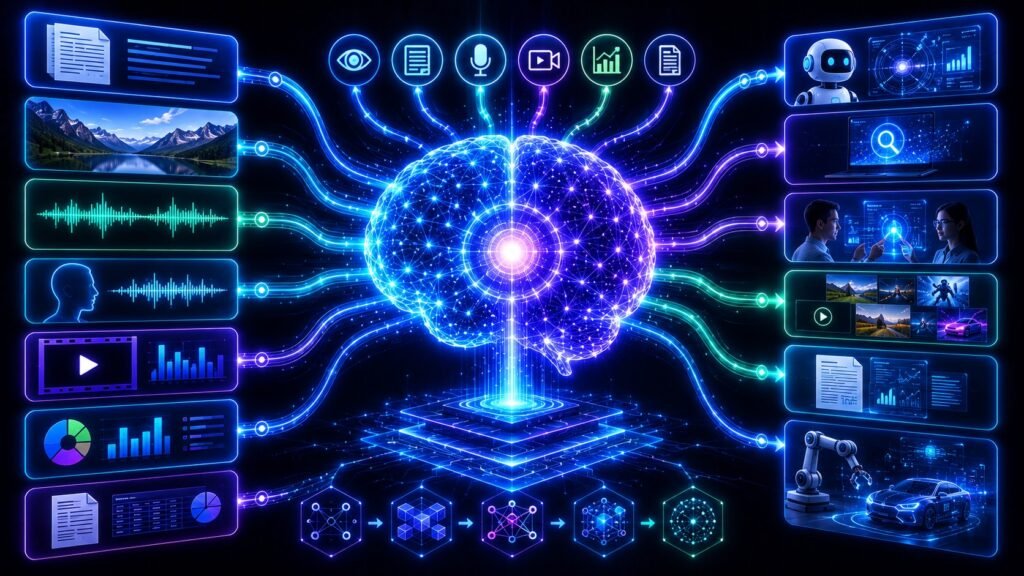
Multimodal AI is artificial intelligence that can understand more than one type of information, such as text, images, audio, video, documents, charts, and sensor data. Instead of only reading words, multimodal AI connects different inputs together so it can understand richer context and give more useful answers.
In Simple Terms
Multimodal AI means AI that can work with several “modes” of information at once. A mode, or modality, is simply a type of data. Text is one modality. Images are another. Audio, video, documents, screenshots, charts, and sensor readings are also modalities.
A normal text chatbot can only understand what you type. A multimodal AI system can read your question, inspect an uploaded image, listen to a voice note, understand a chart, or analyze a document in the same workflow. That is why multimodal artificial intelligence feels more natural than older single-purpose AI systems. It is closer to how people understand the world: we combine language, sight, sound, and context rather than treating them separately.
What Does Multimodal Mean in AI?
In AI, “multimodal” means the system can process and connect different kinds of input. A speech model may only handle audio. A computer vision model may only analyze images. A language model may mainly process written text. A multimodal AI model brings these abilities into one system.
For example, imagine asking, “What does this chart show?” while uploading a sales dashboard screenshot. The AI must understand your text question, inspect the visual chart, recognize the trend, and explain the result clearly. That requires more than keyword matching or image classification. It requires cross-modal reasoning, where the system connects meaning across different data types.
| Modality | Example | What AI Can Do |
| Text | Prompts, emails, reports | Explain, summarize, answer |
| Image | Photos, diagrams, screenshots | Identify, describe, inspect |
| Audio | Voice notes, calls, meetings | Transcribe, summarize, classify |
| Video | Tutorials, surveillance, demos | Analyze scenes and events |
| Documents | PDFs, forms, slides | Extract and explain information |
| Charts | Dashboards, graphs | Interpret trends and patterns |
How Multimodal AI Works
Multimodal AI usually works through four broad stages: input processing, encoding, fusion, and reasoning. First, the system receives different types of input, such as text, an image, a video, an audio file, or a document. Each modality needs a suitable processor. Images may go through a vision encoder, speech may go through an audio model, and text may go through a language model.
Next, the system converts these inputs into embeddings, which are numerical representations of meaning. Then it aligns or combines those representations so the model can understand relationships between them. For example, it can connect a sentence with a picture or a spoken question with a video scene. Finally, it reasons over the combined context and produces an answer, summary, recommendation, image, voice response, or action.
A Simple Example of Multimodal AI
Imagine you upload a screenshot of an app error and ask, “How do I fix this?” A text-only AI system would need you to type the error message manually. A multimodal AI system can inspect the screenshot, read visible error text, understand your question, and suggest troubleshooting steps.
Another simple example is education. A student can upload a diagram from a science textbook and ask, “Explain this simply.” The AI can recognize the labeled parts of the diagram, connect them to the student’s question, and explain the topic in plain language. This is the practical value of multimodal AI explained simply: it lets people ask questions in the same messy, visual, voice-driven way they already communicate in real life.
Multimodal AI vs Traditional AI
Traditional AI systems often specialize in one data type. A natural language processing system handles text. A computer vision system recognizes objects in images. A speech recognition system converts audio into text. These systems are useful, but they can feel limited when a real task involves mixed information.
Multimodal AI connects these capabilities. It can understand a product photo and a customer complaint together, or analyze a video while also using its transcript. This makes it more useful for enterprise search, customer support, healthcare workflows, robotics, analytics, and education. The main difference is not only that multimodal AI accepts more inputs. The bigger difference is that it can reason across those inputs to build a more complete understanding.
Multimodal AI vs Generative AI
Multimodal AI and generative AI are related, but they are not the same thing. Multimodal AI describes the ability to process multiple types of data. Generative AI describes the ability to create new content, such as text, images, audio, video, code, or designs.
Some systems are both multimodal and generative. For example, an AI assistant may accept an image and a text prompt, then generate a written explanation. A video model may accept text, image, or audio inputs and generate video output. Google Cloud notes that multimodal models can process inputs such as images, videos, and text, while NVIDIA describes multimodal LLMs as systems that can understand and generate across text, images, video, audio, and more.
What Are Multimodal Large Language Models?
Multimodal large language models, often called multimodal LLMs or MLLMs, are language models extended beyond text. Traditional LLMs mainly understand and generate language. Multimodal LLMs can also process images, audio, video, screenshots, charts, or documents alongside text prompts.
This matters because AI assistants are becoming more visual, voice-enabled, and file-aware. Instead of only answering typed questions, multimodal LLMs can help users interpret screenshots, summarize uploaded documents, analyze images, or understand mixed business information. These models are important for AI assistants, enterprise copilots, document intelligence, robotics, multimodal search, and accessibility tools. NVIDIA describes MLLMs as deep learning algorithms that understand and generate multiple forms of content across text, images, video, audio, and more.
Real-World Examples of Multimodal AI
Multimodal AI is already useful across many practical workflows. In customer support, an AI assistant can review a screenshot, read the support ticket, and suggest a likely fix. In healthcare, AI systems may combine medical images, patient notes, lab results, and clinical records to support professionals, though high-risk medical decisions still require expert oversight.
In business, multimodal AI can help teams analyze dashboards, charts, PDFs, meeting recordings, product images, and spreadsheets. In robotics, systems combine camera input, sensor readings, speech commands, and spatial reasoning. In education, AI tutors can explain diagrams, listen to spoken questions, and adapt explanations to the learner’s level. These multimodal AI examples show why the technology is becoming useful beyond simple chatbot interactions.
Why Multimodal AI Is Important for Business
Businesses rarely store knowledge in one neat format. Important information may live in emails, PDFs, slide decks, dashboards, call recordings, scanned documents, product photos, support tickets, and spreadsheets. Multimodal AI helps connect these formats so teams can ask better questions and get more complete answers.
For example, a retail team may use product images, customer reviews, inventory data, and support messages together. A finance team may combine charts, tables, reports, and written explanations. A customer support team may use chat history, screenshots, call recordings, and knowledge-base articles. This is why multimodal AI is becoming important for enterprise copilots, document understanding, customer support automation, visual search, and business intelligence workflows.
Benefits of Multimodal AI
The biggest benefit of multimodal AI is better context. Users do not always know how to describe everything in words. An image, screenshot, voice note, or document can provide information that text alone misses. When AI can use these inputs together, answers can become more relevant and helpful.
Multimodal AI also improves usability. People can interact through voice, images, files, or videos instead of typing long descriptions. It can support accessibility by converting visual information into text, summarizing audio, or helping users understand documents. For companies, it can automate workflows that previously required humans to inspect screenshots, forms, charts, recordings, and images manually.
Limitations and Risks of Multimodal AI
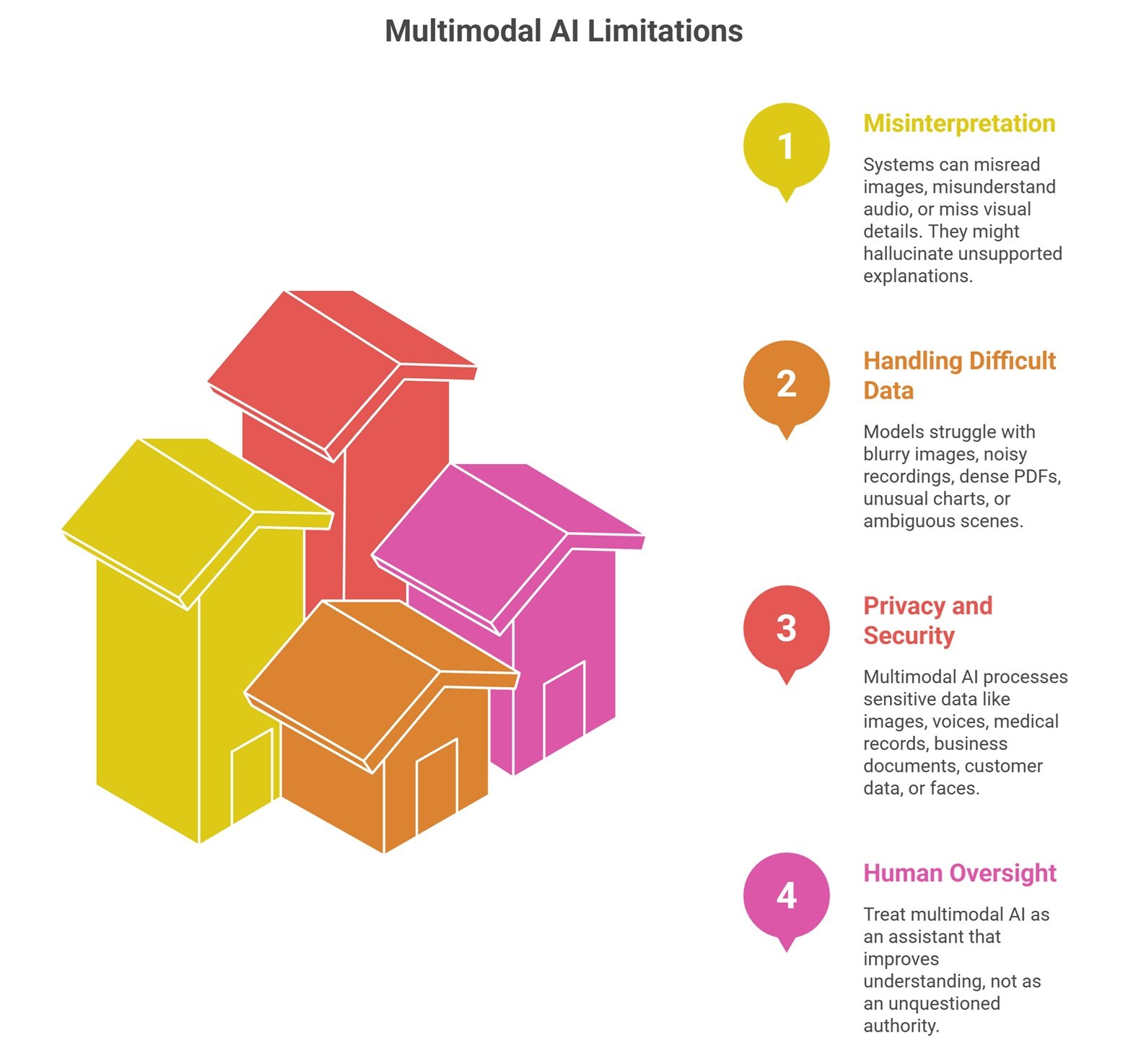
Multimodal AI is powerful, but it is not perfect. These systems can misread images, misunderstand audio, miss small visual details, or hallucinate unsupported explanations. A model might describe something in an image that is not actually there. It may also struggle with blurry images, noisy recordings, dense PDFs, unusual charts, or ambiguous scenes.
Privacy and security are also important. Multimodal AI systems may process sensitive images, voices, medical records, business documents, customer data, or faces. That means organizations need strong access controls, data governance, evaluation, and human review for high-risk workflows. The safer approach is to treat multimodal AI as an assistant that improves understanding, not as an unquestioned authority.
Common Mistakes About Multimodal AI
One common mistake is thinking multimodal AI only means text-to-image generation. That is too narrow. Multimodal artificial intelligence includes image understanding, video analysis, speech processing, document intelligence, visual question answering, multimodal search, robotics, accessibility, and enterprise automation.
Another mistake is assuming multimodal AI is always accurate because it can “see” or “hear.” In reality, it still depends on training data, input quality, model design, and evaluation. If a screenshot is unclear or a chart is complex, the model may misunderstand it. Strong multimodal AI systems need testing, guardrails, and clear limits, especially in regulated fields like healthcare, finance, legal work, and education.
Future of Multimodal AI
The future of AI is increasingly multimodal. AI assistants are becoming more visual, voice-enabled, and document-aware. Enterprise copilots are starting to work across dashboards, screenshots, documents, calls, charts, and business systems. Robotics and autonomous systems also depend heavily on multimodal perception because they must understand real environments.
Future multimodal systems will likely combine perception, memory, reasoning, retrieval, planning, and action. That means AI will not only answer text prompts. It will interpret mixed inputs, retrieve relevant context, explain what it sees, respond through voice, and support workflows across business, healthcare, education, design, engineering, and automation.
Suggested Read:
- What Is Multimodal AI? Complete Beginner’s Guide to AI Beyond Text
- Multimodal AI for Beginners
- How Multimodal AI Works
- Multimodal AI Use Cases
FAQ: Multimodal AI Explained Simply
What is multimodal AI in simple words?
Multimodal AI is AI that can understand more than one type of information at once, such as text, images, audio, video, documents, and charts.
How does multimodal AI work?
It processes different data types, converts them into embeddings, combines them into a shared representation, and reasons across them to generate useful outputs.
What are examples of multimodal AI?
Examples include AI assistants that analyze screenshots, healthcare AI that combines scans and notes, robots that use vision and speech, and tools that summarize videos or documents.
Can AI understand images and text together?
Yes. Multimodal AI systems can connect visual information with written questions, captions, instructions, or documents to produce more context-aware responses.
What are multimodal large language models?
Multimodal LLMs are language models that can process other data types, such as images, audio, documents, video, or screenshots, alongside text.
Why is multimodal AI important?
It helps AI understand real-world information more naturally because real tasks often involve text, visuals, speech, files, and context together.
Final Takeaway
Multimodal AI explained simply means AI that can go beyond text and understand multiple kinds of information together. It can connect language, images, audio, video, documents, charts, and sensor data to create richer context and more useful responses.
As AI assistants become more visual, voice-enabled, and document-aware, multimodal AI will become a core foundation for practical AI systems. To continue learning, explore What Is Multimodal AI, How Multimodal AI Works, and Multimodal AI Use Cases next.