
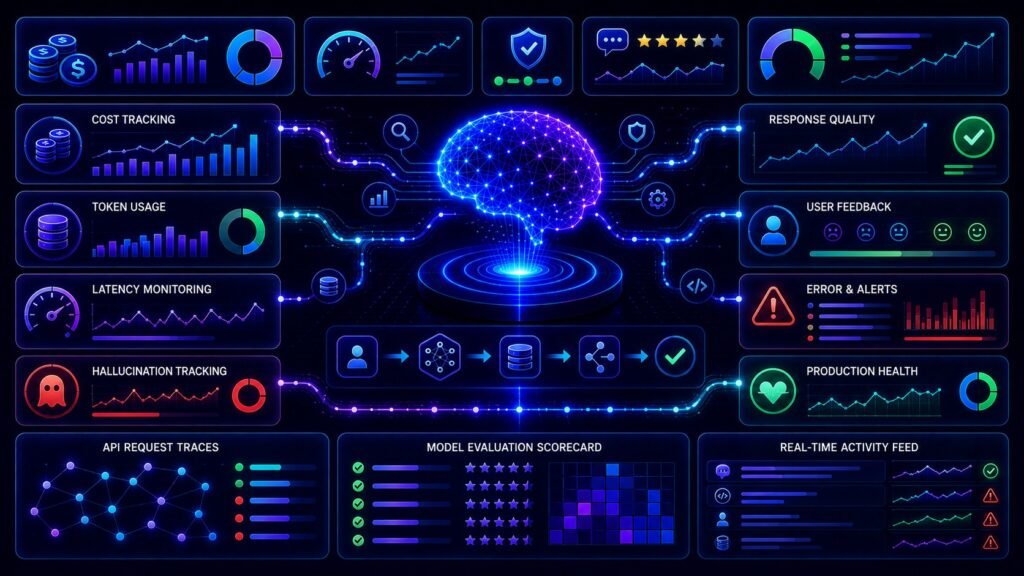
LLM Monitoring Explained: How to Track AI Performance in 2026
Launching a Large Language Model (LLM) application is only the beginning. Once users start interacting with your AI system, performance can change quickly.
Costs may rise. Responses may slow down. Hallucinations may increase. User satisfaction may drop.
That is why LLM monitoring is essential.
This guide explains how to monitor LLM systems in production, what metrics matter most, and how businesses use monitoring to improve quality and reduce cost.
In simple terms
LLM monitoring means:
Tracking how an AI application performs after deployment.
It helps teams understand:
- response speed
- output quality
- token usage
- API costs
- user satisfaction
- hallucination trends
- failures and downtime
- prompt success rates
Think of it as health tracking for AI systems.
Why LLM monitoring matters
Traditional apps are easier to monitor.
If a normal app breaks, errors often appear clearly.
LLM apps are different. They may be technically online while still failing because:
- answers are inaccurate
- prompts stop working
- outputs feel worse
- costs become too high
- users lose trust
Monitoring reveals hidden problems early.
Easy analogy
Imagine managing a hotel.
You would monitor:
- room occupancy
- customer reviews
- wait times
- cleaning quality
- operating costs
If you track nothing, problems grow silently.
LLM products work the same way.
Core LLM Monitoring Metrics
1. Latency
How quickly the model responds.
Track:
- time to first token
- total response time
- peak traffic slowdowns
Fast AI usually converts better.
2. Token Usage
Measures input and output token volume.
Useful for:
- prompt optimization
- cost control
- abuse detection
3. Cost Per Request
Understand what each conversation costs.
Critical for SaaS margins and enterprise budgeting.
4. Error Rate
Track:
- failed API calls
- timeouts
- tool failures
- retrieval failures
5. Output Quality
Measure:
- helpfulness
- relevance
- correctness
- formatting success
6. Hallucination Signals
Track suspicious or unsupported claims.
7. User Satisfaction
Use:
- thumbs up/down
- ratings
- repeat usage
- churn signals
Popular AI ecosystems teams monitor
Many companies deploy systems using:
No matter the provider, monitoring is necessary.
What Good LLM Monitoring Systems Include
Prompt Logs
What users ask.
Output Logs
What the system returns.
Metadata
Model version, latency, tokens, cost.
Session Analytics
Multi-step conversation flows.
Alerts
Sudden failures, cost spikes, quality drops.
Dashboards
Live performance visibility.
LLM Monitoring vs LLM Observability
| Term | Meaning |
| Monitoring | Track metrics and alerts |
| Observability | Deeper diagnosis and root-cause analysis |
Monitoring tells you something is wrong.
Observability helps explain why.
Both are valuable.
LLM Monitoring Guide: Real-world Use Cases
Customer Support Chatbot
Track:
- response speed
- resolution rate
- escalation frequency
- satisfaction score
AI Writing Tool
Track:
- content acceptance rate
- regeneration rate
- subscription retention
Coding Assistant
Track:
- accepted suggestions
- bug complaints
- completion speed
Enterprise Search Bot
Track:
- retrieval success
- grounded responses
- citation quality
How to Build LLM Monitoring
Step 1: Define Success Metrics
Quality, cost, speed, trust.
Step 2: Log Safely
Protect private data.
Step 3: Create Dashboards
Watch trends over time.
Step 4: Set Alerts
Examples:
- cost spike
- latency spike
- error surge
- low ratings
Step 5: Improve Weekly
Treat prompts and models like products.
Common mistakes teams make
Tracking Only Cost
Cheap bad AI still fails.
Tracking Only Speed
Fast wrong answers hurt trust.
No Human Feedback Loop
Users reveal hidden issues.
No Version Tracking
Model changes can impact quality.
Logging Sensitive Data Carelessly
Creates compliance risk.
Best Metrics by Stage
| Stage | Focus Metrics |
| Prototype | Prompt success, latency |
| Launch | Cost, uptime, user ratings |
| Growth | Retention, hallucinations, ROI |
| Enterprise | Compliance, reliability, audit logs |
How LLM Monitoring Reduces Hallucinations
Monitoring can detect:
- repeated wrong answers
- unsupported claims
- low-rated responses
- domain-specific failure patterns
Then teams can improve prompts, retrieval, or model choice.
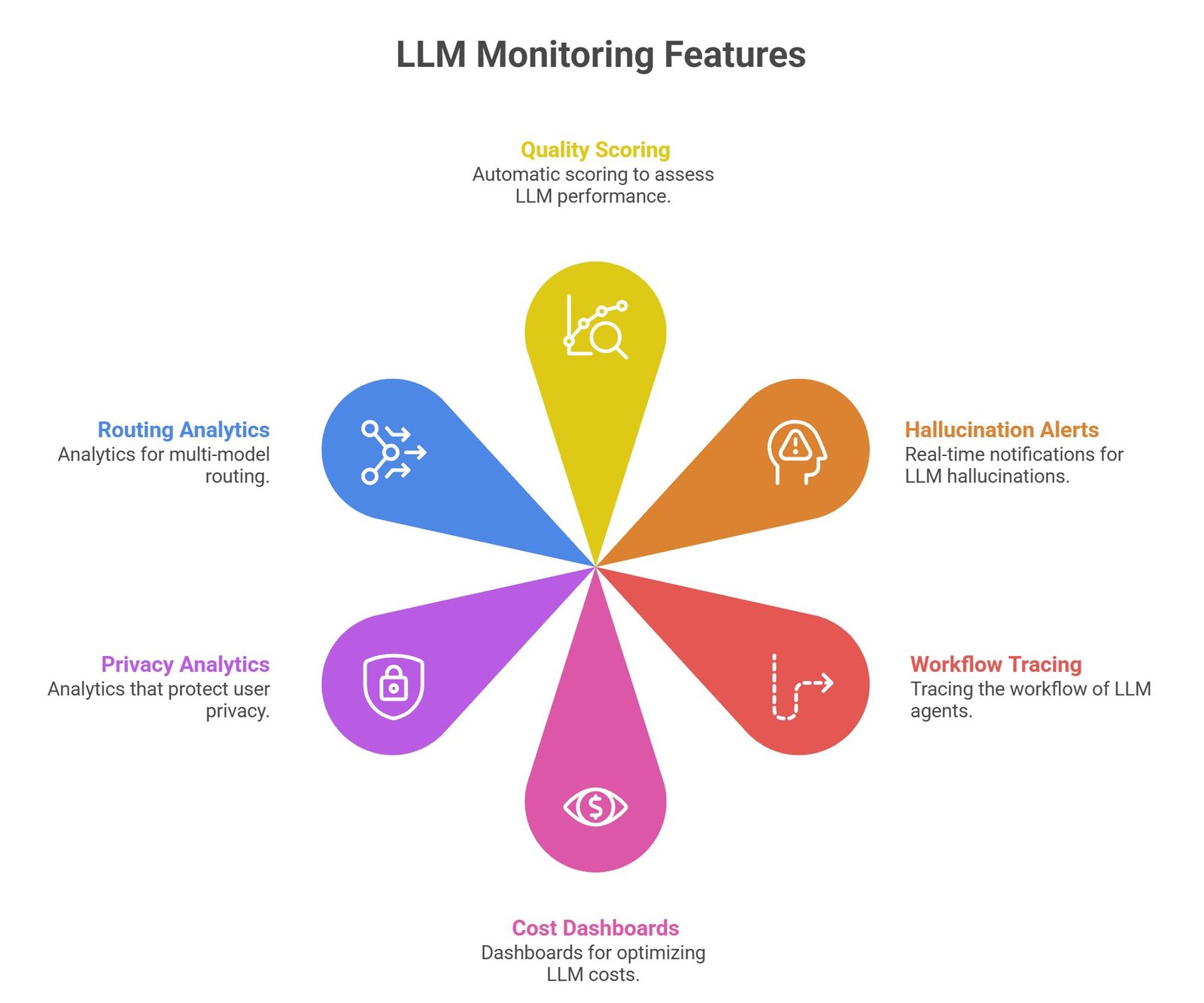
Future of LLM Monitoring
Expect growth in:
- automatic quality scoring
- real-time hallucination alerts
- agent workflow tracing
- cost optimization dashboards
- privacy-safe analytics
- multi-model routing analytics
Monitoring is becoming core AI infrastructure.
Suggested Read:
- LLM Observability
- LLM Evaluation Metrics
- LLM Benchmarking Explained
- How to Reduce LLM Hallucinations
- LLM API Pricing Comparison
- LLM for Beginners
FAQ: LLM Monitoring
What is LLM monitoring?
Tracking how an AI system performs after deployment.
Why is it important?
Because AI apps can degrade even when technically online.
What should startups track first?
Latency, cost, user feedback, and error rate.
Is monitoring different from observability?
Yes. Monitoring tracks signals; observability investigates causes.
Can monitoring improve ROI?
Yes, by reducing waste and improving user experience.
Final takeaway
LLM monitoring helps teams run AI products professionally. It turns hidden problems into visible signals and helps improve quality, trust, and economics over time.
The best AI systems are not only smart—they are continuously monitored and improved.