

LLM Observability Explained: How to Monitor AI Systems in 2026
Building an AI application is only the first step. Once a Large Language Model (LLM) goes live, teams need to know what is happening in production.
Questions quickly appear:
- Why did quality drop today?
- Why are costs increasing?
- Which prompts fail most often?
- Why are users abandoning sessions?
- Are hallucinations rising?
That is where LLM observability becomes essential.
This guide explains LLM observability in simple language, why it matters, key metrics to track, and how teams use it to improve AI systems.
In simple terms
LLM observability means:
Monitoring, measuring, and understanding how an AI system behaves in real-world usage.
It helps teams track:
- prompts
- outputs
- latency
- token usage
- cost
- errors
- hallucinations
- user satisfaction
Think of it as analytics + monitoring for language models.
Why LLM Observability Matters
Traditional software monitoring tracks servers, uptime, and bugs.
AI systems need much more.
An LLM app may technically be online but still fail because:
- responses are low quality
- prompts are confusing
- costs spike
- users dislike answers
- retrieval systems break
- model updates reduce performance
Observability helps catch these issues early.
Easy analogy
Imagine running a restaurant.
Knowing the lights are on is not enough.
You also need to know:
- wait times
- food quality
- customer complaints
- ingredient cost
- repeat customers
That is observability for a restaurant.
Same idea for LLM products.
Core LLM Observability Metrics
1. Latency
How long responses take.
Includes:
- time to first token
- total completion time
- average response time
Critical for user experience.
2. Token Usage
Tracks prompt and output token volume.
Useful for cost control.
3. Cost Per Request
How expensive each interaction becomes.
Especially important for scaled products.
4. Error Rate
Measures:
- failed calls
- timeouts
- tool errors
- retrieval failures
5. Hallucination Signals
Detect suspicious or unsupported outputs.
6. User Satisfaction
Thumbs up/down, ratings, retention, repeat use.
7. Prompt Success Rate
Which prompts consistently deliver good outcomes.
AI ecosystems teams monitor
Many companies deploy systems using providers such as:
Regardless of provider, observability remains important.
What LLM observability tools often capture
Prompt Logs
What users asked.
Response Logs
What the model answered.
Metadata
Model version, latency, tokens.
Session Flows
Multi-step user journeys.
Alerts
Sudden failures or cost spikes.
Quality Signals
Human ratings or automated scoring.
LLM Observability vs Traditional Monitoring
| Feature | Traditional Monitoring | LLM Observability |
| Server Uptime | Yes | Yes |
| Error Logs | Yes | Yes |
| Prompt Tracking | No | Yes |
| Output Quality | Limited | Yes |
| Hallucination Risk | No | Yes |
| Token Cost | No | Yes |
AI systems need a broader lens.
LLM Observability: Real-world use cases
Customer Support Bot
Track:
- resolution rate
- escalation rate
- response quality
- latency
Internal Search Assistant
Track:
- retrieval success
- grounded answers
- citation quality
Writing Tool
Track:
- user satisfaction
- output usefulness
- regeneration frequency
Coding Assistant
Track:
- accepted suggestions
- bug rate
- completion speed
Common problems observability helps solve
Rising Costs
Long prompts or verbose outputs.
Slow Performance
Latency from model or tools.
Hallucination Spikes
After prompt or model changes.
Prompt Drift
Old prompts stop performing well.
Low Adoption
Users abandon confusing experiences.
How to Build LLM Observability
Step 1: Define Success Metrics
Speed, quality, cost, trust.
Step 2: Log Interactions Safely
Respect privacy and compliance.
Step 3: Add Dashboards
Make trends visible.
Step 4: Create Alerts
Notify on anomalies.
Step 5: Review Weekly
Continuous improvement matters.
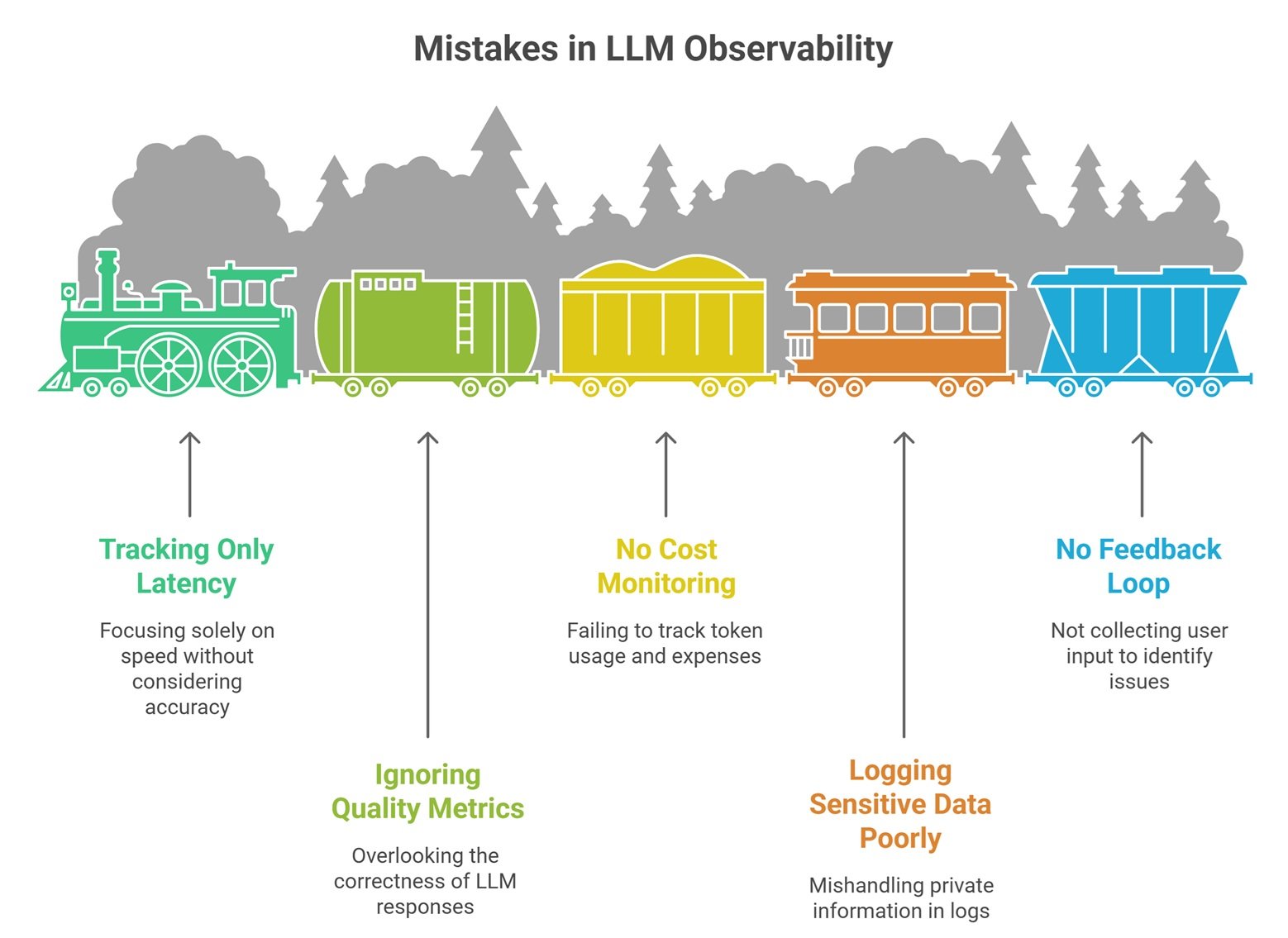
LLM Observability: Common Mistakes Teams Make
Tracking Only Latency
Speed is not enough.
Ignoring Quality Metrics
Fast wrong answers still fail.
No Cost Monitoring
Token waste becomes expensive.
Logging Sensitive Data Poorly
Creates privacy risk.
No Feedback Loop
Users reveal real issues.
Best metrics by maturity stage
| Stage | Focus Metrics |
| Prototype | Prompt success, latency |
| Early Launch | Cost, errors, satisfaction |
| Growth | Retention, hallucination, ROI |
| Enterprise | Compliance, reliability, auditability |
Future of LLM observability
Expect rapid growth in:
- automatic hallucination detection
- prompt optimization analytics
- agent workflow tracing
- model routing dashboards
- business ROI measurement
- privacy-safe analytics systems
Observability will become standard AI infrastructure.
Suggested Read:
- LLM Evaluation Metrics
- LLM Benchmarking Explained
- How to Reduce LLM Hallucinations
- LLM API Pricing Comparison
- LLM Safety Basics
- LLM for Beginners
FAQ: LLM Observability
What is LLM observability?
Monitoring and understanding how AI systems behave in production.
Why is it important?
Because AI apps can fail in ways normal software monitoring misses.
What should teams track first?
Latency, cost, errors, and user feedback.
Does observability reduce hallucinations?
It helps detect and reduce them over time.
Is observability only for enterprises?
No. Even small AI apps benefit.
Final takeaway
LLM observability helps teams move from guessing to knowing. It reveals how prompts, models, users, and costs interact in real production environments.
The best AI systems are not only powerful—they are measurable, monitored, and continuously improved.