

LLM Engineer Roadmap: Step-by-Step Career Guide in 2026
Large Language Models (LLMs) are transforming software, customer support, search, coding, and enterprise automation. As adoption grows, companies need engineers who can build reliable AI applications using these models.
That demand has created one of the fastest-growing technical roles: LLM Engineer.
If you want to work in applied AI without spending years in research, this guide gives you a practical LLM engineer roadmap to build real-world skills and become job-ready.
In simple terms
An LLM Engineer is someone who:
Builds products and systems powered by language models.
They often work on:
- AI chatbots
- internal copilots
- RAG systems
- prompt pipelines
- AI automation tools
- evaluation systems
- model deployment
- monitoring and optimization
This is a practical engineering role focused on shipping useful AI.
Why LLM Engineers are in Demand
Businesses want AI that delivers outcomes, not demos.
They need people who can:
- integrate models into products
- reduce hallucinations
- optimize cost and speed
- connect private data sources
- monitor production systems
- improve user experience
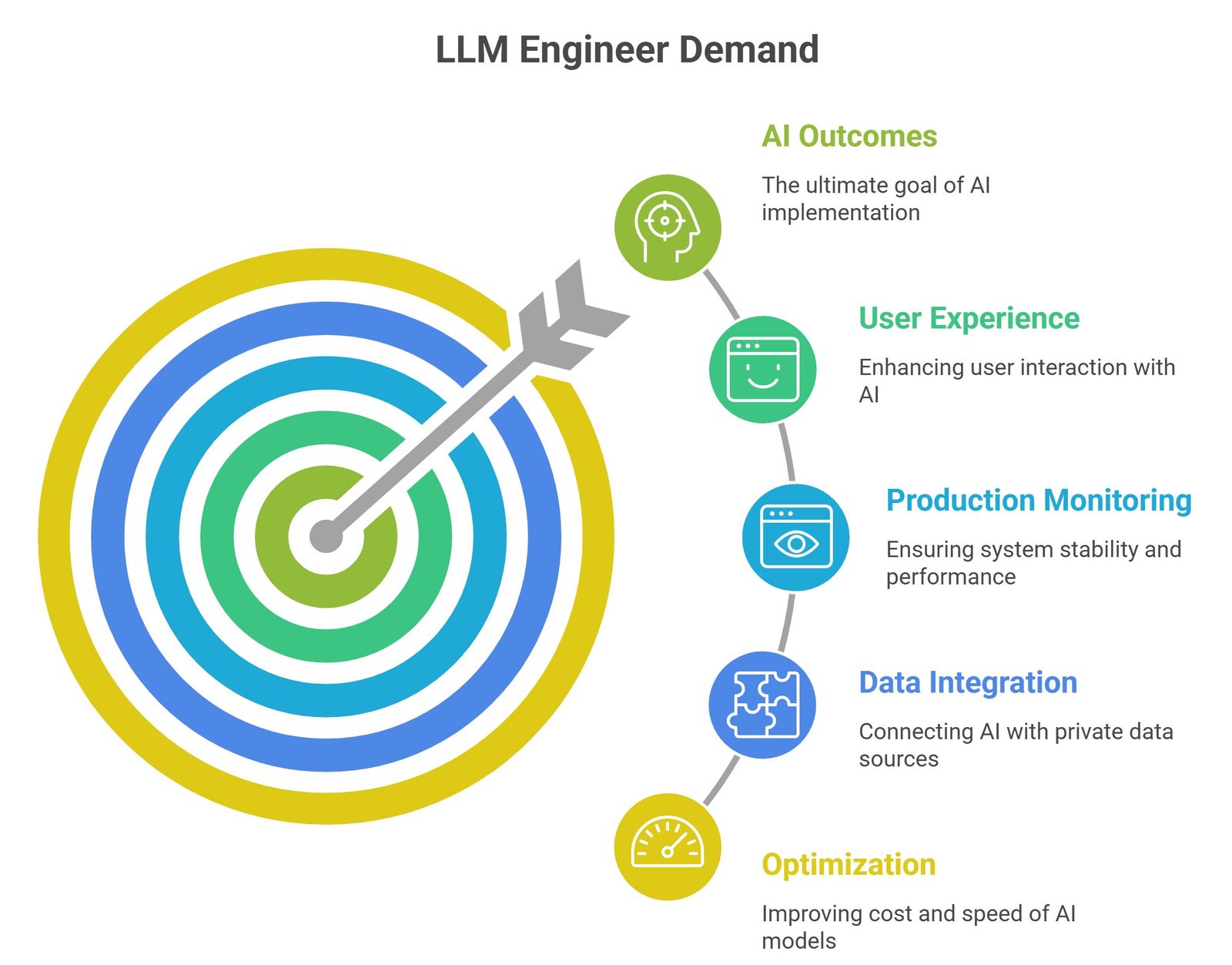
That is why applied AI talent is valuable.
Easy analogy
Think of researchers as people who invent new engines.
LLM Engineers are the people who build fast, safe, usable cars with those engines.
Both matter, but businesses often hire builders.
Popular ecosystems LLM Engineers use
Many teams build with platforms from:
Strong fundamentals matter more than loyalty to one vendor.
Step-by-Step LLM Engineer Roadmap
Stage 1: Programming Foundations (2–6 Weeks)
Learn:
Python
Essential for AI engineering.
Focus on:
- functions
- classes
- APIs
- file handling
- async basics
Git & GitHub
For collaboration and portfolios.
SQL Basics
Useful for product data workflows.
Stage 2: Software Engineering Basics (2–6 Weeks)
Learn:
- REST APIs
- backend basics
- authentication
- debugging
- testing
- clean code
LLM Engineers are still engineers.
Stage 3: AI & LLM Foundations (3–6 Weeks)
Understand:
- transformers
- tokenization
- embeddings
- inference
- context windows
- fine-tuning basics
- hallucinations
You do not need deep research-level math first.
Stage 4: Prompt Engineering (1–3 Weeks)
Learn:
- zero-shot prompting
- few-shot prompting
- structured outputs
- chain workflows
- evaluation prompts
Prompting is a core practical skill.
Stage 5: Build RAG Systems (3–6 Weeks)
Learn:
- vector databases
- chunking strategies
- retrieval pipelines
- re-ranking basics
- source grounding
RAG is one of the highest-demand LLM skills.
Stage 6: Deployment Skills (3–6 Weeks)
Learn:
- cloud hosting
- containers basics
- API deployment
- secrets management
- rate limits
- scaling basics
Shipping matters more than notebooks.
Stage 7: LLMOps & Production Skills
Study:
- monitoring
- observability
- prompt versioning
- A/B testing
- cost optimization
- rollback plans
Stage 8: Safety & Reliability
Learn:
- guardrails
- red teaming basics
- hallucination reduction
- privacy handling
- permission-aware systems
Critical for enterprise roles.
LLM Engineer Roadmap: Best Projects Portfolio
Project 1: PDF Chat Assistant
Upload documents and ask questions.
Project 2: Customer Support Bot
Uses company FAQs.
Project 3: AI Meeting Summarizer
Notes + action items.
Project 4: Sales Copilot
Lead research + outreach drafts.
Project 5: Internal Search Tool
Ask across company docs.
Projects get interviews.
Skills roadmap by experience level
| Level | Focus |
| Beginner | Python, APIs, prompts |
| Intermediate | RAG, deployment, evaluation |
| Advanced | Scaling, LLMOps, security |
| Senior | Architecture, cost, leadership |
What hiring managers often look for
Real Projects
Not only certificates.
Product Thinking
Can you solve business problems?
Strong Communication
Explain tradeoffs clearly.
Reliability Mindset
Know evaluation and monitoring.
Speed of Learning
The field changes fast.
Common Mistakes Learners Make
Learning Only Theory
Build things early.
Ignoring Backend Skills
Important for production roles.
Chasing Every New Model
Learn principles first.
No Portfolio
Show proof publicly.
Ignoring Cost Awareness
Businesses care about economics.
How to get your first LLM Engineer job
Build 3–5 Solid Projects
Deploy at least one live demo.
Use GitHub Well
Readable code + docs.
Write Case Studies
Show architecture decisions.
Network in AI Communities
Many roles spread by referrals.
Apply to Adjacent Roles Too
Titles may include:
- AI Engineer
- Applied AI Engineer
- GenAI Engineer
- ML Engineer
- Solutions Engineer
Future of the role
Expect growth in:
- AI agents
- multimodal systems
- enterprise copilots
- private AI infrastructure
- domain-specific assistants
- autonomous workflows
LLM engineering is likely to expand, not shrink.
Suggested Read:
- LLM Roadmap for Beginners
- LLM for Beginners
- LLM Deployment Basics
- LLM Evaluation Metrics
- LLM Monitoring
- How to Reduce LLM Hallucinations
FAQ: LLM Engineer Roadmap for Beginners
Do I need a computer science degree?
Helpful but not mandatory.
Is Python required?
Yes, for most technical roles.
Do I need advanced math?
Not for many applied LLM roles.
How long to become job-ready?
Often 4–9 focused months depending on background.
What matters most?
Projects, engineering ability, and practical results.
Final takeaway
The best LLM engineer roadmap is simple: master coding basics, learn LLM systems, build production-style projects, and understand business outcomes.
You do not need to invent models. You need to build useful systems with them.