
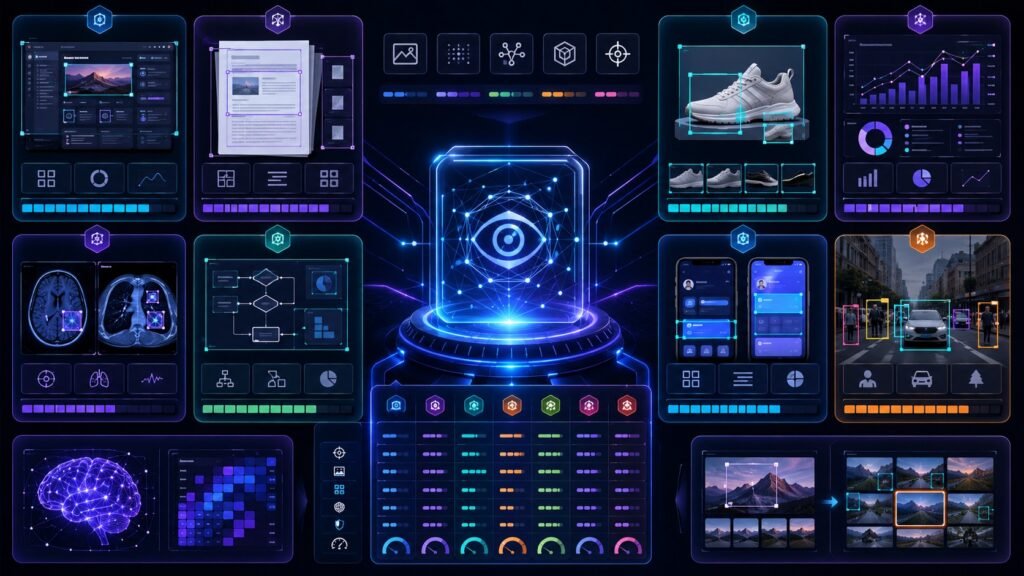
The best image understanding models in 2026 depend on the task. GPT-5.5, Gemini, and Claude are strong hosted options for image reasoning and documents, while Qwen3-VL, Llama 4, InternVL3, and PaliGemma 2 are important open or lightweight choices for developers building vision-language AI apps.
In Simple Terms
Image understanding models are AI models that can inspect visual input and produce useful answers. They can describe images, read screenshots, extract text, interpret charts, answer questions about documents, identify objects, and support visual search.
Many of today’s best image understanding models are also vision-language models. That means they connect visual input with language prompts. Instead of only detecting “cat” or “car,” they can answer questions like “Which button should I click?” or “What does this chart show?”
Quick Comparison: Best Image Understanding Models
| Model | Best For | Main Strength |
| GPT-5.5 | Complex image reasoning and professional apps | Strong hosted vision + reasoning |
| Gemini 3.1 Pro / Gemini family | Images, video, audio, and broad multimodal context | Wide multimodal coverage |
| Claude Opus 4.7 | High-resolution screenshots, diagrams, and documents | Careful image/document analysis |
| Qwen3-VL | Open VLM development | Visual reasoning, OCR, video, agents |
| Llama 4 | Open-weight multimodal apps | Text and image understanding |
| InternVL3 | Open research and visual reasoning | Strong multimodal perception |
| PaliGemma 2 | Lightweight fine-tuning | OCR, captioning, detection, segmentation |
1. GPT-5.5: Best Hosted Model for Complex Image Reasoning
GPT-5.5 is one of the strongest options for teams that want a hosted frontier model for image analysis, screenshot reasoning, document-heavy workflows, and multimodal assistants. OpenAI’s model page lists GPT-5.5 with text and image input and text output, while OpenAI’s latest model guide says GPT-5.5 preserves more visual detail by default for image inputs.
Choose GPT-5.5 when answer quality, professional reasoning, and flexible image understanding matter more than local deployment. It is useful for business assistants, visual QA, UI screenshot analysis, and document workflows. The trade-off is that it is a hosted proprietary model, so teams should evaluate cost, latency, privacy, and governance.
2. Gemini: Best for Broad Multimodal Understanding
Gemini is a strong choice when image understanding is part of a wider multimodal workflow. Google DeepMind describes Gemini 3.1 Pro as supporting advanced multimodal understanding across text, images, video, audio, and code.
This makes Gemini useful for workflows that combine photos, videos, screenshots, voice, documents, and code. It is especially relevant for video understanding, long-context multimodal prompts, Google ecosystem workflows, and developer apps that need more than image-only analysis. The trade-off is that exact model availability, pricing, and API behavior can change, so production teams should check the current Gemini API documentation before building.
3. Claude: Best for Careful Visual Document Analysis
Claude is a strong option for users who care about careful written analysis of visual inputs such as screenshots, diagrams, charts, and documents. Anthropic has documented Claude’s vision capabilities for image understanding, and its newer Claude Opus 4.7 announcement highlights improved multimodal support and higher-resolution image handling.
Claude is a practical choice for analysts, researchers, educators, legal teams, and business users who need thoughtful explanations from visual or document-heavy inputs. It is not mainly a video generation or local open-source option, but it is useful when the output needs to be clear, cautious, and readable.
4. Qwen3-VL: Best Open Model Family for Vision-Language Development
Qwen3-VL is one of the most important open vision-language model families for developers. The official Qwen3-VL repository describes it as the most powerful VLM in the Qwen series, with upgrades in visual perception, reasoning, longer context, spatial and video understanding, and agent interaction.
Choose Qwen3-VL if you need open deployment, experimentation, OCR-heavy workflows, GUI understanding, visual agents, or custom multimodal apps. The trade-off is infrastructure. Larger open models require serving expertise, GPU planning, quantization decisions, and careful evaluation.
5. Llama 4: Best Open-Weight Option for Broad Multimodal Apps
Meta’s Llama 4 family is important because it brought native multimodal support into a widely adopted open-weight ecosystem. Meta describes Llama 4 as designed to enable personalized multimodal experiences, and the Llama model pages describe Llama 4 models as natively multimodal for text and image understanding.
Choose Llama 4 when you want open-weight flexibility, ecosystem support, and image understanding without depending completely on a hosted API. The main caution is licensing and deployment fit. “Open-weight” does not always mean unrestricted open source, and performance depends heavily on your task.
6. InternVL3: Best Open Research Model for Visual Reasoning
InternVL3 is a strong open VLM series for visual perception and reasoning research. The InternVL team describes InternVL3 as an advanced multimodal large language model series with improved perception and reasoning, plus extensions into tool use, GUI agents, industrial image analysis, and 3D vision perception.
InternVL3 is a good candidate for teams evaluating open image understanding models for research, industrial vision, GUI automation, or visual reasoning. It may require more engineering work than hosted models, but it gives researchers and builders more control.
7. PaliGemma 2: Best Lightweight Model for Fine-Tuned Vision Tasks
PaliGemma 2 is a practical option when you need a lighter open VLM that can be fine-tuned for specific image understanding tasks. Google DeepMind describes PaliGemma 2 as a family of lightweight, open vision-language models that interpret text and image inputs, while Google’s developer blog says PaliGemma 2 mix supports tasks like captioning, OCR, visual question answering, object detection, and segmentation.
Choose PaliGemma 2 for focused tasks, smaller deployments, education, research, OCR experiments, or domain-specific fine-tuning. It is not the best all-purpose frontier assistant, but it can be efficient and adaptable.
How to Choose the Best Image Understanding Model
Start with the task. For complex image reasoning, try GPT-5.5, Gemini, or Claude. For open deployment, compare Qwen3-VL, Llama 4, and InternVL3. For smaller task-specific fine-tuning, consider PaliGemma 2.
Then test real examples. Use your own screenshots, product photos, charts, scanned documents, UI images, and edge cases. Public benchmarks are helpful, but your actual images decide whether a model is good enough.
Common Mistakes to Avoid
Do not choose an image understanding model only by leaderboard rank. Check OCR quality, chart reasoning, screenshot accuracy, visual grounding, context window behavior, latency, cost, privacy, and deployment needs.
Do not assume all “vision models” do the same thing. Some are better at documents, some at real-world scenes, some at OCR, and some at open deployment. A model that works well for product photos may fail on dense screenshots or tables.
Suggested Read:
- What Is Multimodal AI? Simple Explanation With Examples
- Vision-Language Models Explained for Beginners
- Best Vision Language Models in 2026
- Best Multimodal AI Tools in 2026
- Image to Text AI
- Document Understanding AI
- Image Grounding in AI
- Multimodal Evaluation
FAQ: Best Image Understanding Models
What are the best image understanding models?
The best image understanding models include GPT-5.5, Gemini, Claude, Qwen3-VL, Llama 4, InternVL3, and PaliGemma 2.
Which AI model is best for image analysis?
For hosted frontier image analysis, GPT-5.5, Gemini, and Claude are strong starting points. For open development, Qwen3-VL, Llama 4, and InternVL3 are important options.
Which image understanding model is best for OCR?
PaliGemma 2, Qwen3-VL, GPT-5.5, Gemini, and document-specialized AI pipelines are good candidates, depending on language, document layout, and deployment needs.
What is the best open-source image understanding model?
Qwen3-VL, InternVL3, PaliGemma 2, and Llama 4 are strong open or open-weight options. The best choice depends on licensing, task, model size, and infrastructure.
Are image understanding models the same as vision-language models?
Many image understanding models are vision-language models, but the terms are not identical. VLMs specifically connect visual input with language understanding or generation.
How do you choose an AI vision model?
Choose based on task type, image quality, OCR needs, reasoning quality, cost, latency, privacy, licensing, and performance on your own test set.
Final Takeaway
The best image understanding models are best chosen by use case. GPT-5.5, Gemini, and Claude are strong hosted options. Qwen3-VL, Llama 4, InternVL3, and PaliGemma 2 are strong choices when open deployment, fine-tuning, or research control matters.
To continue learning, read Vision-Language Models Explained, Best Vision Language Models, and Multimodal Evaluation next.