
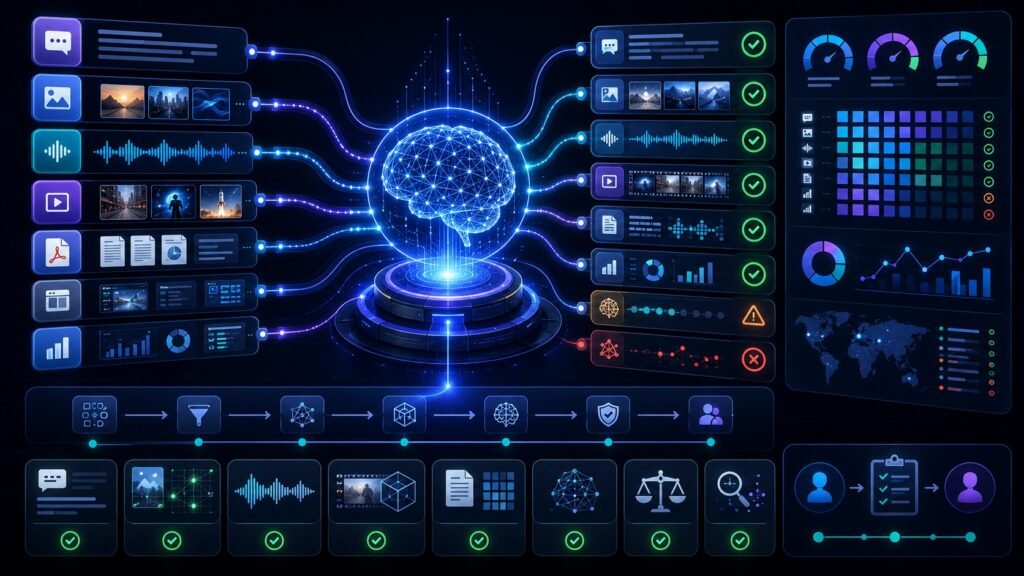
Multimodal evaluation is the process of testing AI systems that work with more than text, including images, audio, video, screenshots, PDFs, charts, and documents. It measures whether the system understands the right inputs, reasons correctly, avoids unsupported claims, and produces useful outputs for real-world workflows.
In Simple Terms
Multimodal evaluation means checking whether a multimodal AI system is actually reliable. A normal text chatbot can be evaluated by checking answer relevance, accuracy, tone, and hallucinations. A multimodal system needs more checks because it may also inspect images, read documents, interpret charts, process audio, or analyze video.
For example, if a vision-language model answers a question about a screenshot, evaluation should ask: Did it read the screenshot correctly? Did it identify the right visual region? Did it answer the user’s question? Did it invent anything not visible in the image? That is why multimodal AI evaluation is more complex than text-only testing.
What Is Multimodal Evaluation?
Multimodal evaluation is a structured way to test models and applications that combine different data types. These systems may include vision-language models, multimodal LLMs, document AI pipelines, audio-video systems, multimodal RAG apps, and AI agents that process mixed inputs.
The goal is not only to get a high benchmark score. The real goal is to understand whether the system performs well on the task you care about. OpenAI’s evaluation guide describes evals as tests for model outputs against criteria you specify, especially when improving apps or changing models. For multimodal systems, those criteria must cover every important modality, not only the final text answer.
Why Multimodal Evaluation Is Harder
Multimodal evaluation is harder because errors can happen at many layers. The model may read the text prompt correctly but misunderstand the image. It may identify objects correctly but connect them to the wrong question. It may transcribe audio well but miss emotion, timing, or context. It may summarize a chart but misread the axis.
This means one final answer score is not enough. A strong evaluation setup should test input understanding, grounding, reasoning, output quality, safety, latency, and user usefulness. Ragas, for example, includes multimodal faithfulness for checking factual consistency against visual and textual context, and multimodal relevance for checking whether the generated answer fits the user input and multimodal context.
Core Multimodal Evaluation Metrics
| Evaluation Area | What It Checks | Example Question |
| Relevance | Does the output answer the user’s request? | Did it address the image question? |
| Faithfulness | Is the answer supported by visual/text context? | Did it invent details? |
| Visual grounding | Did it use the right image region? | Did it identify the correct object? |
| OCR accuracy | Did it read text in the image correctly? | Did it capture the invoice total? |
| Chart understanding | Did it interpret axes and trends correctly? | Did it read the graph correctly? |
| Audio quality | Did it capture speech and meaning? | Did it summarize the call correctly? |
| Video understanding | Did it understand sequence and timing? | Did it identify the right event? |
| Latency and cost | Is it usable in production? | Is response time acceptable? |
How to Evaluate Multimodal AI Step by Step
Start by defining the real task. Do not evaluate “multimodal ability” in general. Evaluate screenshot troubleshooting, document extraction, image question answering, product visual search, video summarization, or medical image triage support as separate tasks.
Next, create a small but realistic test set. Include clean examples, noisy examples, edge cases, and failure cases. For each sample, define expected answers or scoring rules. Then evaluate the pipeline in layers: input parsing, retrieval if used, model reasoning, final output, safety, and latency. Tools such as TruLens support tracing and evaluating app execution flows, including retrieved context, tool calls, and plans.
Evaluation for Vision-Language Models
Vision-language model evaluation focuses on whether a model connects images and language correctly. Common tasks include visual question answering, image captioning, OCR, chart reasoning, object localization, and visual grounding.
Benchmark tools can help, but they should not replace your own test set. VLMEvalKit is an open-source toolkit for evaluating large vision-language models across benchmarks, while lmms-eval focuses on reproducible, efficient, trustworthy evaluation for large multimodal models. These are useful for model comparison, but production teams should still test the exact workflows users will run.
Evaluation for Multimodal RAG
Multimodal RAG needs two layers of evaluation: retrieval quality and generation quality. The system must retrieve the right text, image, chart, or document page before the model can answer correctly. Then the final answer must be grounded in that retrieved evidence.
Useful checks include multimodal context relevance, visual/textual faithfulness, answer relevance, citation quality, image-region grounding, and failure handling. TruLens popularized a RAG triad around context relevance, groundedness, and answer relevance for RAG apps; the same logic can be extended to multimodal workflows when the retrieved context includes images, charts, or document pages.
Human Review Still Matters
Automated metrics are useful, but human review is still essential for multimodal evaluation. Humans can judge whether a chart explanation is genuinely useful, whether an image answer is misleading, or whether a video summary misses the most important event.
Human evaluation is especially important in healthcare, finance, insurance, legal, education, safety, and enterprise decision-support workflows. The goal is not to manually review everything forever. The goal is to build a strong evaluation set, understand failure patterns, and decide where automation is safe enough.
Common Mistakes in Multimodal Evaluation
One common mistake is testing only clean demo examples. Real user inputs are often blurry, cropped, noisy, rotated, low-resolution, long, ambiguous, or incomplete. Your evaluation set should include these imperfect cases.
Another mistake is scoring only the final answer. A multimodal app can fail because OCR was wrong, the wrong image region was used, retrieval missed the right page, or the model hallucinated after seeing correct evidence. Good evaluation separates pipeline components so teams know what to fix.
Limitations and Risks
Multimodal evaluation is still evolving. Benchmarks may not match your domain. LLM-as-a-judge evaluations can be inconsistent if prompts and rubrics are weak. Visual tasks are difficult to score automatically, especially when answers require spatial judgment, medical context, chart reasoning, or subjective quality.
Privacy is also important. Evaluation datasets may include faces, voices, medical records, financial documents, customer screenshots, or proprietary files. Teams should anonymize data where possible, control access, and avoid sending sensitive evaluation data into systems without proper governance.
Suggested Read:
- What Is Multimodal AI? Complete Beginner’s Guide to AI Beyond Text
- Vision-Language Models Explained
- Multimodal Inference
- Multimodal Embeddings
- Multimodal Context Windows
- Multimodal Reasoning
- Image Grounding in AI
- Multimodal RAG Explained
FAQ: Multimodal Evaluation
What is multimodal evaluation?
Multimodal evaluation is the process of testing AI systems that process multiple data types, such as text, images, audio, video, documents, screenshots, and charts.
How do you evaluate multimodal AI?
Define the task, create realistic test cases, choose task-specific metrics, evaluate each pipeline component, include human review, and monitor production behavior.
What metrics are used for multimodal model evaluation?
Common metrics include relevance, faithfulness, grounding accuracy, OCR accuracy, chart understanding, answer correctness, latency, cost, and safety checks.
How do you evaluate vision-language models?
Evaluate visual question answering, image captioning, OCR, visual grounding, chart reasoning, object localization, and domain-specific image understanding.
Why is multimodal evaluation harder than text-only evaluation?
Because errors can happen across multiple input types, including visual perception, audio understanding, document parsing, retrieval, reasoning, and final generation.
What are common mistakes in multimodal AI evaluation?
Common mistakes include using only clean demos, ignoring component-level failures, relying only on benchmark scores, and skipping human review for high-risk workflows.
Final Takeaway
Multimodal evaluation is how teams move from impressive demos to reliable AI systems. It tests whether multimodal AI can understand the right inputs, use the right evidence, reason correctly, and produce useful outputs across text, images, audio, video, and documents.
To continue learning, read Multimodal Inference, Multimodal Embeddings, and Vision-Language Models Explained next.