
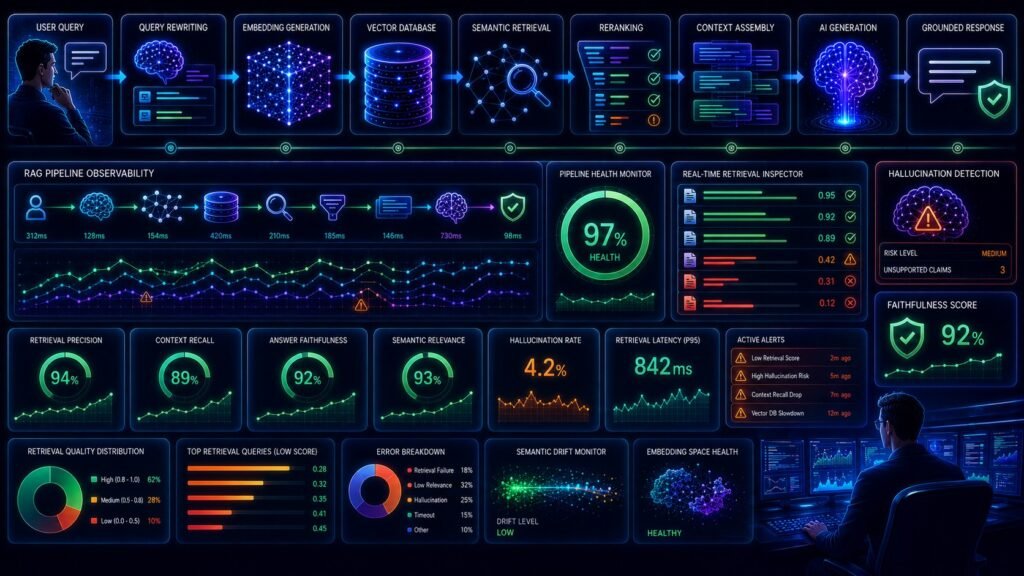
RAG Observability: How to Monitor and Debug AI Retrieval Systems
Retrieval-Augmented Generation (RAG) systems are rapidly becoming foundational infrastructure for modern enterprise AI applications. Organizations increasingly use RAG-powered AI assistants, semantic search systems, customer support copilots, enterprise knowledge platforms, healthcare retrieval systems, and intelligent document search tools to improve AI grounding and reduce hallucinations.
However, deploying a RAG system into production is only the beginning.
Modern enterprise AI systems contain multiple interconnected components including:
- embeddings
- vector databases
- semantic search systems
- reranking pipelines
- query rewriting systems
- chunking frameworks
- retrieval orchestration layers
- Large Language Models
Each component introduces potential failure points.
This creates a major enterprise challenge:
How do you monitor, debug, and optimize RAG systems in production?
That is exactly why RAG observability became one of the most important disciplines in modern AI engineering.
RAG observability helps organizations:
- monitor retrieval quality
- detect hallucinations
- trace retrieval failures
- debug semantic search issues
- analyze groundedness
- optimize production AI systems
- improve enterprise AI reliability
Today, observability platforms are becoming essential across:
- enterprise AI assistants
- legal AI systems
- healthcare AI platforms
- customer support copilots
- semantic enterprise search
- financial AI systems
- intelligent document retrieval systems
In this guide, you will learn what RAG observability means, why enterprises need observability for AI systems, what metrics organizations monitor, how debugging works in modern retrieval pipelines, and the best practices for building reliable production-grade RAG systems.
In Simple Terms
What Is RAG Observability?
RAG observability is the process of monitoring, analyzing, tracing, and debugging Retrieval-Augmented Generation systems.
It helps organizations understand:
- what the retriever retrieved
- why the AI generated a specific answer
- where hallucinations occurred
- how retrieval quality affects outputs
- which pipeline components failed
Observability provides visibility into AI system behavior.
Easy Analogy
Imagine maintaining a large airplane.
Pilots rely on dashboards showing:
- engine health
- fuel systems
- navigation systems
- warning alerts
- system diagnostics
Without observability, identifying problems becomes nearly impossible.
RAG observability works similarly for enterprise AI systems.
It provides visibility into how retrieval pipelines and language models behave internally.
Why Observability Matters in RAG Systems
Traditional software systems are usually deterministic.
RAG systems are probabilistic and dynamic.
This creates major monitoring challenges.
Even advanced AI systems may suddenly produce:
- hallucinations
- irrelevant answers
- missing context
- retrieval failures
- grounding problems
- semantic drift
Without observability, organizations cannot reliably debug these issues.
Why Production AI Systems Need Monitoring
Enterprise AI systems continuously evolve because:
- enterprise documents change
- embeddings update
- retrieval pipelines evolve
- models change over time
- user behavior shifts
This makes continuous monitoring essential.
Why Hallucinations Are Difficult to Debug
Hallucinations may originate from multiple layers inside a RAG pipeline.
Examples include:
- weak retrieval
- noisy chunks
- semantic mismatch
- reranking failures
- unsupported reasoning
- grounding failures
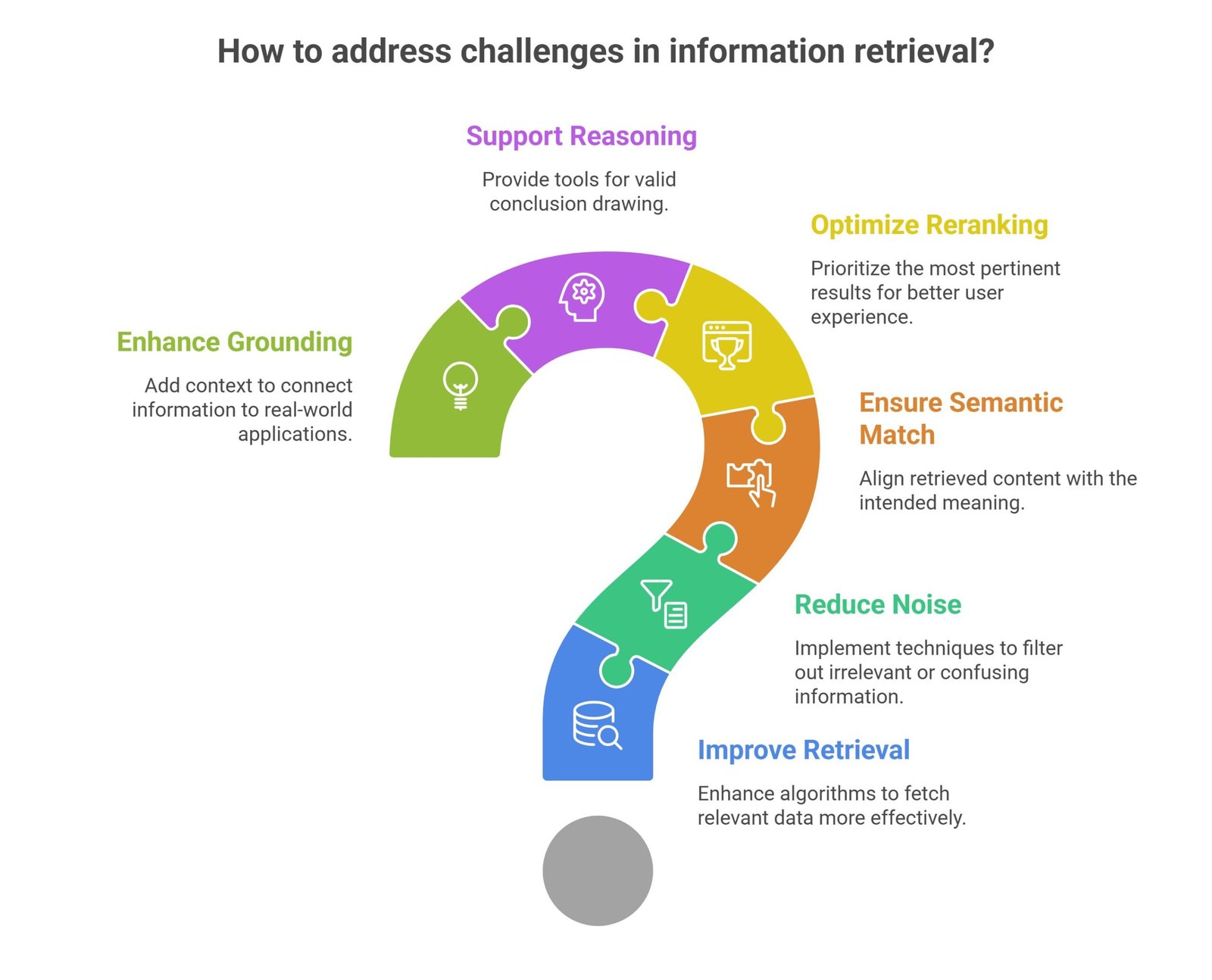
Observability helps identify the exact source of failure.
Understanding the Major Components of RAG Observability
Modern observability systems monitor multiple AI pipeline layers simultaneously.
Retrieval Monitoring
Retrieval monitoring evaluates whether relevant context was retrieved successfully.
Generation Monitoring
Generation monitoring evaluates groundedness and hallucination behavior.
Pipeline Tracing
Tracing tracks the full AI workflow from query to response.
Latency Monitoring
Latency systems track performance bottlenecks.
Semantic Relevance Analysis
Relevance analysis measures contextual alignment quality.
Hallucination Detection
Observability systems identify unsupported AI outputs.
Why Observability Became Essential for Enterprise AI
As organizations increasingly deploy AI systems into production environments, reliability became a major concern.
Enterprise AI systems now influence:
- legal workflows
- customer interactions
- healthcare guidance
- internal knowledge access
- financial operations
- compliance systems
Weak monitoring creates serious operational risks.
Enterprise Search Systems
Employees may receive incorrect or outdated internal information.
Customer Support AI
Support copilots may hallucinate troubleshooting guidance.
Healthcare AI Systems
Medical retrieval failures may create safety risks.
Legal AI Systems
Unsupported legal interpretations may create compliance problems.
Ecommerce AI Systems
Recommendation systems may retrieve irrelevant products.
Research Assistants
Scientific AI systems may produce unsupported conclusions.
Core Metrics Used in RAG Observability
Modern observability platforms track several critical metrics.
Retrieval Precision
Measures how much retrieved information is actually relevant.
Context Recall
Measures whether critical information was successfully retrieved.
Answer Faithfulness
Measures whether generated responses remain grounded in evidence.
Groundedness
Measures how strongly generated answers align with retrieved context.
Hallucination Rate
Measures how frequently unsupported outputs occur.
Semantic Relevance
Measures contextual alignment between queries and answers.
Latency Metrics
Tracks retrieval speed and response generation performance.
Token Usage Monitoring
Monitors infrastructure cost and token efficiency.
Why Tracing Is Critical in RAG Systems
Tracing became one of the most important observability capabilities.
Tracing allows organizations to follow:
- user queries
- rewritten queries
- retrieved chunks
- reranking outputs
- generation prompts
- final answers
This creates full pipeline visibility.
Example of RAG Tracing
A production AI workflow may look like this:
| Pipeline Step | Observability Data |
| User Query | Original question |
| Query Rewriting | Semantic optimization |
| Retrieval | Retrieved chunks |
| Reranking | Chunk prioritization |
| Prompt Assembly | Final contextual prompt |
| Generation | AI response |
| Evaluation | Hallucination analysis |
Tracing helps identify exactly where failures occurred.
Why Retrieval Observability Matters
Many hallucinations originate inside retrieval systems.
Retrieval observability helps organizations analyze:
- semantic search quality
- embedding effectiveness
- chunking behavior
- retrieval coverage
- reranking quality
This improves grounded AI reliability.
Common Retrieval Failures Detected Through Observability
Weak Semantic Search
Semantic retrieval may return conceptually related but contextually incorrect chunks.
Poor Chunking Strategies
Weak chunking may fragment important contextual information.
Incorrect Chunk Sizes
Very large chunks introduce retrieval noise.
Very small chunks lose contextual continuity.
Weak Embeddings
Poor embeddings reduce semantic retrieval precision.
Query Understanding Failures
Ambiguous queries weaken retrieval quality.
Metadata Filtering Errors
Incorrect metadata filtering may hide relevant information.
Why Generation Observability Matters
Even strong retrieval systems may still produce hallucinations.
Generation observability helps analyze:
- unsupported reasoning
- answer grounding
- hallucination behavior
- semantic drift
- contextual faithfulness
How Enterprises Detect Hallucinations
Modern observability systems increasingly use automated hallucination detection.
These systems evaluate:
- groundedness
- semantic consistency
- evidence alignment
- unsupported claims
Hallucination monitoring became foundational for enterprise AI safety.
Common RAG Observability Tools
Several observability frameworks became popular in enterprise AI systems.
LangSmith
LangSmith supports tracing, debugging, and monitoring for LLM pipelines.
TruLens
TruLens focuses heavily on groundedness evaluation and observability.
Arize AI
Arize AI supports monitoring and evaluation for production AI systems.
DeepEval
DeepEval helps benchmark and evaluate AI outputs systematically.
OpenTelemetry-Based Monitoring
Some enterprises integrate AI observability into existing monitoring infrastructure.
Why Human Monitoring Still Matters
Automated observability systems are powerful but imperfect.
Human reviewers still help evaluate:
- business correctness
- legal accuracy
- contextual interpretation
- nuanced reasoning
- compliance validity
This remains especially important in high-risk AI systems.
Best Practices for Building RAG Observability
Modern enterprises increasingly follow structured observability strategies.
Monitor Retrieval and Generation Separately
Both layers require independent analysis.
Use Full Pipeline Tracing
Tracing improves debugging dramatically.
Continuously Evaluate Groundedness
Grounded AI systems require ongoing monitoring.
Track Hallucination Rates
Hallucination detection should be continuous.
Benchmark Production Workflows
Production testing improves reliability significantly.
Monitor Semantic Drift
Enterprise knowledge changes constantly.
Monitoring helps detect retrieval degradation over time.
Use Human-in-the-Loop Validation
Human oversight improves enterprise safety.
Why RAG Observability Directly Improves AI Reliability
Strong observability infrastructure helps organizations:
- reduce hallucinations
- improve retrieval quality
- optimize grounded generation
- debug AI systems faster
- improve enterprise trustworthiness
- scale production AI safely
This makes observability foundational for enterprise AI systems.
Future of RAG Observability
RAG observability systems are evolving rapidly.
Major trends include:
- autonomous AI monitoring
- reasoning-aware observability
- agentic debugging systems
- real-time hallucination detection
- multimodal observability pipelines
- adaptive retrieval monitoring
- intelligent AI optimization systems
Future enterprise AI systems will increasingly rely on advanced observability infrastructure for scalable grounded AI deployment.
Suggested Read:
- RAG Evaluation Metrics
- How to Evaluate RAG
- Reducing Hallucinations in RAG
- Answer Faithfulness in RAG
- Context Recall in RAG
- Retrieval Precision in RAG
- RAG Benchmark Basics
- Reranking in RAG
FAQ: RAG Observability Explained
What is RAG observability?
RAG observability is the process of monitoring, tracing, evaluating, and debugging Retrieval-Augmented Generation systems.
Why is observability important in RAG systems?
Observability helps organizations detect hallucinations, retrieval failures, and grounding problems in production AI systems.
What metrics are monitored in RAG observability?
Common metrics include retrieval precision, context recall, groundedness, faithfulness, hallucination rate, and latency.
How do enterprises debug RAG hallucinations?
Organizations use tracing, retrieval analysis, groundedness evaluation, and hallucination detection systems.
What are the best practices for RAG monitoring?
Best practices include pipeline tracing, continuous evaluation, hallucination monitoring, retrieval benchmarking, and human oversight.
Final Takeaway
Understanding RAG observability is essential because monitoring and debugging directly affect grounded AI reliability, hallucination reduction, retrieval quality, and enterprise AI trustworthiness.
Modern Retrieval-Augmented Generation systems contain highly complex retrieval and generation pipelines that require continuous visibility and evaluation.
Organizations that build strong observability infrastructure can create more reliable, scalable, and production-ready AI systems.
That capability is becoming foundational for enterprise AI assistants, semantic search systems, healthcare AI platforms, legal retrieval systems, customer support copilots, and intelligent enterprise knowledge architectures across industries.