
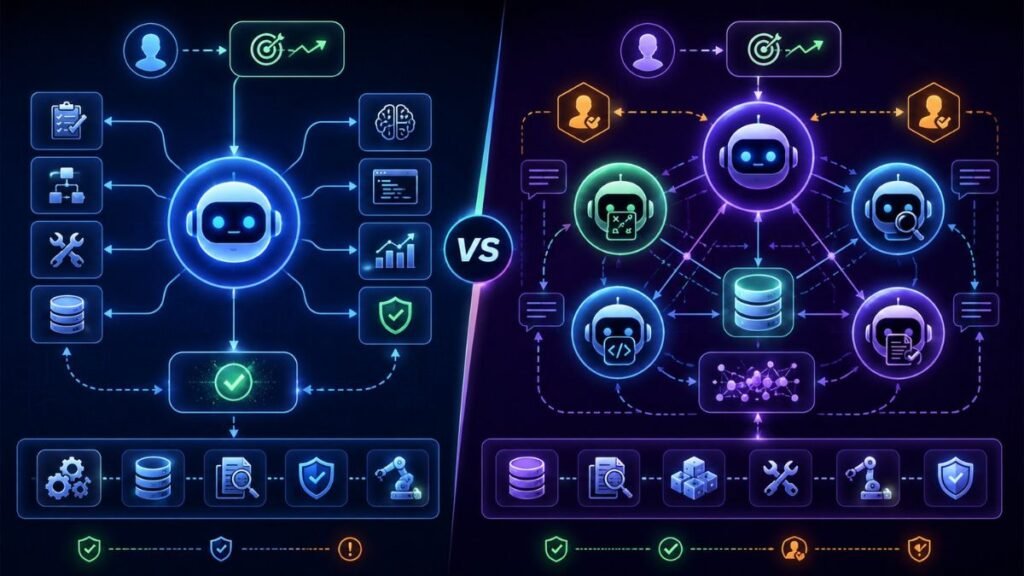
Single-agent vs multi-agent systems in agentic AI comes down to task complexity. A single-agent system uses one AI agent to plan, use tools, and complete a workflow. A multi-agent system uses multiple specialized agents that collaborate, coordinate, or review one another to solve more complex tasks.
In Simple Terms
A single-agent system is like one skilled assistant. It receives a goal, thinks through the task, uses tools, and produces an answer or action.
A multi-agent system is like a small team. One agent may research, another may write, another may check facts, and another may decide when the workflow is complete.
Neither is always better. Single-agent systems are simpler. Multi-agent systems are more flexible for complex tasks, but they also add coordination problems.
What Is a Single-Agent System?
A single-agent system uses one AI agent to handle a task or workflow. The agent may still have tools, memory, retrieval, planning, and feedback loops, but the decision-making center is one agent.
For example, a support assistant may read a customer ticket, retrieve a help article, draft a reply, and create a summary. That can be a single-agent system if one agent manages the whole workflow.
Single-agent systems are usually easier to design, debug, test, and monitor. They are often the best starting point for teams building agentic AI workflows.
What Is a Multi-Agent System?
A multi-agent system uses multiple agents that interact inside a shared environment. Google Cloud defines a multi-agent system as multiple autonomous, interacting computational entities that collaborate, coordinate, or sometimes compete to achieve individual or collective goals.
In agentic AI, these agents are often specialized. A multi-agent workflow might include a planner agent, researcher agent, coding agent, reviewer agent, and executor agent. IBM explains that multi-agent systems allow decentralized autonomous agents to work together toward collective or interdependent goals, helping overcome some limits of constrained single-agent systems.
Multi-agent systems are useful when one agent would become too broad, slow, or unreliable for the full task.
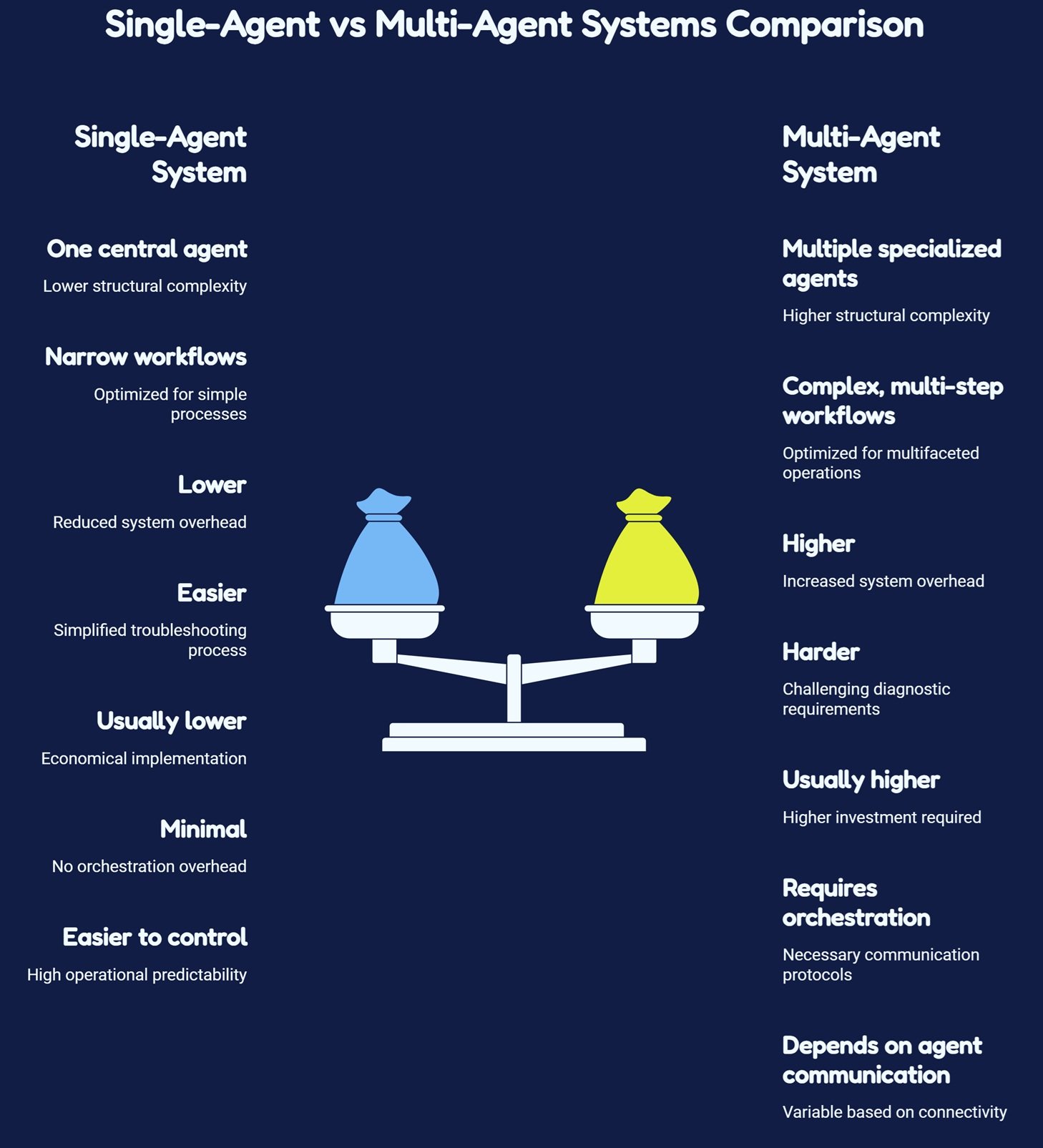
Single-Agent vs Multi-Agent Systems: Quick Comparison
| Feature | Single-Agent System | Multi-Agent System |
| Structure | One central agent | Multiple specialized agents |
| Best for | Narrow workflows | Complex, multi-step workflows |
| Complexity | Lower | Higher |
| Debugging | Easier | Harder |
| Cost | Usually lower | Usually higher |
| Coordination | Minimal | Requires orchestration |
| Reliability | Easier to control | Depends on agent communication |
| Example | One support agent drafts a reply | Researcher, policy checker, reviewer, and support agent collaborate |
How Single-Agent Systems Work
A single-agent system usually follows a simple action loop. It receives a goal, gathers context, plans steps, calls tools, acts, checks results, and returns an output.
This is enough for many practical tasks. A single agent can summarize a document, classify support tickets, draft sales follow-ups, answer questions from a knowledge base, or update a simple workflow after approval.
The main benefit is control. There is one agent to evaluate, one chain of reasoning to trace, and fewer coordination failures. For early-stage agentic AI projects, this simplicity is valuable.
How Multi-Agent Systems Work
A multi-agent system splits work between agents. Each agent may have a role, tool access, memory scope, and responsibility.
A simple multi-agent workflow may look like this:
| Agent Role | Job |
| Planner agent | Breaks the goal into tasks |
| Research agent | Finds relevant information |
| Writer agent | Produces a draft |
| Reviewer agent | Checks quality and accuracy |
| Executor agent | Performs approved actions |
Microsoft Research describes AutoGen as an open-source framework for building AI agents and facilitating cooperation among multiple agents to solve tasks. The current AutoGen documentation also describes it as an event-driven programming framework for scalable multi-agent AI systems.
The main benefit is specialization. Agents can focus on narrower responsibilities, which can improve modularity and task handling.
When a Single-Agent System Is Better
Use a single-agent system when the workflow is narrow, repeatable, and easy to evaluate.
Good examples include:
- A document summarizer.
- A support-ticket classifier.
- A simple sales email drafter.
- A meeting-notes formatter.
- A basic RAG assistant.
- A workflow helper that drafts but does not execute high-risk actions.
Single-agent systems are also better when cost, latency, and observability matter more than advanced collaboration. If one agent can do the job clearly and safely, adding more agents may create unnecessary complexity.
When a Multi-Agent System Is Better
Use a multi-agent system when the task is complex enough to benefit from division of labor.
Good examples include:
- A coding workflow with planner, coder, tester, and reviewer agents.
- A research workflow with search, extraction, synthesis, and citation-checking agents.
- A customer-support workflow with triage, policy-checking, response-writing, and escalation agents.
- A security workflow with monitoring, investigation, remediation, and audit agents.
- A business automation workflow that requires approval across departments.
Multi-agent systems are also useful when agents need different tools or permissions. For example, a research agent may only read sources, while an executor agent may update a system after approval.
Orchestration: The Key to Multi-Agent Systems
Multi-agent systems need orchestration. Orchestration decides which agent acts, when it acts, what context it receives, and how outputs are passed to other agents.
Orchestration can be centralized or distributed. In a centralized design, an orchestrator agent or controller assigns tasks. In a distributed design, agents communicate more freely. Centralized orchestration is often easier to monitor in business systems.
Without orchestration, multi-agent systems can become noisy. Agents may repeat work, disagree, call unnecessary tools, or loop without finishing.
Risks and Limitations
Single-agent systems can become overloaded. If one agent has too many responsibilities, it may plan poorly, miss important context, or use tools incorrectly.
Multi-agent systems have different risks. They can be harder to debug because errors may come from communication, coordination, unclear roles, shared memory issues, or agent disagreement. They can also cost more because each agent may make separate model calls.
Research on AutoGen Studio notes that multi-agent systems are emerging for long-running complex tasks, but specifying models, tools, orchestration mechanisms, and debugging workflows remains challenging for many developers.
Common Mistakes to Avoid
The first mistake is using a multi-agent system because it sounds more advanced. If a single agent works, start there.
The second mistake is creating vague agent roles. “Researcher,” “analyst,” and “reviewer” should have clear responsibilities, allowed tools, and output formats.
The third mistake is skipping evaluation. Multi-agent systems should be tested for task success, cost, latency, tool accuracy, handoff quality, loops, and final answer quality.
Practical Rule of Thumb
Start with a single-agent system. Add more agents only when you can explain exactly why the workflow needs specialization.
A good reason to add agents is: “This task has separate planning, retrieval, execution, and review steps that need different tools or permissions.”
A weak reason is: “Multi-agent sounds more intelligent.”
In production, simpler systems are usually easier to trust.
Suggested Read:
- What Is Agentic AI? A Practical Guide for Beginners
- How Agentic AI Works: Planning, Memory, Tools, and Action
- Agentic AI Architecture Explained Simply
- What Is an AI Agent? A Simple Explanation With Examples
- How to Evaluate an AI Agent Before Production
- AI Agents vs Chatbots: Key Differences Explained
- MCP Explained: Why It Matters for AI Agents
FAQ: Single-Agent vs Multi-Agent Systems
What is the difference between single-agent and multi-agent systems?
A single-agent system uses one AI agent to complete a task. A multi-agent system uses multiple agents that coordinate, collaborate, or review one another.
What is a single-agent system in AI?
It is an AI system where one agent handles the goal, planning, tool use, action, and feedback for a workflow.
What is a multi-agent system in AI?
It is a system where multiple autonomous agents interact in a shared environment to achieve individual or collective goals.
Are multi-agent systems better than single-agent systems?
Not always. Multi-agent systems are better for complex workflows, but single-agent systems are simpler, cheaper, faster, and easier to debug.
When should you use a multi-agent system?
Use one when a task needs specialized roles, separate permissions, review loops, or coordination across multiple subtasks.
What are the risks of multi-agent AI systems?
Risks include coordination failures, higher cost, latency, loops, unclear responsibility, tool misuse, and harder debugging.
Final Takeaway
Single-agent vs multi-agent systems is not about which approach is more advanced. It is about fit. Use a single-agent system for focused workflows. Use multi-agent systems when the task truly benefits from specialization, orchestration, review, and distributed tool use.
To continue learning, read Agentic AI Architecture Explained, How Agentic AI Works, and How to Evaluate an AI Agent Before Production next.