
What Is an AI Agent? A Simple Explanation With Examples
The evolution of artificial intelligence is rapidly moving beyond standard chatbots that simply answer questions. If you are trying to understand the next wave of technology, you might be wondering: what is an ai agent, and how does it change automation?
To provide a clear ai agent definition, it is an autonomous software system engineered to perceive its environment, make independent data-driven decisions, and execute specific tools to achieve a pre-defined goal. Essentially, the core ai agent meaning is a shift from static code that waits for commands to proactive systems that can think, plan, and act independently.
In simple terms
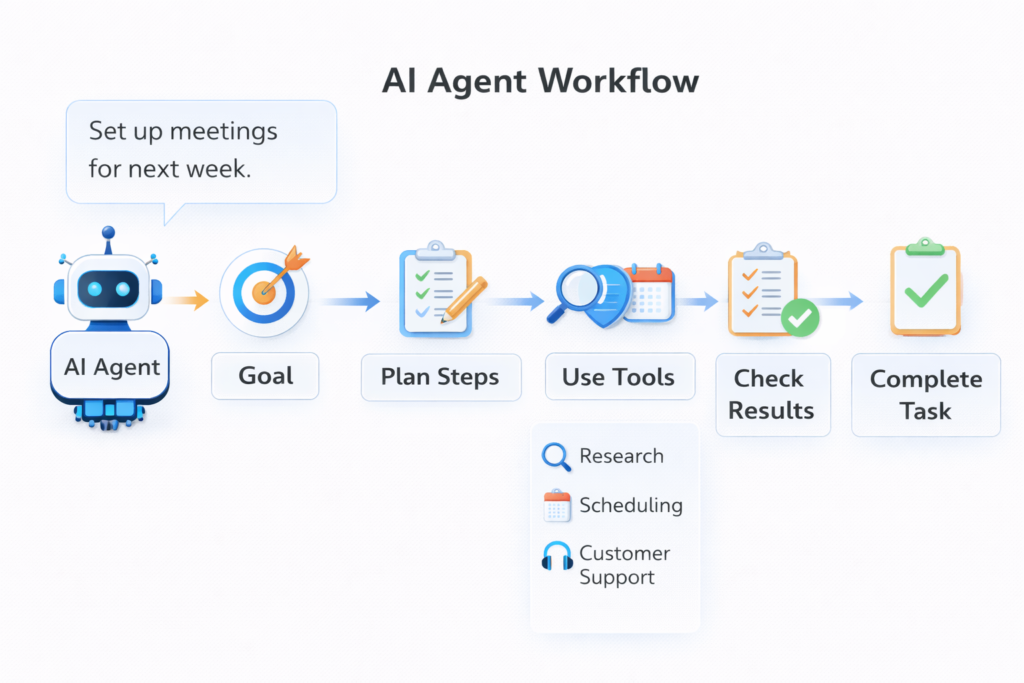
Think of an AI agent as an AI system with more initiative. A normal chatbot answers a question. An AI agent is closer to a worker that can handle a task. You give it an objective, such as “summarize these reports and create a follow-up email,” and it tries to move through the process instead of stopping after one response.
That does not mean the agent is magical or fully autonomous. It still depends on the tools, rules, data, and limits built around it. But the main idea is simple: an AI agent does more than generate text. It can make decisions within a defined workflow.
What makes something an AI agent?
Not every AI-powered tool is an agent. A system is usually called an AI agent when it includes several of these traits:
- it receives a goal rather than only a single prompt
- it can break the task into smaller steps
- it can use tools, software, or external information
- it can track progress and adjust what it does next
- it can continue through a sequence instead of ending after one reply
For example, a chatbot might answer, “Here are three travel options.” An AI agent might compare flights, check calendar conflicts, draft an itinerary, and ask for confirmation before booking.
This is why agent discussions often focus on planning, memory, tool use, orchestration, and evaluation, not just conversation. Those are the building blocks that make an agent useful in practice.
What Is an AI Agent and How Does It Work?
To explain an ai agent in simple terms, think of it as a virtual employee given a specific job description. Rather than relying on constant human prompting to complete a task, an autonomous ai-agent continuously evaluates its own progress through a cyclical execution loop.
If you are analyzing how ai agents work, their internal engine is broken down into four foundational components:
-
Perception: Ingesting real-world inputs, files, SaaS APIs, or user messages.
-
Brain (LLM): Using a large language model to reason, decompose complex objectives, and choose the best path forward.
-
Memory: Keeping track of past conversation logs and tool responses to maintain long-term context.
-
Tools: Utilizing outside capabilities like web searching, calculation engines, or file systems to interact with its environment.
This structured workflow explains what exactly is an ai agent architecturally, showcasing how these tools move beyond basic text retrieval to complete real work on your behalf.
What Can an AI Agent Do? Practical Business Capabilities
When looking at an overview of ai agents, business leaders frequently ask: what can you do with ai agents to reduce operational overhead? Because these tools can access external applications, they are deployed across industries to handle complex, repetitive administration.
Understanding the Agent Function in AI
From a computer science perspective, the underlying mechanism relies on an optimized agent function in ai. This mathematical agent function in artificial intelligence maps any given sequence of environmental perceptions directly to an output action.
In a workplace setting, this means an autonomous agent can monitor a shared company inbox, auto-parse file attachments, look up metadata in a database, and route information to accounting platforms without human hands touching the data.
Core Components of An AI Agent
A beginner-friendly way to understand AI agents is to look at their main parts.
| Component | What it does | Simple example |
| Goal | Defines the task | “Find the best CRM options for a small team” |
| Model | Handles reasoning or language generation | An LLM interprets the request |
| Memory or context | Keeps track of what matters | Stores prior steps or constraints |
| Tools | Lets the agent interact with systems | Search, calendar, email, spreadsheet |
| Planning logic | Decides the next step | Compare options before drafting a report |
| Evaluation or checks | Measures whether output is good enough | Verify results before finalizing |
Not every agent has all of these at the same depth. Some are simple and use only one or two tools. Others are much more structured and can operate in longer workflows.
AI Agents vs. Chatbots: What Distinguishes an Agent?
Many newcomers confuse autonomous workflows with standard conversational software. To clarify the boundary, consider this fundamental question: which of the following best describes what makes an ai system an “agent” rather than a standard llm chatbot? The defining answer is that an agent is built to pursue a long-term goal through multiple self-directed iterations, whereas a chatbot simply responds to immediate individual prompts.
While a standard chatbot operates entirely within a passive, single-turn conversational loop, an active ai-agent has the capability to orchestrate multi-step pipelines. For example, an agent receives a prompt and then connects to one of several external software applications that is best suited to help it fulfill the request automatically. It evaluates its own middle results, handles data modifications inside your SaaS apps, and loops continuously until the overarching objective is achieved.
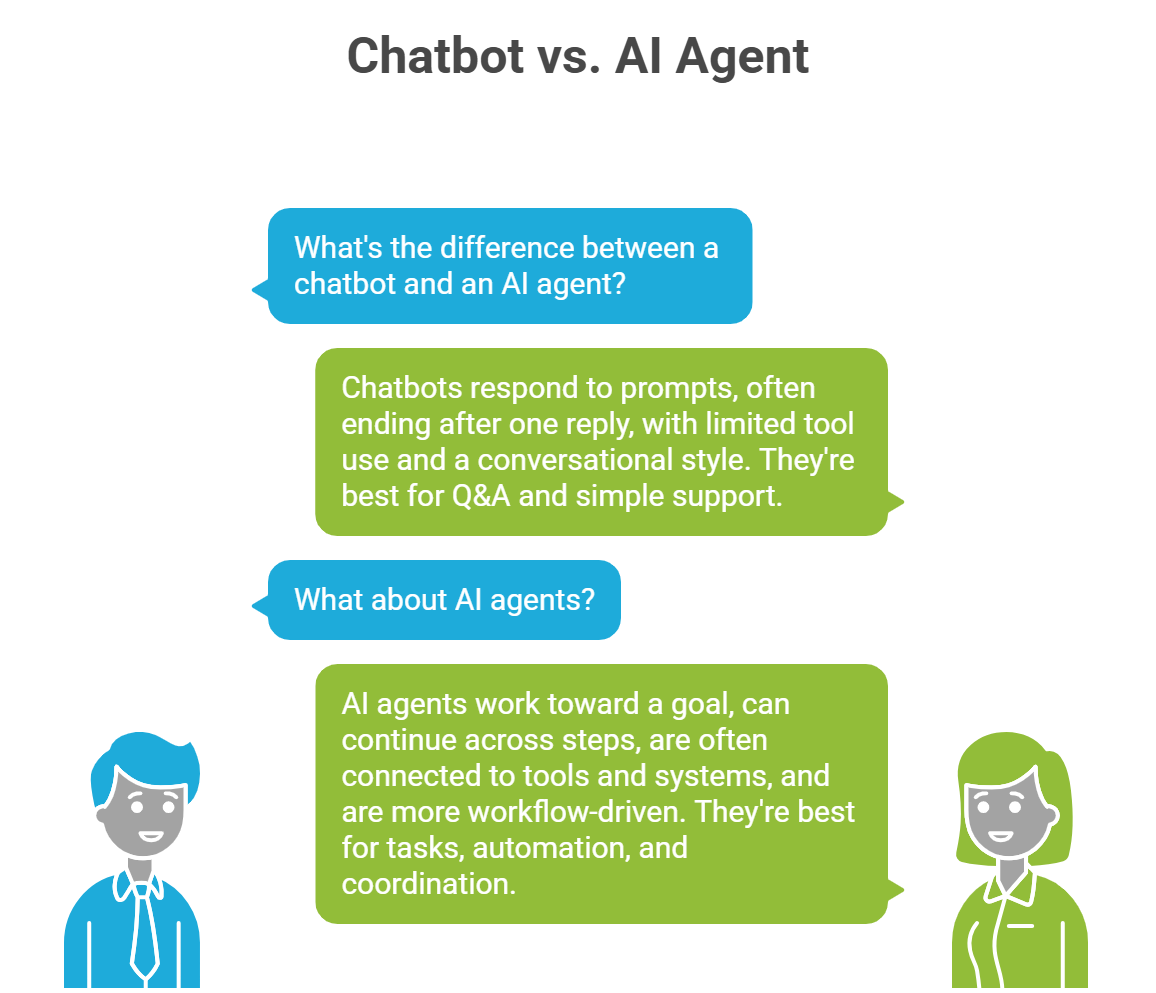
The difference is not always absolute. Some modern systems can act like both. But as a rule, chatbots focus on conversation, while agents focus on task completion.
Simple examples of AI agents
Customer support agent: An AI agent can read a support request, search the help center, check order status, draft a reply, and suggest escalation if needed.
Research assistant agent: A research agent can collect source material, summarize findings, compare options, and organize the final notes into a report.
Meeting preparation agent: An internal assistant can read calendar details, gather relevant documents, summarize past notes, and prepare a briefing before the meeting starts.
Sales workflow agent: A sales-focused agent can qualify leads, update CRM records, draft follow-up messages, and prioritize accounts based on rules.
Coding assistant agent: A developer-facing agent can inspect a codebase, suggest changes, run checks, and explain why a fix may solve the issue.
These examples show why AI agents matter. They are useful when the work involves several connected steps rather than one isolated answer.
Why AI Agents Matter?
AI agents matter because many real tasks are not single-prompt problems. Businesses do not just need text generation. They need systems that can search, decide, act, and work across tools.
That is why AI agents are now discussed in areas such as customer support, research, operations, marketing, software development, and internal knowledge systems. The appeal is not only intelligence. It is coordination.
In practical terms, agents can reduce repetitive work, speed up workflows, and make AI more useful inside real systems. But that value appears only when the workflow is designed well.
The Core Pillars of Agentic Architecture
Moving from simple prompting to complex engineering requires analyzing how a model handles execution layers without constant human intervention. When looking at system design, a critical ai capability refers to autonomy planning and tool use working in unison as a single cohesive engine.
To understand what defines an ai agent from an infrastructure perspective, engineers look at how the framework maps out these three specific behaviors:
-
Autonomy: The system’s capacity to initiate actions, self-correct after receiving software error logs, and continue executing tasks completely hands-free.
-
Planning: The structural capability to take a massive, ambiguous goal, break it down into sequential sub-tasks, and dynamically alter the strategy if an intermediate step fails.
-
Tool Use: The ability to interface with external environments by translating natural language intent into precise software executions, such as running SQL database queries, browsing live webpages, or processing files.
Analyzing which ai capability refers to autonomy planning and tool use proves why running an ai workflow vs ai agent framework yields completely different operational outcomes. While a fixed workflow follows rigid, hard-coded pathways, an agent leverages its underlying reasoning model to navigate changing data states fluidly.
Common Limitations and Risks
AI agents are useful, but they also create new challenges.
- One problem is unreliable planning. An agent may choose weak steps or misread the goal.
- Another issue is tool misuse. If the agent is connected to external tools, a bad decision can have real consequences.
- There is also the risk of hallucination. If the model invents facts or misunderstands context, the whole workflow can drift.
- Finally, there is the challenge of evaluation. It is easier to notice when a chatbot gives a bad answer. It is harder to measure whether a multi-step agent actually handled the task well.
That is why teams working with agents often care about testing, monitoring, guardrails, and governance, not just model quality.
Real-world use cases of AI Agents
Reviewing a real-world what is an ai agent example helps demystify the technology for newcomers. A classic what is an ai agents example in daily operations is an autonomous customer support agent. Unlike a standard rule-based chatbot, these systems check live shipping logs, modify open order profiles in your CRM, and issue refund requests autonomously, demonstrating the absolute breadth of what do ai agents do to streamline digital scaling.
AI agents are most valuable where work follows repeatable patterns.
- A support team may use an agent to draft replies and route tickets.
- A research team may use an agent to gather documents and summarize insights.
- An operations team may use an agent to update records across tools.
- A content team may use an agent to turn a brief into outlines, drafts, and review checklists.
In each case, the value comes from combining reasoning with action.
Suggested Read:
- AI Agents vs Chatbots: Key Differences Explained
- Prompt Engineering for Beginners: A Practical Guide
- What Is RAG in AI? A Beginner-Friendly Guide
FAQ: What is an AI Agents?
Is an AI agent the same as a chatbot?
No. A chatbot mainly answers messages. An AI agent is designed to move through tasks, use tools, and work toward a goal.
Do AI agents think on their own?
Not in a human sense. They follow model outputs, system rules, tool access, and workflow logic. They can appear autonomous, but they still operate within defined limits.
What is a simple example of an AI agent?
A support assistant that reads a customer issue, checks account details, finds the right policy, drafts a reply, and suggests the next step is a simple example.
Are AI agents always fully autonomous?
No. Many are semi-autonomous. They can do part of the workflow, but still need human approval for sensitive or high-risk actions.
Why are AI agents becoming popular?
Because they are useful for multi-step work. Instead of only answering questions, they can help complete tasks across research, support, operations, and software workflows.
Final takeaway
An AI agent is an AI system built to pursue a goal through multiple steps, often by planning actions, using tools, and checking results along the way. That is what makes it different from a simple chatbot. For beginners, the easiest way to understand an agent is this: it is not just answering. It is trying to get something done.
As you go deeper, the next useful questions are how AI agents are structured, how they differ from chatbots, what tools they use, and how to evaluate whether they are safe and reliable in real workflows. If you need any AI agents related services, Hire Our Team (Click Here).