

Agentic AI architecture is the design of an AI system that can receive a goal, understand context, plan steps, use memory, call tools, take actions, check results, and escalate when needed. It is the structure that turns an AI model from a passive responder into a controlled task-completing system.
In Simple Terms
Think of agentic AI architecture as the operating plan behind an AI agent.
A normal chatbot usually follows a simple pattern: user asks, model answers. An agentic AI system needs more structure. It must know the goal, decide what to do next, use the right tools, remember useful context, and avoid unsafe actions.
The model is only one part. The architecture is what makes the whole system work.
What Is Agentic AI Architecture?
Agentic AI architecture is the structure used to build AI systems that can act toward a goal. IBM defines agentic architecture as the structure and design of agentic AI frameworks, shaping the virtual space and workflow structure used to automate models inside an agentic AI system.
In practical terms, architecture answers questions like:
- What can the agent see?
- What tools can it use?
- What information can it remember?
- What actions need approval?
- How does the system detect failure?
- How are logs, permissions, and evaluations handled?
Without clear architecture, an agent can become unpredictable. With clear architecture, the system can be useful, testable, and safer.
The Core Agentic AI Architecture
Most agentic AI systems include these main layers:
| Layer | Role | Example |
| Goal layer | Defines the task | “Resolve this support ticket” |
| Perception layer | Reads inputs and context | Ticket, screenshot, email, PDF |
| Reasoning layer | Interprets the situation | Identify issue type |
| Planning layer | Breaks work into steps | Check policy, draft reply |
| Memory layer | Stores useful context | Customer history |
| Tool layer | Connects to systems | CRM, search, database |
| Action layer | Performs or drafts actions | Create ticket update |
| Feedback layer | Checks progress | Is the issue resolved? |
| Oversight layer | Adds safety and review | Human approval |
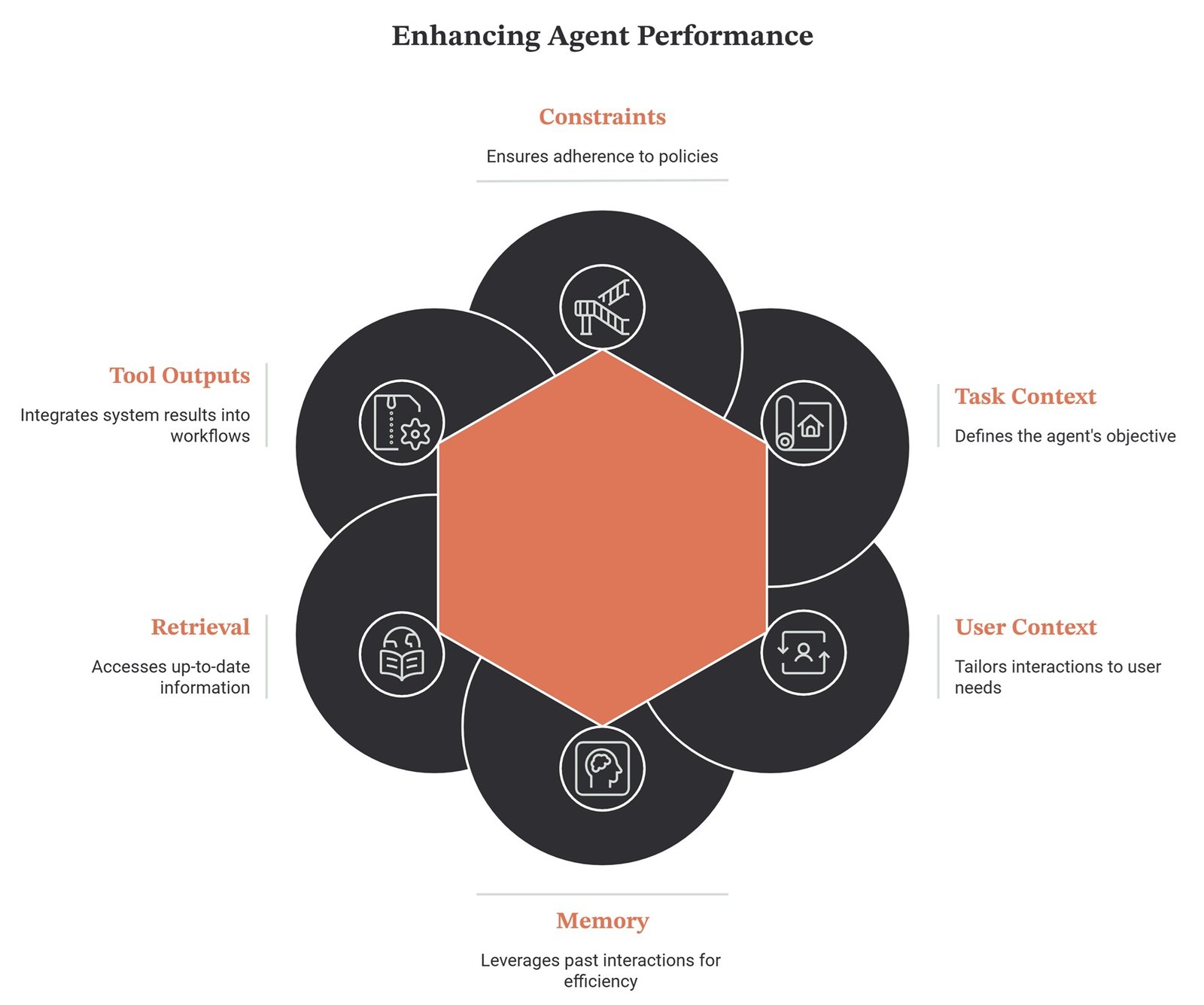
A 2026 survey on agentic AI architectures describes agent systems through components such as perception, brain, planning, action, tool use, and collaboration, which maps closely to this practical structure.
1) Goal Layer: The Starting Point
Every agentic AI system starts with a goal. The goal may come from a user, another system, a workflow trigger, or a scheduled process.
For example:
“Summarize this contract.”
“Investigate this failed payment.”
“Find relevant papers and prepare notes.”
“Create a support ticket from this email.”
A clear goal matters because agents can drift when the objective is vague. “Help with this customer issue” is weaker than “classify the issue, retrieve the policy, draft a response, and escalate if a refund is required.”
2) Perception Layer: Understanding Inputs
The perception layer handles what the agent receives. This may include text, documents, screenshots, images, audio, logs, database records, or API responses.
In a simple agent, perception may only mean reading a text prompt. In a stronger agentic AI architecture, perception may include OCR, document parsing, speech-to-text, image understanding, or retrieval from a knowledge base.
This layer is important because bad input leads to bad actions. If the system misreads a document or misses a key field, the rest of the workflow can fail.
3) Reasoning Layer: Interpreting the Situation
The reasoning layer is where the AI model interprets the user’s request and available context. This is often powered by a large language model or multimodal model.
The reasoning layer may classify the task, decide whether more information is needed, compare options, or identify risk. Google Cloud describes AI agents as systems that use AI to pursue goals and complete tasks, showing reasoning, planning, and memory.
Good architecture does not let reasoning float freely. It constrains reasoning with instructions, policies, retrieved context, tool schemas, and safety rules.
4) Planning Layer: Breaking Work Into Steps
Planning turns a goal into a sequence of actions. IBM describes AI agent planning as the process where an AI agent determines a sequence of actions to achieve a specific goal.
For example, a support agent may plan:
Read the ticket.
Check the customer account.
Retrieve the refund policy.
Draft a response.
Ask for approval before processing a refund.
Planning can be simple or complex. Some agents follow a fixed workflow. Others dynamically decide the next step based on tool results. The more dynamic the planner is, the more evaluation and guardrails it needs.
5) Memory Layer: Keeping Context Useful
Memory allows an agent to store and recall context. IBM defines AI agent memory as an AI system’s ability to store and recall past experiences to improve decision-making, perception, and performance.
Memory can include short-term task state, user preferences, prior tool results, historical outcomes, or reusable lessons. A 2026 survey on autonomous LLM agent memory describes memory as a write-manage-read loop connected to perception and action.
Memory should be governed carefully. Agents should not store sensitive personal data without a clear reason, retention rule, and privacy control.
6) Tool Layer: Connecting AI to Real Systems
Tools let the agent do work. A tool might be search, a database, a CRM, a calendar, a code runner, an email system, a browser, a vector database, or an internal API.
This is where agentic AI becomes more powerful than a chatbot. IBM describes AI agents as systems that autonomously perform tasks by designing workflows with available tools.
Tool design should be narrow and explicit. The agent should know what each tool does, what inputs are allowed, and what actions require approval.
7) Action and Feedback Layer
The action layer executes or drafts the next step. The feedback layer checks whether that step worked.
For low-risk tasks, the agent might summarize a document or update a draft. For higher-risk tasks, it may prepare a recommendation and wait for human approval. Feedback prevents blind execution. If a tool fails, the agent can retry, choose another route, or escalate.
This loop is what makes agentic AI useful: act, observe, adjust.
8) Oversight, Evaluation, and Guardrails
Agentic AI architecture needs safety controls because agents can take actions. The system should include permissions, audit logs, human review, fallback paths, monitoring, and evaluation.
Common evaluation areas include task success, planning quality, tool-call accuracy, memory behavior, hallucination rate, latency, cost, and escalation quality.
This matters because a wrong answer is one problem, but a wrong action can be much worse.
Example: Agentic AI Architecture in Customer Support
A customer writes: “I was charged twice.”
The architecture may work like this:
- The perception layer reads the message and account data.
- The reasoning layer identifies a billing issue.
- The planning layer decides to check transactions and policy.
- The tool layer queries payment history and retrieves refund rules.
- The memory layer keeps customer context.
- The action layer drafts a response and refund recommendation.
- The oversight layer asks a human to approve the refund.
This is a simple but realistic agentic AI architecture because it combines context, tools, planning, action, and review.
Common Mistakes to Avoid
- Do not build an agent around an LLM alone. A model without tool controls, permissions, memory rules, and evaluation is not a reliable architecture.
- Do not give broad tool access too early. Start with read-only tools, then allow draft actions, then supervised writes.
- Do not skip observability. If you cannot inspect what the agent saw, planned, retrieved, and did, you cannot debug it.
Suggested Read:
- What Is Agentic AI? A Practical Guide for Beginners
- How Agentic AI Works: Planning, Memory, Tools, and Action
- Agentic AI vs Generative AI: What’s the Difference?
- What Is an AI Agent? A Simple Explanation With Examples
- MCP Explained: Why It Matters for AI Agents
- How to Evaluate an AI Agent Before Production
- AI Agents vs Chatbots: Key Differences Explained
FAQ: Agentic AI Architecture
What is agentic AI architecture?
Agentic AI architecture is the system design that lets an AI agent receive goals, understand context, plan steps, use memory, call tools, take actions, and check results.
What are the main components of agentic AI architecture?
The main components are goal handling, perception, reasoning, planning, memory, tools, action, feedback, evaluation, and human oversight.
How does AI agent architecture work?
It works by turning a goal into a controlled workflow where the agent observes context, decides next steps, uses tools, acts, and checks whether the task is complete.
What is the role of memory in agentic AI architecture?
Memory stores and recalls useful context such as task state, user preferences, previous results, and workflow history.
Why do agentic AI systems need tools?
Tools connect the AI agent to real systems such as databases, CRMs, calendars, search engines, code tools, and APIs.
What are the risks of agentic AI architecture?
Risks include wrong actions, poor planning, unsafe tool use, stale memory, privacy leaks, prompt injection, infinite loops, and weak human oversight.
Final Takeaway
Agentic AI architecture is the structure that lets AI systems move from answering to acting. The best architectures combine clear goals, perception, reasoning, planning, memory, tools, feedback, evaluation, and human oversight.
To continue learning, read What Is Agentic AI?, How Agentic AI Works, and How to Evaluate an AI Agent Before Production next.