
Self Consistency Prompting Explained: How It Works With Examples
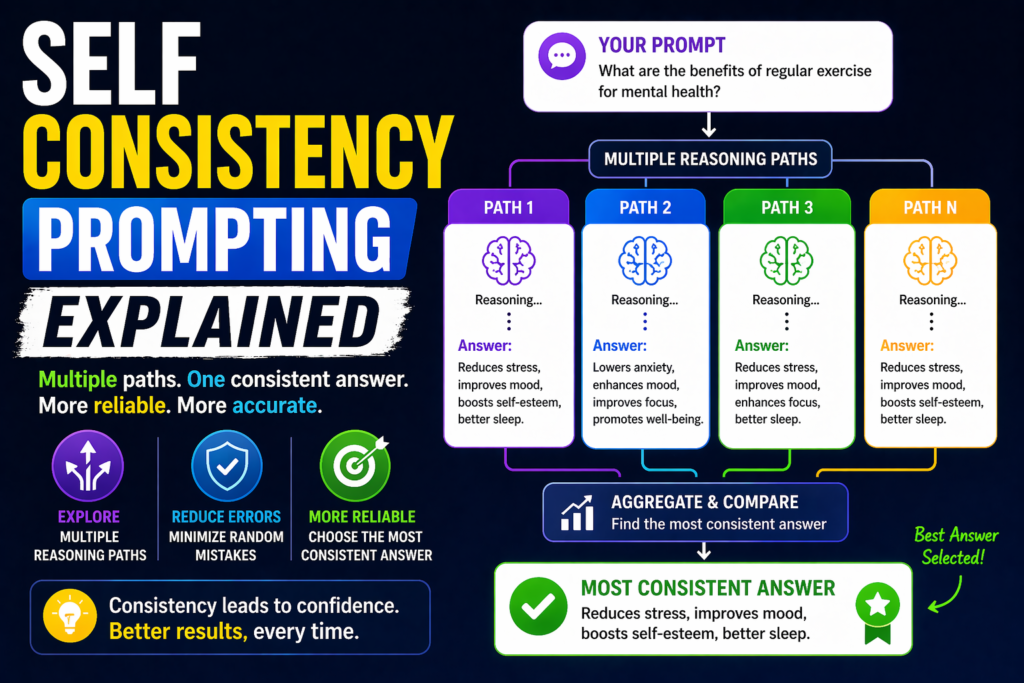
Self consistency prompting is an advanced AI prompting method used to improve reasoning accuracy. Instead of accepting one answer immediately, the model generates multiple reasoning attempts and then selects the most consistent final result.
This can reduce mistakes and improve reliability on difficult tasks.
In this guide, you’ll learn what self consistency prompting is, how it works, where to use it, and how to apply it effectively.
In simple terms
Self consistency prompting means:
Ask the AI to solve the same problem in multiple ways, then choose the most reliable answer.
Instead of:
“Solve this math problem.”
Use:
“Solve this math problem using several reasoning attempts, then provide the most consistent final answer.”
That helps the model avoid single-path errors.
What is Self Consistency Prompting?
Self consistency prompting is a prompt engineering technique where an AI model generates multiple reasoning chains for the same task, then selects the answer that appears most consistently across those attempts.
The process usually looks like this:
- generate several reasoning paths
- compare final answers
- choose the most repeated or strongest result
- return the final response
It is commonly used for reasoning-heavy tasks.
Why self consistency prompting works
Sometimes a model gives the wrong answer because its first reasoning path is flawed.
Self consistency prompting improves results by:
- reducing random reasoning errors
- checking multiple solution paths
- increasing confidence in answers
- improving difficult task performance
- avoiding premature conclusions
It works especially well when problems can be solved in more than one valid way.
Simple Self Consistency Prompting Examples
Example 1: Math Problem
Prompt:
“Solve this equation using three separate reasoning approaches. Then give the most consistent answer.”
Example 2: Logic Puzzle
Prompt:
“Analyze this puzzle with multiple reasoning attempts and provide the answer that appears most reliable.”
Example 3: Business Decision
Prompt:
“Evaluate three approaches to reduce churn, then choose the recommendation supported most consistently.”
Example 4: Data Interpretation
Prompt:
“Interpret this dataset using multiple analytical views and provide the strongest conclusion.”
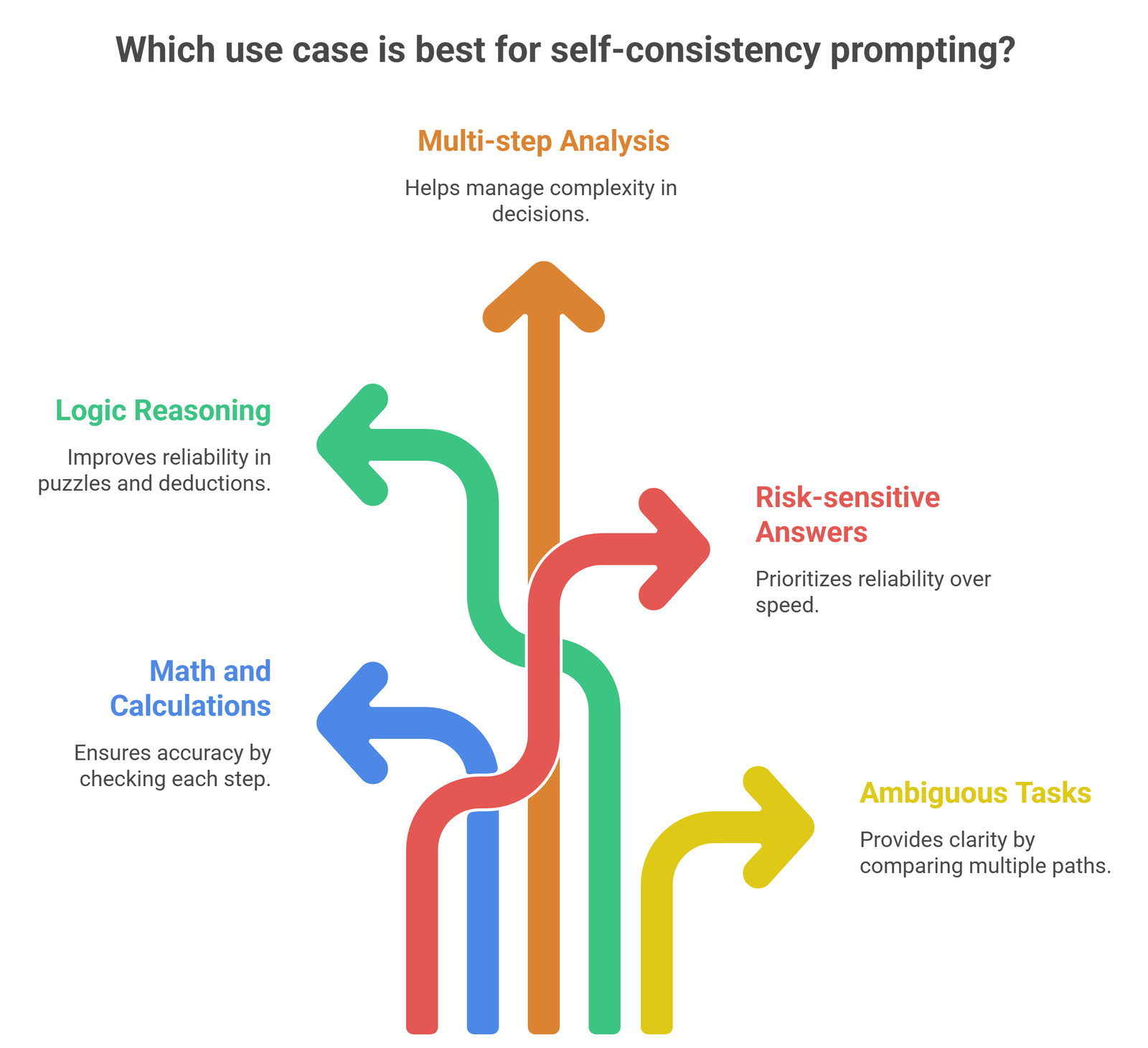
Best use cases for Self Consistency Prompting
This method works best for:
1.Math and calculations
Where a wrong early step can ruin the result.
2.Logic reasoning
Puzzles, deductions, constraints.
3.Multi-step analysis
Complex decisions with several variables.
4.Risk-sensitive answers
When reliability matters more than speed.
5.Ambiguous tasks
Where comparing multiple paths helps clarity.
Self Consistency vs Chain of Thought
| Method | How It Works | Best For |
| Chain of Thought | One step-by-step reasoning path | Standard complex tasks |
| Self Consistency | Multiple reasoning paths + best final answer | Accuracy-critical tasks |
| Zero Shot | Direct answer | Simple tasks |
Think of self consistency as an upgraded reasoning workflow.
How to write better Self Consistency Prompting
1.Request multiple attempts
Use phrases like:
- solve in 3 ways
- generate several reasoning paths
- evaluate multiple approaches
2.Ask for final consensus
Prompt:
“Choose the answer supported most consistently.”
3.Use clear constraints
Example:
- use only given data
- show concise reasoning
- compare outcomes
4.Apply to complex tasks
Best for problems that need thinking, not simple facts.
5.Validate important outputs
Still review high-stakes results manually.
Common mistakes
Using it for simple questions
Too slow for basic tasks.
Too many attempts
Can create unnecessary verbosity.
No final selection step
Need one final consensus answer.
Vague tasks
Unclear prompts create unclear outputs.
Blind trust in consensus
Repeated wrong reasoning can still happen.
Copy-paste self consistency prompt templates
Math
“Solve this problem using 3 different reasoning attempts. Return the most consistent final answer: [problem]”
Decision Making
“Evaluate 3 possible solutions to [problem]. Select the recommendation supported most consistently.”
Analysis
“Analyze this issue from multiple reasoning paths, compare conclusions, then provide the strongest final answer.”
Planning
“Create three plans for [goal], compare feasibility, and choose the most reliable plan.”
When not to use self consistency prompting
It may be unnecessary for:
- quick summaries
- simple rewrites
- direct factual lookups
- grammar correction
- short creative tasks
Use it when accuracy matters more than speed.
Suggested Read:
- What Is Prompt Engineering? Complete Beginner Guide
- Chain of Thought Prompting Explained
- Tree of Thought Prompting Explained
- Prompt Engineering Best Practices
- Prompt Chaining Explained
- ChatGPT Prompting Guide
FAQ: Self Consistency Prompting
What is self consistency prompting?
A prompting method where AI generates multiple reasoning paths and selects the most reliable answer.
How is it different from chain of thought?
Chain of thought uses one reasoning path. Self consistency compares several paths.
Is it useful for ChatGPT?
Yes, especially for reasoning-heavy tasks.
Does it guarantee correctness?
No, but it often improves reliability.
Final takeaway
Self consistency prompting helps AI avoid one-shot reasoning mistakes by comparing multiple solution paths before answering.
For math, logic, planning, and high-accuracy tasks, it can outperform simpler prompting methods.
If correctness matters, self consistency prompting is worth using.