
Reflective Prompting Explained: How It Works With Examples
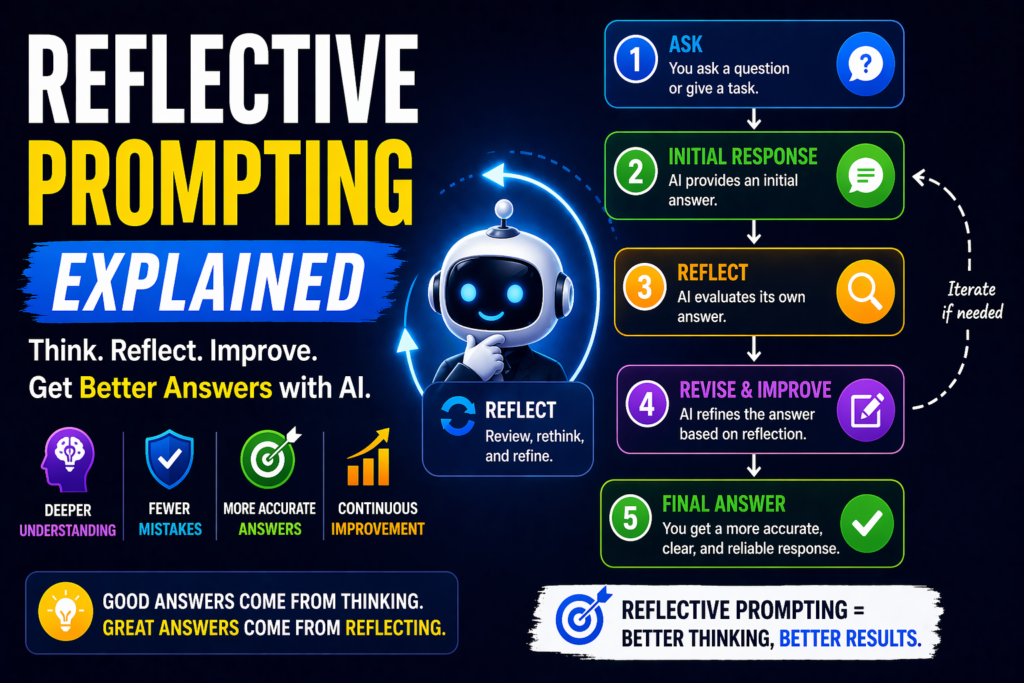
Reflective prompting is a smart AI prompting method where the model reviews its first response, identifies weaknesses, and improves the final answer.
Instead of accepting the first output, you ask the AI to critique and refine its own work. This often leads to clearer, more accurate, and more thoughtful responses.
In this guide, you’ll learn what reflective prompting is, how it works, where to use it, and how to apply it effectively.
In simple terms
Reflective prompting means:
Ask the AI to review its own answer, then improve it.
Instead of:
“Write a blog introduction.”
Use:
“Write a blog introduction, review it for clarity and engagement, then improve it.”
That extra reflection step can raise quality quickly.
What is Reflective Prompting ?
Reflective prompting is a prompt engineering technique where an AI model generates an initial answer, then evaluates that answer and produces a stronger revised version.
The process usually includes:
- generate first draft
- review weaknesses
- identify missing details
- improve clarity or accuracy
- produce final version
It is sometimes called self-review or self-critique prompting.
Why reflective prompting works
Many AI responses are decent on the first try, but not optimal. A review step helps the model catch issues before finalizing.
Reflective prompting improves:
- clarity
- structure
- completeness
- reasoning quality
- usefulness
It is especially effective for writing, planning, and analytical tasks.
Simple Reflective Prompting Examples
Example 1: Writing
Prompt:
“Write a product description. Then review it for persuasion and clarity. Rewrite the improved version.”
Example 2: Research Summary
Prompt:
“Summarize this article. Then check if any key points were missed and revise the summary.”
Example 3: Coding
Prompt:
“Write Python code for this task. Then review it for bugs and optimize performance.”
Example 4: Strategy
Prompt:
“Create a marketing plan. Then critique weak points and improve the final plan.”
Best use cases for Reflective Prompting
This method works best for:
1.Content creation
Blogs, emails, landing pages, headlines.
2.Coding tasks
Bug checks, optimization, readability.
3.Planning
Business plans, study plans, workflows.
4.Analysis
Arguments, decisions, recommendations.
5.Summaries
Improving completeness and accuracy.
Reflective Prompting vs Chain of Thought
| Method | How It Works | Best For |
| Chain of Thought | Step-by-step reasoning | Logic and problem solving |
| Reflective Prompting | First draft + self-review | Quality improvement |
| Few Shot | Uses examples | Formatting consistency |
Reflective prompting focuses on refinement after generation.
How to write better Reflective Prompting
1.Ask for clear review criteria
Use:
- clarity
- accuracy
- tone
- logic
- completeness
Example:
“Review this answer for clarity and missing details.”
2.Separate draft and revision
Use two-step prompts:
- Create first version
- Improve final version
3.Ask for specific fixes
Example:
- shorten it
- make it persuasive
- simplify language
4.Use for medium or complex tasks
The extra step is most useful when quality matters.
5.Keep final output clean
Ask for only the improved final version if needed.
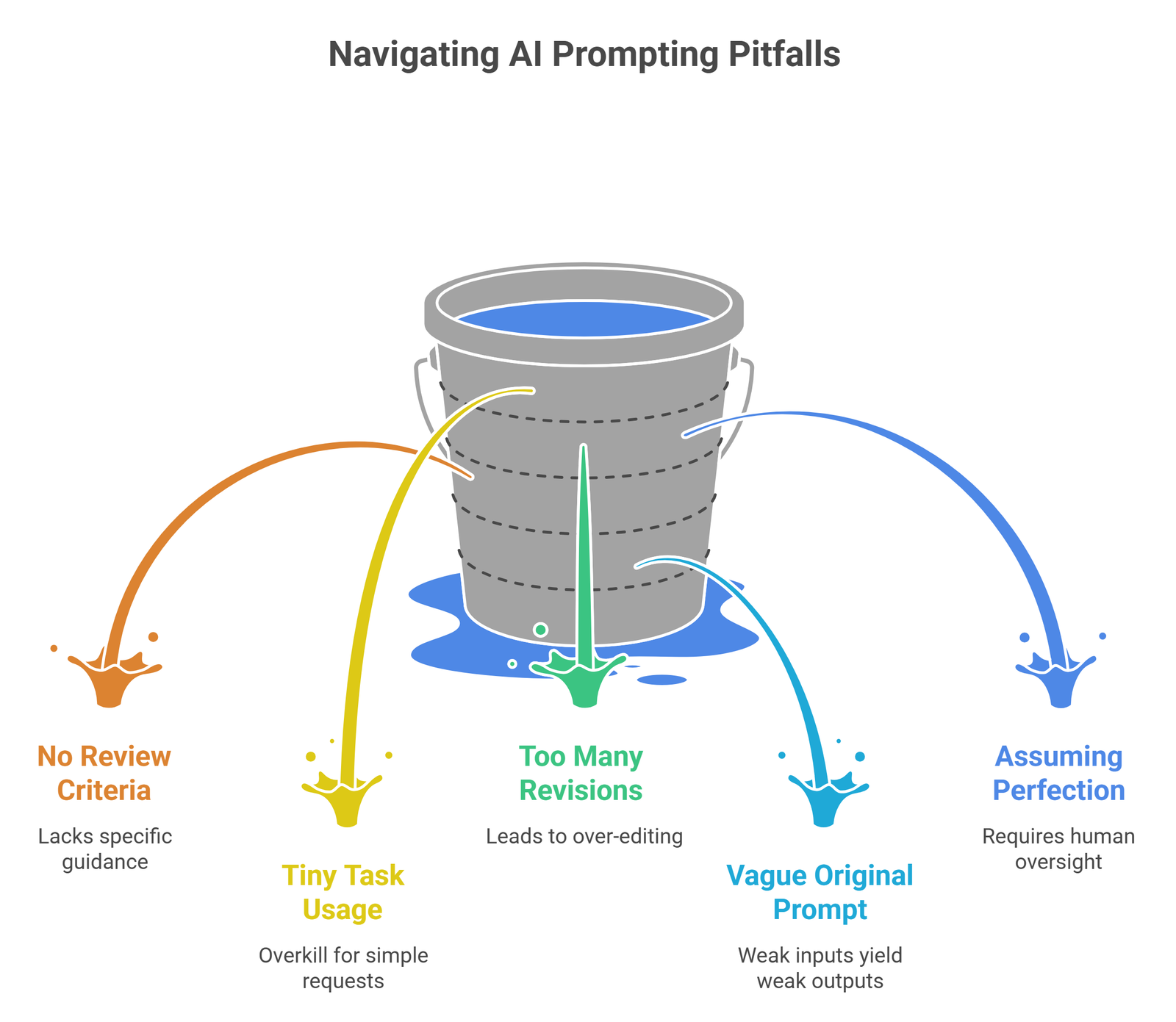
Common mistakes
No review criteria
“Improve this” is weaker than specific instructions.
Using it for tiny tasks
Not needed for one-line requests.
Too many revision rounds
Can create over-editing.
Vague original prompt
Weak inputs still create weak outputs.
Assuming perfection
Always review critical work yourself.
Copy-paste reflective prompt templates
Writing
“Write a draft about [topic]. Review it for clarity and engagement. Return the improved final version.”
Coding
“Write code for [task]. Review for bugs and efficiency. Return the optimized version.”
Analysis
“Answer this question: [question]. Review your reasoning for gaps, then improve the answer.”
Planning
“Create a plan for [goal]. Critique weaknesses, then revise the stronger final plan.”
When not to use reflective prompting
It may be unnecessary for:
- quick facts
- simple translations
- short summaries
- one-line rewrites
- low-priority drafts
Use it when quality is more important than speed.
Suggested Read:
- What Is Prompt Engineering? Complete Beginner Guide
- Chain of Thought Prompting Explained
- Self Consistency Prompting Explained
- Prompt Engineering Best Practices
- Iterative Prompting Explained
- ChatGPT Prompting Guide
FAQ: Reflective Prompting
What is reflective prompting?
A prompting method where AI reviews and improves its own first answer.
Does reflective prompting improve quality?
Often yes, especially for writing and analysis.
Is it useful for ChatGPT?
Yes. It works well for many practical tasks.
Is it the same as chain of thought?
No. Chain of thought focuses on reasoning steps, while reflective prompting focuses on revision.
Final takeaway
Reflective prompting helps AI move beyond first-draft quality. By asking the model to review and refine its own output, you often get clearer, stronger, and more reliable results.
For writing, coding, planning, and analysis, it is one of the easiest ways to improve outputs.
If first responses feel average, add reflection.