
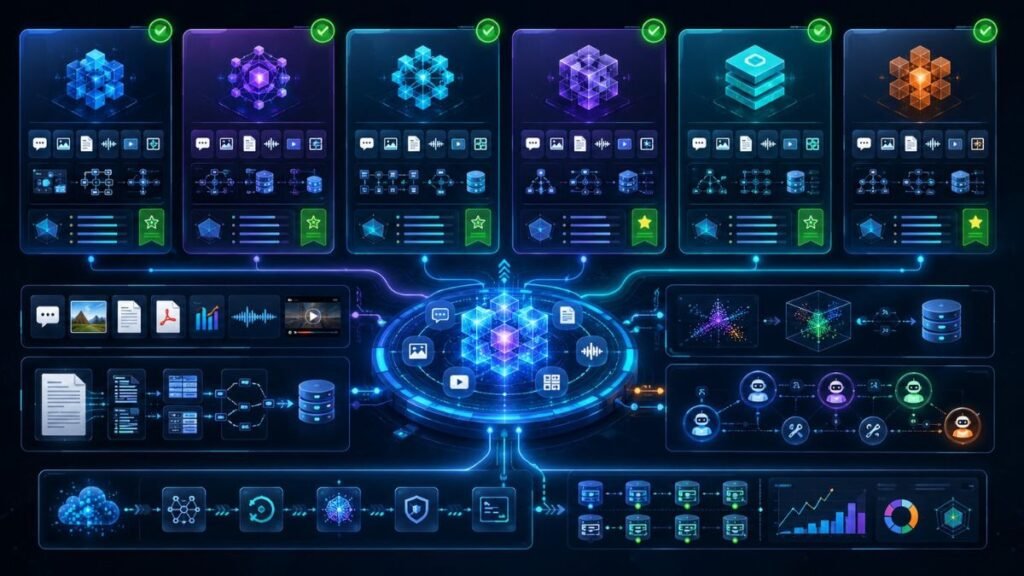
Multimodal AI frameworks help developers build applications that work with text, images, PDFs, screenshots, audio, video, embeddings, retrieval systems, and agents. The best framework depends on the workflow: LangChain for flexible app orchestration, LlamaIndex for data and document-centric RAG, Haystack for production pipelines, and Semantic Kernel or Agent Framework for enterprise agent orchestration.
In Simple Terms
A multimodal AI framework is not the same as a multimodal model. A model understands or generates content. A framework helps you build the full application around that model.
For example, a vision-language model may analyze an image. A multimodal AI framework helps you connect that model to file uploads, vector databases, document parsers, tools, APIs, memory, agents, evaluation, and production workflows. That is why framework choice matters when moving from a demo to a real app.
Quick Comparison of Multimodal AI Frameworks
| Framework | Best For | Main Strength | Main Trade-Off |
| LangChain | Flexible multimodal apps and agents | Broad integrations and model orchestration | Can become complex without structure |
| LlamaIndex | Document-heavy multimodal RAG | Data connectors, indexing, LlamaParse | Best when retrieval is central |
| Haystack | Production RAG and search pipelines | Modular pipelines and transparent control | Python pipeline mindset required |
| Microsoft Agent Framework / Semantic Kernel | Enterprise agents and orchestration | State, type safety, telemetry, workflows | Strongest in Microsoft ecosystem |
| AutoGen | Multi-agent experimentation | Agent collaboration patterns | AutoGen is now maintenance-mode in GitHub |
| CrewAI | Role-based agent workflows | Simple multi-agent automation | Less document/RAG-specific |
| DSPy | Optimized AI programs | Structured modules and prompt optimization | Not a plug-and-play multimodal stack |
| NVIDIA NeMo Retriever | Enterprise retrieval and document extraction | Multimodal extraction, embeddings, reranking | NVIDIA infrastructure fit matters |
LangChain: Best for Flexible Multimodal App Orchestration
LangChain is a strong general-purpose framework when you need to connect multimodal inputs, models, tools, memory, and agents. LangChain documentation specifically covers working with multimodal content such as images, audio, and files in messages.
Use LangChain when you are building a custom application that may combine text prompts, images, document uploads, tool calls, retrieval, and agent workflows. It is especially useful when you want broad model support and many integrations.
The trade-off is architecture discipline. LangChain gives flexibility, but large apps can become hard to maintain if you do not define clear chains, tools, state, evaluation, and observability patterns.
LlamaIndex: Best for Multimodal RAG and Document-Centric Apps
LlamaIndex is a strong choice when your main problem is connecting AI models to data. Its documentation says LlamaIndex supports multimodal applications that combine language and images. LlamaIndex also highlights LlamaParse for complex document parsing, including nested tables, embedded charts, and images.
Use LlamaIndex for multimodal RAG, document search, PDF assistants, image-aware knowledge bases, and enterprise knowledge apps. It is especially relevant when documents, pages, tables, charts, and retrieval quality matter more than agent theater.
The trade-off is that it is retrieval-first. If your app is mainly a multi-agent workflow with tools and approvals, another orchestration framework may fit better.
Haystack: Best for Production RAG and Multimodal Search Pipelines
Haystack is a strong open-source framework for teams that prefer explicit, modular pipelines. Its documentation describes Haystack as a framework for production-ready AI agents, RAG applications, and scalable multimodal search systems. Haystack also provides tutorials for vision-plus-text RAG pipelines that retrieve through captions while using original images during generation.
Use Haystack for production search, question answering, multimodal RAG, and retrieval pipelines where each component should be visible and replaceable. It is useful for teams that want control over retrievers, rankers, generators, routers, and evaluation.
The trade-off is that Haystack may feel more pipeline-engineering focused than conversational-app focused.
Microsoft Agent Framework and Semantic Kernel: Best for Enterprise Agent Workflows
Microsoft’s newer Agent Framework is important because it combines AutoGen-style agent abstractions with Semantic Kernel’s enterprise features such as state management, type safety, middleware, telemetry, and graph-based workflows. Semantic Kernel itself is described as a model-agnostic SDK for building, orchestrating, and deploying AI agents and multi-agent systems.
Use Microsoft Agent Framework or Semantic Kernel when you need enterprise workflow orchestration, agent patterns, telemetry, business-process integration, and Microsoft ecosystem alignment.
The trade-off is fit. If your problem is simple multimodal document search, LlamaIndex or Haystack may be faster. If your problem is enterprise agent orchestration, Microsoft’s stack becomes more compelling.
AutoGen and CrewAI: Best for Multi-Agent Prototyping and Automation
AutoGen is known for multi-agent AI applications, but developers should note that the AutoGen GitHub repository says AutoGen is now in maintenance mode and community-managed going forward. Older AutoGen documentation also showed multimodal agent patterns with GPT-4V through multimodal agents and vision capability.
CrewAI is a role-based multi-agent automation framework. Its official site describes CrewAI Studio and APIs for building crews of AI agents equipped with tools such as Gmail, Teams, Notion, HubSpot, Salesforce, and Slack.
Use these frameworks for agent experiments, workflow automation, delegation patterns, and tool-using agents. They are less ideal when your core problem is high-quality multimodal document parsing or retrieval.
DSPy: Best for Optimizing Structured AI Programs
DSPy is different from most frameworks in this list. Its official site describes it as a declarative framework for building modular AI software, focused on programming language models rather than manually writing brittle prompts.
Use DSPy when you want to optimize AI programs, prompts, or multi-step model pipelines systematically. It can support RAG and agent loops, but it is not mainly a drag-and-drop multimodal app framework. It is better for teams that care about structured experimentation and measurable improvements.
NVIDIA NeMo Retriever: Best for Enterprise Multimodal Retrieval Infrastructure
NVIDIA NeMo Retriever is not a general app framework like LangChain, but it is highly relevant for enterprise multimodal retrieval. NVIDIA’s documentation describes NeMo Retriever as microservices for multimodal data extraction, embedding, and reranking pipelines with enterprise-grade retrieval. Its GitHub repository describes extraction of text, tables, charts, and infographics for downstream generative and RAG applications.
Use NeMo Retriever when the bottleneck is retrieval infrastructure, enterprise document ingestion, multimodal extraction, reranking, privacy, and performance. The trade-off is infrastructure fit, especially if your team is not already using NVIDIA-oriented deployment patterns.
How to Choose a Multimodal AI Framework
Start with the workflow. If you need flexible app orchestration, start with LangChain. If you need document-heavy multimodal RAG, test LlamaIndex. If you need explicit production pipelines, evaluate Haystack. If you need enterprise agents, consider Microsoft Agent Framework or Semantic Kernel. If you need retrieval infrastructure, look at NeMo Retriever.
Then test with real inputs: PDFs, screenshots, charts, images, audio transcripts, videos, user files, and messy documents. Framework comparisons are only useful if they reflect your actual production workload.
Common Mistakes to Avoid
Do not choose a framework only because it is popular. Choose based on data type, workflow, deployment needs, observability, integrations, and team skill.
Also avoid treating frameworks as a substitute for evaluation. A framework can organize pipelines, but it cannot guarantee OCR accuracy, retrieval quality, grounding, latency, or safety. You still need test sets, traces, human review, and monitoring.
Suggested Read:
- What Is Multimodal AI? Simple Explanation With Examples
- Multimodal API Comparison
- Best Multimodal AI Tools in 2026
- Multimodal AI Model Comparison
- Multimodal RAG Explained
- Document Understanding AI
- Multimodal Agents
- Multimodal Evaluation
FAQ: Multimodal AI Frameworks Compared
What are the best multimodal AI frameworks?
The best options include LangChain, LlamaIndex, Haystack, Microsoft Agent Framework, Semantic Kernel, CrewAI, DSPy, and NVIDIA NeMo Retriever, depending on the workflow.
Which framework is best for multimodal RAG?
LlamaIndex and Haystack are strong choices for multimodal RAG. LangChain can also work well when broader app orchestration is needed.
Which framework is best for multimodal agents?
Microsoft Agent Framework, Semantic Kernel, CrewAI, and LangChain are strong candidates for agent workflows, depending on enterprise needs and tooling.
Are multimodal AI frameworks the same as multimodal models?
No. Models process multimodal inputs. Frameworks help developers connect models to data, tools, retrieval, agents, workflows, and production systems.
Which framework is best for document-based multimodal AI?
LlamaIndex, Haystack, Google/enterprise document tools, and NVIDIA NeMo Retriever are strong candidates for document-heavy workflows.
How do you choose a multimodal AI framework?
Choose based on data types, RAG needs, agent needs, integrations, deployment model, observability, evaluation support, and team engineering skill.
Final Takeaway
The best multimodal AI frameworks depend on what you are building. Use LangChain for flexible orchestration, LlamaIndex for document-heavy multimodal RAG, Haystack for production pipelines, Microsoft Agent Framework or Semantic Kernel for enterprise agents, and NeMo Retriever for retrieval infrastructure.
To continue learning, read What Is Multimodal AI, Multimodal API Comparison, and Multimodal Evaluation next.