
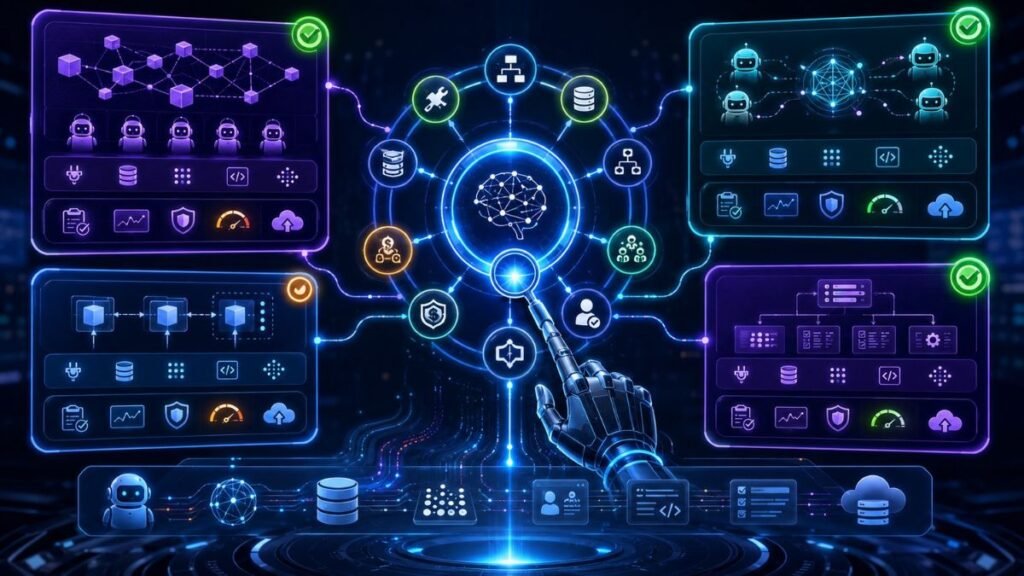
To choose the right agentic AI framework, start with the workflow you need to build. Compare frameworks by tool calling, state management, memory, RAG support, multi-agent orchestration, human approval, observability, security, deployment path, and team skill fit. The best framework is the one that matches your production needs, not the one with the loudest hype.
In Simple Terms
An agentic AI framework helps developers build AI agents that can plan, use tools, retrieve context, remember state, and complete multi-step workflows.
But different frameworks are designed for different jobs. Some are better for production orchestration. Some are better for fast multi-agent prototypes. Some are better for RAG, enterprise workflows, or coding agents.
Do You Actually Need an Agentic AI Framework?
Before comparing agentic AI frameworks, ask whether the task needs one.
A simple LLM app may be enough if the workflow is predictable: summarize a document, classify a ticket, extract fields into JSON, or answer from a fixed knowledge base. A full agent framework becomes useful when the system needs to choose tools, maintain state, coordinate steps, pause for approval, or recover from failures.
OpenAI describes agents as applications that plan, call tools, collaborate across specialists, and keep enough state to complete multi-step work. That means a framework makes more sense when your app needs those abilities, not just one model response.
Quick Decision Table: Which Framework Fits Which Need?
| Need | Strong Starting Choice | Why |
| Stateful production workflows | LangGraph | Durable execution, persistence, human-in-the-loop |
| OpenAI-native agent apps | OpenAI Agents SDK | Tools, handoffs, guardrails, tracing |
| Google Cloud deployment | Google ADK | Multi-agent orchestration, graph workflows, evaluation |
| Microsoft enterprise workflows | Microsoft Agent Framework | Python/.NET, telemetry, checkpointing, type-safe routing |
| Role-based multi-agent teams | CrewAI | Crews, flows, readable agent roles |
| RAG and document agents | LlamaIndex or Haystack | Retrieval and pipeline control |
| Typed Python apps | Pydantic AI | Structured outputs and validation |
| Coding agents | OpenHands | Sandboxed software workflows |
Use this as a shortlist, not a final verdict. The right choice still depends on architecture, risk, and deployment requirements.
1. Start With Workflow Shape
The first selection criterion is workflow shape.
Is the process fixed, like intake → retrieval → draft → review? A workflow framework may be better than a highly autonomous agent. Is the task uncertain, like debugging a bug or investigating a support case? You may need a framework that supports planning loops and dynamic tool use.
LangGraph’s documentation separates workflows from agents by noting that workflows follow predetermined paths, while agents dynamically define their process and tool usage. This distinction matters because many teams overuse agents when a controlled workflow would be safer.
2. Check State and Long-Running Workflow Support
State management is one of the biggest reasons to use an agentic AI framework.
A long-running agent needs to remember what happened: which tool was called, what result came back, what step is pending, and whether a human approval is required. LangGraph is strong here because its documentation positions it as an orchestration runtime for durable execution, streaming, human-in-the-loop, and persistence. Its GitHub page also describes LangGraph as a low-level orchestration framework for long-running, stateful agents.
Choose strong state support for support agents, coding agents, operations agents, research agents, and business workflows that may pause or resume.
3. Compare Tool Calling and API Access
Tool use is central to agentic AI. Your framework should make it easy to define tools, validate arguments, log calls, handle errors, and restrict permissions.
OpenAI’s Agents SDK tools documentation says tools let agents take actions such as fetching data, running code, calling external APIs, and using a computer. That is powerful, but it also creates risk. A wrong tool call can update the wrong record, send the wrong message, or run the wrong command.
For production, prefer frameworks that support tool schemas, guardrails, approval flows, and traceable execution.
4. Evaluate Multi-Agent Orchestration
Use multi-agent systems only when the work clearly benefits from specialist roles.
CrewAI is often attractive for role-based teams because it maps naturally to agents such as researcher, writer, reviewer, planner, and executor. LangGraph can model multi-agent systems as explicit graphs when you need tighter control. Microsoft Agent Framework supports graph-based workflows connecting agents and functions for multi-step tasks with type-safe routing, checkpointing, and human-in-the-loop support. OpenAI’s handoff documentation also describes agents delegating tasks to specialist agents, such as support agents for orders, refunds, and FAQs.
The practical rule: use multi-agent orchestration when roles improve reliability, not just because it sounds advanced.
5. Decide How Much RAG and Data Support You Need
If your agent mostly works with documents, policies, PDFs, search indexes, or knowledge bases, RAG support matters more than broad orchestration.
LlamaIndex and Haystack are often better fits for data-heavy agents because they focus on retrieval, indexing, pipelines, and document workflows. LangGraph can orchestrate RAG workflows, but it is not only a RAG framework.
Choose based on the bottleneck. If the hardest part is retrieval quality, prioritize a RAG-first stack. If the hardest part is long-running task execution, prioritize orchestration.
6. Look for Observability and Evaluation
Agent frameworks should help developers debug what happened. You need traces, model calls, tool calls, handoffs, retrieved context, memory events, costs, latency, errors, and human approvals.
OpenAI’s Agents SDK tracing collects records of LLM generations, tool calls, handoffs, guardrails, and custom events during an agent run. Google ADK also positions itself around multi-agent orchestration, graph workflows, performance evaluation, and enterprise deployment.
Do not choose a framework that only makes demos easy. Choose one that helps you monitor production behavior.
7. Review Security and Human Approval
Agentic AI frameworks connect models to tools, files, APIs, databases, and workflows. That means security controls matter.
Look for support for human-in-the-loop review, permission boundaries, middleware, logging, and secure tool handling. LangGraph interrupts can pause graph execution and wait for external input, enabling human-in-the-loop workflows. Microsoft Agent Framework safety guidance says the framework provides building blocks, but developers remain responsible for validating inputs, securing data flows, and configuring tools appropriately.
For commercial or enterprise apps, this may matter more than framework popularity.
8. Match the Framework to Your Team and Stack
A technically strong framework can still be the wrong choice if your team cannot operate it.
Choose OpenAI Agents SDK when your product is OpenAI-first. Choose Google ADK when you are building around Google Cloud and Gemini workflows. Choose Microsoft Agent Framework when your team uses Azure, .NET, Python, enterprise telemetry, and Microsoft infrastructure. Choose LangGraph when your team wants explicit workflow control. Choose CrewAI when fast role-based collaboration is the priority.
A recent ADK Arena preprint evaluated 51 Python agent development kits and found that no single framework dominated across all benchmark settings, reinforcing the need to choose by task, ecosystem, and developer workflow rather than assuming one universal winner.
Common Mistakes to Avoid
The first mistake is choosing the most popular framework instead of the best fit.
The second mistake is using multi-agent orchestration when a simple workflow is enough. A recent preprint even argues that for some procedural tasks, putting the procedure in context can outperform external orchestration, though this should be treated as task-specific research rather than a universal rule.
The third mistake is ignoring production requirements. Framework demos often hide hard problems: permissions, retries, state, evaluation, cost, latency, and incident response.
Suggested Read:
- What Is an AI Agent? A Simple Explanation With Examples
- Best Agentic AI Frameworks for Developers in 2026
- LangGraph vs CrewAI vs Microsoft Agent Framework
- Agentic AI Architecture Explained Simply
- How Orchestration Works in Agentic AI Systems
- Tool Use in Agentic AI: Function Calling, APIs, and External Actions
- How to Evaluate Agentic AI Systems
- Observability for Agentic AI: What Teams Need to Track
FAQ: How to Choose the Right Agentic AI Framework
How do you choose the right agentic AI framework?
Choose by workflow shape, tool needs, state management, memory, RAG, multi-agent support, observability, security, deployment environment, and team skill fit.
What should developers look for in an AI agent framework?
Developers should look for tool calling, state, memory, human approval, tracing, evaluation, deployment support, security controls, and ecosystem fit.
Which agentic AI framework is best for production?
LangGraph, OpenAI Agents SDK, Google ADK, Microsoft Agent Framework, and Haystack can be strong production choices depending on workflow and deployment needs.
Which framework is best for multi-agent systems?
CrewAI is strong for fast role-based teams. LangGraph and Microsoft Agent Framework are stronger when you need explicit orchestration, state, telemetry, and production controls.
Which AI agent framework is best for RAG?
LlamaIndex and Haystack are strong RAG-first choices. LangGraph can be useful when the RAG workflow is part of a larger stateful agent system.
Do you need an agentic AI framework?
Not always. Simple summarization, extraction, classification, and fixed workflows may only need an LLM API plus application logic.
Final Takeaway
How to choose the right agentic AI framework comes down to practical fit. Use LangGraph for durable orchestration, OpenAI Agents SDK for OpenAI-native agents, Google ADK for Google Cloud, Microsoft Agent Framework for enterprise workflows, CrewAI for role-based multi-agent teams, and LlamaIndex or Haystack for RAG-heavy agents.
To continue learning, compare Best Agentic AI Frameworks for Developers in 2026, LangGraph vs CrewAI vs Microsoft Agent Framework, and How to Evaluate Agentic AI Systems next.