
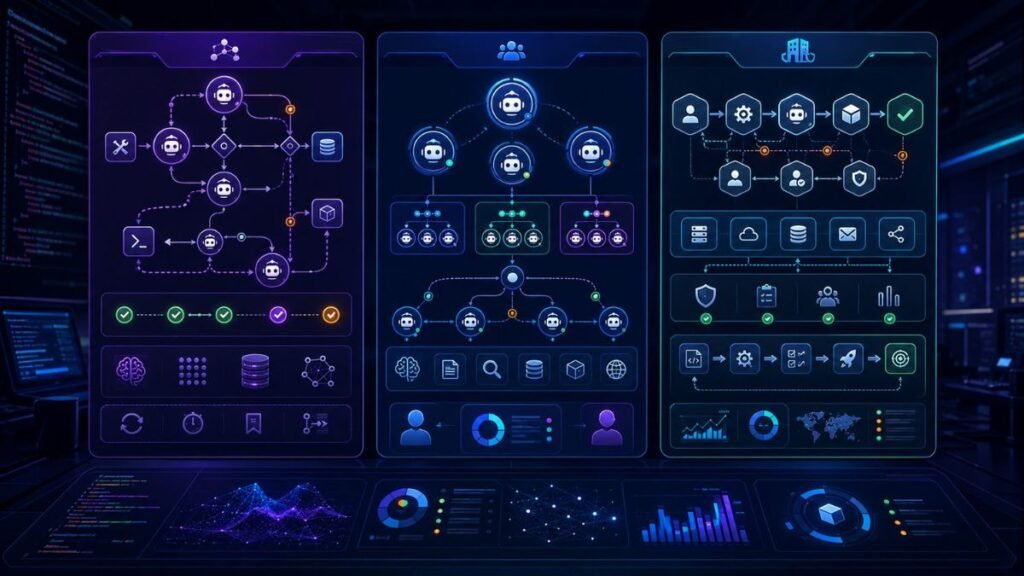
LangGraph vs CrewAI vs Microsoft Agent Framework comes down to design pattern fit. LangGraph is strongest for explicit stateful orchestration. CrewAI is best for fast role-based crews and event-driven flows. Microsoft Agent Framework is strongest for enterprise .NET/Python teams that need telemetry, type safety, state, and graph-based multi-agent workflows.
In Simple Terms
These three frameworks help developers build agentic AI applications, but they solve different problems.
Use LangGraph when you want precise control over workflow state, branching, retries, and human approval. Use CrewAI when you want to quickly model agents as roles working together. Use Microsoft Agent Framework when your organization wants enterprise agent workflows inside the Microsoft, Azure, .NET, or Python ecosystem.
Quick Comparison: LangGraph vs CrewAI vs Microsoft Agent Framework
| Framework | Best Fit | Main Strength | Main Trade-Off |
| LangGraph | Production orchestration | Durable state, graph control, human-in-the-loop | More architecture work |
| CrewAI | Role-based multi-agent apps | Fast crews, flows, readable agent roles | Less explicit low-level control |
| Microsoft Agent Framework | Enterprise agent workflows | State, telemetry, type safety, graph workflows | Best fit for Microsoft-centered teams |
If you want the simplest rule: choose LangGraph for control, CrewAI for speed, and Microsoft Agent Framework for enterprise integration.
What Is LangGraph Best For?
LangGraph is a framework for building stateful agent and workflow systems. Its official documentation says it focuses on capabilities important for agent orchestration, including durable execution, streaming, and human-in-the-loop support.
The design pattern behind LangGraph is explicit graph orchestration. Instead of letting an agent loop freely, developers define nodes, edges, state, routing, and interruption points. This is useful when you care about what happens after each step.
Use LangGraph for:
Customer-support workflows with approvals.
Long-running coding agents.
RAG agents with multiple retrieval paths.
Research agents that need traceable state.
Business workflows where retries and recovery matter.
LangGraph is not always the fastest framework to explain to beginners. Its strength is that it makes complex workflows more inspectable and controllable.
What Is CrewAI Best For?
CrewAI is built around collaborative agents, crews, and flows. Its documentation describes CrewAI as a way to design agents, orchestrate crews, and automate flows with guardrails, memory, knowledge, and observability.CrewAI also describes Flows as structured, event-driven workflows that manage state and control execution, while Crews are teams of autonomous agents that collaborate on tasks delegated by the Flow.
The design pattern behind CrewAI is role-based collaboration. You define agents with roles and goals, then let them work together as a crew inside a flow.
Use CrewAI for:
Researcher-writer-reviewer workflows.
Content operations.
Business process prototypes.
Multi-agent demos and internal tools.
Role-based task delegation.
CrewAI is attractive because it maps naturally to how teams think: researcher, analyst, writer, reviewer, manager. The trade-off is that production teams may need to be careful with role boundaries, state, observability, and stopping conditions.
What Is Microsoft Agent Framework Best For?
Microsoft Agent Framework is designed for enterprise agentic AI development. Microsoft says it combines AutoGen’s simple agent abstractions with Semantic Kernel’s enterprise features, including session-based state management, type safety, middleware, telemetry, and graph-based workflows for explicit multi-agent orchestration. Microsoft’s documentation also positions it as a framework for building robust agentic AI solutions in Python and .NET.
The design pattern here is enterprise workflow orchestration. It is not only about quickly creating agent roles. It is about building agentic systems that fit enterprise software practices.
Use Microsoft Agent Framework for:
Azure-centered agent applications.
.NET and Python enterprise workflows.
Multi-agent orchestration with telemetry.
Internal business systems.
Teams migrating from AutoGen or Semantic Kernel patterns.
The trade-off is ecosystem fit. If your team is not using Microsoft tools or enterprise infrastructure, LangGraph or CrewAI may feel lighter.
Design Pattern Comparison
| Design Need | Best Choice | Why |
| Explicit graph control | LangGraph | Strong node/edge/state architecture |
| Fast multi-agent roles | CrewAI | Natural crew and role abstraction |
| Enterprise .NET/Python workflow | Microsoft Agent Framework | State, telemetry, type safety, middleware |
| Human approval checkpoints | LangGraph or Microsoft Agent Framework | Stronger production-control story |
| Business automation prototype | CrewAI | Fast to model agents and tasks |
| Long-running stateful agents | LangGraph | Durable execution and state focus |
| Microsoft ecosystem integration | Microsoft Agent Framework | Better enterprise alignment |
| Learning multi-agent concepts quickly | CrewAI | Easier mental model |
Which Framework Is Best for Production?
For production, the answer depends on what “production” means.
If production means stateful workflows, failure recovery, checkpointing, and approval gates, LangGraph is often the strongest fit. Its GitHub page also emphasizes durable execution, resuming after failures, and human oversight through state inspection and modification.
If production means enterprise integration, telemetry, .NET/Python support, and Microsoft-stack governance, Microsoft Agent Framework is the stronger fit.
If production means getting role-based agent workflows running quickly, CrewAI can work well, but teams should design observability, state, and review controls carefully.
Which Framework Is Best for Multi-Agent Systems?
CrewAI is often easiest for multi-agent role modeling. It lets developers express work as agents, tasks, crews, and flows. That is useful when your workflow resembles a human team.
Microsoft Agent Framework is better when multi-agent orchestration needs enterprise-grade state, telemetry, middleware, and explicit graph workflows.
LangGraph is better when you want to design the multi-agent workflow as a controlled graph rather than a loose conversation between agents.
Real-World Use Cases
A customer-support automation team might choose LangGraph to manage ticket state, tool calls, refund approval, and escalation paths.
A content operations team might choose CrewAI to coordinate a researcher agent, writer agent, editor agent, and SEO reviewer.
An enterprise IT team might choose Microsoft Agent Framework to build monitored agent workflows across Azure, Microsoft services, Python, and .NET systems.
A startup prototype team might begin with CrewAI for speed, then move parts of the workflow into LangGraph if they need stricter control.
Mistakes, Limitations, and Risks
The biggest mistake is choosing a framework based only on popularity. The better question is: what design pattern does your workflow need?
Avoid CrewAI if you need every transition and state update to be explicitly controlled from day one. Avoid LangGraph if your team wants the fastest possible role-based prototype and does not need detailed orchestration yet. Avoid Microsoft Agent Framework if your product is not aligned with Microsoft infrastructure and you want a lightweight, model-agnostic stack.
Also remember that framework details change quickly. Always check current documentation before making a production decision, especially for deployment, licensing, provider support, pricing, and enterprise features. AIML’s writing rules specifically recommend verifying current framework features and comparing by realistic use case, not marketing language.
Suggested Read:
- What Is an AI Agent? A Simple Explanation With Examples
- Best AI Agent Frameworks for Developers in 2026
- AI Agent Architecture Explained Simply
- How Orchestration Works in Agentic AI Systems
- Design Patterns for Building Agentic AI Applications
- Tool Use in Agentic AI: Function Calling, APIs, and External Actions
- How to Evaluate an AI Agent Before Production
- MCP Explained: Why It Matters for AI Agents
FAQ: LangGraph vs CrewAI vs Microsoft Agent Framework
Which is better: LangGraph, CrewAI, or Microsoft Agent Framework?
LangGraph is better for explicit stateful orchestration, CrewAI is better for fast role-based multi-agent workflows, and Microsoft Agent Framework is better for enterprise .NET/Python teams.
Is LangGraph better than CrewAI?
LangGraph is better when you need durable state, graph control, and human approval. CrewAI is better when you want to quickly model agents as role-based teams.
When should developers use Microsoft Agent Framework?
Use Microsoft Agent Framework when you need enterprise agent workflows, telemetry, type safety, Python/.NET support, and Microsoft ecosystem alignment.
Which framework is best for production AI agents?
LangGraph and Microsoft Agent Framework are stronger for production-heavy needs. CrewAI can be useful for production too, but teams should be deliberate about state, observability, and safety controls.
Which framework is best for multi-agent workflows?
CrewAI is easiest for role-based multi-agent workflows. Microsoft Agent Framework and LangGraph are stronger when the workflow needs stricter orchestration and production controls.
How do you choose between LangGraph, CrewAI, and Microsoft Agent Framework?
Map the workflow first. Choose LangGraph for control, CrewAI for speed, and Microsoft Agent Framework for enterprise integration.
Final Takeaway
Choose LangGraph when reliability, state, and explicit orchestration matter most.
Choose CrewAI when you want quick role-based multi-agent workflows and a simpler mental model.
Choose Microsoft Agent Framework when your team needs enterprise agent workflows with .NET/Python support, telemetry, type safety, and Microsoft ecosystem alignment.
For many teams, the best path is not permanent commitment. Prototype with the fastest framework, then rebuild critical workflows around the framework that gives the right control, observability, and governance.
Soft CTA
To go deeper, read Best AI Agent Frameworks for Developers in 2026, then compare it with AI Agent Architecture Explained Simply and How to Evaluate an AI Agent Before Production.