
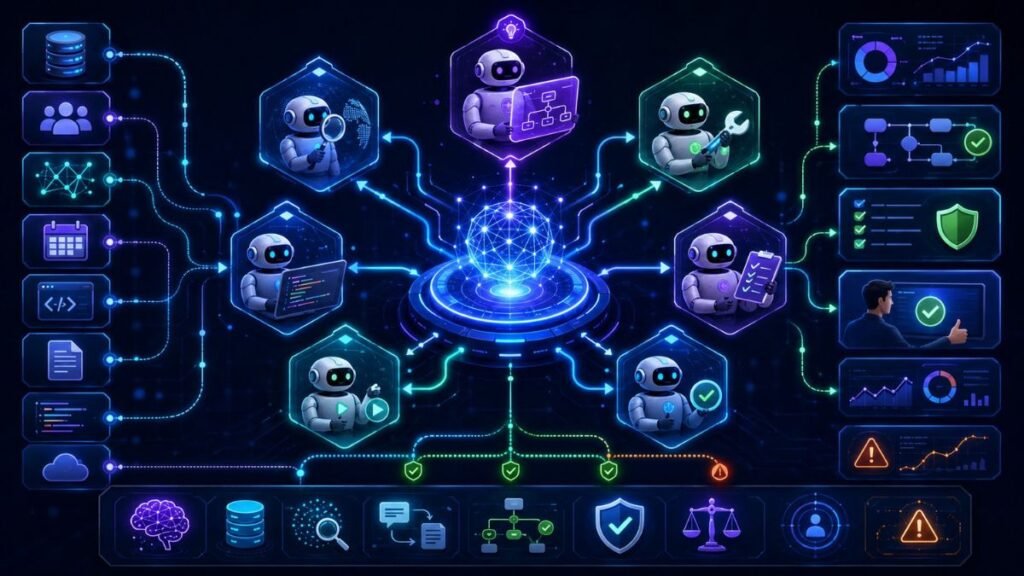
Orchestration in agentic AI systems is the coordination layer that decides what happens next, which agent or tool should act, what context is needed, when to pause, and when to escalate. It turns individual AI agents, tools, memory, retrieval, and workflows into one controlled system that can complete multi-step tasks.
In Simple Terms
Agentic AI orchestration is like a project manager for AI agents.
A single AI agent may be able to reason and use tools. But a real agentic AI system often needs more structure. It must route tasks, manage tool calls, pass context, track state, coordinate handoffs, and stop unsafe actions.
Without orchestration, agents can become scattered, repetitive, or risky.
What Is Agentic AI Orchestration?
Agentic AI orchestration is the process of coordinating agents, tools, workflows, memory, context, and actions so an AI system can complete a goal reliably.
IBM describes agentic workflows as AI-driven processes where autonomous agents make decisions, take actions, and coordinate tasks with minimal human intervention. IBM also defines agentic AI as systems that accomplish goals with limited supervision and notes that in multi-agent systems, each agent performs a subtask while their efforts are coordinated through AI orchestration.
In practical terms, orchestration answers questions such as:
- Which step should happen first?
- Which agent should handle this task?
- Which tool should be called?
- What context should be passed forward?
- When should the workflow pause for approval?
- How should errors, retries, and failures be handled?
Orchestration vs a Single AI Agent
A single AI agent can sometimes complete a task alone. It may read the user request, select a tool, retrieve context, and generate an answer.
Orchestration becomes more important when the system has multiple steps, multiple tools, long-running state, approval gates, or several specialized agents.
| Feature | Single Agent | Orchestrated Agentic System |
| Main unit | One AI agent | Agents, tools, workflows, memory, and controls |
| Best for | Simple tool-using tasks | Multi-step workflows and production systems |
| State handling | Limited or local | Shared, persistent, or workflow-level |
| Tool use | Agent selects tools | Orchestrator routes and validates tool calls |
| Handoffs | Minimal | Agent-to-agent or agent-to-human handoffs |
| Risk control | Basic guardrails | Approval gates, logs, permissions, rollback |
The more business-critical the workflow becomes, the more orchestration matters.
Workflows vs Agents: The Core Distinction
A key idea in orchestration is the difference between workflows and agents.
LangGraph’s documentation explains that workflows follow predetermined code paths and operate in a defined order, while agents are dynamic and define their own processes and tool usage.
This distinction helps teams decide how much autonomy to allow.
Use a workflow when the process is known: receive form, validate fields, call database, generate response, ask for approval.
Use an agent when the process must adapt: investigate issue, decide which tools to use, compare evidence, retry if needed, and escalate uncertainty.
Many production systems combine both. A workflow provides guardrails, while agents handle flexible decision points.
The Main Layers of Agentic AI Orchestration
A strong agent orchestration system usually includes these layers:
| Layer | What It Does |
| Goal router | Understands the user’s objective |
| Task planner | Breaks the goal into steps |
| Agent router | Selects the right agent or specialist |
| Tool router | Chooses tools and validates arguments |
| Context manager | Passes relevant memory, retrieval, and tool results |
| State manager | Tracks progress across steps |
| Handoff manager | Moves work between agents or humans |
| Safety layer | Applies permissions, approvals, and guardrails |
| Observability layer | Records traces, cost, latency, and failures |
These layers can be implemented manually, through frameworks, or through managed agent platforms.
How Tool Orchestration Works
Tool orchestration decides which external capability the agent should use and when.
A tool might be a database query, CRM lookup, calendar action, code runner, document search, email draft tool, browser action, or internal API.
AWS’s agentic AI orchestration guidance contrasts traditional hardcoded integration logic with agentic orchestration, where the agent chooses tools at runtime based on intent and context.
For example, a customer-support agent might choose:
- Order lookup tool for shipment issues.
- Refund policy search for billing issues.
- CRM history for account-specific context.
- Human approval tool for refunds or account changes.
Good tool orchestration should validate tool arguments, restrict permissions, log results, and prevent unsafe actions.
How Multi-Agent Orchestration Works
Multi-agent orchestration coordinates several specialized agents.
One agent may plan. Another may retrieve information. Another may write. Another may review. Another may execute approved actions.
OpenAI’s orchestration documentation covers multiple-agent patterns such as handoffs and agents-as-tools, where one agent can transfer control or call another specialist as part of a workflow. Microsoft’s Agent Framework also supports single-agent and multi-agent patterns with state management, telemetry, type safety, filters, and graph-based workflows.
A multi-agent support workflow might include:
- A triage agent.
- A policy-checking agent.
- A response-drafting agent.
- A quality-review agent.
- A human approval step.
The goal is not to add more agents for complexity’s sake. The goal is to split work only when specialization improves reliability.
Handoffs: Moving Work Between Agents and Humans
Handoffs are central to orchestration.
A handoff happens when one agent passes control, context, or a task to another agent or to a human reviewer. Handoffs matter because not every task should be handled by the same agent, and not every action should be automated.
Google Cloud’s multi-agent architecture guidance recommends human-in-the-loop flows for business-critical agentic AI systems so human supervisors can monitor, override, and pause agents when needed.
Handoffs should include enough context for the next actor to continue safely: task goal, evidence, tool results, current state, confidence level, and reason for escalation.
State and Memory in Orchestration
Orchestration also manages state. State is the record of what has happened so far.
A coding agent needs to know which files were inspected and which tests failed. A support agent needs to know whether the order lookup already happened. An operations agent needs to know which logs were checked and which runbook was used.
LangGraph is often used for stateful orchestration because its documentation describes it as a framework for durable execution, persistence, streaming, debugging, and deployment for agents and workflows. Its GitHub page describes LangGraph as a low-level orchestration framework for long-running, stateful agents.
Without state, agents repeat work, lose context, or make inconsistent decisions.
Example: Orchestration in a Customer Support Agent
A user says, “I was charged twice. Please fix it.”
The orchestrated workflow may work like this:
- The goal router classifies the issue as billing.
- The planner decides to check payment history and refund policy.
- The tool router calls the payment lookup tool.
- The context manager adds the refund policy.
- The agent drafts a customer response.
- The safety layer blocks automatic refund approval.
- The workflow hands off to a human supervisor.
- The observability layer records the trace.
This is orchestration because the system controls the whole path, not just the model response.
Common Orchestration Patterns
| Pattern | Best For | Example |
| Sequential workflow | Known step order | Intake → retrieve → draft → review |
| Router pattern | Different task types | Billing vs technical vs sales |
| Planner-executor | Flexible tasks | Plan steps, then execute them |
| Multi-agent handoff | Specialist roles | Researcher → writer → reviewer |
| Human-in-the-loop | Risky actions | Approve refund or code merge |
| Supervisor agent | Coordinating agents | Manager agent assigns subtasks |
The best pattern depends on how predictable the task is and how much risk the workflow carries.
Risks of Poor Agentic Orchestration
Poor orchestration can create serious failures.
An agent may call the wrong tool, loop through unnecessary steps, pass incomplete context, ignore approval rules, or hand off a task without enough information. In multi-agent systems, agents may duplicate work, disagree, or lose context between roles.
Recent research on AgentX notes that agentic systems often struggle with numerous tools, complex multi-step tasks, and long-context management, which can increase hallucination risk and workflow instability.
Strong orchestration reduces these risks by adding clear routing, state management, limits, approvals, and observability.
Suggested Read:
- What Is Agentic AI? A Practical Guide for Beginners
- What Is an AI Agent? A Simple Explanation With Examples
- Agentic AI Architecture Explained Simply
- The Core Building Blocks of an Agentic AI System
- Single-At vs Multi-Agent Systems in Agentic AI
- Best Agentic AI Frameworks for Developers in 2026
- How to Evaluate Agentic AI Systems
- Observability for Agentic AI: What Teams Need to Track
FAQ: How Orchestration Works in Agentic AI Systems
How does orchestration work in agentic AI systems?
Orchestration coordinates goals, agents, tools, memory, state, handoffs, feedback, human approval, and monitoring so the system can complete multi-step tasks safely.
What is agentic AI orchestration?
Agentic AI orchestration is the control layer that manages how AI agents plan, choose tools, pass context, take actions, and coordinate work across a workflow.
Why do AI agents need orchestration?
They need orchestration because multi-step tasks require routing, state tracking, tool validation, approvals, error handling, and observability.
What is the difference between workflows and agents?
Workflows follow predetermined paths. Agents dynamically choose steps and tools based on context, goal, and intermediate results.
How do AI agents coordinate tools?
Agents coordinate tools through tool routers, schemas, permissions, validation, execution logs, and feedback loops.
What are the risks of poor agent orchestration?
Risks include wrong tool calls, loops, context loss, weak handoffs, duplicated work, unsafe actions, poor observability, and high cost.
Final Takeaway
How orchestration works in agentic AI systems comes down to coordination. Orchestration decides which agent acts, which tool runs, what context moves forward, when humans review, and how the workflow stays observable and safe.
To continue learning, read Agentic AI Architecture Explained, The Core Building Blocks of an Agentic AI System, and How to Evaluate Agentic AI Systems next.