
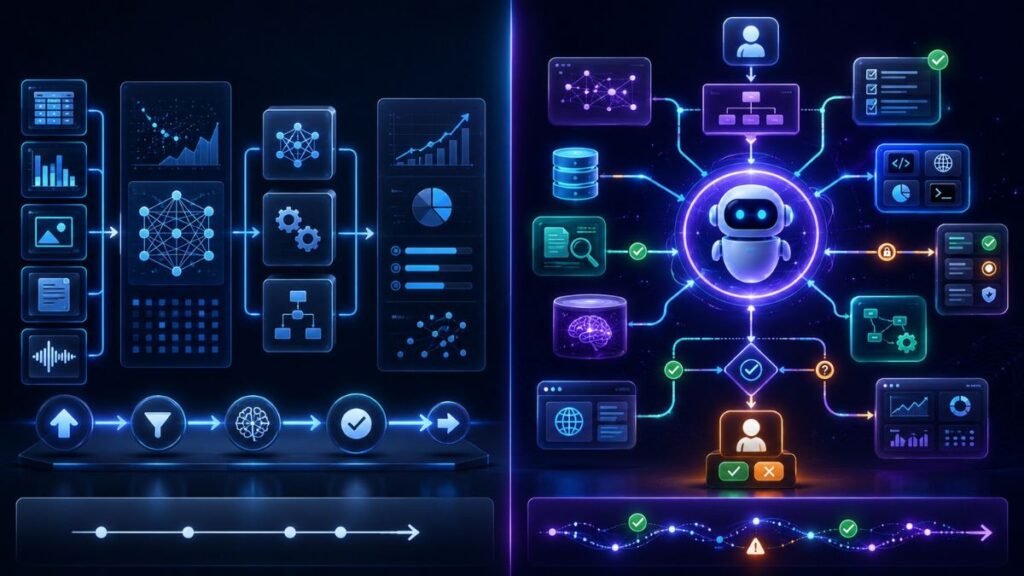
Agentic AI explained simply: it is AI that can pursue a goal, plan steps, use tools, remember context, take actions, and check results with limited human supervision. Traditional AI usually analyzes data, follows rules, or predicts outcomes. Agentic AI goes further by turning goals into actions inside workflows.
In Simple Terms
Traditional AI is usually built to recognize, classify, predict, or generate. It might detect fraud, recommend a product, classify an image, or answer a question.
Agentic AI is built to act toward a goal. It can decide what step comes next, call tools, retrieve information, update systems, and ask for human approval when needed.
The simple difference is this: traditional AI helps with a task; agentic AI can work through a task.
What Is Agentic AI?
Agentic AI is a type of AI system designed around agency. That means it can pursue a goal, make decisions, use tools, and complete multi-step workflows within defined boundaries.
IBM defines agentic AI as an AI system that can accomplish a specific goal with limited supervision. Google Cloud describes agentic AI as an advanced form of AI focused on autonomous decision-making and action, unlike traditional AI that mainly responds to commands or analyzes data.
For example, a normal AI tool may summarize a customer email. An agentic AI system may read the email, classify the issue, check customer history, retrieve the refund policy, draft a response, and route the case to a human if approval is needed.
What Is Traditional AI?
Traditional AI is a broad term, but it usually refers to AI systems designed for specific prediction, classification, optimization, or rule-based tasks.
Examples include:
- A fraud detection model that flags suspicious transactions.
- A recommendation engine that suggests products.
- A computer vision model that detects defects in images.
- A forecasting model that predicts demand.
- A rule-based chatbot that follows scripted paths.
Traditional AI can be very powerful, but it often works inside a fixed task boundary. It usually does not decide its own multi-step workflow or independently use many tools to complete a goal.
IBM defines artificial intelligence more broadly as technology that enables computers and machines to simulate human learning, comprehension, problem solving, decision-making, creativity, and autonomy. Agentic AI is one newer branch of that broader AI landscape.
Agentic AI vs Traditional AI: Quick Comparison
| Feature | Traditional AI | Agentic AI |
| Main purpose | Analyze, classify, predict, or generate | Complete goal-driven workflows |
| Interaction style | Input → output | Goal → plan → tool use → action → feedback |
| Autonomy | Usually low or narrow | Higher, but should be controlled |
| Tool use | Often limited or fixed | Central to many systems |
| Memory | Usually task-specific | Can use task, user, or workflow memory |
| Best for | Prediction, classification, automation | Multi-step tasks and workflow execution |
| Main risk | Wrong prediction or output | Wrong action, tool misuse, weak oversight |
Traditional AI is not obsolete. In many cases, it is simpler, cheaper, and safer. Agentic AI is useful when a workflow needs flexible planning and tool-based action.
How Agentic AI Works
Agentic AI usually works through a loop.
First, the system receives a goal. Then it breaks that goal into steps. Next, it gathers context, retrieves information, calls tools, takes an action, checks the result, and decides whether to continue, stop, or ask a human.
AI agents are the building blocks of many agentic systems. Google Cloud describes AI agents as software systems that pursue goals and complete tasks on behalf of users, showing reasoning, planning, memory, and autonomy. IBM similarly describes AI agents as systems that autonomously perform tasks by designing workflows with available tools.
A simple agentic workflow may look like this:
| Step | What Happens | Example |
| Goal | User gives objective | “Resolve this support ticket” |
| Planning | Agent breaks task into steps | Check account, retrieve policy |
| Context | Agent gathers information | Ticket history, product docs |
| Tool use | Agent calls systems | CRM, database, search |
| Action | Agent drafts or performs work | Write response |
| Feedback | Agent checks progress | Is issue resolved? |
| Handoff | Human reviews risky action | Approve refund |
How Agentic AI Differs From Traditional AI in Practice
The real difference appears in workflow behavior.
A traditional AI model might predict whether a customer is likely to churn. An agentic AI system could detect the churn risk, look up the customer’s account, summarize recent complaints, recommend an action, draft a retention email, and schedule a follow-up task.
A traditional AI model might classify a software bug. A coding agent could inspect the issue, search the codebase, propose a patch, run tests, and prepare a pull request for review.
A traditional AI model might read a document. A document agent could extract key fields, compare them with policy, flag exceptions, create a workflow task, and escalate uncertain cases.
This does not mean agentic AI is always better. It means it operates at a different level: workflow execution rather than only model output.
Real-World Examples of Agentic AI
In customer support, agentic AI can triage tickets, retrieve policy context, draft responses, and escalate sensitive cases.
In coding, AI agents can inspect repositories, suggest fixes, run tests, and prepare pull requests.
In operations, agents can gather logs, check runbooks, summarize incidents, and suggest remediation steps.
In research, agents can search sources, extract evidence, organize notes, and prepare structured briefings.
IBM describes AI agents as useful across functions beyond natural language processing, including decision-making, problem-solving, interacting with external environments, and performing actions. MIT Sloan also notes that agentic AI differs from familiar chatbots because it can integrate with other software systems to complete tasks independently or with minimal supervision.
When Traditional AI Is Still Better
Traditional AI is often better when the task is narrow, predictable, and does not require multi-step action.
Use traditional AI for fraud scoring, demand forecasting, image classification, recommendation systems, anomaly detection, and rule-based automation when the process is stable.
A simpler system is usually easier to test, monitor, and govern. If a fixed model or workflow solves the problem, adding an agent may increase complexity without adding value.
When Agentic AI Is Better
Agentic AI is better when the task requires multiple steps, flexible decisions, external tools, changing context, or human approval.
Good agentic AI use cases include support triage, coding assistance, research workflows, IT operations, document review, sales follow-up, and business process automation.
IBM describes agentic workflows as AI-driven processes where autonomous agents make decisions, take actions, and coordinate tasks with minimal human intervention, while traditional automation follows predefined rules and patterns.
The key question is: does the system need to act through a workflow, or only produce an output?
Risks and Limitations
Agentic AI introduces risks that traditional AI may not have. Because agents can use tools and take actions, mistakes can affect real systems.
Common risks include wrong tool calls, unsafe autonomy, stale memory, prompt injection, data leakage, looping behavior, poor escalation, and weak observability.
A 2026 survey on agentic AI architectures describes modern agents as systems that can perceive, reason, plan, act, use tools, and collaborate, while highlighting open challenges such as hallucination in action, infinite loops, and prompt injection.
The safest approach is to start with narrow, supervised use cases and add autonomy only after evaluation, monitoring, and governance are strong.
Common Mistakes Beginners Should Avoid
The first mistake is thinking agentic AI means fully autonomous AI. Most useful agentic AI systems are semi-autonomous and operate within boundaries.
The second mistake is treating every chatbot as agentic AI. A chatbot that only answers questions is not the same as an agent that plans and uses tools.
The third mistake is using agentic AI where traditional AI is enough. If a task is stable, rule-based, or low-context, simpler automation may be better.
Suggested Read:
- What Is Agentic AI? A Practical Guide for Beginners
- How Agentic AI Works: Planning, Memory, Tools, and Action
- Agentic AI Architecture Explained Simply
- Agentic AI vs Generative AI: What’s the Difference?
- Single-Agent vs Multi-Agent Systems in Agentic AI
- How to Evaluate Agentic AI Systems
- Agentic AI Security Risks You Should Understand
- Real-World Agentic AI Use Cases in Customer Support, Coding, and Operations
FAQ: Agentic AI Explained Simply: Beginner Guide
What is agentic AI in simple terms?
Agentic AI is AI that can pursue a goal, plan steps, use tools, remember context, take actions, and check results with limited human supervision.
How is agentic AI different from traditional AI?
Traditional AI usually analyzes, predicts, classifies, or generates outputs. Agentic AI can act through multi-step workflows using tools, memory, planning, and feedback.
Is agentic AI the same as AI agents?
Not exactly. AI agents are the software components that act. Agentic AI is the broader approach of building goal-driven systems around agents.
What can agentic AI do that traditional AI cannot?
Agentic AI can coordinate steps, use external tools, retrieve context, update workflows, and decide when to continue, stop, or escalate.
What are examples of agentic AI?
Examples include customer support agents, coding agents, research agents, IT operations agents, sales follow-up agents, and workflow automation agents.
What are the risks of agentic AI?
Risks include wrong actions, tool misuse, prompt injection, privacy leaks, hallucinations, infinite loops, weak monitoring, and poor human oversight.
Final Takeaway
Agentic AI explained simply: traditional AI helps analyze or generate outputs, while agentic AI helps complete goals through planning, memory, tool use, action, and feedback. It is powerful for multi-step workflows, but it needs clear boundaries, evaluation, security, observability, and human oversight.
To continue learning, read What Is Agentic AI?, How Agentic AI Works, and Agentic AI Architecture Explained next.