

LLM for Customer Support: How AI Is Transforming Support in 2026
Customer support teams face constant pressure to respond faster, reduce costs, and maintain high satisfaction. Customers expect instant answers across chat, email, apps, and social channels.
That is why many businesses are adopting Large Language Models (LLMs) for customer support.
LLMs can automate repetitive tasks, assist human agents, personalize responses, and improve customer experience at scale.
This guide explains how LLM for customer support works, key use cases, benefits, risks, and best practices.
In simple terms
An LLM for customer support is:
An AI system that understands customer questions and helps answer, route, summarize, or resolve support requests.
It can work through:
- chatbots
- email assistants
- agent copilots
- voice support tools
- help center search
- internal support dashboards
Think of it as a digital support teammate.
Why Customer Support is Ideal for LLMs
Support teams handle many repetitive tasks:
- order status questions
- password reset requests
- refund policies
- billing issues
- product FAQs
- ticket summaries
- multilingual requests
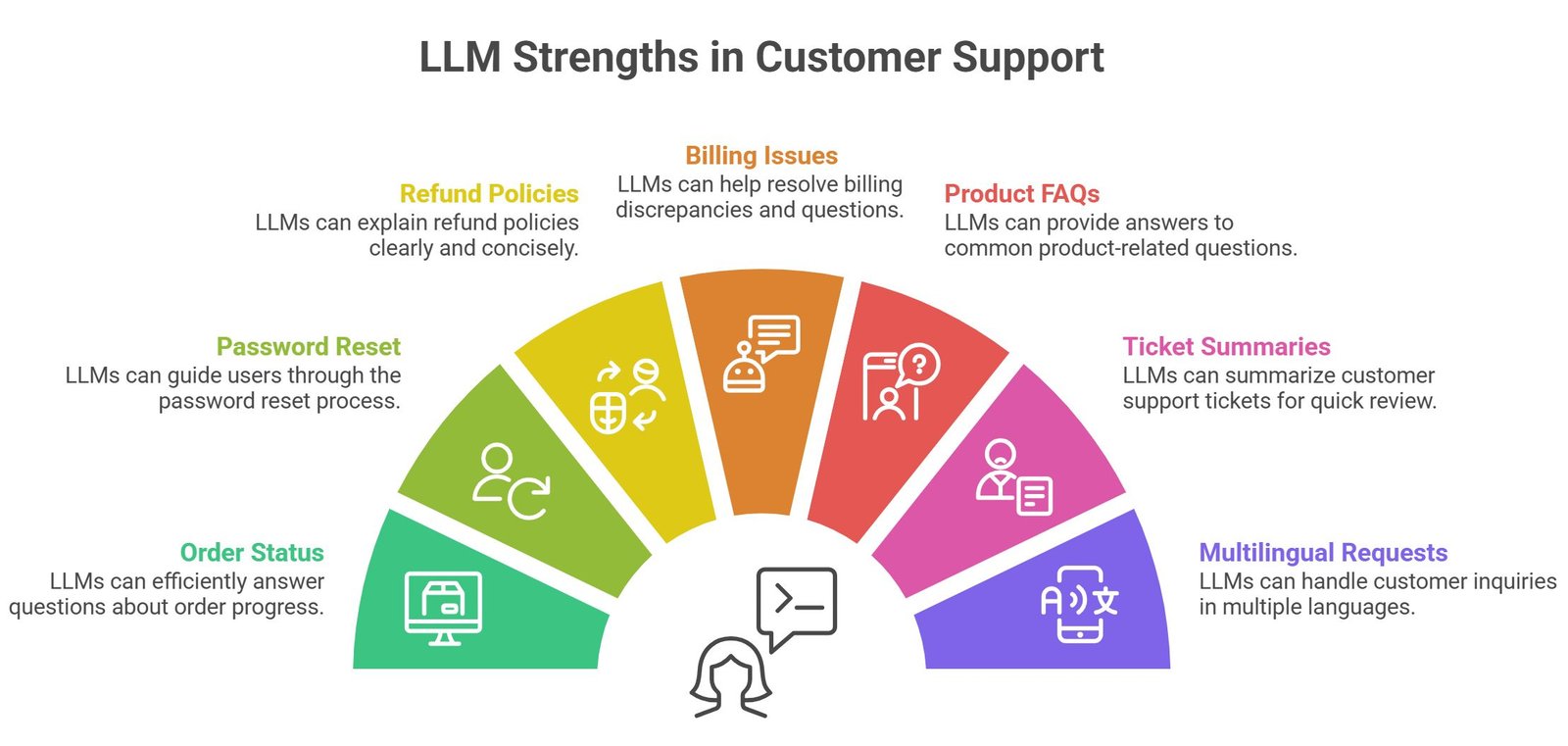
LLMs are strong at language-heavy repetitive workflows.
Easy analogy
Imagine a support team of 10 agents suddenly gaining 10 fast assistants who can draft replies, summarize tickets, search policies, and work 24/7.
That is the value LLMs can create.
Popular AI ecosystems businesses explore
Many companies evaluate customer support solutions using systems from:
The best option depends on privacy, pricing, quality, and integration needs.
Top Use Cases LLM for Customer Support
1. AI Chatbots
Handle common customer questions instantly.
Examples:
- shipping updates
- return policy
- account help
- product information
2. Agent Copilots
Assist human agents with:
- suggested replies
- knowledge search
- next best actions
- tone improvement
3. Ticket Triage
Automatically classify tickets by:
- urgency
- topic
- sentiment
- department
4. Email Response Drafting
Create first drafts for agents to review.
5. Conversation Summaries
Summarize long chat histories quickly.
6. Multilingual Support
Translate and respond across languages.
7. Help Center Search
Let customers ask natural language questions instead of browsing menus.
Major Benefits of LLMs in Support
Faster Response Times
Customers receive answers quickly.
Lower Support Costs
Reduce repetitive manual workload.
Better Agent Productivity
Agents focus on complex cases.
24/7 Availability
AI can assist outside office hours.
Consistent Answers
Responses align with policies when designed well.
Better Global Coverage
Support multiple languages efficiently.
LLM vs Traditional Chatbot
| Feature | Traditional Chatbot | LLM Support System |
| Scripted Replies | Yes | Sometimes |
| Natural Conversations | Limited | Strong |
| Context Awareness | Low | Higher |
| Personalization | Low | Better |
| Complex Queries | Weak | Stronger |
| Multilingual Ability | Limited | Strong |
Real Business Examples
Ecommerce Store
AI handles returns, shipping, and product questions.
SaaS Company
AI helps with onboarding and troubleshooting.
Banking Support
AI routes tickets and drafts responses.
Telecom Provider
AI handles billing and plan questions.
LLM for Customer Support: Common Risks and Limitations
Hallucinations
AI may provide incorrect policy answers.
Privacy Concerns
Sensitive customer data needs protection.
Over-Automation
Some customers prefer humans.
Poor Escalation Flows
Complex issues must reach agents quickly.
Tone Problems
Brand voice matters.
Best practices for success
1. Start With Repetitive Tickets
Good first ROI area.
2. Use Approved Knowledge Sources
Connect help docs and policies.
3. Keep Human Escalation Easy
Never trap users.
4. Monitor Quality
Track satisfaction and accuracy.
5. Protect Customer Data
Use secure systems.
6. Continuously Improve Prompts
Treat AI like a product.
Metrics to Track
| Metric | Why It Matters |
| First Response Time | Speed |
| Resolution Rate | Effectiveness |
| Escalation Rate | AI limits |
| CSAT Score | Customer happiness |
| Cost Per Ticket | ROI |
| Hallucination Incidents | Quality risk |
Best Support Tasks for Humans
Humans still excel at:
- emotional complaints
- negotiation
- exceptions
- relationship recovery
- high-value enterprise accounts
- complex troubleshooting
The best model is AI + humans.
Future of LLM customer support
Expect growth in:
- voice AI agents
- proactive support assistants
- personalized help journeys
- multilingual global support
- agent coaching copilots
- autonomous ticket resolution
Customer support may become one of the biggest LLM use cases.
Suggested Read:
- LLM Use Cases for Startups
- LLM Applications in Business
- LLM Monitoring
- LLM Safety Basics
- How to Reduce LLM Hallucinations
- LLM for Beginners
FAQ: LLM for Customer Support
Are LLMs good for customer support?
Yes, especially for repetitive language tasks.
Will AI replace support agents?
More often it augments agents than fully replaces them.
What is the best first use case?
FAQ chatbot or agent copilot.
Can LLMs handle multiple languages?
Yes, many systems can.
What matters most?
Accuracy, escalation design, and customer trust.
Final takeaway
LLMs are changing customer support by combining speed, scale, and better experiences. Businesses that use them well can lower costs while improving service quality.
The smartest approach is not AI instead of humans—it is AI working with humans.