
LLM Applications in Business: 20 Real Ways Companies Use Large Language Models
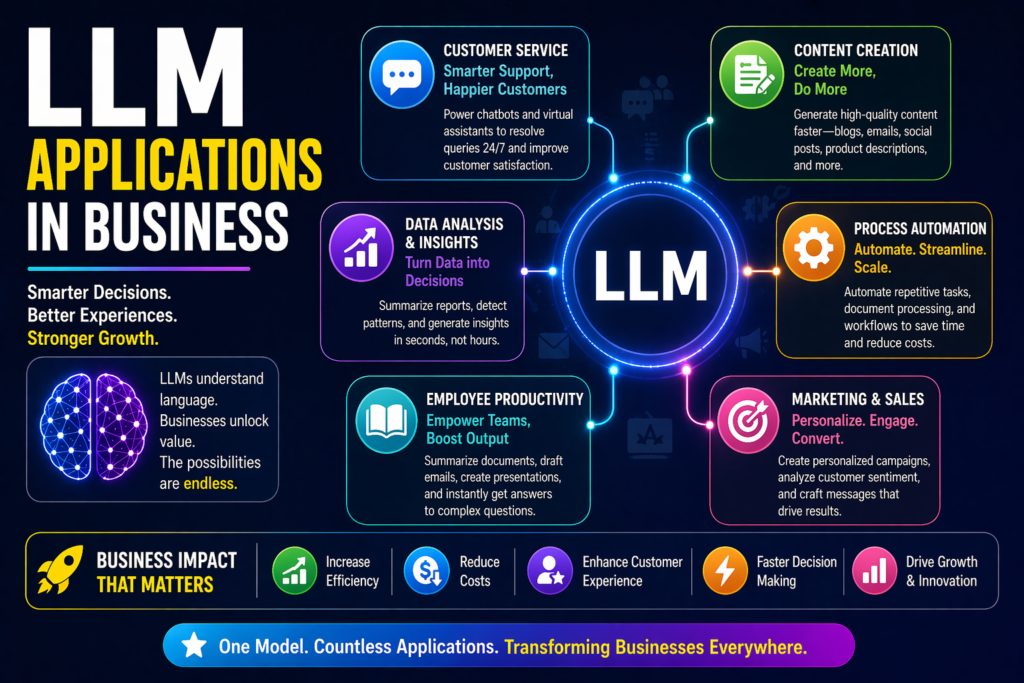
Large Language Models (LLMs) are transforming how companies work. Businesses now use them to automate repetitive tasks, improve customer service, generate content, speed up research, and help teams make faster decisions.
What started as chatbot technology has become a practical business tool across industries.
This guide explains the top LLM applications in business, real examples, benefits, and how companies can start using them strategically.
In simple terms
LLM applications in business are real-world uses of AI language models to improve productivity, reduce costs, and scale communication.
If a task involves text, knowledge, decisions, or communication, an LLM may help.
Why businesses are adopting LLMs fast
Companies like LLMs because one system can support many departments.
Benefits include:
- faster workflows
- lower operating costs
- better customer experiences
- improved employee productivity
- scalable content creation
- quicker access to knowledge
This flexibility drives rapid adoption.
20 Real LLM applications in business
Customer Support
1. AI Chat Support
Instant answers for FAQs, product queries, and onboarding.
2. Ticket Summaries
Condense long support threads for agents.
3. Smart Reply Suggestions
Help agents respond faster.
4. Multilingual Support
Translate and assist customers globally.
Marketing
5. Content Creation
Draft blogs, emails, landing pages, and product copy.
6. SEO Workflows
Keyword clustering, briefs, meta descriptions, FAQs.
7. Ad Copy Generation
Create campaign variations quickly.
8. Social Media Planning
Generate captions, calendars, and ideas.
Sales
9. Personalized Outreach
Create prospecting emails at scale.
10. CRM Note Summaries
Turn calls into action points.
11. Proposal Drafting
Generate first drafts for sales teams.
HR & Talent
12. Job Description Writing
Create better hiring content.
13. Resume Screening Support
Summarize candidate profiles.
14. Employee Helpdesk Bots
Answer internal HR questions.
Finance & Operations
15. Internal Reporting
Convert raw notes into management summaries.
16. Policy Q&A
Employees can ask finance or policy questions.
17. Workflow Documentation
Generate SOPs and internal guides.
Product & Technology
18. Code Assistance
Help engineering teams with coding tasks.
19. User Feedback Analysis
Summarize reviews and identify trends.
20. Internal Knowledge Assistants
Search company documents using natural language.
Which companies are building LLM tools?
Many business tools are powered by models from:
These models are integrated into SaaS products and enterprise platforms.
Best Departments for Early Adoption
| Department | Strong LLM Use Cases |
| Support | Chatbots, summaries |
| Marketing | Content, SEO, ads |
| Sales | Outreach, proposals |
| HR | Hiring, employee help |
| Ops | SOPs, documentation |
| Product | Feedback analysis |
Benefits of LLM Applications in Business
Save Time
Automate repetitive writing and research tasks.
Reduce Costs
Support leaner operations.
Scale Faster
Handle more demand without linear hiring.
Better Decisions
Quick summaries and insights.
Stronger Customer Experience
Faster, always-on responses.
Risks businesses should manage
LLMs are powerful but require controls.
Hallucinations
May generate wrong information.
Data Privacy
Sensitive company data must be protected.
Brand Risk
Outputs need quality review.
Compliance Issues
Regulated industries need stronger governance.
Change Management
Teams need training.
How businesses should start
Step 1: Pick one high-value workflow
Examples:
- support replies
- blog creation
- internal search
Step 2: Run a pilot
Measure results.
Step 3: Improve prompts
Refine instructions and workflows.
Step 4: Add human review
Especially customer-facing tasks.
Step 5: Scale winners
Expand successful use cases across departments.
LLM vs Traditional Automation
| Feature | LLM Systems | Traditional Automation |
| Handles language | Strong | Weak |
| Flexible tasks | Strong | Limited |
| Rule-based precision | Moderate | Strong |
| Creativity | Strong | None |
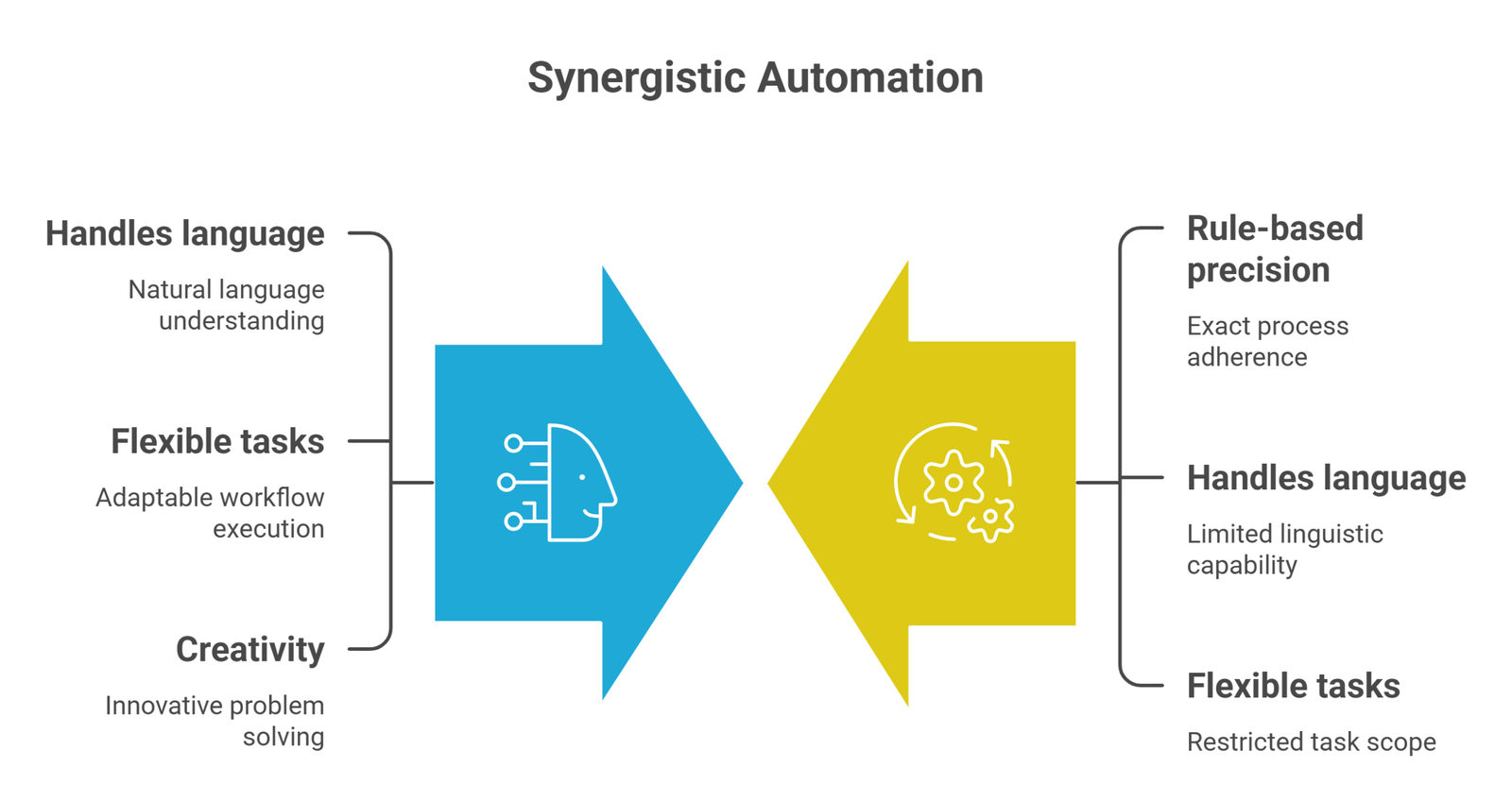
Best results often combine both.
Future LLM Business Applications
Expect growth in:
- AI coworkers
- autonomous service agents
- smarter enterprise search
- voice business assistants
- department-specific copilots
- AI decision support systems
Suggested Read:
- LLM for Beginners
- LLM Use Cases
- LLM Examples
- How LLMs Work
- Prompt Engineering Explained Simply
- How AI Agents Work Explained
FAQ: LLM Applications In Business
What are LLM applications in business?
Real ways companies use large language models to improve operations.
Which teams benefit most?
Support, marketing, sales, HR, and operations.
Are LLMs only for big companies?
No. Small businesses can use affordable tools too.
Can LLMs replace employees?
Usually they augment workers rather than replace entire teams.
What is the best first use case?
Choose repetitive, text-heavy workflows.
Final takeaway
LLM applications in business are growing because they create measurable value across many departments. From support and marketing to HR and operations, large language models help teams move faster and work smarter.
The best strategy is simple: start with one use case, prove ROI, then scale.