

Why LLMs Hallucinate: Causes, Examples & How to Reduce It
Large Language Models (LLMs) can answer questions, summarize reports, generate code, and write content in seconds. But they also have a known weakness:
Sometimes they produce answers that sound confident—but are wrong.
This behavior is called hallucination.
Understanding why LLMs hallucinate is essential for users, developers, and businesses deploying AI tools.
This guide explains hallucinations in simple language, including causes, examples, and practical ways to reduce them.
In simple terms
LLM hallucination means:
When an AI model generates false, misleading, or invented information as if it were true.
Examples:
- fake facts
- invented citations
- wrong summaries
- imaginary APIs in code
- incorrect calculations
- made-up product details
The answer may sound fluent, even when incorrect.
Why Hallucinations Happen
LLMs are not databases. They are prediction systems.
They generate the most likely next words based on patterns learned during training.
That means they optimize for:
- plausible language
- coherent responses
- pattern completion
They do not automatically verify truth before answering.
Easy analogy
Imagine a student who has read millions of books but is taking a test without internet access.
They remember patterns well, but if unsure, they may guess confidently.
That is similar to how hallucinations happen.
Main Reasons LLMs Hallucinate
1. Missing Knowledge
If the model lacks reliable knowledge on a topic, it may guess.
Especially common with:
- recent news
- niche subjects
- private company data
- rare technical issues
2. Prediction Over Verification
The model predicts text sequences, not truth labels.
Good grammar does not equal factual accuracy.
3. Ambiguous Prompts
Vague prompts create vague answers.
Example:
“Tell me about Mercury.”
Could mean:
- planet
- element
- car brand
- mythology
4. Overconfidence in Language Style
LLMs are trained to sound natural and helpful.
Sometimes that creates confident wording around uncertain content.
5. Weak Retrieval Systems
In RAG or search-connected systems, poor document retrieval can still lead to wrong answers.
6. Long Context Confusion
Very long conversations or documents may increase mistakes.
Real-world Examples of LLM Hallucinations
Wrong Facts
Incorrect dates, names, or statistics.
Fake Sources
Invented research papers or URLs.
Coding Errors
Non-existent functions or outdated syntax.
Legal Mistakes
Incorrect citations or precedent claims.
Business Summaries
Missing critical context or fabricating trends.
Why LLM Hallucinations Matter
For casual use, errors may be harmless.
For serious use, they can cause:
- financial mistakes
- legal risk
- poor decisions
- customer trust loss
- engineering bugs
- misinformation spread
That is why verification matters.
Which AI ecosystems work on reducing this?
Many providers actively improve reliability, including:
Reducing hallucinations is a major industry focus.
How to Reduce LLM Hallucinations
1. Use Better Prompts
Be specific.
Instead of:
“Explain taxes.”
Use:
“Explain basic income tax filing for freelancers in India.”
2. Ask for Sources
Request citations or evidence.
3. Use RAG Systems
Connect the model to trusted documents.
4. Break Complex Tasks into Steps
Smaller tasks reduce confusion.
5. Use Human Review
Critical outputs should be checked.
6. Ask the Model to State Uncertainty
Prompt:
“If unsure, say you are unsure.”
7. Compare Multiple Answers
Useful for sensitive workflows.
Hallucinations vs lying
These are different.
| Term | Meaning |
| Hallucination | Incorrect output due to prediction errors |
| Lying | Intentional deception |
LLMs do not “intend” deception like humans.
Hallucinations vs Bias
Bias means unfair or skewed patterns.
Hallucination means fabricated or false information.
A model can have one, both, or neither in a specific response.
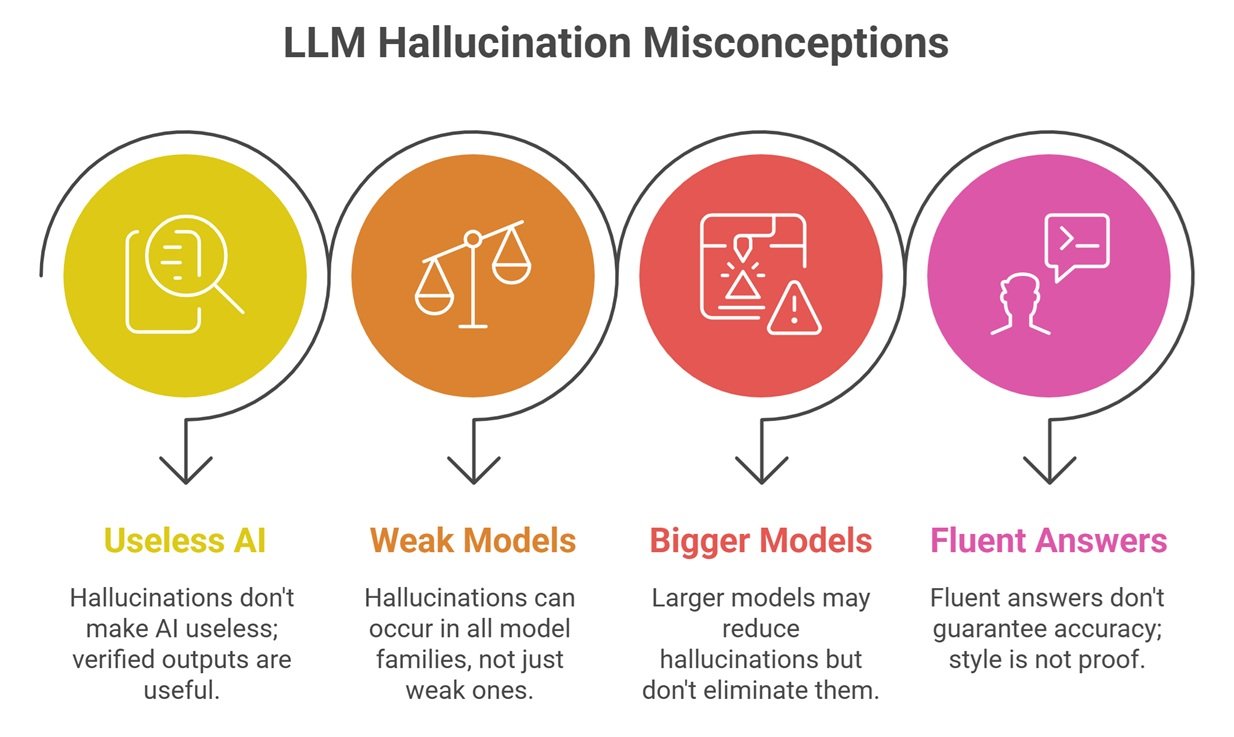
Why LLMs Hallucinate: Common Misconceptions
Hallucinations mean AI is useless
No. Many outputs are highly useful when verified.
Only weak models hallucinate
All model families can hallucinate.
Bigger models never hallucinate
Larger models may improve, but not eliminate the issue.
Fluent answers are accurate
Style is not proof.
Best use cases despite hallucination risk
LLMs still excel at:
- brainstorming
- drafting
- summarization with review
- coding assistance with testing
- customer support with guardrails
- search copilots with citations
Future of hallucination reduction
Expect progress in:
- retrieval-first AI systems
- better uncertainty estimation
- stronger reasoning checks
- tool-using AI agents
- automatic fact verification
- domain-specific trusted models
Hallucinations may reduce, but likely not disappear fully.
Suggested Read:
- How LLMs Work
- LLM for Beginners
- Domain Specific Language Models
- LLM Fine Tuning Basics
- Multimodal LLMs
- Prompt Engineering Explained Simply
FAQ: Why LLMs Hallucinate
Why do LLMs hallucinate?
Because they predict likely text patterns rather than guaranteed truth.
Can hallucinations be removed completely?
Probably not completely, but they can be reduced.
Are hallucinations dangerous?
They can be in high-stakes use cases.
Do all AI models hallucinate?
Yes, to varying degrees.
What is the best defense?
Good prompting, retrieval systems, and human review.
Final takeaway
LLM hallucinations happen because language models generate plausible answers, not perfect truth. They are powerful tools—but not infallible sources.
Use AI for speed and productivity, but apply verification where accuracy matters most.