
Why Agentic AI Is More Than a Chatbot Upgrade: Goals, Tools, Workflows, Memory, Autonomy, and Human Oversight Explained
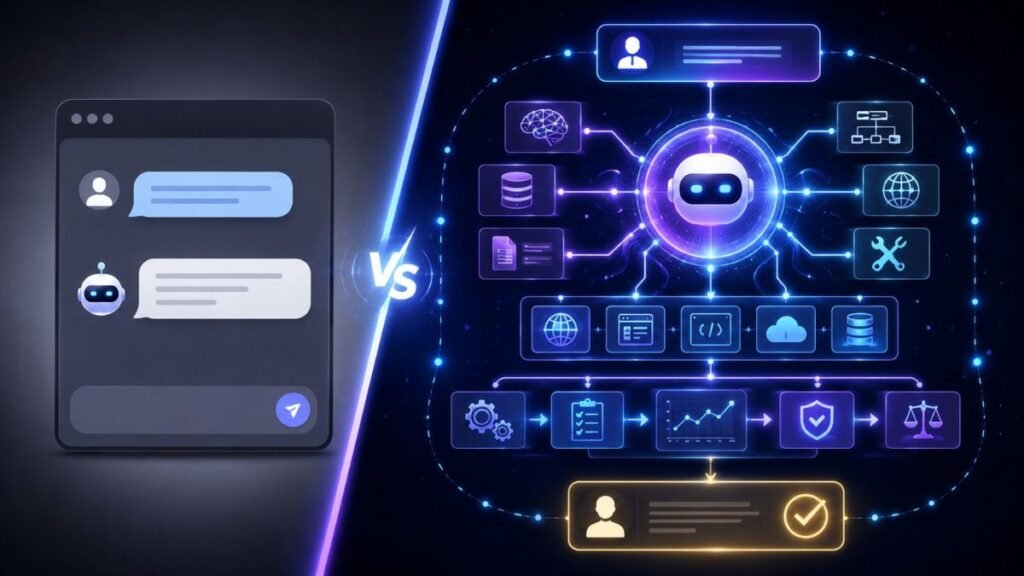
Agentic AI is more than a chatbot upgrade because it changes AI from a conversation tool into a goal-driven workflow system. A chatbot mainly answers questions. Agentic AI can plan steps, use tools, retrieve context, remember task state, take actions, evaluate results, and escalate decisions when human review is needed.
In Simple Terms
A chatbot is designed for conversation. It responds to what the user asks.
Agentic AI is designed for task progress. It takes a goal, decides what should happen next, uses tools, and works through a process.
For example, a chatbot can explain a refund policy. An agentic AI system can check the order, retrieve the policy, draft a response, create a ticket, and ask a human to approve the refund.
What Is a Chatbot?
A chatbot is a conversational interface that answers questions, guides users, or helps them find information. Some chatbots are rule-based. Others use large language models to generate more natural responses.
Chatbots are useful for FAQs, onboarding, product guidance, support deflection, internal knowledge search, and simple customer conversations. They are often easier to deploy than agentic AI because they usually do not need deep tool access or action permissions.
A chatbot becomes more advanced when it uses retrieval, memory, or integrations. But it is still not necessarily agentic unless it can pursue a goal through adaptive steps and controlled action.
What Is Agentic AI?
Agentic AI refers to AI systems that can act toward goals with some degree of autonomy. Google Cloud describes agentic AI as focused on autonomous decision-making and action, where systems can set goals, plan, and execute tasks with minimal human intervention.
AI agents are often the working components inside agentic systems. IBM defines an AI agent as a system that autonomously performs tasks by designing workflows with available tools.
That tool-and-workflow part is the key. Agentic AI is not just a better answer box. It is a system that can connect reasoning to action.
Agentic AI vs Chatbots: Quick Comparison
| Feature | Chatbot | Agentic AI |
| Main purpose | Conversation and answers | Goal-driven task completion |
| Interaction style | User asks, bot responds | User gives goal, agent works through steps |
| Tool use | Optional or limited | Usually central |
| Planning | Usually minimal | Core capability |
| Memory | Often session-based | Can maintain task or workflow state |
| Autonomy | Low | Controlled, task-specific autonomy |
| Best for | FAQs, guidance, support answers | Multi-step workflows and business actions |
| Main risk | Wrong or unhelpful answer | Wrong action, tool misuse, poor oversight |
A chatbot is often the right choice when conversation is enough. Agentic AI is useful when the system must do work beyond the chat window.
Why Agentic AI Is Not Just a Better Chat UI
The interface may still look like chat, but the system underneath is different.
A chatbot may receive a prompt and generate a response. An agentic AI system may receive a goal and create a plan. It may retrieve documents, call APIs, update records, use a browser, run checks, and wait for approval.
A useful way to think about it is:
Chatbots manage interaction. Agentic AI manages progress.
That difference matters for product design, security, governance, evaluation, and business value.
1) Agentic AI Has Goal Ownership
A chatbot usually waits for user instructions. Agentic AI can take partial ownership of the next step.
If a user says, “I need help with a failed payment,” a chatbot may explain common payment issues. An agentic support system can classify the case, check transaction status, retrieve the payment policy, and decide whether escalation is needed.
A developer article on agentic systems describes the key difference as ownership of the next step: observe the current state, decide what to do next, execute an action, evaluate the result, and repeat until a condition is met.
This is why agentic AI feels less like a Q&A system and more like a workflow participant.
2) Agentic AI Uses Tools to Act
Tool use is where agentic AI becomes operational. Tools may include databases, CRMs, calendars, help desks, code runners, search systems, vector databases, document stores, or internal APIs.
IBM describes agentic workflows as AI-driven processes where autonomous agents make decisions, take actions, and coordinate tasks with minimal human intervention. These workflows use reasoning, planning, and tool use to execute complex tasks.
A chatbot that answers from a help-center article is useful. An AI agent that checks account status, retrieves policy, drafts a response, and updates a ticket is a different class of system.
3) Agentic AI Needs Memory and State
Chatbots often use short session context. Agentic AI may need task state.
Task state means the agent knows what it has already done, what tools returned, what the user approved, and what still needs to happen. For longer workflows, this state matters more than conversational memory.
For example, a coding agent should remember that it already ran tests and which test failed. A support agent should remember that it already checked the order and found a duplicate charge. Without state, the agent can repeat steps, miss progress, or produce inconsistent outputs.
4) Agentic AI Can Coordinate Workflows
A chatbot usually handles one conversational turn at a time. Agentic AI can coordinate multi-step work.
In customer support, it can triage a ticket, retrieve policy, summarize context, suggest a reply, and escalate risky cases. In coding, it can inspect an issue, search files, propose a patch, run tests, and prepare a pull request. In operations, it can gather logs, check runbooks, summarize likely causes, and draft incident updates.
Recent enterprise activity shows the direction clearly. Reuters reported that Meta launched an enterprise-focused AI Business Agent for daily operations such as customer inquiries, lead qualification, appointment booking, and forwarding complex issues to human staff.
These are not just chat tasks. They are operational workflows.
When a Chatbot Is Still Better
Agentic AI is not always the right answer. A chatbot is often better when the task is simple, low-risk, and conversation-focused.
Use a chatbot for FAQs, basic product guidance, onboarding, policy lookup, internal knowledge search, and simple lead capture. Chatbots are easier to test, cheaper to run, and safer when users only need answers.
If a simple chatbot solves the problem, adding agentic AI may create unnecessary complexity.
When Agentic AI Is Better
Use agentic AI when the task requires action, not just explanation.
Good use cases include customer support triage, coding assistance, sales follow-up, IT operations, research workflows, document processing, scheduling, and back-office automation.
The key question is: does the AI need to decide and do, or only answer and guide?
If the system needs to use tools, manage state, complete a workflow, and escalate exceptions, agentic AI is a stronger fit.
Why This Matters for Businesses
For business teams, the difference changes buying decisions.
A chatbot platform may improve customer interaction. An agentic AI system may reshape the workflow behind that interaction. That means teams need to evaluate permissions, data access, integrations, observability, security, and accountability.
This also changes success metrics. Chatbots are often measured by containment rate, answer helpfulness, and user satisfaction. Agentic AI should also be measured by task completion, tool-call accuracy, escalation quality, cost per workflow, and human override rate.
Risks of Treating Agentic AI Like a Chatbot
The biggest mistake is deploying agentic AI with chatbot-level governance.
A chatbot that gives a bad answer may frustrate a user. An agent that takes the wrong action can affect accounts, code, payments, customer records, or compliance workflows.
Key risks include wrong tool calls, prompt injection, stale memory, data leakage, runaway loops, excessive autonomy, and weak observability.
This is why agentic AI needs stronger controls: least-privilege access, human approval for risky actions, audit logs, trace monitoring, evaluation datasets, and rollback plans.
Suggested Read:
- What Is Agentic AI? A Practical Guide for Beginners
- Agentic AI Explained Simply: How It Differs From Traditional AI
- Agentic AI vs AI Agents: Meaning, Key Differences, Architecture, Examples, and Real-World Use Cases
- How Agentic AI Works: Planning, Memory, Tools, and Action
- Agentic AI Architecture Explained Simply
- Agentic AI Governance: Risks, Controls, and Accountability
- Observability for Agentic AI: What Teams Need to Track
- Common Failure Modes in Agentic AI Systems
FAQ: Why Agentic AI Is More Than a Chatbot Upgrade
Why is agentic AI more than a chatbot upgrade?
Agentic AI is more than a chatbot upgrade because it can pursue goals, plan steps, use tools, remember task state, take actions, check results, and escalate decisions.
How is agentic AI different from a chatbot?
A chatbot mainly responds in conversation. Agentic AI works through a task or workflow using planning, tools, context, memory, and feedback.
Is agentic AI just a smarter chatbot?
No. It may use a chat interface, but the underlying system is different. Agentic AI is built for goal-driven workflow execution, not only better conversation.
What can agentic AI do that chatbots cannot?
Agentic AI can call tools, update systems, retrieve context, coordinate tasks, monitor progress, and ask for human approval before risky actions.
When should teams use agentic AI instead of a chatbot?
Use agentic AI when the workflow requires multi-step action, tool access, state, decision-making, or escalation. Use a chatbot when conversation and guidance are enough.
What are the risks of agentic AI compared with chatbots?
Agentic AI has higher risks because it can take actions. Risks include wrong tool use, data leaks, prompt injection, poor escalation, excessive autonomy, and weak monitoring.
Final Takeaway
Why agentic AI is more than a chatbot upgrade comes down to one difference: chatbots answer, while agentic AI progresses through goals. Agentic AI combines planning, tools, memory, action, feedback, and oversight to complete workflows that ordinary chatbots cannot safely handle alone.
To continue learning, read Agentic AI vs AI Agents, How Agentic AI Works, and Agentic AI Governance next.