
Tree of Thought Prompting Explained: How It Works With Examples
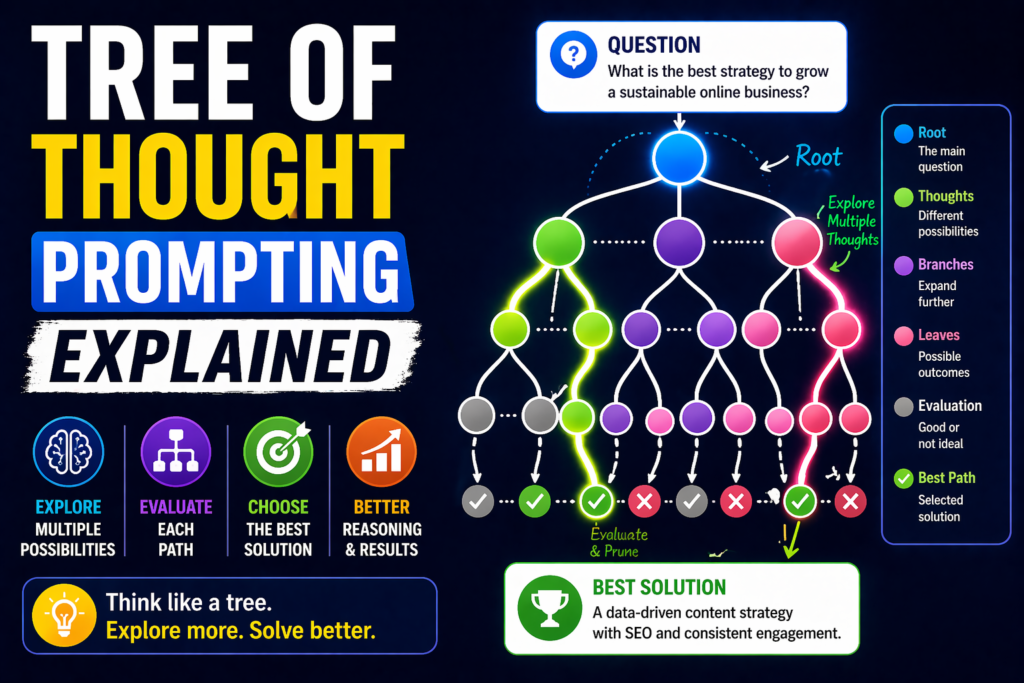
Tree of thought prompting is an advanced AI reasoning method that asks models to explore multiple possible solution paths before choosing the best answer.
Instead of following one straight line of reasoning, the model branches into different approaches, evaluates them, and selects the strongest result.
In this guide, you’ll learn what tree of thought prompting is, how it works, where to use it, and how to write better prompts.
In simple terms
Tree of thought prompting means:
Ask the AI to consider multiple ways to solve a problem, then choose the best one.
Instead of:
“Solve this business problem.”
Use:
“Generate three possible strategies, evaluate each one, then recommend the best option.”
That creates broader and smarter reasoning.
What is Tree of Thought Prompting?
Tree of thought prompting is a prompt engineering technique where an AI model explores several intermediate reasoning paths rather than one single chain.
The process usually includes:
- generating multiple ideas
- expanding strong options
- rejecting weak paths
- comparing outcomes
- selecting the best final answer
It is called “tree of thought” because reasoning branches like a tree.
Why Tree of Thought Prompting Works
Many complex problems have more than one possible solution. A single reasoning path may miss better options.
Tree of thought prompting helps by:
- exploring alternatives
- reducing premature answers
- improving creativity
- increasing decision quality
- handling ambiguous problems better
It is useful when there is no obvious one-step solution.
Simple Tree of Thought Prompting Examples
Example 1: Business Strategy
Prompt:
“Generate three ways to grow a new SaaS product. Evaluate cost, speed, and risk. Recommend the best option.”
Example 2: Travel Planning
Prompt:
“Suggest three travel itineraries for a 5-day Japan trip. Compare budget, convenience, and experience quality.”
Example 3: Problem Solving
Prompt:
“Find three ways to reduce customer churn for an ecommerce store. Analyze pros and cons of each.”
Example 4: Hiring Decision
Prompt:
“Evaluate three candidate profiles for a data analyst role using skills, experience, and communication.”
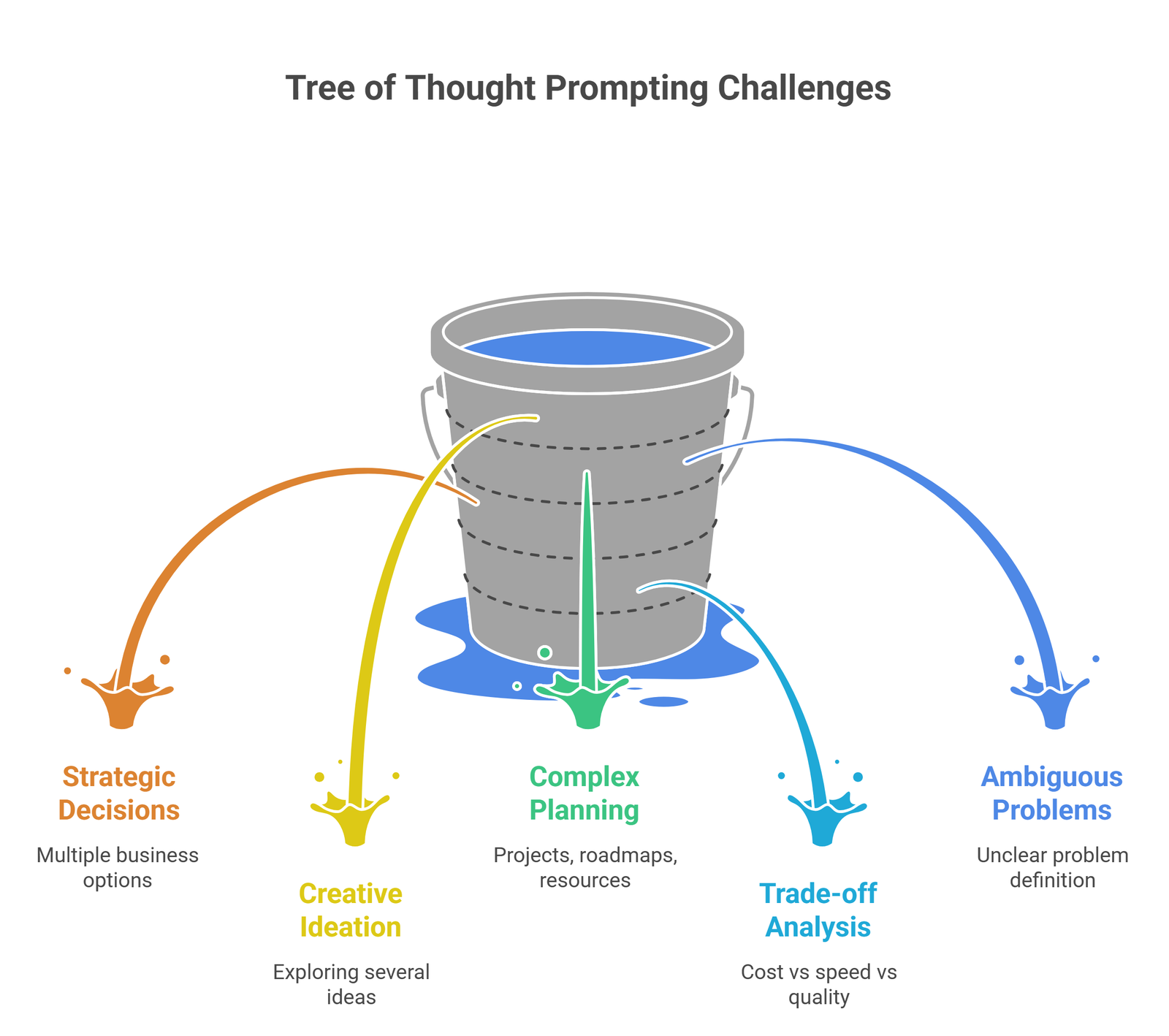
Best use cases for Tree of Thought Prompting
This method works best for:
1.Strategic decisions
Choosing between multiple business options.
2.Creative ideation
Exploring several ideas before selecting one.
3.Complex planning
Projects, roadmaps, resource allocation.
4.Trade-off analysis
Cost vs speed vs quality decisions.
5.Ambiguous problems
Situations with no single obvious answer.
Tree of Thought Prompting vs Chain of Thought Prompting
| Method | How It Works | Best For |
| Chain of Thought | One step-by-step path | Math, logic, sequential tasks |
| Tree of Thought | Multiple reasoning branches | Strategy, choices, complex planning |
| Zero Shot | Direct answer | Simple tasks |
If one reasoning path feels limiting, tree of thought can be stronger.
How to Write Better Tree of Thought Prompting
1.Ask for multiple options
Use:
- generate 3 approaches
- suggest several strategies
- create multiple solutions
2.Define evaluation criteria
Examples:
- cost
- speed
- risk
- quality
- scalability
3.Ask for ranking
Prompt:
“Rank the options from best to worst.”
4.Require explanation
Ask why one path wins.
5.Keep the number of branches reasonable
Three to five options usually works well.
Common mistakes
Too many branches
Creates messy outputs.
No evaluation criteria
Hard to compare options.
Using it for simple tasks
Not needed for basic summaries or rewrites.
No final decision step
Need a conclusion after exploration.
Blind trust in rankings
Always review important outputs.
Copy-paste Tree of Thought prompt Templates
Strategy
“Generate 3 strategies for [goal]. Evaluate each using [criteria]. Recommend the best option.”
Decision Making
“List 3 possible choices for [problem], compare pros and cons, then rank them.”
Planning
“Create 3 plans to achieve [goal] within [constraint]. Select the strongest plan.”
Creative Work
“Suggest 5 ideas for [topic], score originality and practicality, choose top 2.”
When not to use Tree of Thought Prompting
It may be unnecessary for:
- simple factual answers
- quick summaries
- grammar fixes
- short coding snippets
- direct classification tasks
Use it when comparing options or solving open-ended problems.
Suggested Read:
- What Is Prompt Engineering? Complete Beginner Guide
- Chain of Thought Prompting Explained
- Self Consistency Prompting Explained
- Prompt Engineering Best Practices
- Prompt Chaining Explained
- ChatGPT Prompting Guide
FAQ: Tree of Thought Prompting
What is tree of thought prompting?
A prompting method where AI explores multiple reasoning paths before choosing an answer.
How is it different from chain of thought?
Chain of thought follows one path. Tree of thought compares several paths.
Is it useful for ChatGPT?
Yes, especially for strategy, planning, and decision-making tasks.
Does it guarantee better answers?
No, but it often improves quality on complex tasks.
Final takeaway
Tree of thought prompting helps AI think more like a strategist. Instead of committing to one early answer, it explores several possible paths and chooses the strongest option.
For business decisions, planning, creativity, and complex reasoning, it can outperform simpler prompts.
If your problem has multiple possible answers, use tree of thought prompting