
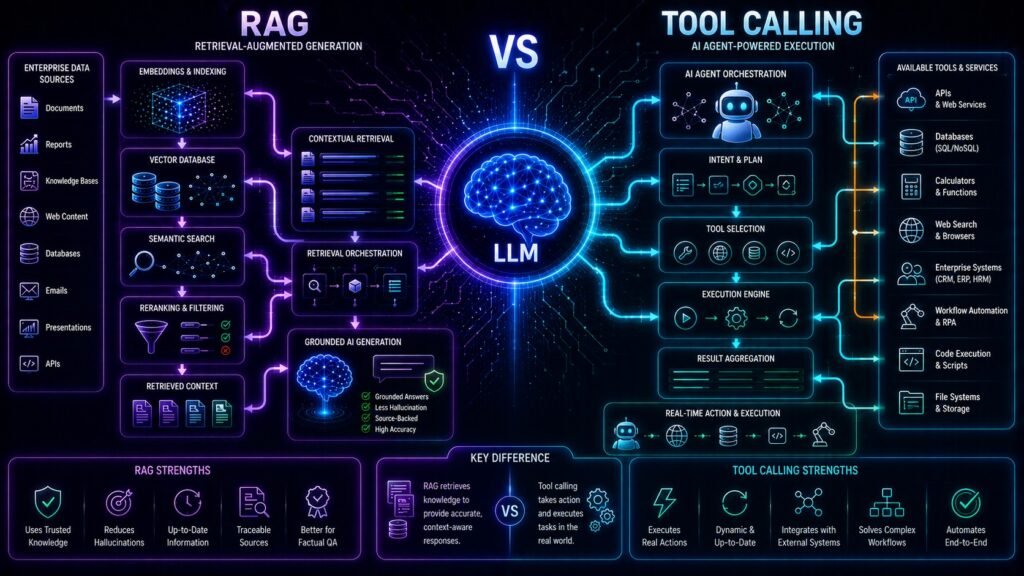
RAG vs Tool Calling: Which AI Architecture Works Better?
Modern enterprise AI systems are evolving rapidly beyond simple chatbots and standalone Large Language Models.
Organizations increasingly deploy advanced AI architectures across:
- enterprise AI assistants
- autonomous AI agents
- customer support copilots
- research automation systems
- enterprise workflow orchestration
- AI engineering assistants
- healthcare AI systems
- intelligent enterprise search platforms
As AI systems become more capable, enterprises face a major architectural decision:
Should AI systems rely on Retrieval-Augmented Generation (RAG) or tool calling?
This became one of the most important enterprise AI architecture debates because both approaches dramatically extend what Large Language Models can do.
However, they solve very different problems.
RAG focuses on:
- semantic retrieval
- contextual grounding
- enterprise search
- document-aware AI generation
- hallucination reduction
Tool calling focuses on:
- external system execution
- API interactions
- workflow automation
- dynamic actions
- real-time operations
Many organizations incorrectly assume:
“RAG and tool calling are competing technologies.”
That is not true.
In reality:
RAG and tool calling solve different AI capability gaps.
Understanding the differences between RAG and tool calling is essential because modern enterprise AI systems increasingly combine both approaches together.
Choosing the wrong architecture may lead to:
- hallucination risks
- unreliable AI automation
- weak enterprise search
- poor orchestration workflows
- scalability limitations
- operational inefficiencies
In this guide, you will learn how RAG and tool calling work, their strengths and weaknesses, enterprise use cases, hallucination implications, infrastructure trade-offs, AI agent orchestration patterns, and why hybrid AI architectures are rapidly becoming the future of enterprise AI systems.
In Simple Terms
What Is RAG?
Retrieval-Augmented Generation improves AI systems by retrieving external information before generating responses.
RAG systems use:
- embeddings
- vector databases
- semantic retrieval
- contextual search
- enterprise document retrieval
to ground AI responses using real information.
What Is Tool Calling?
Tool calling allows AI systems to interact with external tools and services dynamically.
Instead of only generating text, AI systems can:
- call APIs
- query databases
- perform calculations
- retrieve real-time data
- trigger workflows
- execute enterprise actions
This dramatically expands AI capabilities.
Easy Analogy
Imagine asking two employees for help.
A RAG-powered employee searches company documents before answering.
A tool-calling employee can actually:
- access enterprise software
- run calculations
- send emails
- retrieve live system data
- trigger workflows
before responding.
This is the core architectural difference.
Why Enterprises Compare RAG and Tool Calling
Modern enterprise AI systems increasingly require:
- grounded knowledge retrieval
- real-time data access
- enterprise workflow automation
- contextual reasoning
- semantic search
- autonomous orchestration
RAG improves retrieval and grounding.
Tool calling improves action execution and system integration.
Understanding how both systems differ is becoming increasingly important.
Understanding How RAG Works
RAG extends Large Language Models using semantic retrieval systems.
A modern RAG architecture usually includes:
- embeddings
- vector databases
- retrievers
- rerankers
- orchestration systems
- enterprise knowledge repositories
Before generation begins, the retriever finds relevant contextual information.
Core Components of RAG Systems
| Component | Purpose |
| Embeddings | Represent semantic meaning |
| Vector Database | Stores searchable embeddings |
| Retriever | Finds contextual information |
| Reranker | Improves retrieval quality |
| LLM | Generates grounded responses |
RAG primarily focuses on contextual knowledge access.
Understanding How Tool Calling Works
Tool calling enables AI systems to interact with external software systems.
Instead of only generating responses, the AI can execute actions dynamically.
Examples include:
- retrieving weather data
- querying CRMs
- accessing ERP systems
- checking inventory
- sending emails
- triggering automation workflows
The model decides when tools should be used.
Core Components of Tool Calling Systems
| Component | Purpose |
| LLM | Interprets tasks |
| Tool Registry | Defines available tools |
| APIs | Connect external systems |
| Orchestrator | Manages execution flow |
| External Systems | Perform real-world actions |
Tool calling focuses heavily on execution and orchestration.
Why RAG Became Important
Traditional LLMs struggle with:
- outdated information
- hallucinations
- weak enterprise grounding
- missing organizational knowledge
RAG solved these problems by introducing grounded retrieval.
Modern enterprises increasingly depend on RAG for:
- enterprise search
- document intelligence
- semantic retrieval
- contextual AI reasoning
Why Tool Calling Became Important
Traditional LLMs also struggle with:
- real-time system access
- executing workflows
- dynamic calculations
- operational automation
- interacting with enterprise software
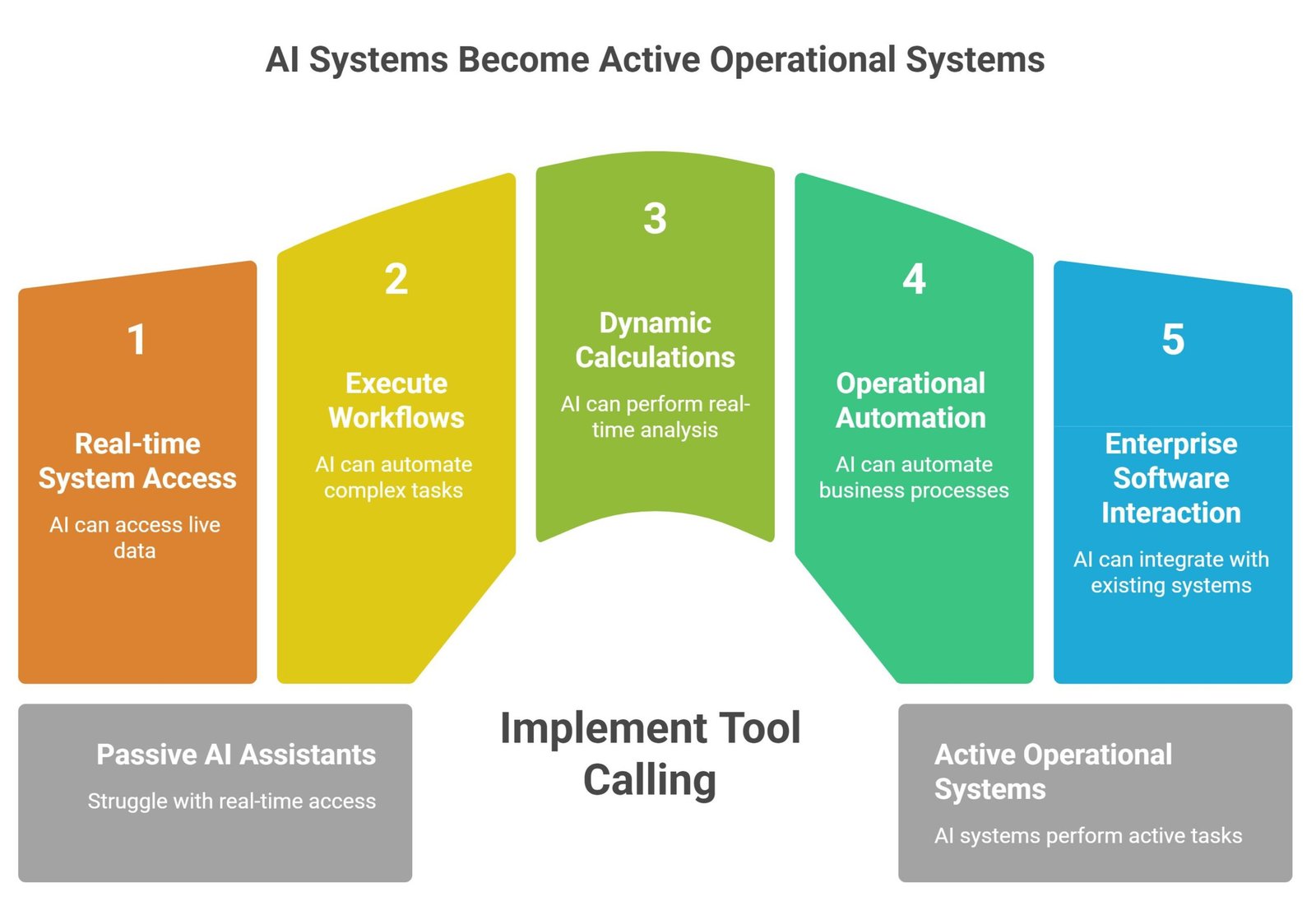
Tool calling solved these problems.This enabled AI systems to move from passive assistants to active operational systems.
Major Advantages of RAG
Better Grounded AI Generation
Retrieved evidence improves factual reliability.
Strong Semantic Retrieval
RAG improves contextual document search.
Better Enterprise Search
AI systems retrieve organizational knowledge effectively.
Reduced Hallucinations
External grounding improves answer quality.
Dynamic Knowledge Updates
Knowledge can update without retraining models.
Better Explainability
Retrieved evidence improves transparency.
Major Limitations of RAG
Despite its strengths, RAG has operational limitations.
Cannot Execute Actions
RAG retrieves information but cannot trigger workflows directly.
Retrieval Dependency
Weak retrieval reduces answer quality.
Increased Infrastructure Complexity
RAG systems require multiple infrastructure layers.
Latency Challenges
Retrieval pipelines increase processing overhead.
Monitoring Complexity
Production RAG systems require evaluation infrastructure.
Major Advantages of Tool Calling
Real-Time System Access
AI systems can access live enterprise data.
Workflow Automation
AI agents can trigger operational workflows.
Dynamic Execution Capabilities
AI systems can interact with external software.
Better Operational AI
Tool calling enables real enterprise automation.
Strong Agentic AI Support
AI agents rely heavily on tool orchestration.
Better Enterprise Integration
AI systems integrate with enterprise APIs and platforms.
Major Limitations of Tool Calling
Tool calling also introduces important challenges.
No Semantic Knowledge Retrieval
Tool calling does not inherently provide semantic grounding.
Hallucination Risks Still Exist
AI systems may misuse tools incorrectly.
Higher Security Complexity
External system access introduces operational risks.
API Dependency Problems
System reliability depends heavily on connected services.
Complex Orchestration Requirements
Tool orchestration may become difficult at scale.
RAG vs Tool Calling: Key Differences
| Category | RAG | Tool Calling |
| Primary Function | Retrieval | Action Execution |
| Core Capability | Semantic Search | External Operations |
| Grounded Knowledge Access | Excellent | Weak |
| Real-Time Actions | Weak | Excellent |
| Enterprise Search | Excellent | Weak |
| Workflow Automation | Limited | Strong |
| Hallucination Reduction | Strong | Moderate |
| API Integration | Limited | Excellent |
| AI Agent Support | Strong | Excellent |
| Infrastructure Complexity | High | High |
Why RAG Does Not Replace Tool Calling
One major misconception in enterprise AI is:
“RAG systems eliminate the need for tools.”
This is incorrect.
RAG retrieves information but cannot inherently:
- send emails
- update CRMs
- run workflows
- execute transactions
- interact with APIs
Tool calling remains essential for operational AI systems.
Why Tool Calling Does Not Replace RAG
Tool calling also has major limitations.
AI agents still need grounded contextual knowledge.
Tool calling alone cannot reliably solve:
- enterprise semantic search
- document retrieval
- contextual grounding
- knowledge retrieval
- hallucination reduction
This is why RAG remains foundational.
Why Hybrid Architectures Are Becoming the Future
Modern enterprise AI systems increasingly combine:
- RAG pipelines
- tool calling systems
- AI agents
- orchestration frameworks
- semantic retrieval
- workflow automation
This creates highly capable enterprise AI architectures.
Example Hybrid Enterprise AI Workflow
A modern AI assistant may:
- retrieve enterprise documentation using RAG
- analyze retrieved information
- call APIs dynamically
- update systems automatically
- generate grounded responses
This architecture combines retrieval and execution capabilities.
Example Enterprise Hybrid Architecture
| Layer | Purpose |
| Enterprise Documents | Knowledge source |
| Vector Database | Semantic retrieval |
| Retriever | Contextual search |
| Tool Layer | External execution |
| APIs | System integrations |
| LLM | Orchestrates workflows |
This architecture is rapidly becoming standard for enterprise AI.
Why AI Agents Depend on Both RAG and Tool Calling
Modern AI agents require both:
- grounded reasoning
- operational execution
RAG provides contextual grounding.
Tool calling enables real-world actions.
Together, they create highly capable autonomous AI systems.
Enterprise Use Cases for RAG
Enterprise Search Systems
Employees retrieve internal knowledge semantically.
Customer Support AI
AI systems retrieve troubleshooting documentation dynamically.
Legal AI Systems
RAG retrieves grounded contracts and regulations.
Healthcare AI Platforms
Medical systems retrieve updated clinical information.
Research Intelligence Systems
AI systems retrieve semantically related research documents.
Enterprise Use Cases for Tool Calling
Workflow Automation
AI systems automate enterprise operations dynamically.
CRM Integration
AI agents update customer systems automatically.
Ecommerce Operations
AI systems manage inventory and order workflows.
Financial Operations
AI systems trigger reporting and calculations.
DevOps Automation
AI agents interact with deployment infrastructure dynamically.
Why RAG Usually Reduces Hallucinations Better
Tool calling enables actions but does not inherently improve factual grounding.
RAG reduces hallucinations more effectively because retrieved evidence grounds generation.
However, weak retrieval pipelines may still produce incorrect outputs.
Retrieval quality remains critical.
Common Enterprise Mistakes
Many organizations misunderstand how retrieval and execution architectures should work together.
Treating RAG as Workflow Automation
RAG retrieves information but does not inherently execute operations.
Assuming Tool Calling Eliminates Hallucinations
Tool calling alone does not guarantee grounded reasoning.
Ignoring Security Risks
Tool-calling systems require strong permission controls.
Overengineering Agent Architectures Early
Not every enterprise workflow requires autonomous orchestration immediately.
Why Evaluation Matters for Both Architectures
Organizations increasingly benchmark:
- retrieval precision
- groundedness
- hallucination rates
- workflow reliability
- tool execution accuracy
- contextual relevance
- orchestration stability
Continuous evaluation improves enterprise AI reliability significantly.
Future of RAG and Tool Calling
Enterprise AI architectures are evolving rapidly.
Major trends include:
- agentic RAG systems
- autonomous AI agents
- GraphRAG architectures
- multimodal retrieval systems
- orchestration-aware retrieval
- adaptive tool routing
- grounded workflow automation
Future enterprise AI systems will increasingly combine:
- semantic retrieval
- grounded generation
- tool orchestration
- autonomous reasoning
- contextual memory
- enterprise automation
into unified AI architectures.
Suggested Read:
- What Is RAG in AI
- How RAG Works
- Agentic RAG Explained
- GraphRAG Explained
- RAG Monitoring
- Reducing Hallucinations in RAG
- RAG Evaluation Metrics
- LLM Plus RAG vs Standalone LLM
FAQ: RAG vs Tool Calling
What is the difference between RAG and tool calling?
RAG retrieves contextual information for grounded AI generation, while tool calling enables AI systems to execute external actions and workflows.
Can tool calling replace RAG?
No. Tool calling does not inherently provide semantic retrieval or grounded knowledge access.
Does RAG reduce hallucinations better than tool calling?
Yes. Retrieved contextual evidence improves factual grounding significantly.
Can AI systems use both RAG and tool calling together?
Yes. Modern enterprise AI systems increasingly combine both architectures.
Which is better for enterprise AI systems?
It depends on the use case. RAG excels at semantic retrieval, while tool calling excels at operational execution and automation.
Final Takeaway
Understanding RAG vs tool calling is essential because modern enterprise AI systems increasingly require both grounded retrieval and operational execution capabilities.
RAG improves semantic retrieval, contextual reasoning, enterprise search, and hallucination reduction, while tool calling enables AI systems to interact with external software, APIs, workflows, and enterprise platforms dynamically.
Organizations that understand how both architectures complement each other can build more scalable, intelligent, reliable, and production-ready enterprise AI systems.
That capability is becoming foundational for enterprise AI assistants, autonomous AI agents, workflow automation systems, semantic search architectures, customer support copilots, and next-generation grounded AI platforms.