
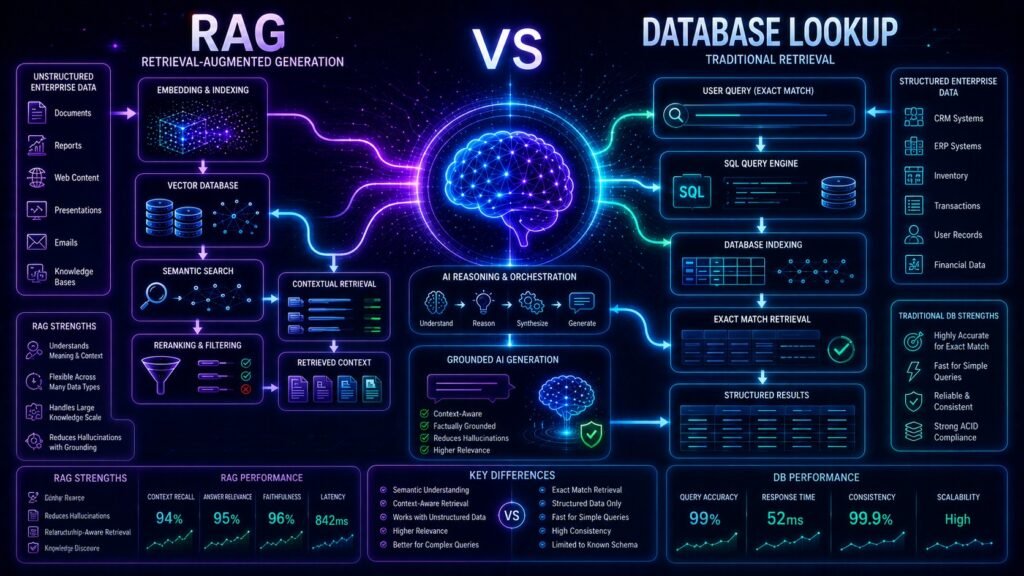
RAG vs Database Lookup: Which AI Retrieval Method Works Better?
Modern enterprise AI systems increasingly depend on intelligent retrieval architectures to power:
- AI assistants
- enterprise search systems
- customer support copilots
- document intelligence platforms
- healthcare AI systems
- legal retrieval systems
- ecommerce AI platforms
- workflow automation systems
However, as organizations scale AI adoption, a major architectural question continues to appear:
Should you use Retrieval-Augmented Generation (RAG) or traditional database lookup systems?
This became one of the most important enterprise AI design debates because both approaches retrieve information, but they work in fundamentally different ways.
Traditional databases have powered enterprise software for decades using:
- SQL queries
- relational databases
- indexed lookups
- structured retrieval systems
Meanwhile, modern AI systems increasingly rely on:
- semantic retrieval
- vector databases
- embeddings
- contextual search
- grounded AI generation
through Retrieval-Augmented Generation architectures.
Many organizations incorrectly assume that RAG simply replaces databases.
That is not true.
In reality:
Databases and RAG solve different retrieval problems.
Traditional databases excel at:
- structured data retrieval
- exact matching
- transactional systems
- deterministic queries
RAG excels at:
- semantic retrieval
- contextual reasoning
- unstructured knowledge retrieval
- grounded conversational AI
Understanding the differences between RAG and database lookup systems is essential for building scalable enterprise AI architectures.
Choosing the wrong retrieval strategy may create:
- hallucination risks
- poor search quality
- retrieval inefficiencies
- weak contextual reasoning
- scalability problems
- expensive infrastructure mistakes
In this guide, you will learn how RAG and database lookup systems work, their strengths and weaknesses, enterprise use cases, hallucination implications, infrastructure trade-offs, and why hybrid retrieval architectures are becoming increasingly common.
In Simple Terms
What Is Database Lookup?
Database lookup retrieves information using structured queries.
Traditional databases rely on:
- rows
- columns
- indexes
- relationships
- exact matches
For example:
SELECT * FROM customers WHERE customer_id = 1024;
This retrieves highly structured information deterministically.
What Is RAG?
Retrieval-Augmented Generation (RAG) retrieves semantically relevant information before generating answers.
Instead of exact matching, RAG uses:
- embeddings
- semantic similarity
- contextual retrieval
- vector search
to retrieve meaning-based information.
The retrieved context becomes grounding information for Large Language Models.
Easy Analogy
Imagine asking a librarian for information.
A database lookup works like asking for a book using an exact catalog number.
RAG works differently.
RAG behaves like an intelligent research assistant that understands the meaning of your question and retrieves relevant information even if exact words differ.
This is the biggest architectural difference.
Why Enterprises Compare RAG and Database Lookup
Modern organizations increasingly need AI systems capable of:
- contextual understanding
- enterprise search
- conversational AI
- semantic retrieval
- structured transaction handling
- grounded AI generation
Traditional databases remain essential for enterprise systems, but AI workflows introduced new retrieval requirements that databases alone cannot solve efficiently.
This created the RAG vs database lookup debate.
Understanding How Database Lookup Works
Traditional databases organize information into structured schemas.
A typical relational database contains:
- tables
- rows
- columns
- relationships
- indexes
- query engines
Retrieval occurs through deterministic query execution.
Core Components of Database Lookup Systems
| Component | Purpose |
| Tables | Store structured data |
| Indexes | Improve query speed |
| Query Engine | Executes retrieval queries |
| Schema | Defines data structure |
| Relationships | Connect structured entities |
Traditional database systems excel at exact retrieval.
Understanding How RAG Works
RAG combines semantic retrieval systems with Large Language Models.
A modern RAG pipeline usually includes:
- embeddings
- vector databases
- semantic retrieval systems
- reranking pipelines
- contextual orchestration layers
- grounded generation systems
The retriever searches semantically related information dynamically.
Core Components of a RAG System
| Component | Purpose |
| Embeddings | Represent semantic meaning |
| Vector Database | Stores searchable embeddings |
| Retriever | Finds contextual information |
| Reranker | Improves relevance quality |
| LLM | Generates grounded answers |
RAG focuses heavily on contextual retrieval.
Why Traditional Databases Became Foundational
Databases became the foundation of enterprise software because they provide:
- reliability
- consistency
- deterministic retrieval
- transactional integrity
- structured relationships
- efficient indexing
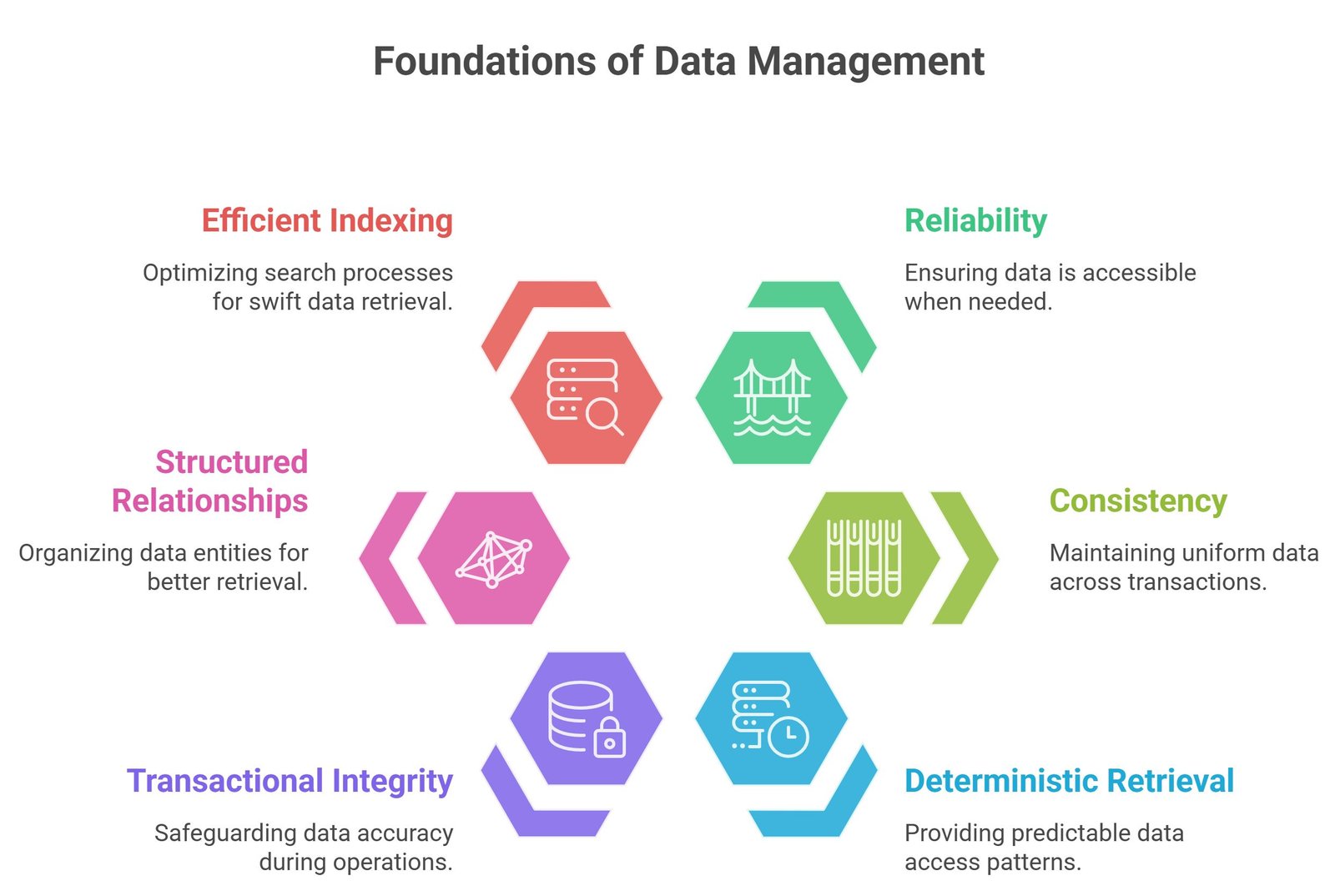
For decades, enterprise systems relied almost entirely on database lookup architectures.
Major Advantages of Database Lookup
Exact Retrieval Accuracy
Structured queries produce deterministic results.
High Reliability
Database systems are highly stable and predictable.
Fast Transaction Processing
Relational databases support efficient transactional workflows.
Strong Data Integrity
Structured schemas improve consistency.
Excellent Structured Data Handling
Databases excel at handling rows, columns, and relationships.
Mature Enterprise Ecosystem
Database infrastructure is highly mature.
Major Limitations of Database Lookup
Despite their strengths, databases struggle with modern AI retrieval requirements.
Weak Semantic Understanding
Databases rely heavily on exact matches.
Poor Unstructured Document Handling
Traditional databases struggle with large unstructured text repositories.
Limited Conversational Retrieval
Natural language interactions remain difficult.
Weak Contextual Search
Databases do not inherently understand semantic meaning.
No Grounded AI Generation
Databases retrieve records but do not generate contextual AI responses.
Why RAG Became Important
RAG solved several major limitations of traditional retrieval systems.
Modern enterprise AI systems increasingly require:
- semantic retrieval
- contextual understanding
- grounded generation
- conversational interfaces
- dynamic knowledge access
RAG enables these capabilities effectively.
Major Advantages of RAG
Semantic Understanding
RAG retrieves information based on meaning.
Better Conversational AI
Users can ask natural language questions.
Grounded AI Generation
Retrieved evidence improves factual reliability.
Better Unstructured Document Retrieval
RAG handles PDFs, reports, and enterprise documents effectively.
Reduced Hallucinations
Grounded retrieval improves answer reliability.
Dynamic Enterprise Knowledge Access
RAG integrates naturally with enterprise knowledge systems.
Major Limitations of RAG
RAG also introduces operational complexity.
Higher Infrastructure Complexity
RAG systems require multiple infrastructure layers.
Retrieval Dependency
Weak retrieval reduces grounded generation quality.
Increased Latency
Retrieval pipelines increase processing overhead.
Monitoring Complexity
Production RAG systems require evaluation infrastructure.
Retrieval Noise Problems
Irrelevant retrieval may weaken contextual grounding.
RAG vs Database Lookup: Key Differences
| Category | Database Lookup | RAG |
| Retrieval Method | Exact Match | Semantic Retrieval |
| Data Type | Structured | Structured + Unstructured |
| Conversational AI | Weak | Strong |
| Semantic Understanding | Limited | Excellent |
| Grounded Generation | No | Yes |
| Hallucination Reduction | Limited | Strong |
| Natural Language Support | Weak | Strong |
| Infrastructure Complexity | Lower | Higher |
| Enterprise Search | Moderate | Excellent |
| Transactional Systems | Excellent | Weak |
Why Databases Do Not Replace RAG
One of the biggest misconceptions in enterprise AI is:
“Databases already store enterprise information, so RAG is unnecessary.”
In practice, databases struggle with:
- semantic understanding
- contextual retrieval
- natural language search
- grounded generation
- unstructured knowledge retrieval
Traditional SQL systems cannot fully support modern conversational AI experiences alone.
Why RAG Does Not Replace Databases
RAG also has limitations.
RAG systems struggle with:
- transactional consistency
- exact numeric retrieval
- structured record management
- transactional updates
- deterministic workflows
Databases remain essential for enterprise operations.
Why Hybrid Architectures Are Becoming Common
Modern enterprise AI systems increasingly combine:
- relational databases
- vector databases
- semantic retrieval systems
- RAG pipelines
- SQL query engines
This creates hybrid enterprise retrieval architectures.
How Hybrid Retrieval Architectures Work
A modern enterprise AI system may:
- query structured databases for exact records
- retrieve contextual documents using RAG
- combine both results into grounded AI responses
This improves both precision and contextual reasoning.
Example Hybrid Enterprise Architecture
| Layer | Purpose |
| SQL Database | Structured transactional data |
| Vector Database | Semantic retrieval |
| Retriever | Contextual search |
| RAG Pipeline | Grounded generation |
| LLM | Conversational AI responses |
This architecture is becoming increasingly common.
Why RAG Improves Enterprise Search
Traditional database lookup works well for exact queries.
However, enterprise users often ask vague questions such as:
- “What are the latest refund policy changes?”
- “Show documents related to supplier delays.”
- “What are the risks in this contract?”
These questions require semantic understanding.
RAG improves retrieval quality dramatically in these scenarios.
Why Structured Databases Remain Critical
Even advanced AI systems still rely heavily on structured databases.
Examples include:
- financial transactions
- customer records
- inventory systems
- authentication systems
- healthcare records
- ERP platforms
RAG complements databases rather than replacing them.
Enterprise Use Cases for Database Lookup
Banking Systems
Transactional consistency remains essential.
Ecommerce Platforms
Product inventories rely heavily on structured databases.
CRM Systems
Customer records require deterministic retrieval.
ERP Systems
Enterprise resource planning depends on structured workflows.
Financial Reporting
Exact numeric consistency is critical.
Enterprise Use Cases for RAG
Enterprise AI Assistants
Employees retrieve contextual enterprise knowledge dynamically.
Customer Support AI
AI systems retrieve troubleshooting documents semantically.
Legal AI Systems
RAG retrieves contextual regulations and contracts.
Healthcare AI Platforms
Medical systems retrieve grounded clinical information.
Research Assistants
AI systems retrieve semantically related research documents.
Why RAG Usually Reduces Hallucinations Better
Databases retrieve exact records but do not inherently ground AI generation.
RAG improves hallucination reduction because retrieved context guides generation.
However, weak retrieval pipelines may still produce hallucinations.
This is why retrieval quality remains essential.
Common Enterprise Mistakes
Many organizations misunderstand how retrieval systems should work together.
Treating RAG as a Database Replacement
RAG complements databases instead of replacing them.
Using SQL for Semantic Search
Traditional SQL systems struggle with contextual retrieval.
Ignoring Retrieval Evaluation
Weak semantic retrieval reduces grounded generation quality.
Overcomplicating Infrastructure Early
Not every enterprise workflow requires full RAG architectures immediately.
Why Evaluation Matters for Both Systems
Organizations increasingly benchmark:
- retrieval precision
- semantic relevance
- groundedness
- hallucination rates
- latency
- contextual accuracy
- transaction consistency
Continuous evaluation improves enterprise AI reliability significantly.
Future of RAG and Database Retrieval
Enterprise AI architectures are evolving rapidly.
Major trends include:
- hybrid SQL + vector architectures
- semantic database systems
- AI-native retrieval engines
- multimodal retrieval systems
- autonomous retrieval orchestration
- graph-enhanced retrieval
- retrieval-aware enterprise databases
Future enterprise AI platforms will increasingly combine structured databases with semantic retrieval systems.
Suggested
- What Is RAG in AI
- How RAG Works
- Vector Database for RAG
- Embeddings for RAG
- Hybrid Search in RAG
- Reducing Hallucinations in RAG
- RAG Evaluation Metrics
FAQ: RAG vs Database Lookup
What is the difference between RAG and database lookup?
Database lookup retrieves exact structured records, while RAG retrieves semantically relevant information for grounded AI generation.
Can databases replace RAG?
No. Databases struggle with semantic understanding and contextual conversational retrieval.
Can RAG connect to SQL databases?
Yes. Modern RAG systems often integrate structured databases alongside vector retrieval systems.
Which is better for enterprise AI systems?
It depends on the use case. Databases excel at structured transactions, while RAG excels at semantic retrieval and conversational AI.
Does RAG reduce hallucinations better than databases?
Yes. Grounded retrieval improves factual generation quality significantly.
Final Takeaway
Understanding RAG vs database lookup is essential because enterprise retrieval architecture directly affects grounded AI generation, semantic understanding, hallucination reduction, scalability, and enterprise search quality.
Traditional databases excel at structured transactional retrieval and deterministic workflows, while RAG excels at semantic retrieval, contextual reasoning, and grounded conversational AI generation.
Organizations that understand how both architectures complement each other can build more scalable, intelligent, reliable, and production-ready enterprise AI systems.
That capability is becoming foundational for enterprise AI assistants, semantic search systems, healthcare AI platforms, legal retrieval systems, customer support copilots, and next-generation intelligent enterprise knowledge architectures.