
OpenAI’s Patch the Planet Turns AI Bug Reports Into Real Fixes
OpenAI introduced Patch the Planet on June 22, 2026, partnering with Trail of Bits to help maintainers secure critical open-source software.
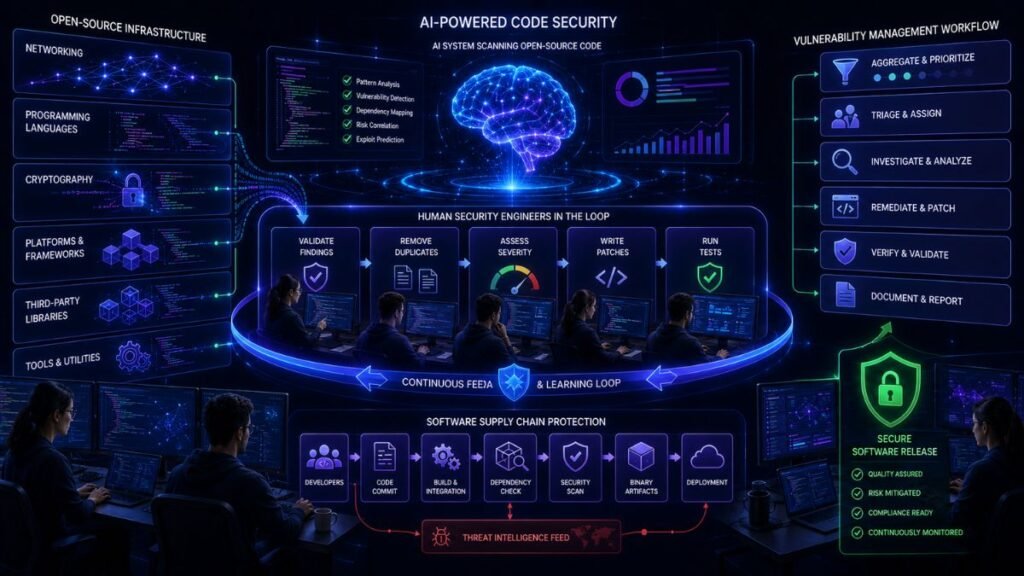
The initiative combines AI-assisted vulnerability research with human security review. Its goal is not merely to identify suspicious code. Engineers reproduce findings, remove duplicates, reassess severity, write and test patches, and work with maintainers through established disclosure channels.
This matters because AI security tools can now generate findings faster than volunteer maintainers can review them. Without validation and remediation, that output can become another backlog rather than a defensive advantage.
Early participants include cURL, Python, python.org, the Go project, Sigstore, aiohttp, NATS Server, freenginx, and pyca/cryptography—projects used across networking, cryptography, language infrastructure, and software supply chains.
What Is OpenAI Patch the Planet?
OpenAI Patch the Planet is a Daybreak cybersecurity initiative built with Trail of Bits.
It provides selected open-source maintainers with hands-on security engineering rather than access to a scanner alone. Trail of Bits says an engineer spends a dedicated week with each participating codebase, focusing on the areas the project considers most valuable. The work can include vulnerability review, patching, fuzzing, CI improvements, supply-chain hardening, and preparation for agent-assisted development.
OpenAI supplies access to its cyber-capable models and Codex Security. Participating projects may also receive ChatGPT Pro access, conditional Codex Security access, and API credits for open-source development and automation.
Trail of Bits contributes the human security expertise required to determine whether model-generated findings are real, relevant, severe, and repairable.
Why Discovery Alone Does Not Secure Software
Finding a suspicious code pattern is only the beginning of vulnerability management.
A report may be:
- A genuine exploitable vulnerability
- A duplicate of an existing issue
- A harmless code path
- A theoretical concern blocked by the threat model
- A low-severity correctness bug described as critical
- A valid problem with an unusable proposed fix
Maintainers must reproduce the behavior, understand its security impact, check affected versions, design a safe patch, add tests, prepare releases, and coordinate disclosure.
OpenAI acknowledges that frontier models still produce many false positives. Trail of Bits manually reviews every issue before it reaches a maintainer, checks it against project documentation and threat models, removes duplicates, corrects severity, and prioritizes confirmed problems.
That human filter is central to the program.
How the Complete Security Loop Works
The initiative begins with direct consultation rather than a generic scan.
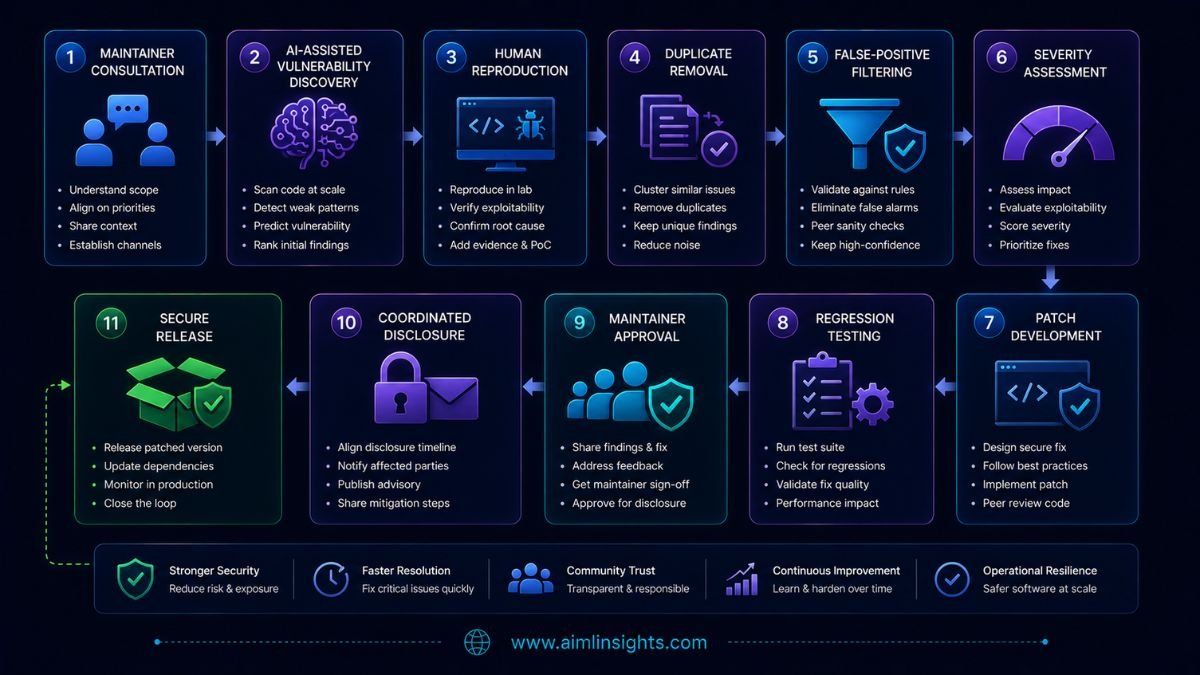
1. Maintainer consultation
Security engineers ask maintainers which components matter most, how the project handles disclosures, and whether the priority is bug validation, patch development, testing infrastructure, CI/CD, or longer-term hardening.
2. AI-assisted discovery
OpenAI models and Codex Security inspect code, historical vulnerabilities, specifications, tests, and likely attack surfaces.
The program has used techniques including fuzzing, historical-CVE variant analysis, differential testing, property-based testing, and comparison between software behavior and documented specifications.
3. Validation and reproduction
Trail of Bits researchers attempt to reproduce the suspected problem. A model’s explanation is not treated as confirmation.
This stage may involve test cases, sanitizers, fuzzing harnesses, debugger analysis, or proof-of-concept behavior under controlled conditions.
4. Deduplication and false-positive filtering
Candidate findings are compared with existing issues, security advisories, patches, and other model outputs.
Trail of Bits has developed AI-assisted workflows for deduplication, triage, and false-positive filtering, but engineers still review the strongest candidates manually.
5. Severity review
Severity depends on reachability, privileges, deployment conditions, user interaction, and the project’s threat model.
Trail of Bits reports that models tend to overrate issues as critical without explicit guidance. Project-specific security documentation improved the quality of filtering and severity assessment.
6. Patch development and testing
Engineers write or refine a patch according to the maintainer’s conventions. They may also add regression tests, fuzzing harnesses, threat models, CI checks, or supply-chain tooling to reduce the chance of similar defects returning.
7. Coordinated disclosure
Maintainers retain control over what is accepted, when a fix ships, and how the issue is disclosed. Sensitive technical details may remain private until affected users have a reasonable opportunity to update.
Patch the Planet Workflow
Maintainer priorities
↓
AI-assisted code and vulnerability research
↓
Human reproduction and evidence review
↓
Duplicate and false-positive removal
↓
Project-specific severity assessment
↓
Patch development
↓
Regression tests and security hardening
↓
Maintainer review and approval
↓
Coordinated disclosure and release
The key design choice is that AI accelerates parts of the workflow without taking control away from the maintainers responsible for the project.
Which Projects Are Participating?
OpenAI’s initial list includes:
- cURL
- NATS Server
- pyca/cryptography
- Sigstore
- aiohttp
- The Go project
- freenginx
- Python
- python.org
Trail of Bits says the first sprint covered 19 projects, including urllib3, PyPI, SimpleX, Valkey, and RustCrypto. More than 30 projects had joined the wider initiative by launch.
These projects are high-leverage targets. A security improvement in a networking library, package repository, cryptographic component, or programming-language toolchain can protect many downstream systems.
Early Results and Evidence Audit
Trail of Bits reports the following output from the program’s first week:
| Measure | Reported result | What it shows | What it does not show |
| Projects in initial sprint | 19 | Broad early participation | Long-term coverage |
| Total pull requests | 64 | Engineering output was submitted | All PRs were security fixes |
| Filed issues | 51 | Findings and improvements were documented | Every issue was a vulnerability |
| Merged patches | 37 | Maintainers accepted substantial work | Independent security effectiveness |
| Projects committed overall | More than 30 | Demand from maintainers | Capacity to serve every project |
| Bugs discovered | Hundreds | High discovery volume | Precision or false-positive rate |
Some pull requests improved testing, CI, supply-chain tooling, documentation, correctness, or requested features rather than fixing a confirmed vulnerability. Trail of Bits says this broader engineering work is intentional because long-term resilience requires more than isolated patches.
The numbers are early outputs reported by program participants. There is no independent benchmark comparing Patch the Planet with conventional audits under equivalent codebases, staffing, time, and disclosure conditions.
What the First Sprint Found
One early effort used repeated Codex /goal runs with GPT-5.5-Cyber to create a fuzzing lab covering multiple entry points, builds, platforms, and test seeds. OpenAI says the setup took less than one day, while Trail of Bits estimated that a similar manual effort could require several weeks. That estimate is provider-reported and project-specific.
The team also built a reusable variant-analysis pipeline. It ingests historical CVEs, extracts vulnerability patterns, searches code for similar flaws, applies specialized judging agents, removes duplicates, filters likely false positives, and routes the strongest evidence to human researchers.
Other contributions included GitHub Actions auditing for python.org, correctness fixes in RustCrypto, PyPI workflow improvements, software-bill-of-materials support, new fuzzing campaigns, and expanded test infrastructure.
Why This Matters
Critical open-source software often has global reach but limited security staffing.
AI changes the economics of vulnerability discovery. It can inspect more code, generate test harnesses, compare historical bug patterns, and explore unusual execution paths at higher speed.
That same scale can harm maintainers when tools submit speculative or duplicated reports. A project receiving hundreds of weak findings may spend less time fixing the important ones.
Patch the Planet attempts to fund the expensive middle and final stages: validation, prioritization, remediation, testing, and disclosure.
The initiative’s real value will therefore depend less on the number of bugs an AI model flags and more on the number of high-quality fixes maintainers can safely release.
Comparison With Conventional Security Scanning
| Approach | Main strength | Main limitation |
| Static analysis | Fast, repeatable code checks | Often limited to known rule patterns |
| Dependency scanning | Identifies known vulnerable packages | Does not usually discover new flaws |
| Fuzzing | Finds crashes and unexpected behavior | Requires harnesses and expert triage |
| Manual security audit | Deep, context-aware analysis | Expensive and difficult to scale |
| AI-only bug reporting | Broad and fast exploration | High risk of noise and severity errors |
| Patch the Planet | AI discovery plus expert validation and patching | Resource-intensive and not yet broadly scalable |
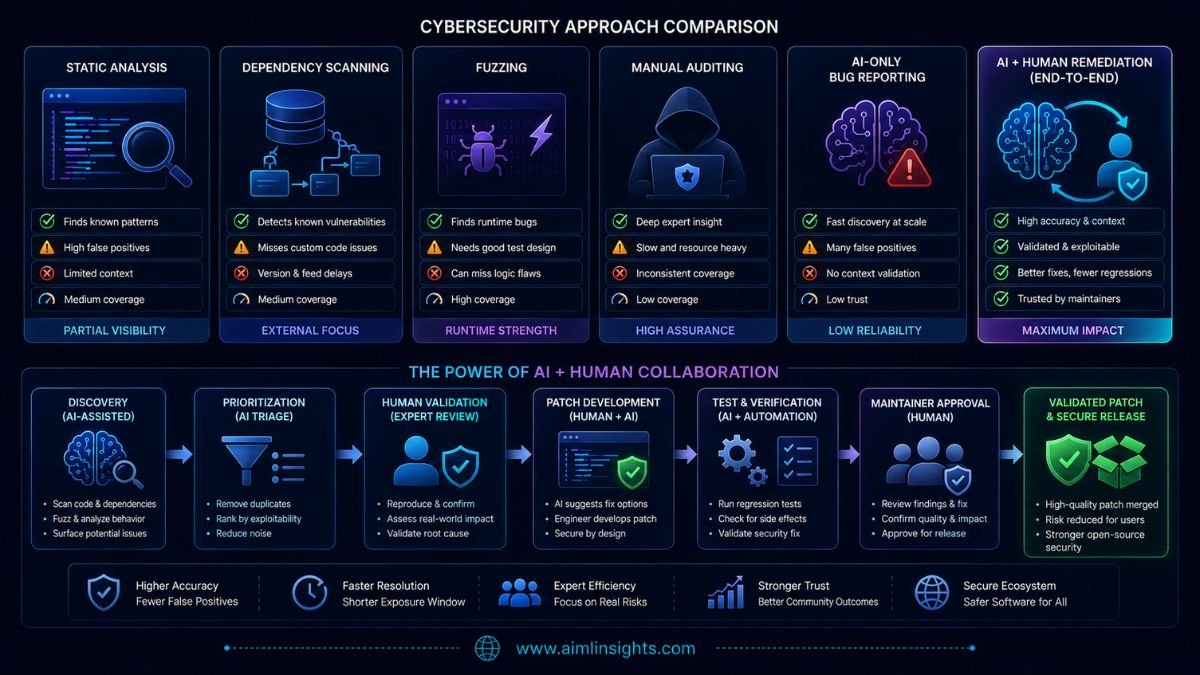
Patch the Planet does not replace conventional tools. Its workflows incorporate fuzzing, CI scanning, historical analysis, threat modeling, and human review.
Security, Privacy, and Disclosure Risks
AI-assisted vulnerability research creates its own risks.
Unpatched findings must be protected before disclosure. Model-generated patches may introduce regressions. Proof-of-concept code can become dangerous if shared too early. Private repositories, security reports, and maintainer communications require strict access controls.
The program must also avoid turning open-source projects into testing grounds for opaque automated changes.
OpenAI says maintainers remain responsible for deciding which patches land and how disclosure proceeds. HackerOne and Calif are also supporting triage, focused research, and coordinated disclosure.
Limitations and Unanswered Questions
Patch the Planet is promising, but several questions remain:
- What percentage of model-generated findings survive human review?
- How many merged patches fix exploitable vulnerabilities?
- How will the program prioritize projects as applications grow?
- Who maintains the generated fuzzing and CI infrastructure later?
- How are sensitive findings and model logs retained?
- How will success be measured after the initial sprint?
- Can the approach help smaller projects without dedicated security contacts?
- Will model-generated patches reduce or increase long-term maintenance work?
OpenAI plans to publish deeper technical reports after fixes land and disclosure processes conclude. Until then, many project-specific findings cannot be independently examined.
Simple Explanation for Beginners
Imagine an AI system finds what looks like a broken lock.
Simply emailing the maintainer “your lock may be broken” is not enough.
A security expert must check whether the problem is real, determine how dangerous it is, design a replacement, test the repair, and give users time to install it.
Patch the Planet is designed to support that complete process.
Conclusion: OpenAI Patch the Planet
OpenAI Patch the Planet is a significant experiment in using AI to strengthen shared software infrastructure without handing vulnerability management entirely to machines.
OpenAI provides advanced models and security tooling. Trail of Bits supplies expert validation, triage, patching, testing, and maintainer collaboration.
The early volume of pull requests and merged patches is encouraging, but it is not yet proof of long-term security impact.
The initiative will succeed if it reduces maintainers’ workload, delivers trustworthy fixes, leaves projects with stronger testing infrastructure, and manages disclosure responsibly—not simply if its models find the most bugs.
Final Takeaways
- OpenAI launched Patch the Planet on June 22, 2026.
- Trail of Bits is the primary security-engineering partner.
- The initiative covers discovery, validation, deduplication, severity review, patching, testing, and disclosure.
- Human researchers review every finding before submission to maintainers.
- Initial projects include cURL, Python, Go, Sigstore, aiohttp, and pyca/cryptography.
- Trail of Bits reports 64 pull requests, 51 issues, and 37 merged patches from the first week.
- Some contributions improve CI, fuzzing, supply-chain security, and testing rather than fixing individual vulnerabilities.
- Maintainers retain control over patches and disclosure.
- No independent precision, recall, cost, or long-term security benchmark has been published.
- The initiative’s value depends on validated remediation, not raw finding volume.
Suggested Read:
- AI Cybersecurity Explained
- Codex Security Guide
- AI Agents Can Now Work for Hours
- China’s Cheap AI Model Is Making Claude Look Expensive
- AI Coding Agents Explained
- Latest OpenAI News
FAQ: OpenAI Patch the Planet
What is OpenAI Patch the Planet?
It is an OpenAI and Trail of Bits initiative that uses AI-assisted security research and human experts to find, validate, patch, test, and disclose vulnerabilities in critical open-source software.
How does Patch the Planet work?
Security engineers consult maintainers, inspect code with AI tools, reproduce candidate issues, remove duplicates, assess severity, develop patches, run tests, and coordinate disclosure through the project’s preferred process.
Which open-source projects are participating?
Initial participants include cURL, Python, python.org, Go, Sigstore, aiohttp, NATS Server, freenginx, and pyca/cryptography. Trail of Bits says more than 30 projects had committed by launch.
Does AI automatically publish security patches?
No. Human security engineers review findings and develop patches with maintainers. Maintainers decide what is accepted, deployed, and disclosed.
What role does Trail of Bits play?
Trail of Bits provides dedicated security researchers who validate findings, correct severity, eliminate false positives, write and test patches, and work directly with project maintainers.
How can maintainers join Patch the Planet?
Trail of Bits provides an application process for maintainers of critical open-source projects. Selected projects receive dedicated review and patching support.
References: