

Samsung Is Bringing ChatGPT and Codex to Employees Worldwide
Samsung Electronics is deploying ChatGPT Enterprise and Codex across a large part of its global workforce, OpenAI announced on June 21, 2026.
Access will extend to all Samsung Electronics employees in South Korea and all employees worldwide in the company’s Device eXperience division, which covers major consumer businesses such as mobile devices, televisions and home appliances. OpenAI describes the agreement as one of its largest enterprise deployments to date.
The Samsung ChatGPT Enterprise rollout matters because it moves generative AI beyond small pilots and specialist teams. Samsung plans to apply the tools across research, software development, product work, manufacturing, marketing and corporate operations. Yet the announcement contains no measured productivity, adoption or ROI results, making this a deployment milestone rather than proof of business impact.
What Samsung Actually Announced
The agreement gives Samsung employees access to two related but different OpenAI products.
ChatGPT Enterprise is intended for broad knowledge work. OpenAI says Samsung employees can use it to search and analyze information, draft documents, interpret data, develop ideas and work through business problems.
Codex focuses more heavily on execution. It can support writing, reviewing and debugging code, but OpenAI now positions it for wider work such as creating internal tools, websites, prototypes and automated workflows.
The rollout follows an earlier relationship between Samsung and OpenAI. In October 2025, the companies announced infrastructure cooperation involving advanced memory, data-center opportunities and potential deployment of ChatGPT Enterprise and OpenAI APIs inside Samsung operations.
The latest announcement moves that workforce deployment from exploration into broad availability.
How the Enterprise AI Stack Could Work
A practical Samsung workflow may have four layers:
- Employee interface: Staff use ChatGPT Enterprise for analysis, writing, research and problem-solving.
- Execution layer: Developers and other teams use Codex to modify code, build tools or automate repeatable work.
- Company context: Approved internal sources, project files and applications provide relevant business information.
- Governance layer: Identity management, access controls, retention rules, security monitoring and usage analytics determine what users and tools are allowed to do.
ChatGPT Enterprise supports centralized workspace administration, SAML single sign-on, SCIM provisioning, domain controls, usage insights and managed access. OpenAI also says Codex follows enterprise workspace controls, including role-based permissions and compliance logging.
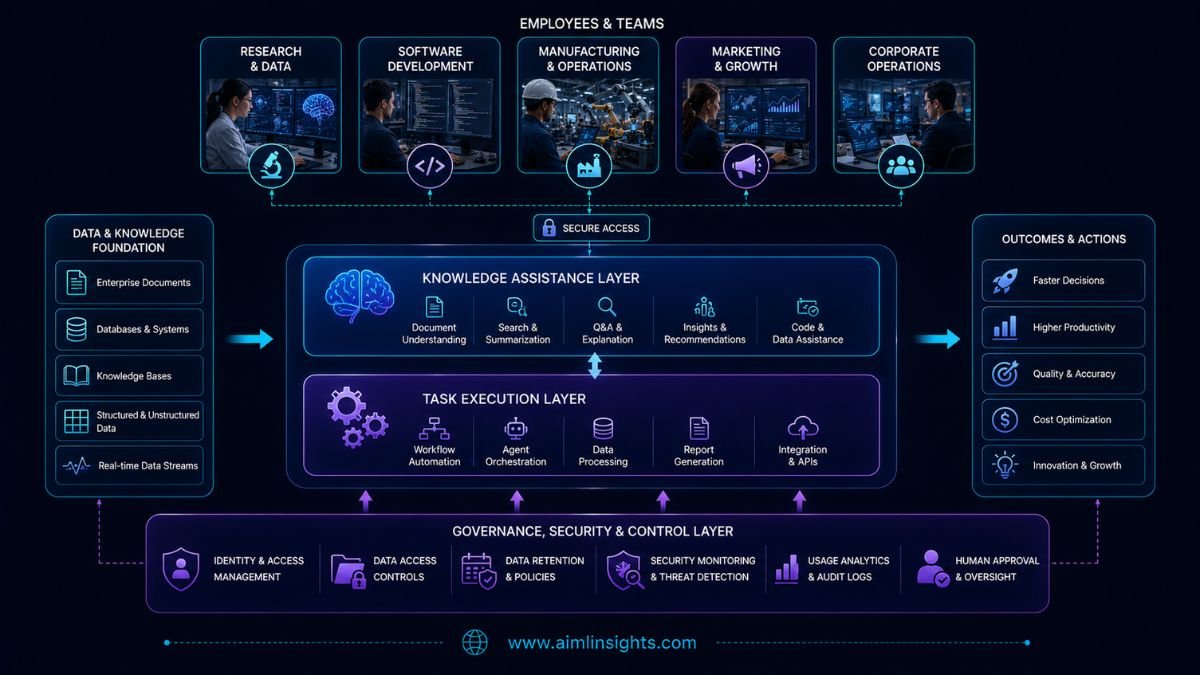
The architecture is important because enterprise adoption cannot depend on employees individually deciding what information is safe to share.
How Samsung Could Use ChatGPT Across Its Business
Research and product development
Researchers could use ChatGPT to summarize technical material, compare approaches, organize experimental results and draft early product requirements.
The system may help employees connect information faster, but technical conclusions still need source checking. A fluent answer should not be treated as verified engineering evidence.
Software development
Codex can assist with code generation, debugging, tests, documentation, repository analysis and routine maintenance.
The largest opportunity may be workflow compression rather than raw code volume. Another enterprise adopter, Endava, reports using Codex across requirements, design, specifications, development and operations, including reducing some requirements-analysis work from weeks to hours. That is a separate company-reported case study, not evidence that Samsung will achieve the same result.
Manufacturing
Manufacturing teams could use AI to analyze reports, draft work instructions, explain error logs, create dashboards or prototype workflow tools.
This area requires stronger controls than general office writing. AI output should not directly change production equipment, quality thresholds or safety procedures without deterministic checks and authorized human approval.
Marketing and corporate operations
Marketing teams may use ChatGPT for research, localization, campaign concepts and drafts. Corporate teams could apply it to meeting preparation, policy summaries, spreadsheet analysis and internal communications.
These are relatively accessible starting points because the work can remain reviewable before publication or action.
Why a Managed Rollout May Reduce Shadow AI
Shadow AI occurs when employees use unapproved consumer tools because official systems are absent, slow or less useful.
A blanket prohibition may reduce visible use without eliminating demand. Employees still face deadlines and may move information through personal accounts or unmanaged applications.
Providing a capable enterprise workspace can bring usage into a system with organizational identities, access policies and administration. OpenAI says business data from ChatGPT Enterprise is not used to train its models by default. Customers can control retention, connected sources and user access, while data is encrypted at rest and in transit. (OpenAI)
That does not remove Samsung’s responsibility. The company still needs clear rules describing:
- Which data classifications are permitted
- Whether source code may be processed
- Which connectors employees may enable
- When human approval is required
- How generated material should be labeled
- Which workflows are prohibited
- How incidents and policy violations are reported
An approved platform reduces one shadow-AI incentive, but poor training or overly restrictive controls can push employees back toward unmanaged tools.
Governance Must Extend Beyond Data Privacy
Data protection is only one part of enterprise AI governance.
Samsung must also manage output quality, intellectual property, security vulnerabilities, regulatory obligations and inappropriate automation.
Codex-generated code can contain defects or insecure assumptions. ChatGPT can misstate facts or invent sources. Connected tools may expose information the user technically has permission to access but should not place into a particular workflow.
The safest approach is risk-based:
| Workflow | Typical risk | Recommended control |
| Brainstorming and first drafts | Low to moderate | Employee review |
| Public-information research | Moderate | Source verification |
| Internal document summaries | Moderate to high | Access and retention controls |
| Code generation | High | Tests, security scanning and code review |
| Manufacturing decisions | Very high | Deterministic validation and authorized approval |
| External customer content | High | Brand, legal and factual review |
OpenAI offers features such as SSO, fine-grained access, retention controls and enterprise administration. These are enabling controls, not a substitute for Samsung’s own policies and review processes.
Employee Adoption Will Determine the Outcome
Large license counts do not guarantee useful adoption.
Some employees will use AI daily. Others may avoid it because they do not trust the output, cannot identify a relevant task or fear violating policy.
Effective rollout requires role-specific training rather than a single general demonstration.
Developers need instruction on repository context, tests, security review and safe agent permissions. Manufacturing teams need guidance on operational boundaries. Marketing employees need source, copyright and brand checks. Managers need to understand when an AI-generated summary is insufficient for a decision.
Samsung can also create internal AI champions who collect proven workflows, reusable prompts and failure examples. The goal should be repeatable task improvement—not simply increasing message volume.
Benchmark and Evidence Audit
Samsung and OpenAI have not published a controlled productivity benchmark for this deployment.
| Measurement | Published result |
| Eligible employee count | Not disclosed |
| Activated users | Not disclosed |
| Weekly active users inside Samsung | Not disclosed |
| Time saved per employee | Not disclosed |
| Coding throughput improvement | Not disclosed |
| Defect or security-change rate | Not disclosed |
| Manufacturing impact | Not disclosed |
| Financial ROI | Not disclosed |
| Contract value | Not disclosed |
| Independent evaluation | None published |
OpenAI reports that Codex has more than five million weekly users globally and that weekly active users in South Korea grew nearly 800% from February 1 to June 2026. Those numbers provide market context, but they do not measure Samsung’s deployment.
The central evidence gap is therefore clear: deployment scale has been announced, while business outcomes have not.
How Samsung Should Measure ROI
A serious ROI program should compare defined workflows before and after adoption.
Useful measures include:
- Time to complete a task
- Percentage of employees actively using approved tools
- Acceptance rate of generated code
- Review time per AI-generated change
- Defects introduced or prevented
- Security findings after AI-assisted development
- Time from product idea to prototype
- Rework rates
- Employee satisfaction
- Cost per completed workflow
- Reduction in unapproved AI usage
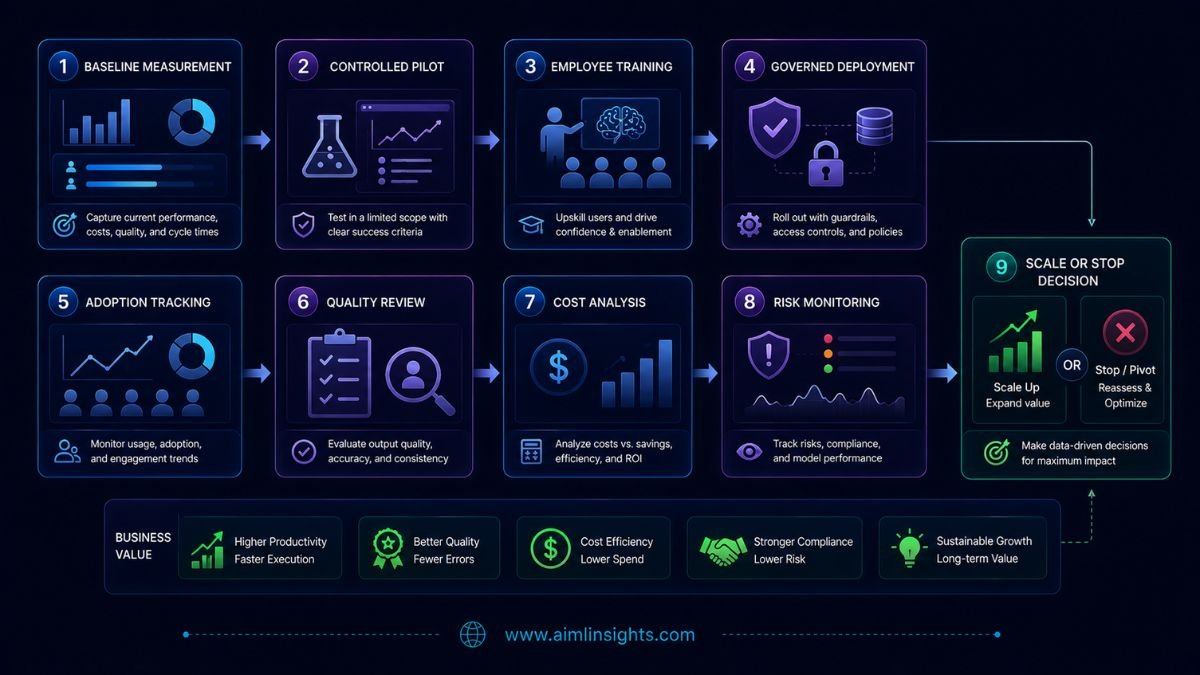
The wrong metrics can create bad incentives. Counting prompts rewards activity, not value. Counting generated lines of code may reward unnecessary code. Measuring tasks completed without evaluating quality may hide expensive rework.
ROI should be measured at the workflow level: did the team deliver a correct, secure and useful result faster or at lower total cost?
Why This Matters for Other Large Enterprises
Samsung’s rollout offers several lessons.
First, enterprise AI is becoming a platform decision rather than a collection of isolated chatbot pilots.
Second, technical and non-technical adoption are converging. Codex is no longer positioned only for developers, while ChatGPT is increasingly connected to operational work.
Third, governance and usability must develop together. A secure tool that employees cannot use effectively creates little value. A powerful tool without controls creates unacceptable risk.
Finally, enterprises should avoid copying Samsung’s scale before proving their own workflows. A smaller rollout with clear baselines, trained users and measurable outcomes may create more value than immediate company-wide access.
Limitations and Unanswered Questions
The announcement comes from OpenAI and presents the partnership from the provider’s perspective.
Samsung has not publicly detailed its internal policies, employee-training program, approved data categories, model-access tiers or evaluation framework in the cited announcement.
Other unanswered questions include:
- Will every eligible employee receive the same features?
- Which repositories and internal sources can Codex access?
- How will Samsung separate consumer, manufacturing and semiconductor data?
- Which tasks require human approval?
- How will the company detect shadow AI outside the managed workspace?
- What happens when AI-generated work causes an error?
- Will productivity gains exceed licensing, training and review costs?
Until Samsung releases outcome data, claims about transformation should remain forward-looking.
Simple Explanation for Beginners
Samsung is giving employees an approved workplace version of ChatGPT and OpenAI’s coding agent.
ChatGPT can help with research, writing and data analysis. Codex can help build software and automate tasks.
The company gains administrative and security controls that personal accounts do not provide.
But buying the tools is only the first step. Samsung must train employees, protect sensitive information, review AI output and prove that the tools save more money or time than they cost.
Conclusion: Samsung ChatGPT Enterprise Rollout
The Samsung ChatGPT Enterprise deployment is one of the clearest signs that generative AI is moving into company-wide operations.
Samsung plans to use ChatGPT and Codex across development, research, manufacturing, marketing and corporate work. The rollout may improve productivity and provide a governed alternative to shadow AI.
However, no verified productivity or ROI figures have been published.
The success of the deployment will depend on adoption, task selection, security controls, employee training and disciplined measurement—not the number of licenses announced.
Final Takeaways
- OpenAI announced the Samsung deployment on June 21, 2026.
- Access covers Samsung Electronics employees in South Korea and global Device eXperience employees.
- Samsung plans to use ChatGPT and Codex across technical and non-technical functions.
- ChatGPT supports knowledge work; Codex supports coding, tools and workflow execution.
- OpenAI calls it one of its largest enterprise deployments.
- No seat count, contract value, adoption rate or ROI figure was disclosed.
- Managed access may reduce shadow AI but cannot eliminate it.
- Manufacturing and production workflows require deterministic controls and human approval.
- Training must be tailored to individual roles.
- ROI should measure completed, correct workflows—not prompt volume or generated code.
Suggested Read:
- ChatGPT Enterprise Explained
- OpenAI Codex Guide
- Enterprise AI Governance Guide
- China’s Cheap AI Model Is Making Claude Look Expensive
- AI Agents Can Now Work for Hours
FAQ: Samsung ChatGPT Enterprise Rollout
What is the Samsung ChatGPT Enterprise deployment?
It is a broad rollout of ChatGPT Enterprise and Codex to Samsung Electronics employees in South Korea and Device eXperience employees worldwide.
Which Samsung employees will receive ChatGPT and Codex?
OpenAI says all Samsung Electronics employees in South Korea and all global employees in the Device eXperience division will receive access. The exact number of users has not been disclosed.
How will Samsung use Codex?
Samsung plans to use Codex for writing, reviewing and debugging code, as well as creating internal tools, websites, software prototypes and automated workflows.
Is Samsung’s business data used to train OpenAI models?
OpenAI says it does not train its models on ChatGPT Enterprise business data by default. Enterprise customers also receive controls for retention, access and connected data sources.
Can enterprise AI reduce shadow AI?
An approved platform can reduce employees’ need to use unmanaged consumer tools. Success still depends on useful access, clear policy, employee training and enforcement.
How should Samsung measure AI return on investment?
Samsung should compare time, cost, quality, rework, defect rates, adoption and human-review effort for specific workflows before and after AI adoption.
References:
- OpenAI’s official Samsung deployment announcement.
- OpenAI and Samsung’s earlier Stargate and enterprise-collaboration announcement.
- OpenAI’s enterprise privacy commitments.
- OpenAI’s ChatGPT Enterprise administration overview.
- OpenAI’s Codex enterprise-scaling announcement.
- OpenAI’s enterprise usage analytics and spend controls.