
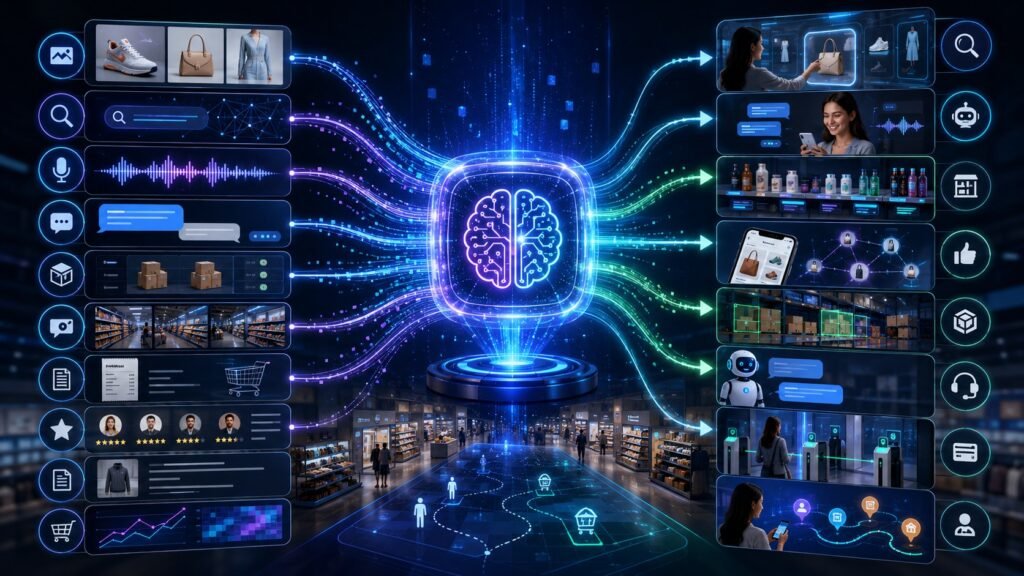
Multimodal AI in retail combines product images, text searches, voice requests, customer behavior, inventory data, shelf visuals, reviews, receipts, and support messages to create smarter shopping experiences. Retailers use it for visual search, AI shopping assistants, personalization, inventory monitoring, customer support, fraud detection, and smart store operations.
In Simple Terms
Multimodal retail AI helps shopping systems understand more than one kind of information at the same time. A normal ecommerce search engine may depend mostly on keywords. A multimodal retail AI system can combine a product photo, written query, voice request, review text, customer history, and inventory data before recommending a product or answering a question.
For example, a shopper may upload a photo of a jacket and ask, “Find something similar but cheaper.” The AI must understand the image, the written request, price constraints, product catalog data, and availability. That is what makes multimodal AI useful in retail: it connects how people naturally shop with how retail systems organize products.
What Is Multimodal AI in Retail?
Multimodal AI in retail means using AI systems that process multiple retail data types together. These data types can include product photos, item descriptions, customer reviews, voice searches, chat messages, videos, shelf camera feeds, inventory databases, purchase history, and location data.
This is different from single-purpose retail AI. A recommendation engine may use only click history. A computer vision system may only analyze shelf images. A chatbot may only answer text questions. Multimodal AI connects these signals so the system has more context. Rasa notes that retail is one of the industries using multimodal AI where visual, audio, or contextual data can improve conversational interfaces and user experiences.
Use Case 1: Retail Visual Search
Visual search is one of the clearest examples of multimodal AI in retail. Instead of typing a product name, a customer can upload a photo or screenshot. The system then matches the visual input with similar products in the catalog.
This is especially useful in fashion, beauty, furniture, decor, accessories, and lifestyle categories where users may not know the exact product name. A shopper might search by style, shape, color, pattern, or visual similarity. The model connects image embeddings with product descriptions, metadata, pricing, reviews, and stock availability. That makes search more natural and reduces the gap between inspiration and purchase.
Use Case 2: AI Shopping Assistants
AI shopping assistants are becoming more capable because they combine language, product data, customer preferences, search behavior, and sometimes visual inputs. A user can ask for product comparisons, gift ideas, size guidance, or recommendations based on past purchases.
Recent retail assistant launches show where the market is moving. Amazon introduced Alexa for Shopping as an assistant that combines shopping search, product comparisons, purchase history, price tracking, and recurring purchase actions for U.S. customers. Google also announced shopping integrations with retailers such as Walmart, Shopify, and Wayfair, allowing users to browse and purchase through Gemini-based shopping experiences.
Use Case 3: Personalized Product Recommendations
Retail personalization improves when AI can combine more context. A basic recommendation engine may use browsing history and purchase behavior. A multimodal system can add product images, review sentiment, search language, voice preferences, size data, brand affinity, and current availability.
For example, two customers may search for “comfortable black shoes,” but one may prefer running shoes while another prefers formal footwear. A multimodal system can interpret text, product images, customer history, and style signals together. This can improve recommendation relevance, but retailers must be careful with privacy and avoid making personalization feel invasive.
Use Case 4: Smart Shelves and Inventory Monitoring
In physical stores, multimodal AI can combine shelf camera feeds, product labels, inventory systems, sales data, and staff workflows. The system may detect missing products, misplaced items, incorrect shelf labels, or low stock.
This use case is practical because shelf gaps directly affect revenue. If an item is out of stock on the shelf but available in the back room, the retailer may lose a sale unless the issue is detected quickly. Computer vision can identify shelf conditions, while inventory databases and sales signals help confirm what action is needed.
Use Case 5: Customer Support With Images and Messages
Retail customer support often involves mixed information. A shopper may send a photo of a damaged item, a screenshot of an order issue, a receipt, and a written complaint. A multimodal support system can combine these inputs before generating a response or routing the case.
For example, if a customer submits a photo of a broken product and an order number, the AI can inspect the image, extract relevant text, connect the issue to the order record, and suggest a refund, replacement, or escalation workflow. This reduces manual triage while still allowing human review for sensitive or high-value cases.
Use Case 6: Product Catalog Enrichment
Retail catalogs are difficult to maintain. Product listings may have missing attributes, inconsistent descriptions, poor tags, low-quality images, or incomplete metadata. Multimodal AI can analyze product images, descriptions, reviews, and supplier data to enrich catalog fields.
For example, a model can detect color, pattern, material, sleeve length, style category, or product type from an image and compare it with the written listing. This helps improve search filters, recommendations, and marketplace consistency. It is especially useful for large catalogs where manual tagging is expensive.
Use Case 7: Fraud, Loss Prevention, and Store Operations
Multimodal AI can support store operations by combining video feeds, transaction logs, checkout data, sensor signals, and staff alerts. In retail loss-prevention workflows, the goal is to detect anomalies or suspicious patterns, not to make unchecked accusations.
This area requires careful governance. Visual systems can make mistakes, and biased or poorly validated models may harm customers or staff. Retailers should use human review, audit logs, and transparent policies. Multimodal AI should support safer operations, not create unfair surveillance or automated blame.
Benefits of Multimodal AI in Retail
The biggest benefit is better customer context. Retailers can understand what customers show, say, type, buy, return, review, and browse. That can make search, support, and recommendations more useful.
Another benefit is operational efficiency. Multimodal AI can help monitor shelves, enrich catalogs, summarize reviews, automate support triage, and connect store data with ecommerce behavior. For omnichannel retailers, this is especially valuable because customers move between websites, apps, physical stores, social media, and support channels.
Risks and Limitations
Multimodal AI in retail can still make mistakes. Visual search may return similar-looking but irrelevant products. Shopping assistants may recommend unavailable items. Computer vision systems may misread shelves. Support systems may misunderstand customer photos or receipts.
Privacy is also a major issue. Retailers may process images, voices, purchase history, location signals, and behavioral data. Customers need clear data practices, and businesses need strong security, consent controls, retention policies, and human review. Over-personalization can also feel intrusive if customers do not understand why the AI made a recommendation.
Suggested Read:
- What Is Multimodal AI? Complete Beginner’s Guide to AI Beyond Text
- Multimodal AI Use Cases
- Multimodal AI Examples
- Multimodal AI for Visual Search
- Multimodal AI in E Commerce
- Vision-Language Models Explained
- Text and Image Models
- Best Multimodal AI Tools in 2026
FAQ: Multimodal AI in Retail
What is multimodal AI in retail?
Multimodal AI in retail is AI that combines product images, text, voice, customer behavior, inventory data, shelf visuals, reviews, and support messages to improve shopping and store workflows.
How is multimodal AI used in retail?
It is used for visual search, AI shopping assistants, product recommendations, smart shelves, inventory monitoring, customer support, catalog enrichment, and fraud detection.
What is an example of multimodal AI in retail?
A shopper uploads a product photo and asks for similar items. The AI matches the image with catalog data, descriptions, prices, reviews, and availability.
Why is multimodal AI useful for ecommerce?
It lets ecommerce platforms understand visual intent, written queries, customer preferences, product metadata, and inventory together.
What are the risks of multimodal retail AI?
Risks include wrong recommendations, biased visual systems, privacy concerns, excessive personalization, inventory errors, and over-automation without human review.
Is multimodal AI only for online retail?
No. It is useful for ecommerce, physical stores, omnichannel retail, customer support, inventory operations, catalog management, and smart store systems.
Final Takeaway
Multimodal AI in retail helps retailers connect product images, text queries, voice requests, customer data, shelf visuals, inventory signals, and support messages. It can improve visual search, shopping assistants, personalization, catalog quality, and store operations.
For the next step, read What Is Multimodal AI, Multimodal AI Use Cases, and Multimodal AI for Visual Search to understand how these retail workflows fit into the broader multimodal AI ecosystem.