
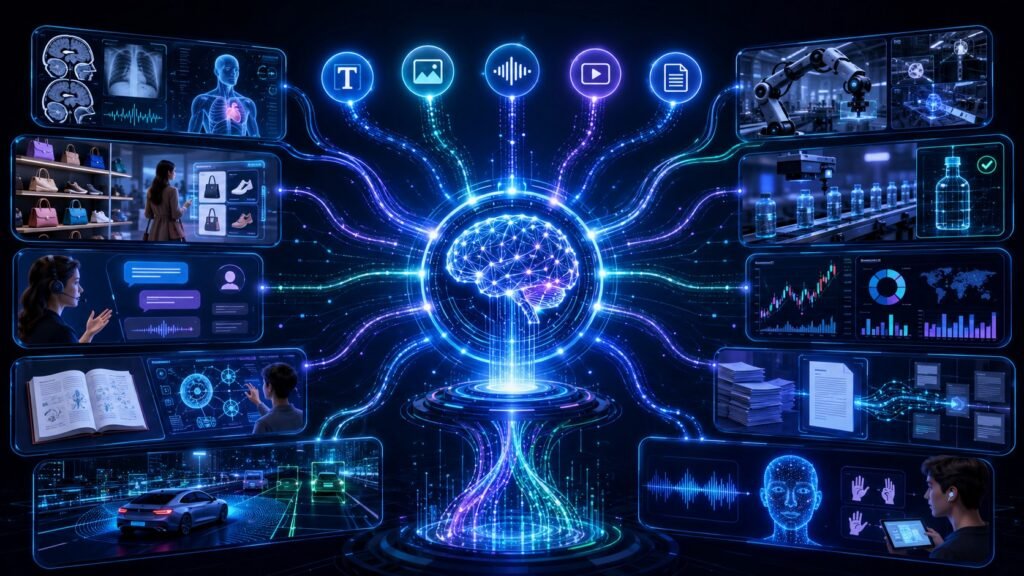
Multimodal AI use cases are growing because modern AI can combine text, images, audio, video, documents, charts, and sensor data in one workflow. This makes AI more useful for real-world tasks such as customer support, healthcare, retail search, education, robotics, document processing, and enterprise decision-making.
In Simple Terms
Multimodal AI means AI that can understand more than one type of information at the same time. A text-only chatbot can read and answer written prompts. A multimodal AI system can combine a written question with an image, voice recording, video clip, document, chart, or sensor signal.
This matters because most real-world work is not text-only. A customer sends screenshots with a complaint. A doctor reviews scans and notes. A retail shopper searches using a product photo. A factory monitors camera feeds, sound, and machine data together. These are practical multimodal AI applications because the AI must connect multiple data types before producing a useful answer.
Customer Support With Screenshots, Voice, and Chat History
Customer support is one of the strongest multimodal AI use cases because users often cannot describe problems clearly in text. A support assistant can analyze screenshots, typed complaints, product photos, voice notes, and previous chat history together. This helps the system understand the problem faster and suggest better next steps.
For example, a user may upload a screenshot of a software error and write, “Why is this happening?” The AI can read the visible error, understand the user’s message, compare it with support documentation, and recommend a solution. Rasa highlights customer service and dynamic assistants as major multimodal AI use cases because combining text, voice, and images can create more natural and context-aware user experiences.
Healthcare With Scans, Notes, Lab Results, and Voice
Healthcare decisions often depend on multiple information sources. A clinician may need medical images, patient history, lab results, prescriptions, symptoms, and clinical notes. Multimodal AI can help organize these signals so professionals can review information more efficiently.
A useful example is combining a radiology scan with a patient note and lab report. The AI may help summarize relevant findings, flag missing context, or prepare a draft explanation for review. This does not mean AI should replace clinicians. Healthcare use cases need expert oversight, privacy controls, validation, and careful governance. The value is in support: helping professionals connect scattered data more quickly and consistently.
Retail Visual Search and Product Discovery
Retail and ecommerce platforms use multimodal AI to connect product images, descriptions, reviews, user behavior, and search queries. A shopper may upload a photo of a jacket, shoe, lamp, or sofa and ask for similar products. The AI can analyze visual features, match them with product metadata, and return relevant items.
This is more powerful than keyword search alone because users may not know the right product name, style, or category. Multimodal AI can understand color, shape, pattern, brand-like attributes, and written product descriptions together. Rasa notes that image plus natural language capabilities are already popular in ecommerce and visual search, including “scan to search” experiences.
Education and AI Tutors With Diagrams, Speech, and Text
Education is a strong multimodal AI application because students learn through text, images, diagrams, video, speech, and handwritten notes. A multimodal tutor can analyze a chart, read a question, listen to a spoken explanation, and generate a beginner-friendly response.
For example, a student may upload a physics diagram and ask, “Why is this force pointing downward?” The AI can inspect the visual layout, identify labels, understand the question, and explain the concept step by step. This creates a more natural learning experience than text-only tutoring. It also helps students who learn better visually or verbally.
Document Processing With PDFs, Tables, Forms, and Layout
Enterprise documents are rarely plain text. Contracts, invoices, medical forms, financial reports, and insurance claims often include paragraphs, tables, charts, signatures, stamps, images, and layout structure. Multimodal AI can process the document more like a person would: reading the text while also understanding the visual layout.
This is useful for insurance, legal operations, finance, HR, procurement, healthcare administration, and compliance. For example, an AI system can extract information from an invoice, understand table rows, identify missing fields, and summarize the document. Compared with basic OCR, multimodal document AI can better understand structure and context.
Manufacturing Quality Inspection With Images, Audio, and Sensors
Manufacturing teams can use multimodal AI for quality inspection and predictive monitoring. A system may combine camera images, sound from machines, vibration data, temperature readings, and production logs. This gives the model a more complete view of what is happening on the factory floor.
For example, a defect may appear visually as a surface scratch, but a machine issue may first appear as unusual vibration or sound. A multimodal system can detect patterns across these signals. This helps manufacturers improve inspection, reduce downtime, and catch issues earlier. The goal is not only visual defect detection; it is cross-modal operational awareness.
Robotics With Vision, Speech, Sensors, and Movement
Robots need multimodal AI because they operate in physical environments. A robot may need to understand a voice command, identify objects with a camera, interpret sensor data, estimate distance, and plan movement. These tasks require multiple modalities working together.
Imagine a warehouse robot receiving the instruction, “Pick up the red box near the loading door.” The robot must process speech or text, recognize the red box visually, locate the door, avoid obstacles, and move safely. This is why multimodal AI is important for warehouse automation, home robots, industrial robots, drones, and future embodied AI systems.
Autonomous Vehicles With Cameras, Radar, Lidar, and GPS
Autonomous vehicles are classic multimodal AI systems. They combine camera feeds, radar, lidar, GPS, maps, speed data, and environmental signals to understand the road. Each modality provides a different view of the world.
Cameras help identify lanes, pedestrians, traffic lights, and signs. Radar and lidar help estimate distance and motion. GPS and maps provide location context. The vehicle must combine these signals to make safer decisions. This use case shows that multimodal AI is not only about chatbots or document tools. It is also central to real-time physical-world intelligence.
Finance and Insurance With Forms, Photos, Audio, and Records
Finance and insurance workflows often involve many formats. An insurance claim may include accident photos, written descriptions, scanned forms, repair estimates, voice calls, and historical records. Multimodal AI can help organize this evidence and support faster review.
In finance, analysts may use multimodal AI to connect charts, earnings reports, call transcripts, tables, and written commentary. The AI can summarize patterns, highlight inconsistencies, and help professionals review information faster. These workflows still require human judgment, especially where money, compliance, and risk are involved.
Enterprise AI Assistants for Knowledge Work
Enterprise AI assistants are becoming one of the most practical multimodal AI use cases. Employees work across emails, documents, dashboards, spreadsheets, call recordings, screenshots, slide decks, and chat messages. A multimodal assistant can help search, summarize, explain, and connect that information.
For example, a manager may upload a dashboard screenshot and ask, “Which region needs attention?” The AI can inspect the chart and explain the trend. A compliance analyst may upload a policy document and scanned form together. A sales team may summarize call recordings and CRM notes. Google Cloud describes multimodal AI as systems that can process inputs such as text, images, and audio, which fits this kind of mixed enterprise workflow.
Accessibility and Inclusive Interfaces
Multimodal AI can make digital tools more accessible. A system can describe images for visually impaired users, convert speech into text, summarize documents aloud, interpret visual interfaces, or translate information between formats. This helps users interact through the mode that works best for them.
For example, a visually impaired user may ask an AI assistant to describe a chart or photo. A user with limited typing ability may prefer voice input. A person with language barriers may use images, speech, and translation together. Rasa notes that multimodal AI can improve accessibility and inclusivity by supporting voice, audio, visuals, and varied input devices.
Research and Scientific Discovery
Researchers often work with mixed data: papers, charts, lab notes, images, microscopy scans, audio transcripts, datasets, and simulations. Multimodal AI can help organize, search, and interpret these materials together.
For example, a researcher may ask a system to compare a chart from a paper with experimental notes and related figures. In biomedical research, multimodal systems may combine images, structured measurements, and text. In climate or materials research, systems may analyze images, sensor data, tables, and reports. This use case is still evolving, but it shows why multimodal AI can support complex knowledge work.
Multimodal AI Use Cases by Industry
| Industry | Common Modalities | Example Use Case |
| Customer Support | Text, screenshots, voice | Troubleshooting assistant |
| Healthcare | Scans, notes, lab data | Clinical review support |
| Retail | Images, descriptions, reviews | Visual product search |
| Education | Diagrams, text, speech | AI tutoring |
| Manufacturing | Images, audio, sensors | Quality inspection |
| Robotics | Vision, speech, sensors | Object handling |
| Automotive | Cameras, radar, lidar, GPS | Autonomous driving |
| Finance | Charts, reports, transcripts | Analyst support |
| Insurance | Photos, forms, audio | Claims processing |
| Enterprise AI | Documents, dashboards, chats | Knowledge assistant |
Why Multimodal AI Use Cases Are Growing
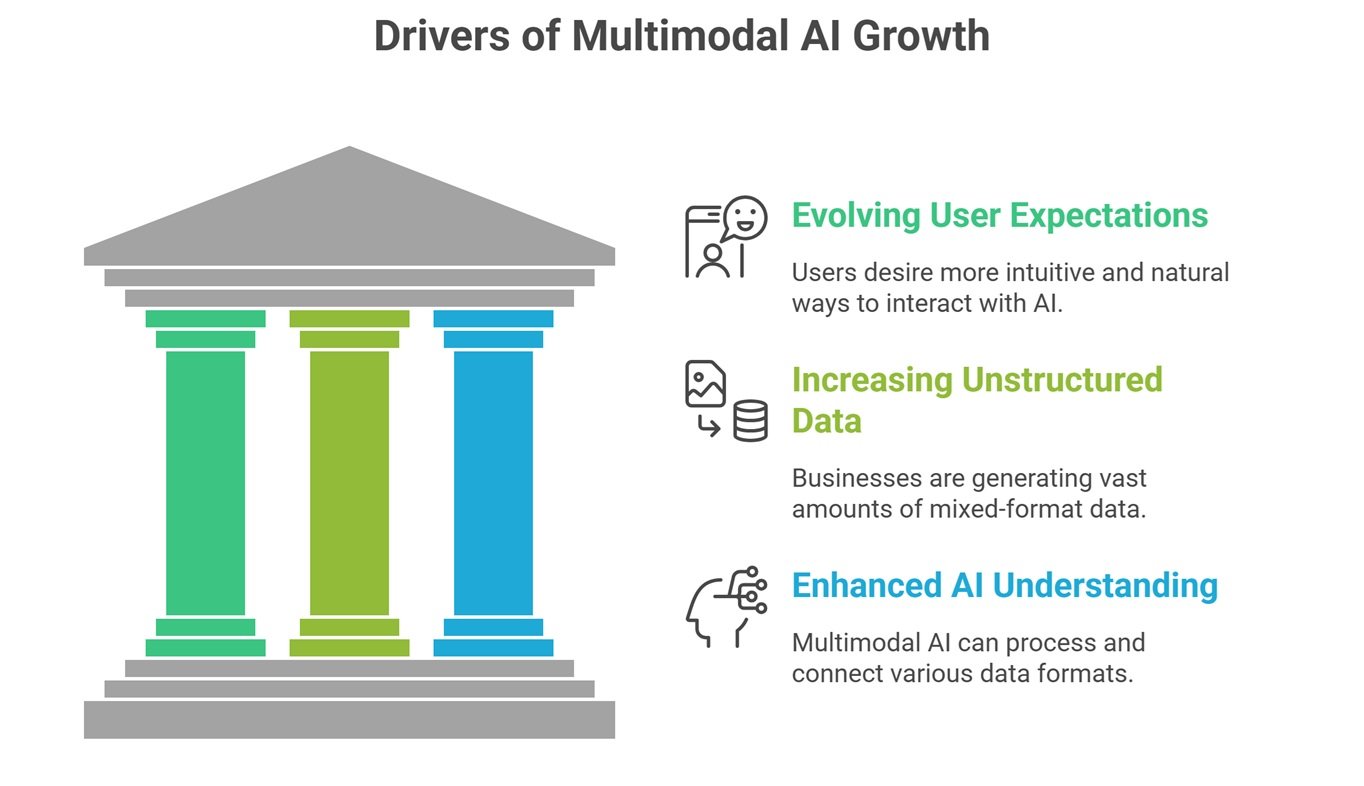
Multimodal AI use cases are growing because user expectations are changing. People do not want to explain everything in typed prompts. They want to upload a screenshot, speak naturally, share a document, point to an image, or ask questions about a chart.
At the same time, businesses have more unstructured and mixed-format data than ever. Text-only AI is useful, but it cannot fully understand product photos, scanned documents, video footage, voice calls, dashboards, or sensor streams alone. Multimodal AI helps connect these formats into one workflow, which makes AI more useful for real business problems.
Limitations and Risks: Multimodal AI Use Cases
Multimodal AI still has limitations. It can misread images, misunderstand audio, overlook details, or hallucinate unsupported explanations. A blurry screenshot, noisy recording, low-quality scan, or complex chart can lead to mistakes. More input types do not automatically guarantee better results.
Security and privacy are also major concerns. Multimodal systems may process faces, voices, medical records, financial documents, customer data, or confidential screenshots. Organizations should use access controls, evaluation, human review, and clear governance before deploying multimodal AI in sensitive workflows.
Suggested Read:
- What Is Multimodal AI? Complete Beginner’s Guide to AI Beyond Text
- Multimodal AI Explained Simply
- Multimodal AI Examples
- How Multimodal AI Works
- How Multimodal AI Helps With Documents and Images
- Best Multimodal AI Tools in 2026
FAQ: Multimodal AI Use Cases
What are the main use cases of multimodal AI?
The main use cases include customer support, healthcare, retail visual search, education, robotics, autonomous vehicles, document processing, manufacturing inspection, finance, insurance, accessibility, and enterprise AI assistants.
How is multimodal AI used in business?
Businesses use multimodal AI to analyze documents, dashboards, screenshots, product images, customer messages, voice calls, videos, and structured records together.
How is multimodal AI used in healthcare?
Healthcare teams may use multimodal AI to connect medical scans, patient notes, lab results, clinical records, and speech documentation for professional review and workflow support.
How is multimodal AI used in retail?
Retailers use multimodal AI for visual search, product recommendations, catalog tagging, customer support, and connecting product images with descriptions and reviews.
Why are multimodal AI use cases important?
They matter because real-world information is usually spread across text, images, audio, video, documents, and sensor data. Multimodal AI helps connect those signals.
Final Takeaway
Multimodal AI use cases show why AI is moving beyond text-only chat. The most useful systems can combine language, images, audio, video, documents, charts, and sensor data to understand real-world context more clearly.
To continue building topical understanding, read What Is Multimodal AI, How Multimodal AI Works, and Multimodal AI Examples next.