
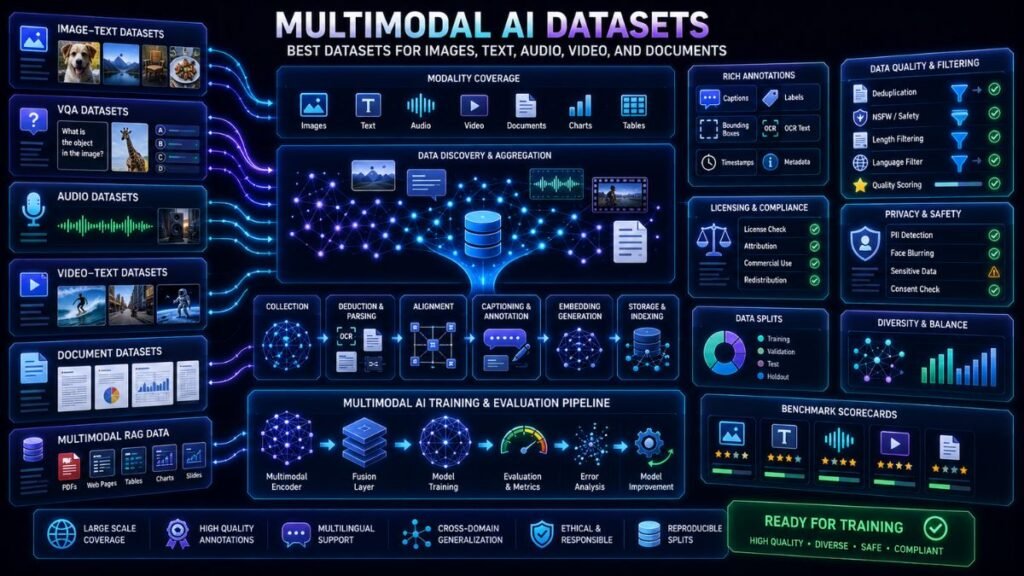
Multimodal AI datasets are datasets that combine two or more data types, such as images and captions, videos and transcripts, audio and labels, documents and layouts, or visual questions and answers. They are used to train, test, fine-tune, and evaluate multimodal AI systems such as VLMs, visual search engines, document AI, and multimodal RAG apps.
In Simple Terms
A multimodal AI dataset gives a model more than one kind of signal. Instead of learning from images alone or text alone, the model learns how different formats connect.
For example, an image-text dataset may pair a product photo with a caption. A video-text dataset may pair a clip with a description. A VQA dataset may pair an image with a question and answer. These connections help AI systems understand visual, written, audio, or video context together.
What Are Multimodal AI Datasets?
Multimodal AI datasets are collections of linked data across multiple modalities. Common combinations include image + text, video + text, audio + labels, document image + OCR text, chart + question, or image + question + answer.
They are useful for different tasks. Vision-language models need image-text or visual instruction data. Visual search systems need image embeddings and metadata. Audio models need sound clips and labels. Multimodal RAG systems need documents, images, tables, charts, and metadata. Benchmarking needs carefully labeled test sets that measure whether a model truly understands multiple formats.
Quick Comparison of Multimodal Dataset Types
| Dataset Type | Best For | Example Datasets |
| Image-text | Captioning, CLIP-style training, retrieval | COCO, Conceptual Captions, LAION |
| Visual QA | Image reasoning and question answering | VQA, Visual Genome-style data |
| Video-text | Video retrieval, summarization, video understanding | WebVid, Ego4D |
| Audio | Sound classification and audio understanding | AudioSet |
| Document | OCR, layout, table extraction, document AI | PDF/form/table datasets |
| Benchmark/curation | Dataset filtering and model evaluation | DataComp |
1. COCO: Best Classic Dataset for Images, Captions, and Vision Tasks
COCO is one of the most widely used computer vision and multimodal datasets. The official COCO site describes it as a large-scale object detection, segmentation, and captioning dataset.
Use COCO when you are learning image captioning, object detection, segmentation, or image-text evaluation. It is also useful for beginner and intermediate multimodal AI projects because it is well-known, well-documented, and widely supported in tutorials and libraries.
COCO is not the largest modern image-text dataset, but it remains valuable because its annotations are structured and easier to work with than noisy web-scale data.
2. Conceptual Captions: Best for Image Captioning at Larger Scale
Conceptual Captions is an image-caption dataset from Google Research. Google’s repository describes it as containing image URL and caption pairs designed for training and evaluating image captioning systems.
Use Conceptual Captions when you want a larger image-text dataset for captioning or image-language learning. It is useful for training models that connect web-style images with natural-language descriptions.
The important caution is that web-derived captions can be noisy. Always check licensing, access rules, broken URLs, and data quality before using it in serious projects.
3. LAION-5B: Best Known Open Web-Scale Image-Text Dataset
LAION-5B is one of the most influential web-scale image-text datasets. The LAION-5B paper describes it as containing 5.85 billion CLIP-filtered image-text pairs, including 2.32 billion English pairs and additional multilingual data.
Use LAION-style datasets for research into large-scale image-text pretraining, retrieval, filtering, and dataset curation. However, this is not a beginner-friendly dataset. It is huge, noisy, and requires careful filtering.
There are also serious safety and privacy concerns around large web-scraped datasets. Reporting and research have raised concerns about harmful or sensitive material in LAION-5B, and LAION temporarily removed datasets in response to safety concerns. For most builders, curated subsets or safer alternatives are a better starting point.
4. DataComp: Best for Learning Dataset Curation
DataComp is not just a dataset. It is a benchmark and testbed for dataset design. Its GitHub page explains that the task is to curate a multimodal pretraining dataset of image-text pairs while model architecture and hyperparameters are fixed.
Use DataComp if you want to study how data filtering, caption quality, and dataset composition affect model performance. This is useful for advanced learners, research teams, and anyone interested in why dataset quality matters as much as model architecture.
DataComp is especially relevant because multimodal AI performance is not only about bigger models. Better data selection can strongly affect downstream results.
5. VQA: Best Dataset for Visual Question Answering
The VQA dataset is designed for visual question answering. The official VQA site says it contains open-ended questions about images that require understanding vision, language, and commonsense knowledge. It includes COCO and abstract-scene images, multiple questions per image, and multiple ground-truth answers per question.
Use VQA when you want to train or evaluate systems that answer questions about images. It is useful for VLM projects, image reasoning tasks, and interview-ready multimodal portfolio work.
VQA is stronger for learning visual reasoning than simple captioning because the model must connect the user’s question with the right visual evidence.
6. WebVid: Best for Video-Text Learning
WebVid is a video-text dataset used for video retrieval and video-language learning. TensorFlow Datasets describes WebVid-10M as containing 10.7 million video-caption pairs and 52,000 total video hours.
Use WebVid for video-text retrieval, video captioning, and video understanding experiments. It is useful when you want models to connect moving visual content with text descriptions.
Video datasets are heavier than image datasets. Storage, download rules, frame sampling, clip length, and licensing checks matter more.
7. Ego4D: Best for Egocentric Video and Real-World Activity Understanding
Ego4D is designed for first-person video understanding. The official Ego4D site describes it as a large egocentric dataset with 3,670 hours of video from 923 participants across 74 worldwide locations and 9 countries.
Use Ego4D for tasks involving long-horizon video understanding, daily activity recognition, episodic memory, human-object interaction, and first-person perception.
This dataset is more advanced than beginner image-text datasets. It is useful for research and serious video AI projects.
8. AudioSet: Best for Audio Event Understanding
AudioSet is a large dataset for audio event classification. Google describes it as an ontology of 632 audio event classes with 2,084,320 human-labeled 10-second sound clips drawn from YouTube videos.
Use AudioSet when your multimodal AI project includes sound recognition, audio tagging, event detection, or audio-video understanding. It is especially useful for combining video frames with environmental sounds or speech-related context.
How to Choose the Right Multimodal AI Dataset
Start with the task. For image captioning, use COCO or Conceptual Captions. For image-text pretraining research, study LAION or DataComp. For visual question answering, use VQA. For video-text learning, use WebVid. For first-person video understanding, use Ego4D. For audio events, use AudioSet.
Then check five practical factors: license, size, quality, annotation type, and safety. A dataset may be famous but still unsuitable for your project if it is too large, noisy, restricted, sensitive, or poorly aligned with your use case.
Common Mistakes to Avoid
The biggest mistake is choosing a dataset only because it is large. Large datasets can contain noisy labels, broken links, sensitive content, biased coverage, and licensing issues.
Another mistake is using training datasets as benchmarks without proper splits. Always keep separate training, validation, and test data. For evaluation, use data that reflects the real user task, not only a popular leaderboard.
Suggested Read:
- What Is Multimodal AI? Simple Explanation With Examples
- Vision-Language Models Explained for Beginners
- Multimodal Embeddings
- Multimodal RAG Explained
- Building Multimodal Apps
- Multimodal Benchmarking
- Multimodal Evaluation
- Multimodal Project Ideas
FAQ: Multimodal AI Datasets: Best Datasets and Uses
What are multimodal AI datasets?
Multimodal AI datasets are datasets that combine multiple data types, such as images and text, video and captions, audio and labels, or documents and layout information.
Where can I find multimodal AI datasets?
You can find them on official dataset sites, research project pages, Hugging Face Datasets, TensorFlow Datasets, academic benchmark pages, and dataset repositories.
What are the best datasets for multimodal AI?
Popular options include COCO, Conceptual Captions, LAION-5B, DataComp, VQA, WebVid, Ego4D, and AudioSet, depending on the task.
Which datasets are used for vision-language models?
Vision-language models often use image-text, VQA, captioning, and instruction-style datasets such as COCO, Conceptual Captions, LAION-style data, VQA, and curated visual instruction datasets.
What is the best video-text dataset for multimodal AI?
WebVid is a strong video-text dataset for video-caption learning, while Ego4D is strong for egocentric video understanding and real-world activity research.
How do you choose a multimodal AI dataset?
Choose based on task fit, modality, license, size, annotation quality, safety, benchmark relevance, and whether the dataset reflects your real application.
Final Takeaway
Multimodal AI datasets are the foundation for training, testing, and evaluating AI systems that work across images, text, audio, video, and documents. Choose datasets by use case, not popularity: COCO for structured vision tasks, VQA for image reasoning, WebVid for video-text, Ego4D for egocentric video, AudioSet for audio, and DataComp for dataset curation research.
To continue learning, read Vision-Language Models Explained, Multimodal Benchmarking, and Multimodal Benchmarking next.