
LLM Token Limits Explained: What They Mean and Why They Matter
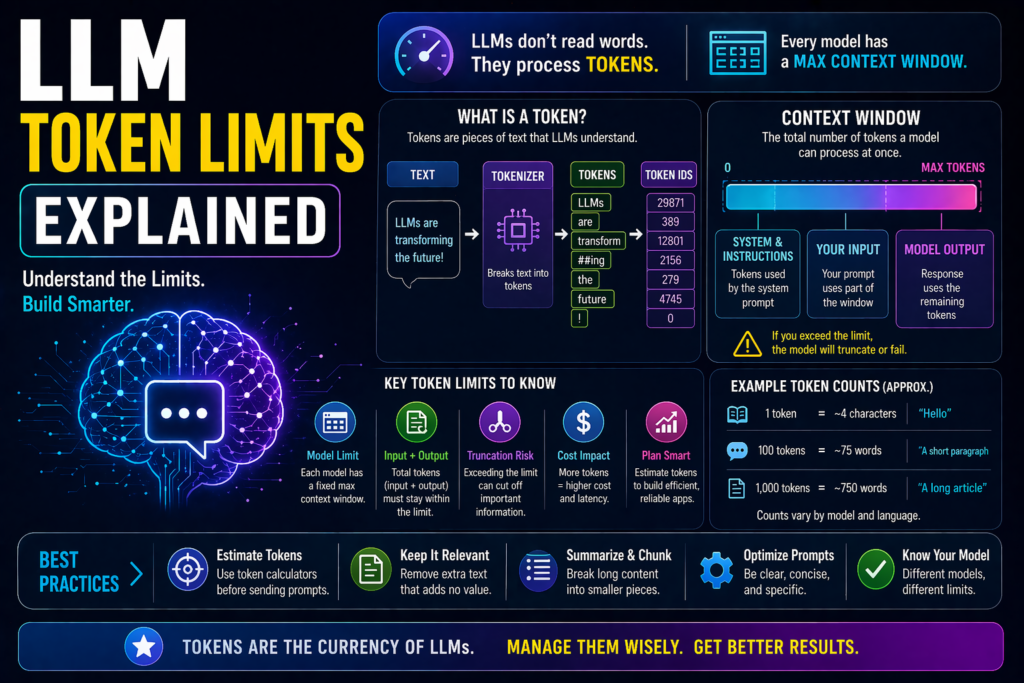
Large language models do not read text the way humans do; instead, they parse data fragments using mathematical building blocks known as tokens. Understanding your target engine’s llm token limit parameters is essential for building stable applications and avoiding sudden data truncation.
In this comprehensive llm token limit explanation, we pull back the curtain on how context hardware windows scale. Whether you are trying to map out llm token limits across production APIs or looking for a basic breakdown of the underlying token limit meaning, mastering these computational boundaries is critical to preventing model hallucination and keeping runtime token costs highly predictable.
In simple terms
When designing chat interfaces, tracking the average tokens per message in a long llm conversation is vital for forecasting compute overhead. In standard business interactions, an individual message typically averages between 150 to 400 llm tokens. However, as the chat history grows, the entire system must re-ingest all preceding messages on every single turn, turning short interactions into massive token-guzzling loops if prompt caching is not properly configured.
A token limit is:
The maximum number of text units an LLM can process in one request.
These text units are called tokens.
Tokens may include:
- full words
- parts of words
- punctuation
- numbers
- symbols
- formatting characters
Think of tokens as the model’s counting system for language.
Can an LLM Model Generate an Unlimited Number of Tokens at a Time?
A common point of confusion for engineers is whether a state-of-the-art model can generate an unlimited number of tokens at a time. The short answer is no. While frontier context windows have expanded dramatically to handle 1 million to 10 million input tokens, the output token limit remains strictly capped by hardware reality and inference compute budgets.
When an LLM generates text, it appends each newly predicted token back into its short-term memory canvas to compute the next word fragment. This sequence requires massive GPU VRAM allocation. While a model can technically loop continuously, providers enforce a hard ceiling—typically ranging from 4,096 to 65,536 tokens per single response sequence—meaning no system can generate an infinite chunk of data in a single operational run.
Why LLM Token Limits Matter
Token limits affect:
- prompt length
- conversation memory
- file analysis size
- output length
- speed and cost
- response quality
The more tokens used, the more resources are required.
What is a Token?
AI models usually do not count words directly.
They break text into smaller chunks called tokens.
Examples:
- “Hello” may be one token
- “unbelievable” may become multiple tokens
- punctuation like commas may count too
So 1,000 words does not always equal 1,000 tokens.
Prompt Tokens vs Output Tokens
Most AI requests include two token categories.
Input Tokens
These include:
- your prompt
- previous chat history
- system instructions
- uploaded text
Output Tokens
These are the tokens generated in the response.
Both usually count toward total limits.
Example of Token limits in Action
Suppose a model supports a certain maximum token capacity.
If your request includes:
- long conversation history
- large pasted article
- detailed instructions
There may be less room left for the answer.
That can lead to shorter or incomplete outputs.
Token Limits vs Context Window
These terms are related.
Token Limit
The numeric cap on tokens.
Context Window
The total working space where tokens fit.
In practice, token limits help define the usable context window.
Why long chats lose memory
As conversations grow, earlier messages also consume tokens.
When limits are reached, systems may:
- remove old messages
- summarize earlier chat
- prioritize recent messages
- reduce retained detail
That is why AI sometimes forgets old context.
Why businesses care about Token Limits
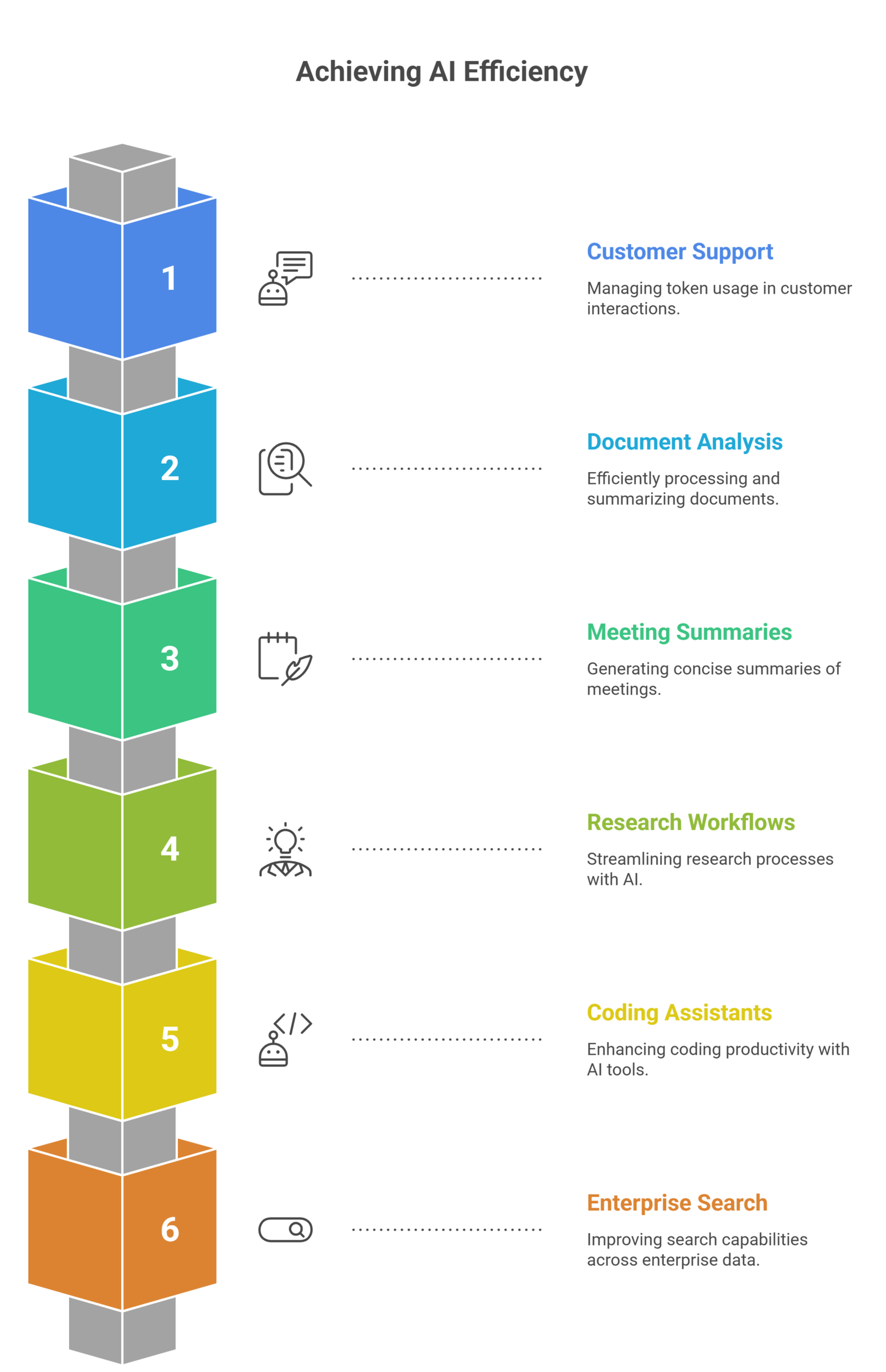
Companies using AI for operations need to manage token usage for:
- customer support chats
- document analysis
- meeting summaries
- research workflows
- coding assistants
- enterprise search tools
Better token efficiency often means lower cost and faster responses.
Real examples where Token Limits Matter
1.Long PDF Summaries
Large reports may need chunking.
2.Coding Projects
Big codebases can exceed limits.
3.Multi-step Strategy Work
Long prompts may reduce output space.
4.Support Conversations
Very long histories may lose details.
5.RAG Systems
Retrieved documents use token budget too.
Popular AI companies improving token capacity
Many providers continue expanding long-context capabilities, including:
Longer context is a major competitive area.
LMArena.ai Prompt Token Limit & Chatbot Arena Boundaries
When benchmark testing models under blind conditions, developers frequently hit performance ceilings and research the exact lmarena.ai prompt token limit 2026 guidelines. Because the LMSYS Chatbot Arena serves as a volunteer-driven evaluation system, platform computing costs must be strictly managed.
Understanding the LMArena.ai Prompt Length Limit
If you are analyzing the lmarena.ai prompt length limit or input limit or token limit, the web platform natively enforces a prompt truncation filter around 32,000 tokens.
This constraint is crucial for developers to remember during testing: if you paste a massive 100,000-token file into the arena duel workspace, the underlying lmarena prompt token limit mechanics will clip your input data before it hits the side-by-side models. This system limit levels the playing field for compact open-weights architectures, but it simultaneously penalizes frontier engines built to maintain high accuracy across ultra-long contexts.
Consumer Platform Windows: Character.ai and NovelAI Token Limits
Beyond enterprise developer APIs, consumer entertainment platforms utilize unique context-pruning architectures to manage immense multi-user server loads.
-
Character.ai Context Window Token Limit 2026: To support fluid, long-form personality emulation without causing runaway lag, chat profiles use automated “rollover” compression. As an aggregate conversation continues, older memory blocks are systematically condensed into low-token status summaries to preserve personality consistency within strict computing budgets.
-
NovelAI Prompt Token Limit 2026: For creative writers running long-form generation scripts, the system operates on structured input and output buckets. Runtimes are restricted to specific rolling generation parameters—such as a default allocation of 2,048 output tokens every 4 minutes per script—encouraging authors to practice defensive context management to maximize memory retention.
How to work within LLM Token Limits
1.Use concise prompts
Remove unnecessary text.
2.Break large tasks into steps
Use multiple smaller prompts.
3.Summarize previous context
Replace long history with summaries.
4.Send only relevant content
Avoid dumping entire documents if not needed.
5.Ask for structured answers
Focused outputs use fewer tokens.
Do bigger token limits always mean better AI?
Not always.
A model may have:
- huge token capacity but average reasoning
- smaller capacity but stronger answers
Token size matters, but model quality matters too.
Common beginner mistakes
- confusing tokens with words
- using overly long prompts
- forgetting outputs also use tokens
- assuming memory is unlimited
- sending irrelevant background text
Token limits and cost
Many AI pricing systems are linked to token usage.
More tokens can mean:
- higher API cost
- slower responses
- larger compute demand
That is why businesses optimize prompts carefully.
Suggested Read:
- LLM for Beginners
- LLM Context Window Explained
- How LLMs Work
- LLM Explained Simply
- LLM Training vs Inference
FAQ: LLM Token Limits
What are LLM token limits?
The maximum number of tokens an AI model can handle in one request.
Are tokens the same as words?
No. Tokens may be full words or parts of words.
Why does AI stop mid-answer?
The response may hit output token limits.
Why does AI forget old chat messages?
Older messages may be removed when token capacity fills up.
Should I always use long prompts?
No. Clear, focused prompts usually work better.
Final takeaway
LLM token limits control how much text an AI model can process and generate at one time. They influence memory, prompt length, output size, speed, and cost.
If you understand token limits, you can prompt smarter, reduce waste, and get better results from AI tools.