
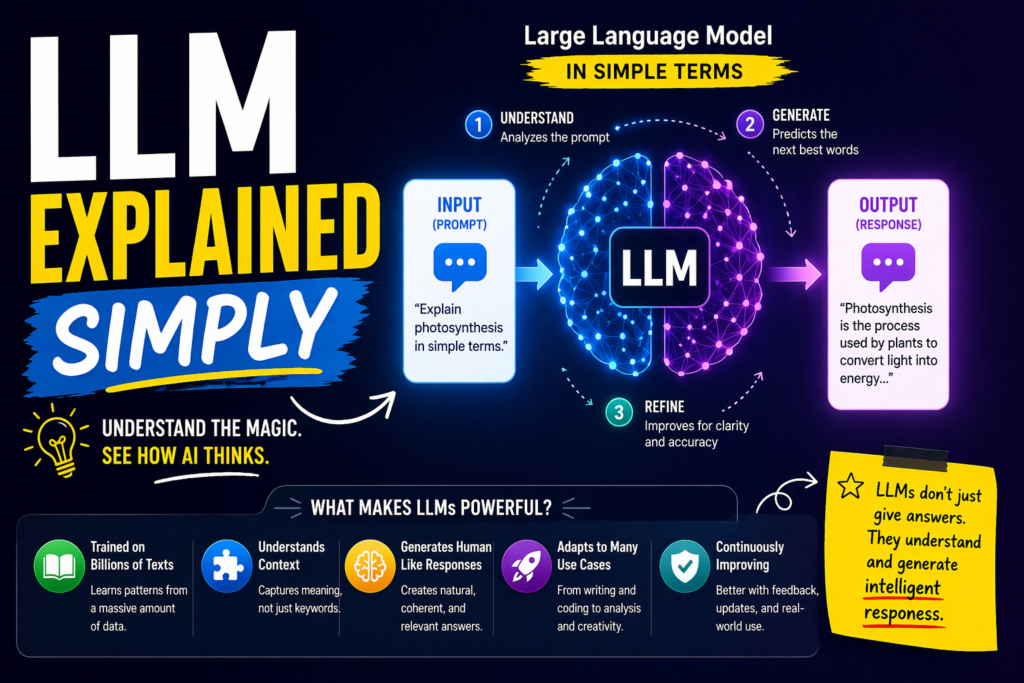
LLM Explained Simply: What Large Language Models Are and How They Work
LLMs are one of the biggest reasons AI tools became popular worldwide. They power chatbots, writing assistants, coding tools, search systems, and many modern business applications.
But many beginners still ask: What is an LLM?
This guide explains LLMs simply—without technical jargon—so anyone can understand how they work, where they are used, and why they matter.
In simple terms
LLM stands for Large Language Model.
It is an AI system trained on huge amounts of text so it can understand and generate human-like language.
That means an LLM can:
- answer questions
- write content
- summarize text
- translate languages
- generate code
- explain topics
- assist with research
Think of it like an AI engine trained to work with words.
Why is it called a Large Language Model?
The name has three parts:
Large
It is trained on massive datasets and usually has many parameters.
Language
It works mainly with human language such as English, Hindi, Spanish, and code.
Model
It is a mathematical AI system trained to predict useful text.
How LLMs work
At the core, an LLM learns patterns from text.
It studies billions of examples such as:
- books
- articles
- websites
- documentation
- code repositories
- conversations
- public text sources
Then it learns:
- grammar
- facts and concepts
- writing styles
- reasoning patterns
- question-answer relationships
When you type a prompt, it predicts the most useful next words based on training and context.
Example of an LLM in action
You ask:
“Explain blockchain simply.”
The LLM analyzes:
- what blockchain means
- your request for simplicity
- likely helpful structure
Then it generates an answer in natural language.
That is why tools feel conversational.
Popular examples of LLMs
Some well-known LLM-powered tools come from:
These organizations build models used in chatbots, APIs, and enterprise tools.
Where LLMs are used today
Content Creation
Writing blogs, emails, product descriptions, scripts.
Customer Support
Answering FAQs and helping support teams.
Coding Assistance
Generating code, debugging, documentation.
Search & Research
Summarizing information quickly.
Education
Tutoring, explanations, study help.
Business Productivity
Meeting notes, reports, workflow automation.
Why LLMs became so popular?
Several reasons caused rapid growth:
Easy to use
Users type prompts in plain language.
Fast results
Tasks that took hours can take minutes.
Flexible
One model can do many tasks.
Improves productivity
Useful for individuals and companies.
Constantly improving
Newer models are more capable.
Benefits of LLMs
- Save time
Automates repetitive language tasks.
- Improve productivity
Helps writers, developers, marketers, analysts.
- Scales communication
Useful for teams serving many users.
- Supports creativity
Brainstorming ideas and drafts.
- Accessible learning
Explains complex topics simply.
Limitations of LLMs
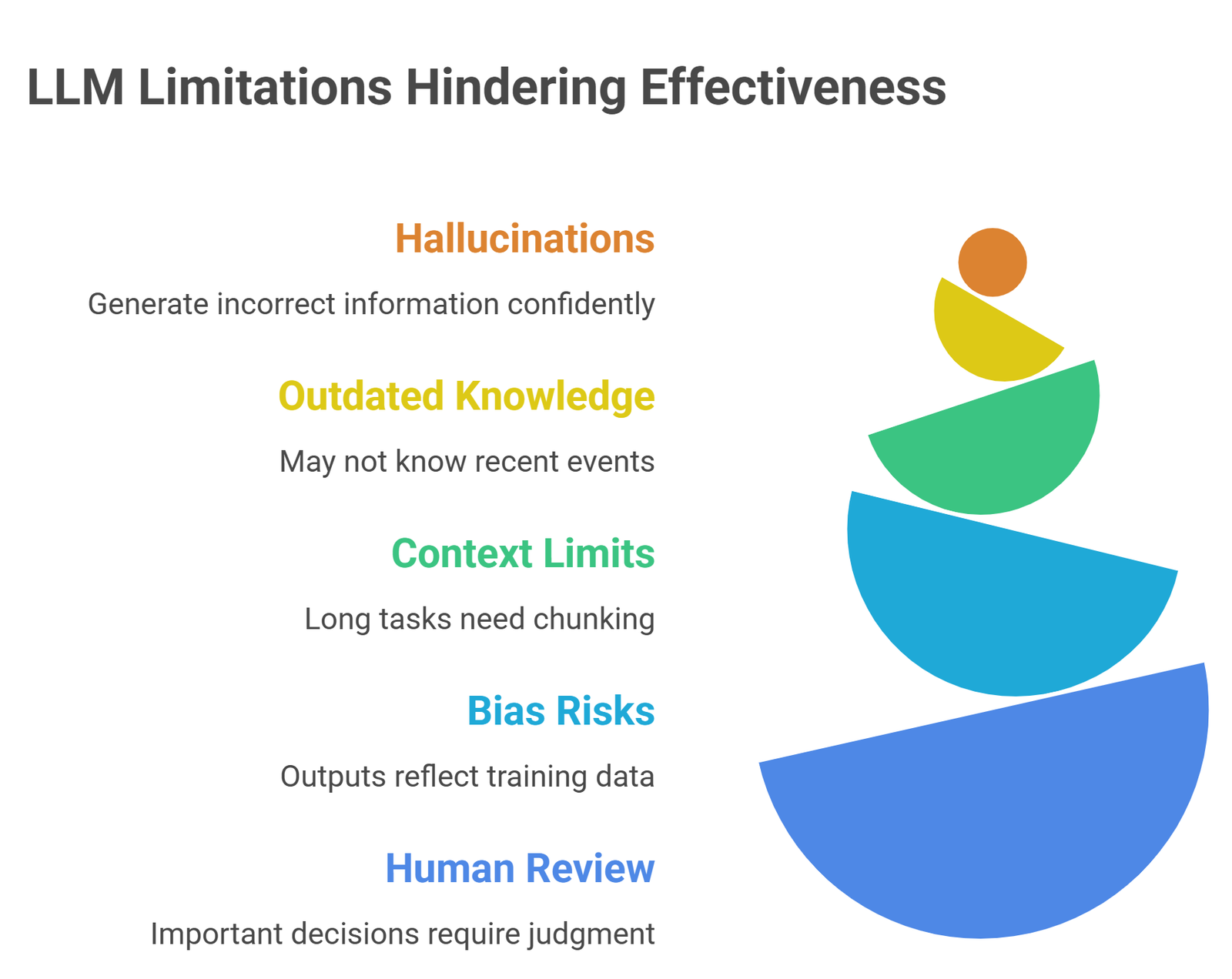
LLMs are powerful but not perfect.
Hallucinations
Sometimes generate incorrect information confidently.
Outdated knowledge
Some models may not know recent events unless connected to live data.
Context limits
Very long tasks may need chunking or tools.
Bias risks
Outputs may reflect training data patterns.
Need human review
Important decisions still require judgment.
LLM vs Traditional Search
| Feature | LLM | Search Engine |
| Gives direct answers | Yes | Sometimes |
| Summarizes content | Yes | Limited |
| Conversational | Yes | Limited |
| Live web accuracy | Sometimes | Stronger |
| Creative generation | Yes | No |
Many users now use both together.
LLM vs Chatbot
Not every chatbot uses an LLM.
Traditional chatbots follow rules.
LLM chatbots understand flexible language and generate richer responses.
Do LLMs think like humans?
No.
They do not think exactly like humans or have human consciousness.
They detect patterns and generate outputs statistically.
However, outputs can appear intelligent because language ability is advanced.
How to use LLMs effectively
Ask clear prompts
Specific requests get better answers.
Give context
Mention audience, tone, goal.
Verify important facts
Especially finance, health, law.
Iterate
Refine prompts for better outputs.
Use for assistance
Best used as a co-pilot, not final authority.
Suggested Read:
- What Is Generative AI? Complete Beginner Guide
- Prompt Engineering Explained Simply
- Best Prompts for ChatGPT
- Hallucination Reduction Prompts
- Prompt Evaluation Methods
- How AI Agents Work Explained
FAQ: LLM Explained Simply
What does LLM stand for?
Large Language Model.
Is ChatGPT an LLM?
It is an application powered by LLM technology.
Can LLMs write code?
Yes, many can assist with coding tasks.
Are LLMs always accurate?
No. Human review is still important.
Will LLMs replace jobs?
They are more likely to reshape tasks than replace every role.
Final takeaway
LLMs are AI systems trained on huge amounts of text to understand and generate language. They power many modern tools for writing, coding, support, learning, and productivity.
If you understand LLMs simply, you understand one of the most important technologies shaping the future of AI.