
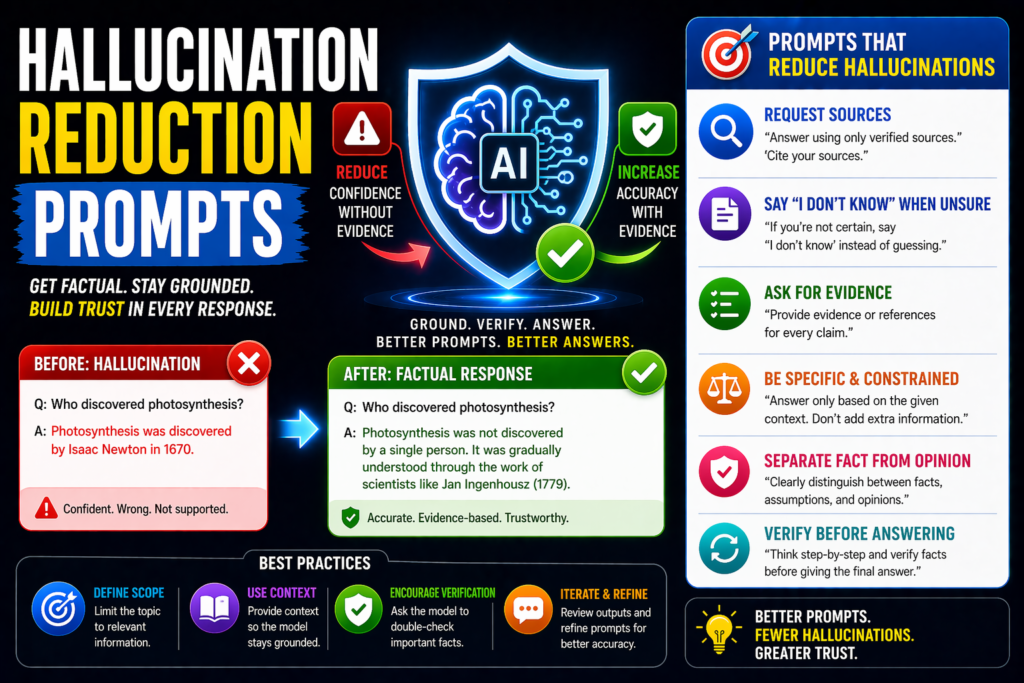
Hallucination Reduction Prompts: 25 Best Prompts for More Accurate AI Answers
AI tools can sound confident even when they are wrong. That problem is commonly called hallucination. It may appear as invented facts, fake citations, incorrect numbers, or unsupported claims.
The good news is that better prompting can reduce hallucinations significantly.
This guide shares the best hallucination reduction prompts for ChatGPT, Claude, Gemini, and other AI tools so you can get more accurate and trustworthy outputs.
In simple terms
A hallucination reduction prompt is:
A prompt designed to prioritize accuracy, uncertainty, verification, and evidence over confident guessing.
Instead of:
“Answer quickly.”
Use:
“Answer only if reasonably confident. If uncertain, say what is unknown.”
Why Hallucination Reduction Prompts Matter
Many users optimize for speed, not truth. That creates risk.
Better prompts help you:
- reduce false claims
- improve factual accuracy
- reveal uncertainty
- lower business risk
- improve research quality
- build trust in outputs
These prompts are especially useful for professional workflows.
25 Best Hallucination Reduction Prompts
Accuracy First Prompts
1.Confidence Prompt
“Answer only if reasonably confident. If uncertain, state uncertainty clearly.”
2.No Guessing Prompt
“If you do not know, say you do not know. Do not invent facts.”
3.Conservative Answer Prompt
“Provide the most reliable answer, even if incomplete.”
4.Fact Priority Prompt
“Prioritize factual accuracy over sounding fluent.”
5.Clarify Before Answering
“If the question is ambiguous, ask clarifying questions first.”
Verification Prompts
6.Evidence Prompt
“Answer and explain what evidence supports the claim.”
7.Source Direction Prompt
“Provide likely sources or where to verify this information.”
8.Separate Fact vs Assumption
“Label facts, assumptions, and speculation separately.”
9.Confidence Score Prompt
“Answer and rate confidence as high, medium, or low.”
10.Countercheck Prompt
“Before finalizing, review your answer for possible errors.”
Research Prompts
11.Balanced Summary Prompt
“Summarize only well-supported findings. Mention disputed areas.”
12.Comparison Prompt
“Compare these options using verified known facts only.”
13.Statistics Prompt
“If statistics are uncertain, say approximate or unknown.”
14.Timeline Prompt
“Only include dates you are confident about.”
15.Definition Prompt
“Give a precise definition and avoid unsupported claims.”
Business & Decision Prompts
16.Risk Review Prompt
“Recommend an option and list unknowns or risks.”
17.Assumption Audit Prompt
“State assumptions before giving recommendations.”
18.Scenario Prompt
“Give best-case, likely-case, and uncertain-case outcomes.”
19.Missing Data Prompt
“What important data is missing before making a decision?”
20.Safer Decision Prompt
“If evidence is weak, say so before recommending.”
Coding & Technical Prompts
21.Version Prompt
“If version-specific info may vary, state assumptions.”
22.Syntax Caution Prompt
“Provide code likely to work and flag uncertain parts.”
23.Dependency Prompt
“Mention libraries or dependencies required.”
24.Edge Case Prompt
“List possible edge cases or failure points.”
25.Test Prompt
“Provide code and include tests to validate correctness.”
How to write Best Hallucination Reduction Prompts
1.Reward honesty
Ask for uncertainty.
2.Request assumptions
Useful for planning tasks.
3.Ask for limits
Example:
“What can you not know here?”
4.Ask for verification paths
Sources, databases, documentation.
5.Slow the answer down
Ask for review before final output.
Common mistakes that increase hallucinations
- demanding instant certainty
- vague questions
- missing context
- asking for fake citations unknowingly
- trusting outputs without checks
- using AI for high-stakes decisions alone
Copy-paste universal template
“Answer this accurately.
If uncertain, say so clearly.
Separate facts from assumptions.
Ask clarifying questions if needed.
Review for possible errors before finalizing.
Question: [insert question]”
When these prompts matter most
Use them for:
- research
- coding
- finance planning
- legal/general guidance
- healthcare information
- strategy decisions
- data interpretation
Suggested Read:
- What Is Prompt Engineering? Complete Beginner Guide
- Truthfulness Prompting Explained
- Prompt Evaluation Methods
- Testing Prompts Systematically
- Prompts for Question Answering
- Prompt Engineering Best Practices
FAQ: Best Hallucination Reduction Prompts
What are hallucination reduction prompts?
Prompts designed to make AI more accurate and less likely to invent information.
Do they eliminate hallucinations completely?
No, but they can reduce them significantly.
Which AI tools support them?
ChatGPT, Claude, Gemini, and most modern LLMs.
Should I still verify answers?
Yes, especially for high-stakes topics.
Final takeaway
Hallucination reduction prompts are one of the easiest ways to improve AI reliability. By rewarding honesty, uncertainty, and evidence, you can get safer and more useful outputs.
Use these prompts whenever accuracy matters more than speed.