
Europe’s JUPITER Supercomputer Is Modeling Earth, the Brain and Quantum Systems
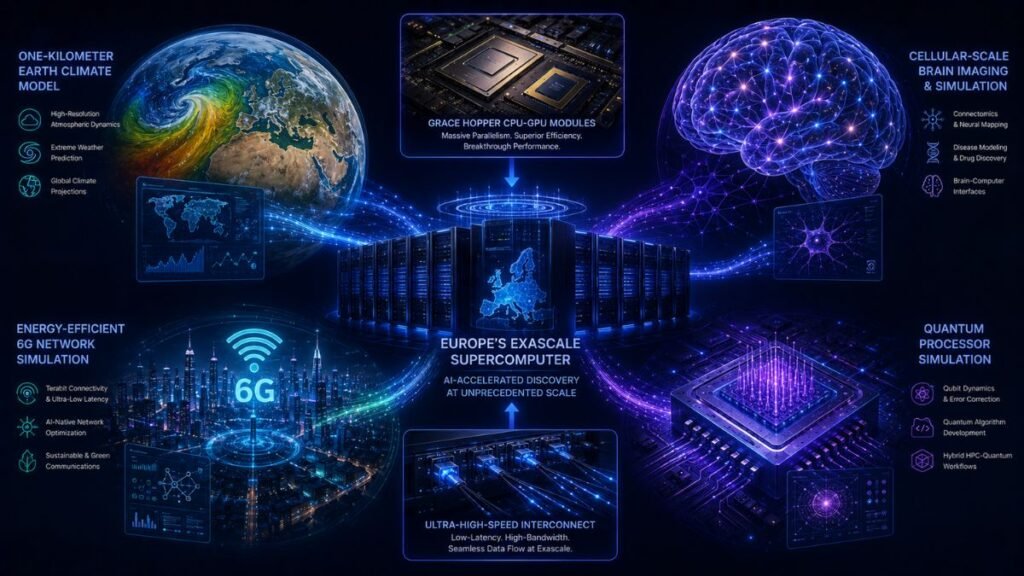
NVIDIA published a new overview of Europe’s JUPITER supercomputer on June 22, 2026, highlighting four projects in climate science, brain mapping, 6G development, and quantum-system simulation.
The JUPITER exascale supercomputer AI platform is hosted at the Jülich Supercomputing Centre in Germany. It officially passed one exaflop of sustained high-precision computing performance in November 2025, making it Europe’s first system to cross the exascale threshold.
Its significance goes beyond one ranking. JUPITER combines conventional high-performance computing with GPU-heavy AI infrastructure, allowing researchers to run physical simulations, train scientific foundation models, analyze enormous datasets, and connect those workloads inside one modular environment.
What Is the JUPITER Exascale Supercomputer?
JUPITER stands for Joint Undertaking Pioneer for Innovative and Transformative Exascale Research.
It is based on Eviden’s BullSequana XH3000 platform and uses a modular architecture developed for different types of scientific workloads. Its GPU-intensive Booster includes approximately 24,000 NVIDIA GH200 Grace Hopper Superchips, spread across roughly 6,000 compute nodes and connected through NVIDIA InfiniBand networking.
A second cluster module is designed for more general and data-intensive tasks. The two modules can operate separately or together, depending on whether a scientific problem requires massive GPU parallelism, complex data handling, or a combination of both.
This modular design is important because scientific computing is not one workload. Climate models, neural-network training, quantum simulations, and data analytics stress hardware in different ways.
What Exascale Actually Means
An exascale computer can sustain approximately one quintillion calculations per second on a recognized high-precision benchmark.
JUPITER reached one exaflop on the TOP500’s high-performance LINPACK measurement and ranked fourth globally in November 2025.
That number should not be confused with its AI-performance figures.
EuroHPC reports up to 80 exaflops for selected 8-bit sparse AI operations. Lower-precision AI arithmetic can produce much higher operation counts than the 64-bit floating-point calculations commonly used for scientific simulation. The figures describe different workloads and are not direct alternatives.
How Grace Hopper Supports Both HPC and AI
Each GH200 Superchip combines an NVIDIA Grace CPU with a Hopper GPU through a high-bandwidth, coherent NVLink-C2C connection.
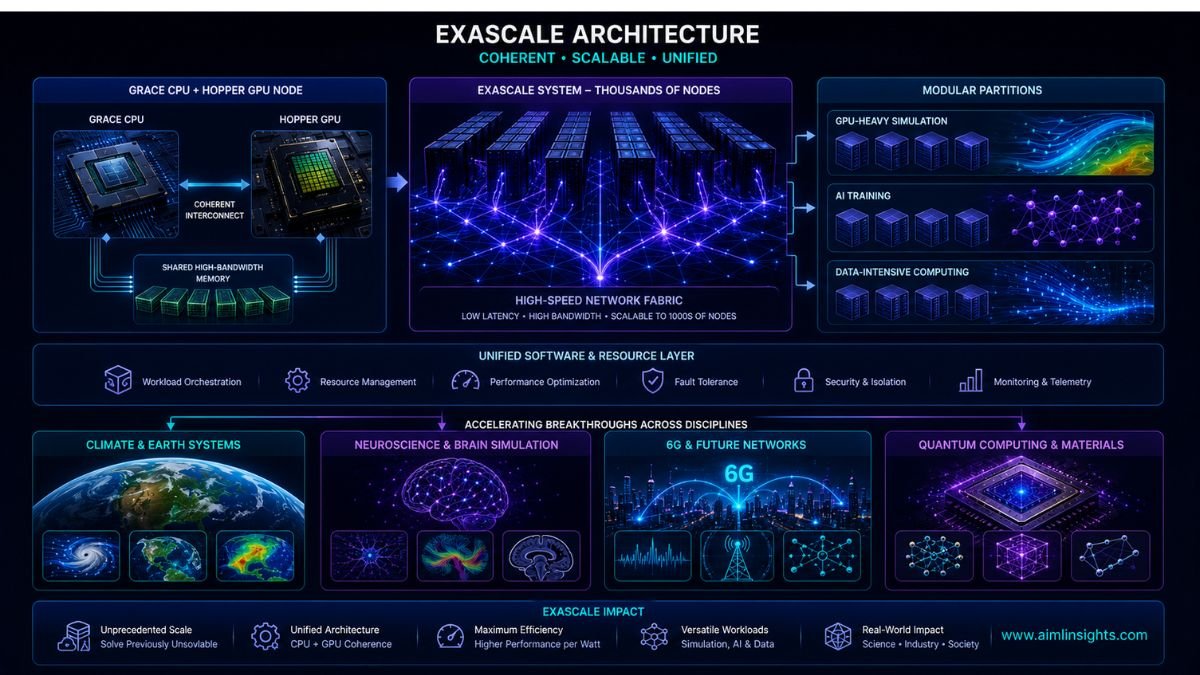
The design allows the CPU and GPU to operate across a unified memory architecture rather than moving all data through a conventional PCIe boundary. NVIDIA specifies a coherent interface of up to 900GB per second.
This helps with workloads that need:
- Fast GPU matrix computation
- Large CPU-accessible memory
- Frequent movement between simulation and AI stages
- Datasets larger than one GPU’s local memory
- Tightly coupled CPU and GPU algorithms
The memory design was especially relevant to JUPITER’s 50-qubit quantum simulation, where the quantum state exceeded ordinary GPU-memory limits.
Climate Modeling at One-Kilometer Resolution
One highlighted project uses the ICON Earth-system model to simulate the planet at approximately one-kilometer global resolution.
The configuration couples atmosphere, ocean, land, biogeochemistry, and the carbon cycle. NVIDIA says the system simulated about 146 days of climate in 24 hours of computation using 20,480 Grace Hopper Superchips.
Higher resolution matters because many processes—such as ocean eddies, fine-scale winds, mixing, storms, and marine-ecosystem interactions—must otherwise be approximated through simplified equations.
At one kilometer, more of those processes can emerge from the underlying physics rather than being represented entirely through coarse parameterizations.
That does not make the forecast automatically correct. Climate results still depend on model equations, initial conditions, observational data, numerical methods, and validation against the real world.
Cellular-Scale Brain Mapping
Jülich researchers are also using JUPITER to train CytoNet, a foundation model for analyzing human brain microarchitecture.
The project works with cellular-scale brain-imaging data and aims to connect individual cell structures with broader patterns of brain organization.
According to NVIDIA, training used 6.5 petabytes of data from 21 post-mortem brains and ran in under five days on 4,096 Grace Hopper Superchips.
This is better described as AI-assisted brain mapping than a full simulation of the human brain.
The system analyzes tissue images and cellular organization. It does not reproduce all 86 billion neurons, their biochemical states, or a living brain’s complete electrical activity.
Researchers plan to extend the work with an AI assistant that can help scientists query and reason over brain data. That remains a research direction rather than a validated clinical tool.
JUPITER’s Role in 6G Research
Ericsson and Forschungszentrum Jülich announced a research collaboration on March 25, 2026, using JUPITER to develop and evaluate AI methods for evolving 5G systems and future 6G networks.
Research areas include:
- AI for radio and core networks
- Network management
- Radio-channel estimation
- Massive MIMO optimization
- Large-scale model training
- Energy-efficient inference at the network edge
- Neuromorphic, or brain-inspired, computing
The partnership is particularly focused on energy efficiency. Future networks may need to coordinate more devices, antennas, data streams, and intelligent services without allowing energy consumption to grow at the same rate.
JUPITER provides an environment for training and stress-testing large AI systems before attempting deployment in real network infrastructure.
This does not mean commercial 6G is available. Forschungszentrum Jülich notes that the first commercial services are generally expected around 2030.
Simulating a 50-Qubit Quantum Computer
Jülich researchers also report fully simulating a universal 50-qubit quantum computer, exceeding a previous 48-qubit record.
A classical simulation of quantum states becomes exponentially more difficult as qubits are added. A full state representation for 50 qubits contains more than one quadrillion complex amplitudes.
JUPITER’s tightly connected CPU–GPU memory allowed data exceeding GPU-memory capacity to spill into CPU memory with relatively low communication overhead.
The resulting JUQCS-50 simulator is intended to help researchers design and test quantum algorithms before sufficiently capable quantum hardware is available.
JUPITER is not itself a quantum computer. It is a classical exascale system simulating how a quantum machine would behave.
Traditional HPC Simulation vs Machine Learning
JUPITER supports both workload types, but they solve problems differently.
| Workload | Core approach | JUPITER example |
| Traditional HPC simulation | Solves physical or mathematical equations numerically | ICON climate modeling |
| Machine learning | Learns patterns from large datasets | CytoNet brain-image model |
| AI-assisted engineering | Trains models to optimize or predict system behavior | 6G network research |
| Classical quantum simulation | Represents quantum states using classical computation | JUQCS-50 |
| Hybrid scientific AI | Combines simulation data with learned surrogate models | Future climate, materials, or biology workflows |
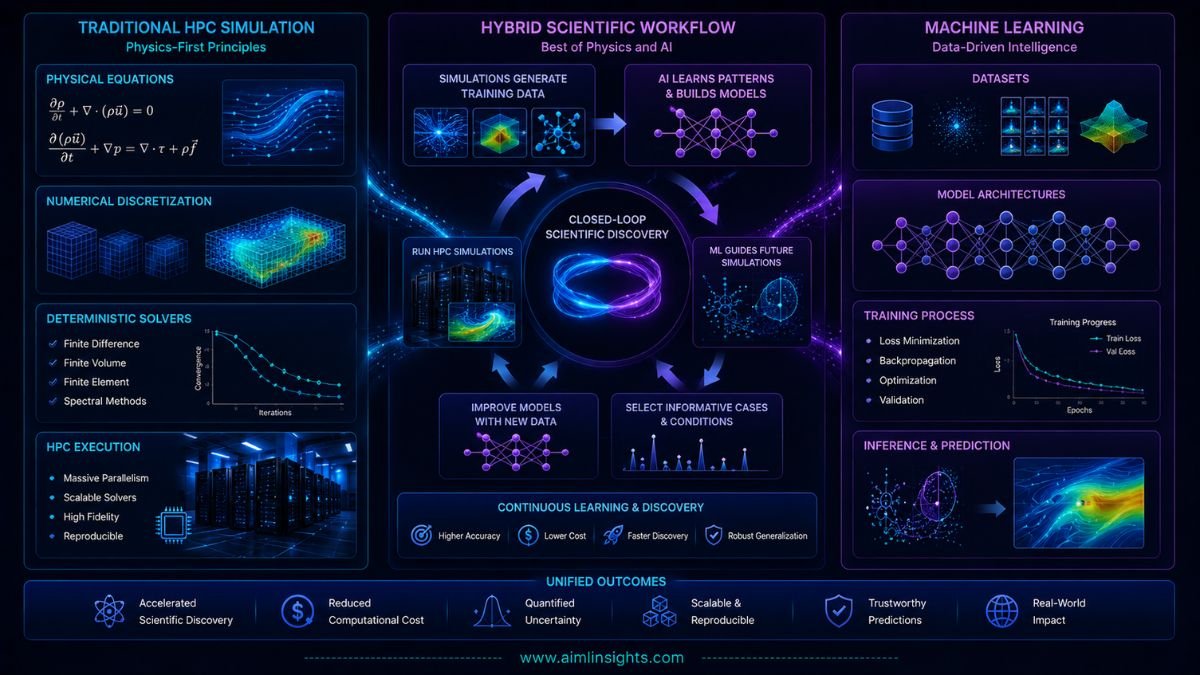
Traditional HPC starts with explicit scientific rules. Machine learning learns statistical relationships from examples.
The two approaches can complement each other. A physics simulation can generate training data, while an AI model can approximate expensive calculations or identify which simulations should run next.
However, a learned surrogate does not automatically preserve every physical law. Researchers must test its accuracy outside the training distribution.
Benchmark and Evidence Audit
| Result | Metric | Reported outcome | Owner | Independently standardized? |
| JUPITER system performance | TOP500 HPL | 1 exaflop; fourth globally | TOP500/EuroHPC | Yes, standardized benchmark |
| AI throughput | 8-bit sparse operations | Up to 80 exaflops | EuroHPC | Provider specification |
| Climate simulation | Simulated climate per day | About 146 days in 24 hours | NVIDIA and research partners | Project-reported |
| CytoNet training | Time and data volume | Under five days; 6.5PB | NVIDIA and Jülich partners | Project-reported |
| Quantum simulation | Maximum simulated qubits | 50 universal qubits | Jülich and NVIDIA | Research-team reported |
| 6G research | Commercial or benchmark result | Not disclosed | Ericsson and Jülich | Not yet applicable |
The strongest independently standardized claim is JUPITER’s one-exaflop TOP500 result.
The project-specific findings are scientifically important, but they use different methods, software, hardware allocations, and success criteria. They should not be treated as a single benchmark proving superiority across every research domain.
Why This Matters
JUPITER gives European researchers access to infrastructure capable of supporting both frontier AI and large-scale scientific simulation.
That matters for scientific sovereignty. Climate, health, telecommunications, and quantum research increasingly depend on access to enormous computing systems, specialized accelerators, software ecosystems, and trained personnel.
JUPITER also supports the emerging JUPITER AI Factory, intended to help European researchers, startups, and smaller companies build AI systems using shared infrastructure.
The challenge is access. Exascale machines are expensive, heavily scheduled, technically complex, and unsuitable for routine workloads that can run efficiently on smaller systems.
Limitations and Open Questions
JUPITER’s capabilities are substantial, but several questions remain.
Energy efficiency does not mean low total power consumption. Exascale computing still requires major electricity, cooling, networking, and operational infrastructure.
Scientific speed also does not guarantee scientific validity. Faster models can produce wrong results more quickly when assumptions, data, or numerical settings are flawed.
Other unanswered issues include:
- How researchers will receive and prioritize access
- Whether projects can reproduce results on other architectures
- Total energy use per scientific result
- Long-term software maintenance
- Data-governance rules for sensitive medical or industrial data
- How smaller institutions will obtain technical support
- Whether AI surrogates preserve physical reliability
Simple Explanation for Beginners
JUPITER is an extremely large scientific computer.
It can run physics equations for the whole planet, train AI on microscopic brain images, test ideas for future mobile networks, and imitate a small quantum computer.
Some jobs use traditional simulation. Others use machine learning.
Its main advantage is that it can support both approaches—and move huge amounts of data between CPUs and GPUs quickly.
Conclusion: JUPITER Exascale Supercomputer AI
The JUPITER exascale supercomputer AI platform is becoming one of Europe’s most important scientific infrastructures.
Its Grace Hopper architecture supports physics-based climate modeling, cellular-scale brain analysis, large AI experiments for 6G, and classical simulation of quantum systems.
The headline projects are impressive, but they represent different kinds of computing and different levels of evidence.
JUPITER’s long-term value will depend not only on speed, but on reproducible science, broad researcher access, efficient energy use, trustworthy AI workflows, and results that can be validated beyond one supercomputer.
Final Takeaways
- JUPITER officially reached one exaflop in November 2025.
- It is Europe’s first exascale supercomputer.
- The Booster uses approximately 24,000 NVIDIA GH200 Superchips.
- Grace Hopper combines coherent CPU and GPU memory.
- ICON modeled a coupled Earth system at one-kilometer resolution.
- CytoNet analyzes cellular-scale post-mortem brain imagery.
- Ericsson and Jülich are using JUPITER for 5G and 6G AI research.
- Researchers report simulating a universal 50-qubit quantum computer.
- JUPITER is not itself a quantum computer.
- HPC simulation and machine learning are different but complementary.
- Most project results are partner-reported; the TOP500 result is standardized.
Suggested Read:
- NVIDIA AI for Science Software
- What Is Exascale Computing?
- AI Climate Models Explained
- LoRA Alternatives PEFT Benchmark: Which Methods Perform Better?
- Latest NVIDIA AI News
- Agentic Coding Benchmark Tests Real Software Tool Use
FAQ: JUPITER Exascale Supercomputer AI
What is the JUPITER exascale supercomputer?
JUPITER is Europe’s first supercomputer to sustain one exaflop on the TOP500 high-performance benchmark. It is hosted by the Jülich Supercomputing Centre in Germany.
How powerful is JUPITER?
It reached one exaflop of high-precision performance and can provide up to 80 exaflops for selected 8-bit sparse AI workloads. These figures use different numerical precision and should not be compared directly.
How does JUPITER use AI for climate research?
Its climate work combines large-scale physical simulation with accelerated computing. AI may also support analysis and surrogate modeling, but the highlighted ICON result is primarily a physics-based Earth-system simulation.
Is JUPITER simulating the human brain?
It is helping train AI models that analyze cellular-scale brain images. This is not the same as simulating an entire functioning human brain.
How will JUPITER support 6G research?
Ericsson and Jülich plan to use it for large AI training, network optimization, radio-edge inference, Massive MIMO research, and neuromorphic computing experiments.
Is JUPITER a quantum computer?
No. It is a classical supercomputer that can simulate quantum computers and algorithms.
References:
- NVIDIA’s ISC overview of JUPITER’s four scientific projects.
- EuroHPC’s official exascale certification and TOP500 update.
- Forschungszentrum Jülich’s official JUPITER architecture page.
- EuroHPC’s system launch and architecture details.
- Forschungszentrum Jülich’s official Ericsson 6G partnership announcement.
- NVIDIA’s official GH200 Grace Hopper architecture documentation.