
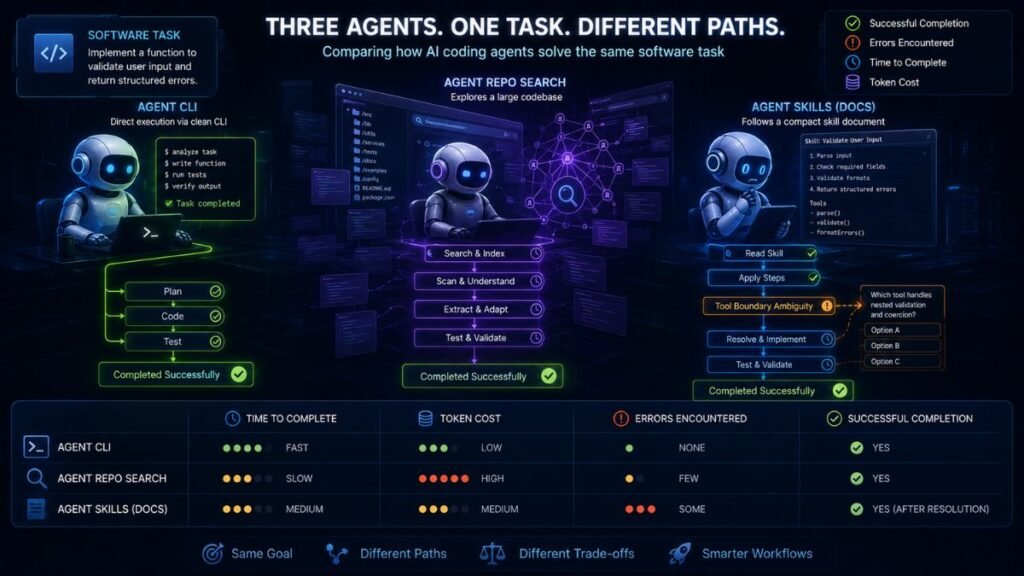
A New Benchmark Reveals Whether Coding Agents Use Tools Efficiently
Hugging Face published a new agentic coding benchmark on June 18, 2026, designed to measure how effectively AI agents use real software—not merely whether they eventually produce the expected answer.
The benchmark uses the Transformers library as its first case study. Open models are asked to complete practical machine-learning tasks such as sentiment classification, image classification, audio transcription, and question answering through a coding-agent harness.
Every run records the final result, execution time, token consumption, errors, commands, files read, and the software interface the agent chose. That richer view exposed a surprising result: documentation and a new command-line interface helped the strongest models complete tasks faster, but confused several smaller models and sometimes reduced their success rate.
What Is an Agentic Coding Benchmark?
A conventional coding benchmark often provides a problem and grades the final output.
That is useful, but it hides everything that happened before the answer appeared.
Two agents can both return the correct sentiment label. One may write a long Python script, load several classes, trigger an error, retry twice, and finally print the result. Another may run one supported command and finish immediately.
A final-answer test marks both as successful.
An agentic coding benchmark asks additional questions:
- How long did the task take?
- How many tokens did the agent consume?
- How many retries or errors occurred?
- Did it use the intended high-level interface?
- Did it read useful documentation?
- Did it fall back to deprecated or improvised code?
- Did the repository make the task easier or harder?
Hugging Face built its harness to evaluate both the model and the tool surface it must operate.
Why Final-Answer Accuracy Misses Tool-Use Quality
Coding agents do more than predict text.
They inspect files, choose APIs, execute commands, interpret failures, modify code, and decide when the task is complete.
That process has economic and reliability consequences.
An agent that reaches the right answer after 20,000 tokens and several failed executions is not equivalent to one that succeeds with a short, supported command. The first path costs more, takes longer, creates more failure opportunities, and may be harder to audit.
This distinction becomes especially important for strong models. Hugging Face notes that large open models often approach complete task success on common examples. Once completion rate saturates, the useful differences shift to turns, seconds, token use, errors, and interface choices.
For smaller local models, completion rate remains highly informative because tool use and task reasoning may both fail.
How the Evaluation Works
The benchmark runs each task across a matrix of:
- Coding model
- Transformers revision
- Task
- Assistance setting
Each run is executed as an independent Hugging Face Job so comparisons use consistent hardware. The model is driven through the open pi coding-agent CLI, while complete native traces are stored for later inspection.
The harness currently focuses on deterministic tasks with explicit matching rules. Depending on the task, the grader may use exact matching, a regular expression, or a case-insensitive substring.
That design makes the results easier to reproduce, though it also limits the benchmark to tasks with clearly verifiable answers.
Bare vs Clone vs Skill
Every task is tested under three separate conditions.
| Setting | What the agent receives | What it measures |
| Bare | Installed Transformers package only | Ability to use prior knowledge and discover installed APIs |
| Clone | Full Transformers repository in the working directory | Ability to inspect source, examples, and local documentation |
| Skill | Curated CLI documentation and task examples loaded into context | Ability to follow compact agent-specific guidance |
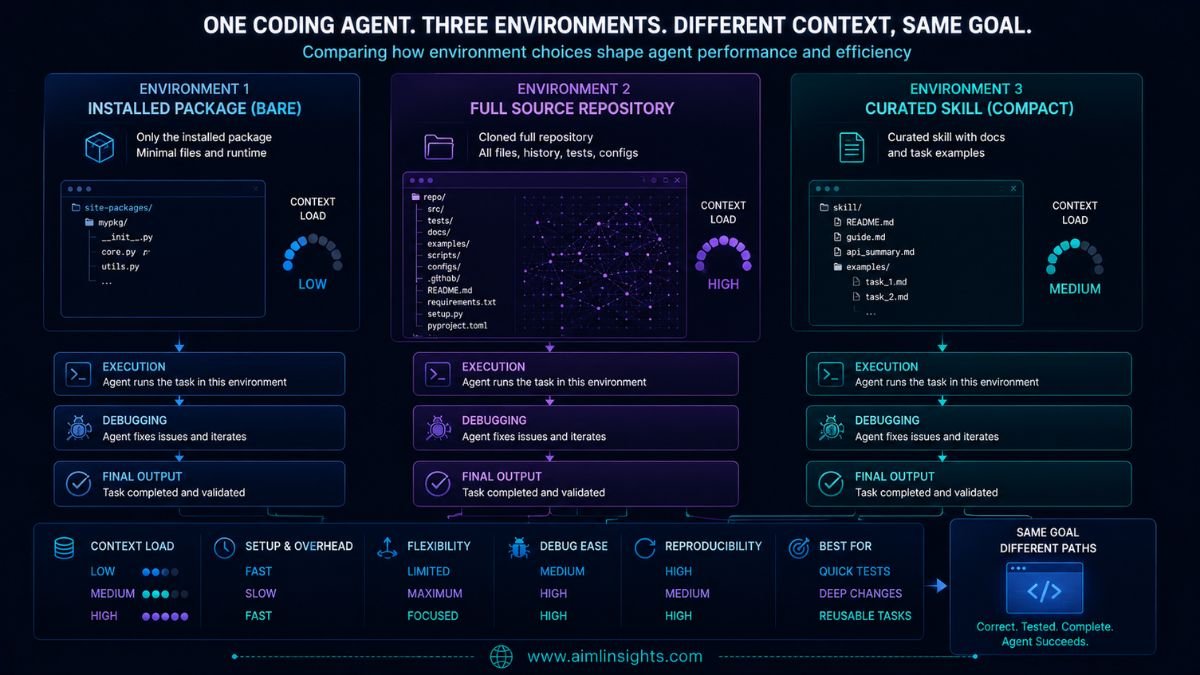
These settings are not cumulative. The Skill does not include the complete repository, while the cloned repository does not automatically load the curated Skill into the prompt.
The comparison reveals whether an agent benefits more from raw source access or from concise instructions.
It also tests whether added context genuinely helps—or simply adds another surface the model can misunderstand.
The Metrics That Matter
The benchmark tracks several dimensions.
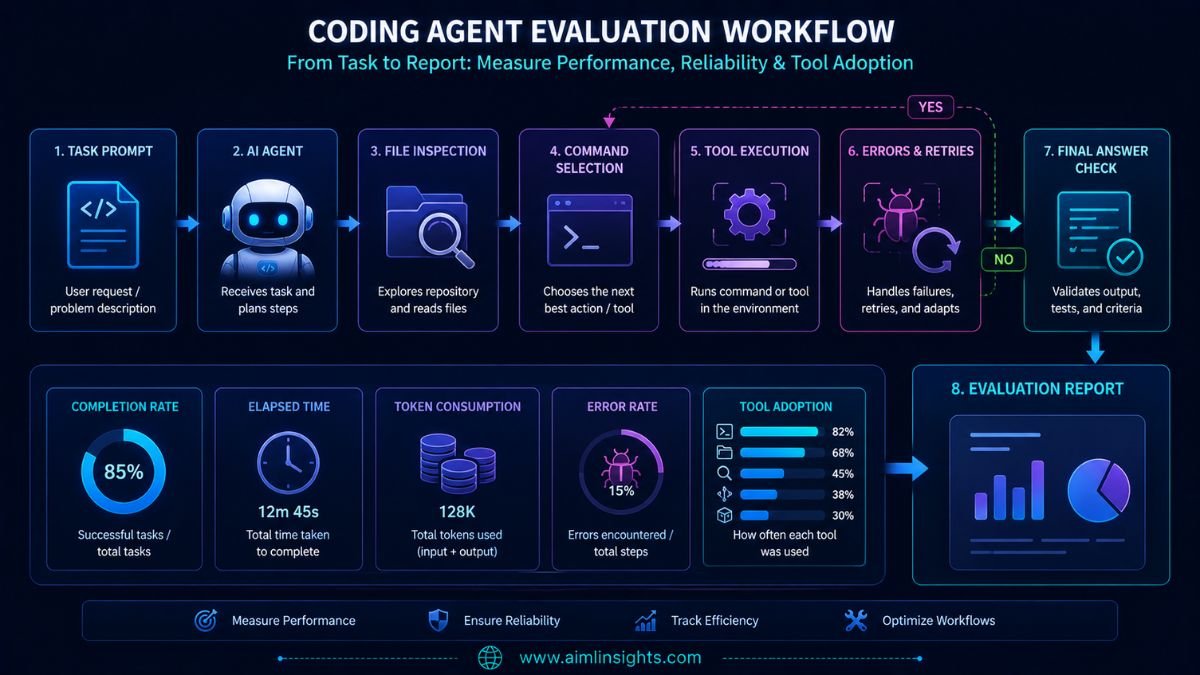
Completion or match rate
Did the answer satisfy the task’s explicit grading rule?
This is closest to a conventional benchmark score.
Execution time
How many seconds passed before completion?
Longer execution may indicate slow discovery, unnecessary commands, repeated downloads, or debugging.
Token consumption
The harness separates new input, repeated or cached context, and generated output where available.
Token use represents both cost and cognitive load. A repository change that forces an agent to read thousands of additional tokens may reduce practical efficiency even when accuracy is unchanged.
Error rate
The benchmark records runs with errors and specifically detects silent failures where the agent produces no output, tool call, or final answer.
Marker adoption
Markers are defined behavioral patterns detected in commands, code, file reads, or answers.
For the Transformers study, two important markers were:
- Use of the new transformers CLI
- Use of the high-level Python pipeline() API
This allows maintainers to test whether new documentation actually changes agent behavior instead of merely existing in the repository.
What the Transformers Case Study Found
Hugging Face tested whether a new CLI, curated Skill, and task examples made Transformers easier for agents to use.
For the three large open models highlighted in the analysis—Kimi-K2.6, GLM-5.1, and MiniMax-M2.7—the Skill-enabled revision generally reduced task-completion time. Stronger models noticed the new CLI and used it instead of writing and debugging custom Python.
The Skill condition adopted the newly introduced CLI in 55.3% of measured runs. Because the CLI was new and absent from model training data, this adoption suggests the curated documentation affected behavior.
However, the same repository change increased token consumption in cloned environments. Roughly one-third of those runs inspected the new CLI source or examples before using it, raising median input from approximately 4,000 to 6,400 tokens.
The result was a real trade-off: less execution time, but more context consumption.
Why Smaller Models Sometimes Performed Worse
The most important finding was that agent guidance is not automatically helpful.
For Qwen3-4B, the updated cloned repository increased median new-token consumption from roughly 2,400 to 23,000 without improving match rate. The smaller model read large portions of the new CLI source and examples but failed to convert that context into better performance.
Qwen3-14B showed a more severe failure. Its overall match rate fell from 67% in the bare setting to 43% with the Skill. On the sentiment-classification task, the cloned setting maintained 100% success while the Skill setting fell to 0%.
Trace inspection showed why.
The model interpreted the documented CLI as though it were a directly registered agent tool. It attempted calls resembling transformers(…) rather than invoking the command through a shell. In 39 of 56 Skill runs, it either tried the nonexistent tool or concluded that none of its available tools could execute the task.
The documentation was technically correct, but ambiguous to that model.
Benchmark Audit
| Evaluation element | Reported design or result | Independent verification |
| Case-study software | Hugging Face Transformers | Open repository and traces available |
| Agent harness | pi coding agent | Reproducible through published code |
| Main metrics | Match rate, time, tokens, errors, markers | Defined in repository |
| Assistance settings | Bare, clone, Skill | Reproducible |
| CLI adoption in Skill setting | 55.3% | Author-reported |
| Qwen3-4B token increase | ~2.4K to ~23K median new tokens | Author-reported |
| Qwen3-14B overall match change | 67% bare to 43% Skill | Author-reported |
| Real production ROI | Not measured | No |
| Human developer comparison | Not included | No |
The benchmark is transparent and open, but it is still a case study rather than a universal agent leaderboard.
Important limitations include:
- Only one main software library
- Deterministic tasks with simple answer matching
- Fresh sessions for each task
- No long-term memory or repeated-work amortization
- No proprietary coding-agent comparison
- Uneven task coverage across some models
- Results influenced by the selected agent harness and prompts
Hugging Face notes that the cloned-repository reading cost may be a worst-case estimate because each run starts fresh. In a persistent session, an agent could learn the interface once and reuse that knowledge.
What Makes Software Agent-Ready?
The study suggests that agent-ready software needs more than an API.
It needs:
- Discoverable entry points
- Short, task-focused examples
- Predictable commands
- Clear error messages
- Explicit distinction between shell commands and registered tools
- Machine-readable output
- Stable behavior across versions
- Documentation tested against models of different sizes
- Traces that reveal where agents become confused
A repository can contain comprehensive documentation and still be difficult for an agent if the useful path is buried among implementation details.
The case study also shows that guidance should be tested across model classes. An instruction that helps a frontier-scale model may overload or mislead a smaller local model.
Why This Matters
As coding agents become software users, developer experience is no longer designed only for humans.
Libraries, CLIs, SDKs, error messages, and repositories will increasingly be evaluated by how efficiently agents can operate them.
This could lead maintainers to add agent-focused regression tests alongside unit and integration tests.
For example, a team might test whether a model:
- Selects the recommended command
- Avoids deprecated APIs
- Completes the task within a token budget
- Recovers from one expected error
- Reads the correct guidance file
- Produces an auditable trace
That is a different standard from asking whether the library functions correctly when operated by an expert developer.
Security and Deployment Risks
The published harness is intended for trusted local evaluation.
It runs coding agents with bypassed permissions and may execute arbitrary shell commands or code from the selected repository revision. Untrusted prompts, malicious repositories, or compromised code can therefore create remote-code-execution risk.
The traces may also contain file contents, local paths, model outputs, environment details, or sensitive data.
Hugging Face advises stripping secrets, using isolated environments, reviewing revisions before execution, and treating traces as untrusted content before sharing or feeding them into another model.
Simple Explanation for Beginners
Imagine two workers assembling the same product.
Both finish correctly.
One follows the official instructions and uses the right machine. The other searches through every cabinet, tries several broken tools, and eventually builds a replacement by hand.
A normal benchmark says they both passed.
This agentic benchmark measures which worker was faster, cheaper, safer, and better at using the available tools.
Conclusion: Agentic Coding Benchmark
The new agentic coding benchmark from Hugging Face expands software evaluation beyond final-answer accuracy.
Its Transformers case study shows that a CLI and curated guidance can make strong agents faster, yet increase token cost or cause smaller models to fail.
The wider lesson is that agent-ready software must be tested as an interactive environment.
A correct API is no longer enough. Tools must also be discoverable, economical, difficult to misinterpret, and usable across the range of models developers may deploy.
Final Takeaways
- Hugging Face published the benchmark on June 18, 2026.
- It evaluates coding agents using real software tools.
- Metrics include completion rate, time, tokens, errors, and behavior markers.
- Bare, clone, and Skill settings expose agents to different forms of guidance.
- Large models often benefited from the new Transformers CLI and Skill.
- The Skill setting adopted the new CLI in 55.3% of reported runs.
- Repository inspection increased input-token use for some agents.
- Qwen3-4B consumed about ten times more new tokens in one cloned setting without an accuracy gain.
- Qwen3-14B sometimes misread CLI documentation as a registered agent tool.
- Agent-facing documentation should be tested across both large and small models.
- The harness is open source but intended for trusted, isolated use.
Suggested Read:
- AI Coding Agents Explained
- SWE-bench Explained
- Best Open Coding Models
- How AI Agents Use Tools
- Samsung ChatGPT Enterprise Rollout: Strategy, Risks and ROI
- AI Agents Can Now Work for Hours
- China’s Cheap AI Model Is Making Claude Look Expensive
FAQ: Agentic Coding Benchmark
What is an agentic coding benchmark?
It measures how an AI agent completes software tasks, including its final result, tool calls, errors, execution time, token cost, and use of documentation or supported interfaces.
Why is final-answer accuracy insufficient for coding agents?
It cannot distinguish an efficient one-command solution from a long path involving unnecessary code, repeated failures, or unsupported APIs.
What do bare, clone, and Skill mean?
Bare provides only the installed package. Clone gives the agent the full repository. Skill loads curated documentation and examples into its context.
How does repository documentation affect AI agents?
Clear guidance can shorten the path for capable models, but too much or ambiguous context may increase token consumption or mislead smaller models.
Which metrics should coding-agent benchmarks track?
Useful metrics include task completion, elapsed time, input and output tokens, errors, retries, tool adoption, deprecated API use, and complete execution traces.
What makes software agent-ready?
Agent-ready software has discoverable commands, concise examples, predictable behavior, clear errors, structured output, tested guidance, and safe execution boundaries.
References: