
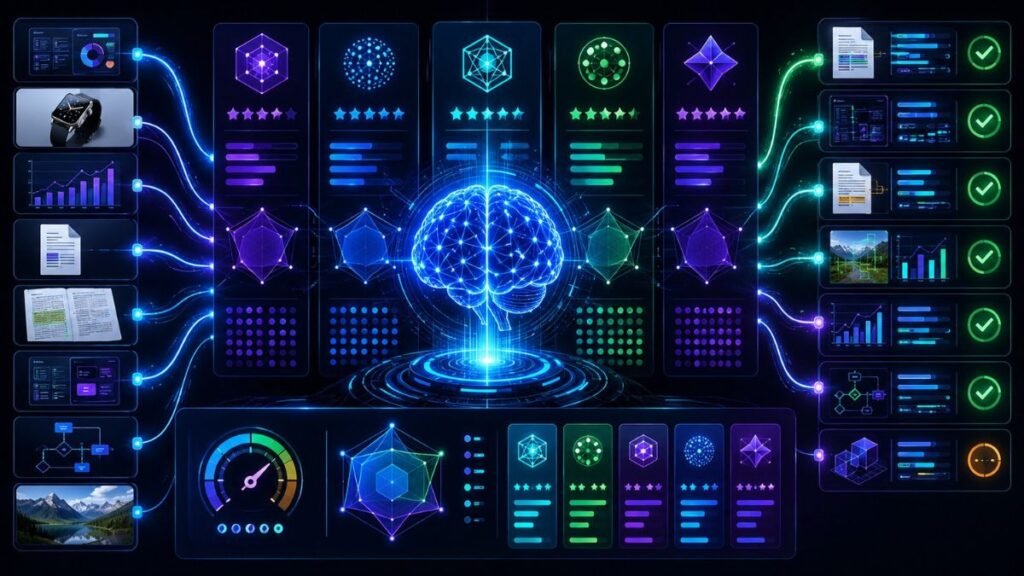
Image capable LLMs are language models that can understand images along with text prompts. The best options depend on the workflow: GPT-5.5, Gemini, and Claude are strong hosted choices, while Qwen3-VL, Llama 4, InternVL3, Pixtral, and PaliGemma 2 are important open or lightweight options for developers.
In Simple Terms
Image capable LLMs are AI models that can “look” at an image and answer questions about it. You can upload a screenshot, product photo, chart, scanned page, UI screen, or diagram, then ask the model to explain, summarize, extract, compare, or reason about what it sees.
These models are often called vision LLMs, multimodal LLMs, or vision-language models. The core idea is simple: the model combines visual input with language reasoning.
Quick Comparison of Image Capable LLMs
| Model | Best For | Main Strength | Main Trade-Off |
| GPT-5.5 | Professional image reasoning | Strong hosted text + image workflow | Proprietary hosted model |
| Gemini | Images plus video/audio/code workflows | Broad multimodal coverage | Check current API limits |
| Claude | Screenshots, diagrams, documents | Careful visual explanation | Hosted ecosystem |
| Qwen3-VL | Open VLM development | Visual reasoning, video, agents | Requires infrastructure |
| Llama 4 | Open-weight multimodal apps | Ecosystem and text-image support | Licensing/task fit vary |
| InternVL3 | Open research VLMs | Strong perception and reasoning | Engineering-heavy |
| Pixtral | Open-weight image-text use | Multi-image and image-text tasks | Model availability varies |
| PaliGemma 2 | Lightweight fine-tuning | OCR, captioning, detection | Not a frontier assistant |
GPT-5.5: Best Hosted Image Capable LLM for Complex Reasoning
GPT-5.5 is a strong choice when you need a hosted model for professional image reasoning, screenshot analysis, visual Q&A, and document-heavy tasks. OpenAI’s model documentation says the latest OpenAI models support text and image input, text output, multilingual capabilities, and vision, and it points users toward GPT-5.5 for complex reasoning and coding workflows.
Use GPT-5.5 when answer quality matters more than local deployment. It is useful for business copilots, support screenshot analysis, UI review, product image reasoning, and document question answering. The trade-off is that it is proprietary and hosted, so teams should evaluate cost, latency, privacy, and API dependency.
Gemini: Best for Broad Multimodal Workflows
Gemini is a strong option when image understanding is only one part of the task. Google Cloud describes Gemini as a multimodal model that can be prompted with images, text, code, and video, and designed to reason across text, images, video, audio, and code.
This makes Gemini useful for workflows that combine screenshots, videos, audio, documents, code, and long context. For example, a team might analyze a tutorial video, related screenshots, and a user question in the same workflow. Gemini is a strong candidate for video-aware apps, multimodal search, and Google ecosystem use. The practical caution is to check model availability, pricing, context limits, and supported inputs before production use.
Claude: Best for Careful Screenshot and Document Analysis
Claude is a strong image capable LLM for users who need careful analysis of screenshots, charts, dense documents, and diagrams. Anthropic’s Claude vision documentation says users can upload images through Claude, Console Workbench, or the API, making it useful for visual workflows.
Claude is a good fit for analysts, educators, researchers, writers, support teams, and business users who want structured explanations from visual inputs. It is especially useful when the output should be cautious, readable, and well organized. It is less suitable when local deployment or open-weight fine-tuning is the main requirement.
Qwen3-VL: Best Open Image Capable LLM Family for Developers
Qwen3-VL is one of the most important open vision-language model families for developers. The official Qwen3-VL repository describes it as the most powerful Qwen vision-language model generation so far, with upgrades in text understanding, visual perception, reasoning, long context, spatial and video understanding, and agent interaction.
Choose Qwen3-VL if you want more control over deployment, visual agents, OCR-style extraction, GUI understanding, video-image workflows, or custom multimodal apps. The trade-off is operational. Open models require GPU planning, model serving, evaluation, and maintenance.
Llama 4: Best Open-Weight Option for Broad Ecosystem Use
Llama 4 is relevant because it brings multimodal capability into a widely adopted open-weight model ecosystem. Reuters reported that Meta released Llama 4 Scout and Maverick as part of its multimodal AI systems, able to process and translate multiple data formats including text, video, images, and audio.
Choose Llama 4 when you want open-weight flexibility, ecosystem support, and integration with existing Llama-based tooling. The trade-off is that “open-weight” does not always mean unrestricted use, and performance depends heavily on task, deployment stack, and evaluation quality.
InternVL3, Pixtral, and PaliGemma 2: Best for Open Research and Focused Vision Tasks
InternVL3 is useful for open multimodal research and advanced visual reasoning. The InternVL team describes InternVL3 as an advanced MLLM series with improved multimodal perception and reasoning, extending into tool usage, GUI agents, industrial image analysis, and 3D vision perception.
Pixtral is another important open-weight image-text model family. The Pixtral 12B paper describes it as a multimodal language model trained to understand images and text, released with open weights under an Apache 2.0 license.
PaliGemma 2 is best when you need lightweight fine-tuning rather than a frontier general assistant. Google DeepMind describes it as a family of lightweight open vision-language models that can interpret text and image inputs.
How to Choose the Right Image Capable LLM
Start with the task. For hosted quality, test GPT-5.5, Gemini, and Claude. For open deployment, compare Qwen3-VL, Llama 4, InternVL3, and Pixtral. For lightweight fine-tuning, consider PaliGemma 2.
Then test on your own images. Use real screenshots, scanned documents, forms, charts, product images, UI screens, and edge cases. Public benchmarks help, but your actual data decides whether the model is good enough.
Common Mistakes to Avoid
Do not choose an image capable LLM only by leaderboard score. Check OCR quality, screenshot accuracy, chart reasoning, visual grounding, latency, cost, privacy, licensing, and integration needs.
Also avoid assuming “image capable” means “good at every image task.” Some models handle documents well. Others are better for real-world scenes, videos, GUI screens, or fine-tuned detection-style tasks. A strong model choice depends on workflow fit.
Suggested Read:
- What Is Multimodal AI? Simple Explanation With Examples
- Vision-Language Models Explained for Beginners
- Best Image Understanding Models in 2026
- Best Vision Language Models in 2026
- Multimodal AI Model Comparison
- Image to Text AI
- Document Understanding AI
- Multimodal Evaluation
FAQ: Image Capable LLMs Compared
What are image capable LLMs?
Image capable LLMs are language models that can process image input along with text prompts and return text-based answers, summaries, explanations, or structured outputs.
Which LLMs can understand images?
GPT-5.5, Gemini, Claude, Qwen3-VL, Llama 4, InternVL3, Pixtral, and PaliGemma 2 are examples of image capable or vision-language model options.
What is the best image capable LLM?
There is no single best choice. GPT-5.5, Gemini, and Claude are strong hosted options, while Qwen3-VL, Llama 4, InternVL3, Pixtral, and PaliGemma 2 are useful open or lightweight options.
Are image capable LLMs the same as vision-language models?
Many image capable LLMs are vision-language models because they connect visual input with language prompts and language outputs.
Which image capable LLM is best for documents?
Claude, GPT-5.5, Gemini, Qwen3-VL, and document-specialized pipelines are strong candidates. Test OCR, tables, layout, and citations before choosing.
What is the best open-source image capable LLM?
Qwen3-VL, InternVL3, Pixtral, PaliGemma 2, and Llama 4 are important open or open-weight choices, depending on licensing, infrastructure, and task fit.
Final Takeaway
Image capable LLMs make language models useful for visual workflows such as screenshots, OCR, documents, charts, product images, and visual reasoning. Use hosted models like GPT-5.5, Gemini, and Claude for fast access and strong quality. Use open or lightweight models like Qwen3-VL, Llama 4, InternVL3, Pixtral, and PaliGemma 2 when control, fine-tuning, or deployment flexibility matters.
To continue learning, read Vision-Language Models Explained, Best Image Understanding Models, and Multimodal Evaluation next.