
Few Shot Prompting Explained: Meaning, Examples, and How It Works
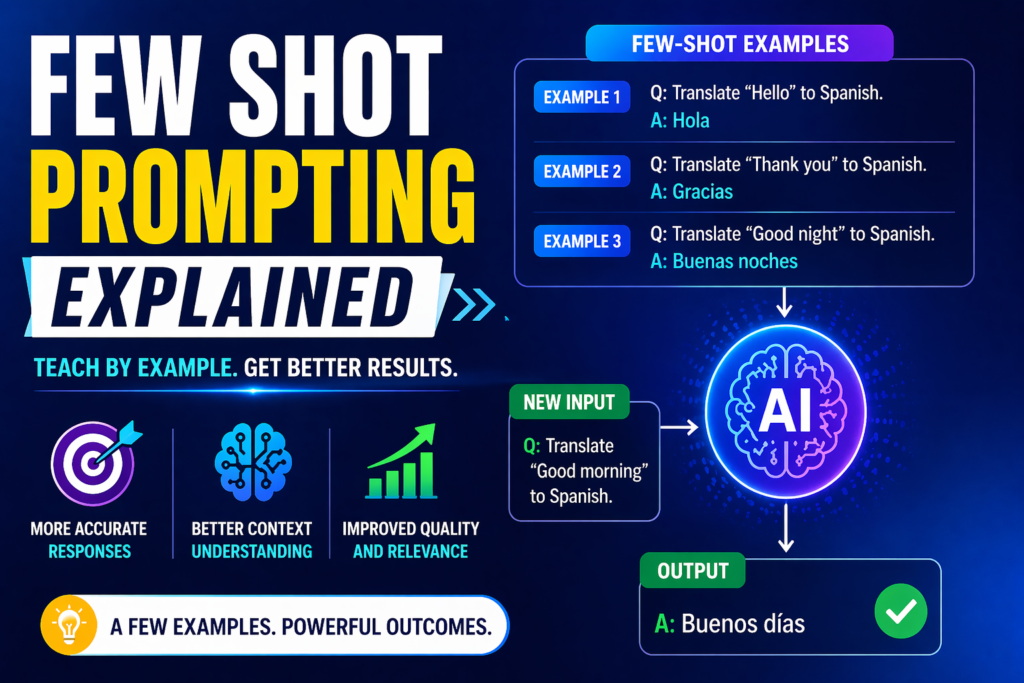
Few shot prompting is one of the most useful prompt engineering techniques for improving AI output quality. Instead of giving only one instruction, you provide a few examples first so the model understands the pattern you want.
This often leads to more accurate, consistent, and better-formatted responses.
In this guide, you’ll learn what few shot prompting means, how it works, when to use it, and practical examples.
In simple terms
Few shot prompting means:
Give AI a few examples, then ask it to continue the same pattern.
Instead of saying:
“Classify this review.”
Use:
Review: Great battery life → Positive
Review: Terrible customer service → Negative
Review: Fast delivery and nice quality → ?
The model learns the pattern from examples.
Why Few Shot Prompting Matters
Many AI tasks fail because instructions are vague. Examples reduce ambiguity.
Few shot prompting helps when you need:
- consistent tone
- better formatting
- improved classification
- structured extraction
- task-specific behavior
- higher reliability
This is why many high-performing prompt workflows use examples.
How Few Shot Prompting works
The model reads the examples and detects:
- task type
- desired format
- label system
- writing style
- reasoning pattern
Then it applies that pattern to the new input.
Think of it like showing samples before asking for final work.
Few Shot Prompting Examples
1.Sentiment Classification
Prompt:
Product was amazing → Positive
Very disappointing experience → Negative
Excellent support team → Positive
Slow and rude service → ?
Expected output:
Negative
2.Tone Rewriting
Prompt:
Formal: We need to talk soon.
Friendly: Let’s catch up when you’re free!
Formal: Please send the file today.
Friendly: ?
Expected output:
Could you send the file today when you get a chance?
3.Data Extraction
Prompt:
Text: John joined Google in 2021
Output: Name = John, Company = Google, Year = 2021
Text: Sarah joined Microsoft in 2023
Output: ?
Expected output:
Name = Sarah, Company = Microsoft, Year = 2023
4.Content Formatting
Prompt:
Topic: SEO
Output: Beginner guide with checklist
Topic: Email marketing
Output: Beginner guide with checklist
Topic: AI tools
Output: ?
Expected output:
Beginner guide with checklist
When to use Few Shot Prompting
Few shot prompting works best for repeatable tasks such as:
Classification
- spam detection
- sentiment analysis
- lead scoring
Transformation
- rewriting text
- formatting outputs
- translations
Extraction
- pulling names, dates, values
Style Matching
- brand voice
- tone consistency
- email formats
Structured Generation
- tables
- templates
- summaries
Few Shot Prompting vs Zero Shot Prompting
| Method | Meaning | Best For |
| Zero Shot | Only instruction, no examples | Simple tasks |
| One Shot | One example given | Light guidance |
| Few Shot | Multiple examples given | Accuracy and consistency |
Few shot usually outperforms zero shot when tasks need precision.
Benefits of Few Shot Prompting
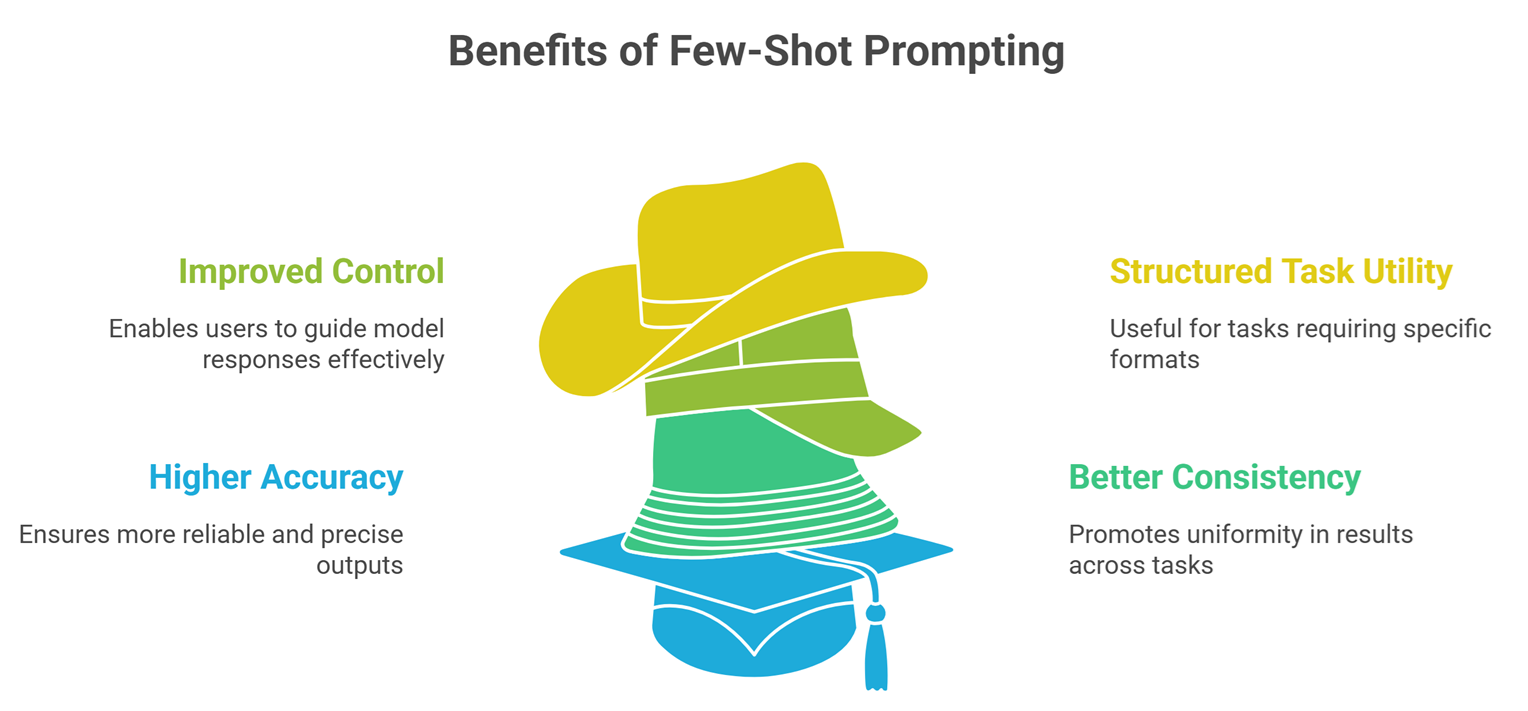
1.Better accuracy
Examples reduce misunderstanding.
2.More consistency
Useful for repetitive workflows.
3.Stronger formatting control
Great for tables, labels, JSON, lists.
4.Less back-and-forth
Often works better on first try.
5.Easier automation
Useful inside apps and pipelines.
Limitations of Few Shot Prompting
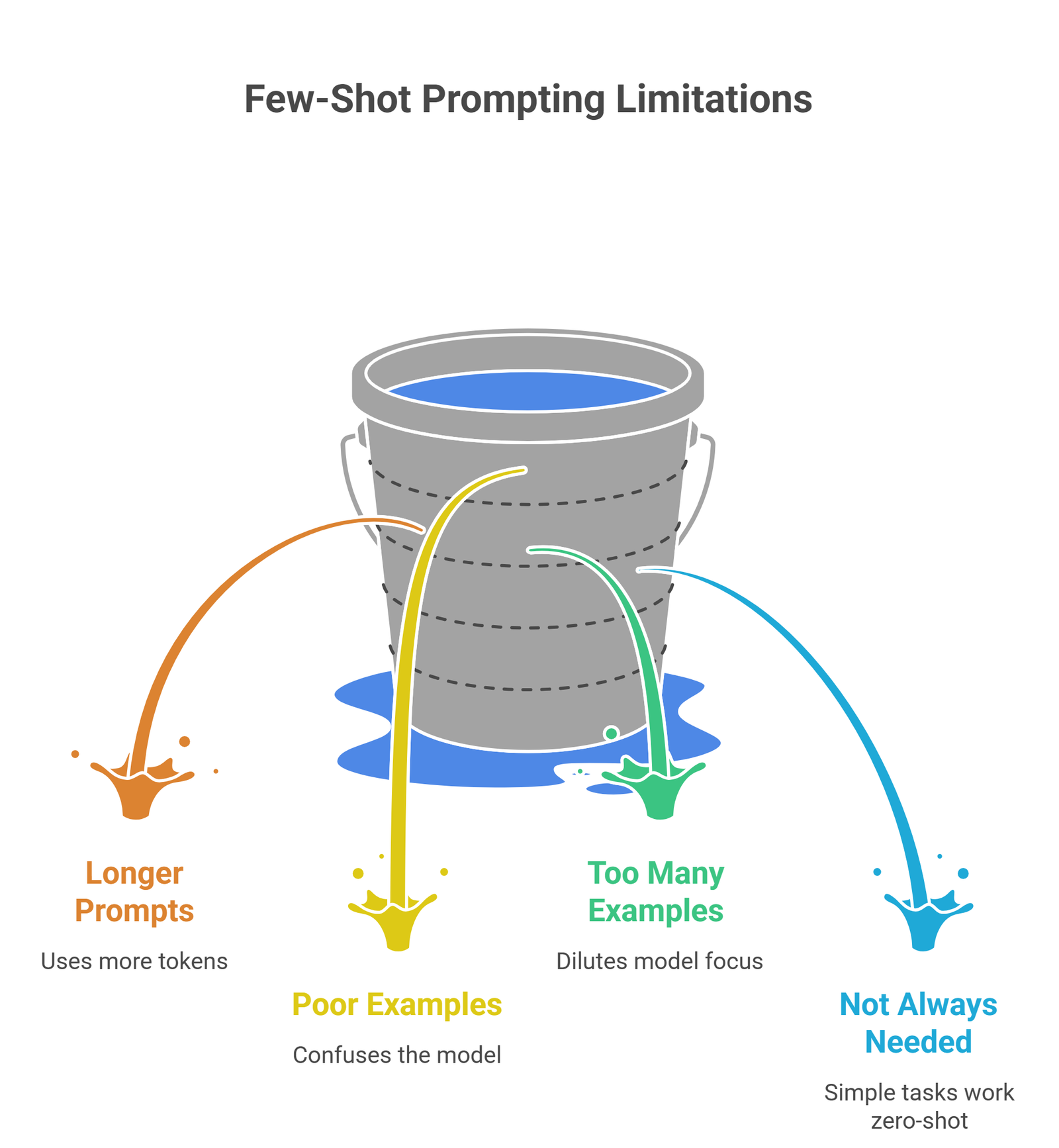
1.Longer prompts
Examples use more tokens.
2.Poor examples create poor results
Bad samples confuse the model.
3.Too many examples can dilute focus
Use only the most relevant ones.
4.Not always needed
Simple tasks may work with zero shot prompts.
Best practices for Few Shot Prompting
Use high-quality examples
Clear and correct examples matter.
Match real use cases
Use examples similar to target tasks.
Keep formatting consistent
Same structure across samples.
Use 2 to 5 examples first
Often enough for most tasks.
Test and refine
Swap examples if results are weak.
Copy-paste Few Shot Prompt Template
Task: Classify customer sentiment
Example 1: Fast delivery and great quality → Positive
Example 2: Product arrived broken → Negative
Example 3: Helpful support and easy refund → Positive
Now classify:
Example 4: Slow shipping and rude response → ?
Suggested Read:
- What Is Prompt Engineering? Complete Beginner Guide
- Zero Shot Prompting Explained
- Chain of Thought Prompting Explained
- Reusable Prompt Templates
- Prompt Engineering Best Practices
- Step by Step Prompting Guide
FAQ: Few Shot Prompting
What is few shot prompting?
It means giving AI a few examples before asking it to complete the task.
Is few shot prompting better than zero shot?
Often yes for structured or accuracy-sensitive tasks.
How many examples should I use?
Usually 2 to 5 strong examples are enough.
Does it work on ChatGPT, Claude, and Gemini?
Yes. Few shot prompting works across major LLMs.
Final takeaway
Few shot prompting is one of the easiest ways to improve AI results without changing models or tools. By showing a few examples first, you guide the model toward the output you want.
Use it for classification, extraction, rewriting, formatting, and consistent workflows to get better results faster.