
Domain Specific Language Models Explained: Industry AI Models in 2026
Large Language Models (LLMs) are powerful general-purpose AI systems. They can write, summarize, answer questions, and generate code across many topics.
But many businesses need more than general intelligence.
A hospital may need medical terminology accuracy. A law firm may need contract understanding. A bank may need finance-focused language workflows.
That is where domain specific language models become important.
This guide explains what domain specific language models are, how they work, and why organizations increasingly prefer them.
In simple terms
A domain specific language model is:
An AI language model designed or adapted for one industry, profession, or specialized task area.
Instead of being broad and generic, it focuses deeply on one domain.
Examples:
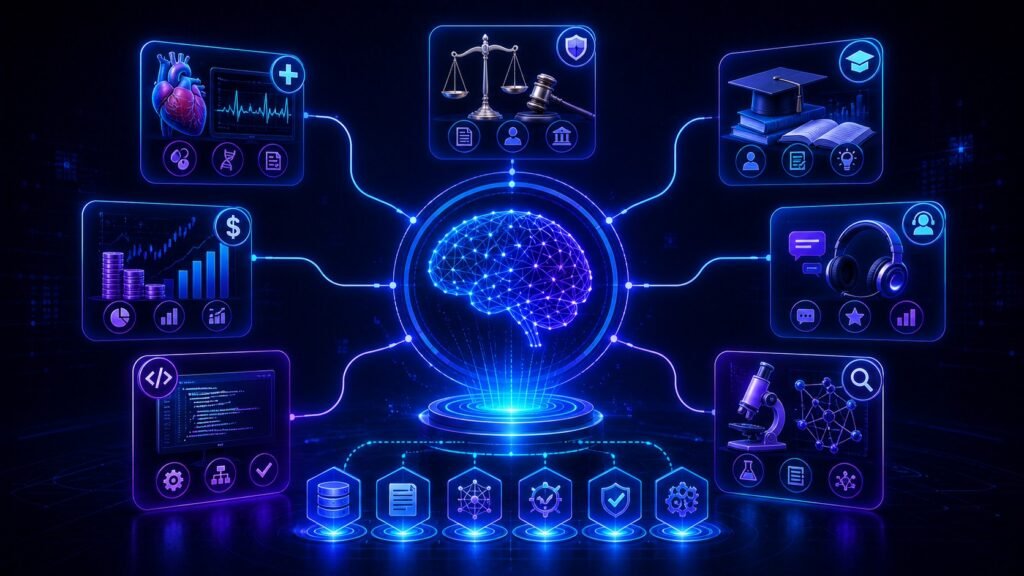
- healthcare AI models
- legal AI models
- finance AI models
- coding language models
- customer support models
- scientific research models
Why domain specific models matter
General models are versatile, but specialized industries often need:
- accurate terminology
- industry workflows
- regulatory awareness
- better structured outputs
- lower hallucination risk
- higher trust levels
That is why many enterprises move beyond generic AI tools.
General LLM vs Domain Specific Model
| Feature | General LLM | Domain Specific Model |
| Breadth | Very wide | Narrower |
| Industry Knowledge | Moderate | Deep |
| Custom Workflows | Moderate | Strong |
| Accuracy in Niche Terms | Variable | Often better |
| Setup Speed | Fast | Slower |
| Best For | Broad tasks | Specialized use cases |
Easy analogy
Think of doctors.
- General practitioner = general LLM
- Cardiologist = domain specific model
Both are useful, but each serves different needs.
How Domain Specific Models are Built
1. Fine-Tuning a Base Model
A general LLM is trained further on industry data.
2. Retrieval-Augmented Systems
A model accesses trusted domain documents during inference.
3. Custom Prompt Layers
Special workflows built on top of general models.
4. Fully Native Specialized Models
Built specifically for one industry from the start.
Popular industries using specialized language models
Healthcare
Medical notes, coding, triage, summaries.
Legal
Contract review, case search, clause extraction.
Finance
Research summaries, risk analysis, reporting.
Ecommerce
Catalog automation, support workflows.
Software Development
Code generation and debugging.
Scientific Research
Paper summarization and literature review.
Real ecosystem examples
Many specialized solutions are built using general model providers or open ecosystems such as:
These platforms are often customized for domain use.
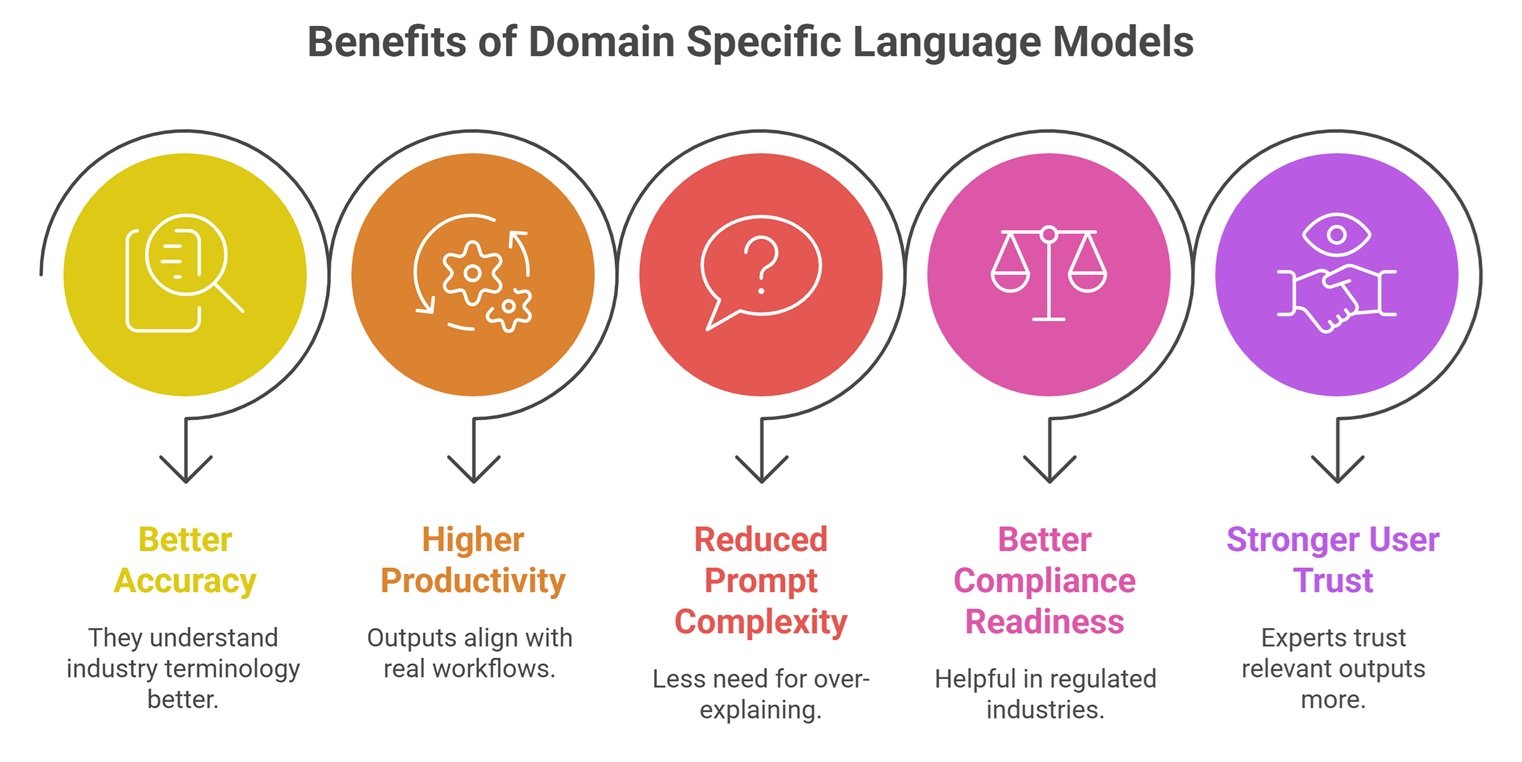
Benefits of Domain Specific Language Models
Better Accuracy
They understand industry terminology better.
Higher Productivity
Outputs align with real workflows.
Reduced Prompt Complexity
Less need for over-explaining.
Better Compliance Readiness
Helpful in regulated industries.
Stronger User Trust
Experts trust relevant outputs more.
Domain Specific Language Models: Challenges and Limitations
Narrow Scope
May perform worse outside the target domain.
Data Quality Problems
Poor training data creates poor results.
Maintenance Needs
Industries change over time.
Cost
Specialized AI can require extra investment.
Governance Complexity
Sensitive sectors need oversight.
Domain Specific Model vs Prompt Engineering
Prompt Engineering
Use instructions to guide general models.
Domain Specific Model
Model behavior itself is adapted.
Prompting is faster to start.
Specialized models are stronger for repeated workflows.
When should a business consider one?
Choose domain-specific AI when:
- teams repeat the same niche tasks daily
- terminology errors are expensive
- compliance matters
- brand/process consistency matters
- general tools require overly long prompts
- scale justifies customization cost
Common use cases by team
HR Teams
Resume screening, policy assistants.
Sales Teams
Industry-specific proposals.
Operations Teams
Structured workflow summaries.
Support Teams
Accurate product troubleshooting.
Analysts
Sector-specific research synthesis.
Common Misconceptions: Domain Specific Language Models
Specialized models replace all general AI
No. Many companies use both.
They are always better
Only for relevant tasks.
They must be built from scratch
Often fine-tuning is enough.
Only enterprises need them
Startups with niche products may benefit too.
Future of domain specific AI
Expect growth in:
- private enterprise vertical models
- healthcare copilots
- legal contract assistants
- finance research systems
- industrial knowledge bots
- small efficient niche models
The future of AI may be increasingly specialized.
Suggested Read:
- LLM Fine Tuning Basics
- Open Source vs Closed Source LLMs
- LLM Deployment Basics
- How LLMs Work
- Best LLMs for Coding
- LLM for Beginners
FAQ: Domain Specific Language Models
What are domain specific language models?
AI language models specialized for one industry or task area.
Are they better than general LLMs?
For niche workflows, often yes.
Do they require training from scratch?
Not always. Many use fine-tuning or retrieval systems.
Which industries use them most?
Healthcare, legal, finance, coding, support, and research.
Are they expensive?
Depends on build method and scale.
Final takeaway
Domain specific language models help organizations move from generic AI outputs to real business value. They improve accuracy, efficiency, and trust in specialized workflows.
General LLMs are broad tools. Domain-specific models turn AI into an expert assistant.