

Best AI Tools for Thesis Writing in 2026: Research, Literature Review, and Citations
The best AI tools for thesis writing help students find papers, understand dense research, organize notes, manage citations, and improve drafts without replacing original academic work. The strongest thesis workflow does not depend on one tool. It combines source discovery, literature review support, PDF analysis, reference management, writing assistance, and human verification.
In Simple Terms
AI tools for thesis work are research assistants, not thesis writers.
A good AI tool can help you search academic papers, summarize a PDF, compare studies, extract themes, organize references, or polish a paragraph. But it should not invent sources, make unsupported claims, or write your thesis without your understanding.
The safest approach is simple: use AI to speed up research tasks, then verify every important claim against original sources.
Best AI Tools for Thesis: Quick Comparison
| Tool | Best For | Why It Helps Thesis Work | Main Limitation |
| Elicit | Literature review and paper screening | Helps explore papers, screen studies, and extract structured details | Needs manual verification |
| Consensus | Evidence-backed academic answers | Useful for quick research questions across peer-reviewed literature | Best for questions with clear evidence |
| SciSpace | Reading and explaining papers | Helps understand dense PDFs, methods, and findings | Summaries still need source checking |
| NotebookLM | Source-grounded note synthesis | Works well with uploaded thesis sources and notes | Quality depends on uploaded materials |
| Semantic Scholar | Academic paper discovery | Free AI-powered scientific search and citation exploration | Not a full thesis writing system |
| Scite | Citation context checking | Helps see how studies are cited by other papers | More useful after you already have sources |
| Research Rabbit | Paper mapping | Good for finding connected papers and research networks | Can become overwhelming without a clear scope |
| Zotero | Reference management | Organizes citations, PDFs, and bibliographies | Not an AI writing assistant |
| Grammarly | Academic editing and clarity | Helps improve grammar, tone, and readability | Cannot judge research quality |
| ChatGPT / Claude / Gemini | Brainstorming and structure | Useful for outlines, explanations, and revision prompts | Can hallucinate if used without sources |
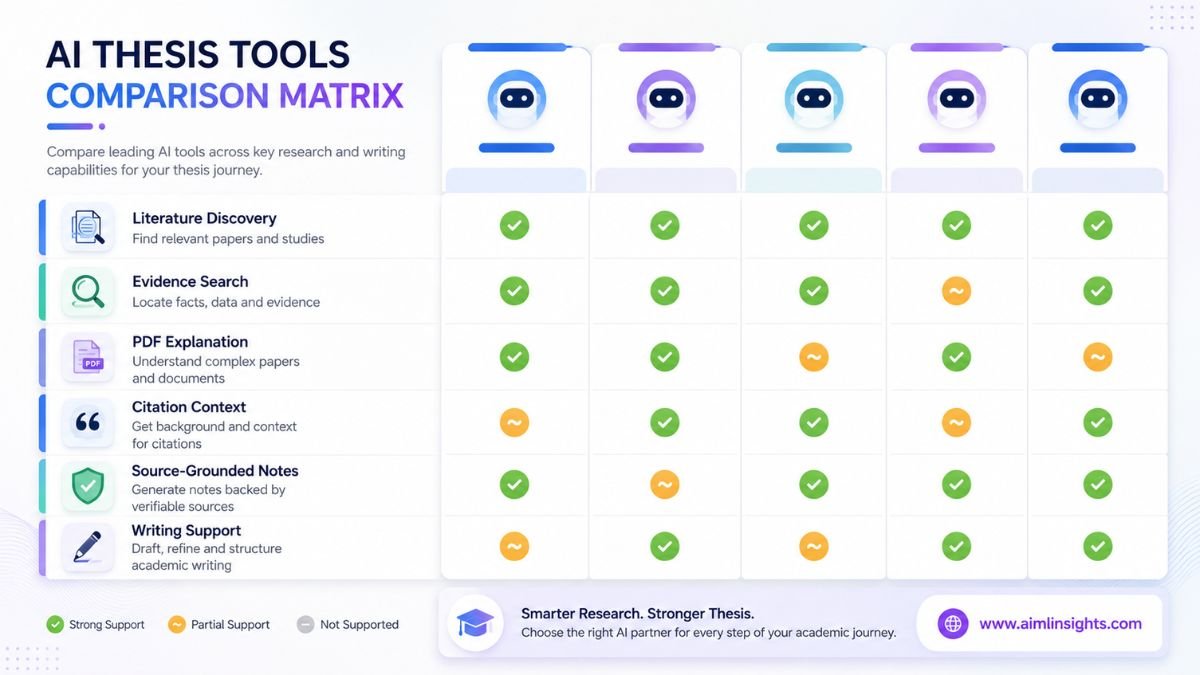
Elicit: Best for Literature Review Screening
Elicit is one of the best AI tools for thesis literature review because it is designed around scientific research workflows. It can help students search papers, screen results, and extract information into structured tables. Elicit says it supports systematic literature review tasks such as screening and data extraction, with partial support for search and report generation.
Use Elicit when you need to move from a broad topic to a clearer set of papers. For example, a master’s student researching “AI in medical diagnosis” can use it to compare studies by population, method, outcome, and limitation.
Best for: literature review, study screening, research question refinement.
Avoid using it for: final claims without reading the original papers.
Consensus: Best for Evidence-Based Research Questions
Consensus is useful when your thesis question can be answered through existing research evidence. Its official page says it searches and analyzes peer-reviewed literature and draws on more than 250 million research papers, including licensed full-text content from major publishers.
This makes Consensus helpful for early thesis validation. If your topic is “Does remote work improve employee productivity?” or “Does mindfulness reduce academic stress?”, Consensus can help you find a fast evidence overview.
Best for: evidence checks, yes/no research questions, quick literature scanning.
Avoid using it for: complex theoretical arguments that require deep interpretation.
SciSpace: Best for Understanding Dense Papers
SciSpace is strong for students who struggle with technical papers. Its official site describes it as an AI research assistant for academics that can run literature reviews on more than 280 million papers and support writing with cited sources.
For thesis work, SciSpace is useful when you need to understand methodology, variables, equations, findings, or unfamiliar terminology. Instead of skipping difficult papers, you can use it to break down sections and then confirm the meaning from the original text.
Best for: PDF explanation, paper reading, technical understanding.
Avoid using it for: replacing your own critical reading.
NotebookLM: Best for Source-Grounded Thesis Notes
NotebookLM is one of the best AI tools for thesis students who already have a source folder. Google describes NotebookLM as an AI research tool and thinking partner that can analyze your sources and turn complex material into clearer outputs.
This is valuable for thesis writing because your notes stay closer to your uploaded material. You can upload papers, supervisor notes, proposal drafts, field notes, or policy documents and ask for themes, contradictions, summaries, or study-guide style explanations.
Best for: source-grounded synthesis, thesis notes, chapter planning.
Avoid using it for: sources you have not checked or uploaded carefully.
Semantic Scholar: Best Free Academic Search Tool
Semantic Scholar is a free AI-powered research tool for scientific literature from Ai2. Its official site positions it around paper search, documentation, and research discovery.
For thesis students, it is a strong starting point because it helps discover papers, authors, citation trails, and related work. It is especially useful when you want to expand from one good paper into a broader research area.
Best for: finding papers, citation trails, related research.
Avoid using it for: full literature synthesis without additional tools.
Scite: Best for Citation Context
Scite is useful when you need to understand how a paper has been cited. This matters in thesis writing because a highly cited paper is not always strongly supported. Some citations may support, contrast, question, or merely mention the work.
Use Scite after you have built your reading list. It can help you decide whether a study is foundational, disputed, limited, or frequently referenced in a specific context.
Best for: citation quality, source evaluation, literature review depth.
Avoid using it for: early brainstorming before you have a paper set.
Research Rabbit and Connected Papers: Best for Research Mapping
Research Rabbit and Connected Papers are helpful for visual literature mapping. They show relationships between papers, authors, topics, and citation networks.
These tools are useful when your thesis topic feels scattered. Start with one strong seed paper, then explore nearby work. This can help you find older foundational studies, newer related papers, and possible research gaps.
Best for: research mapping, finding related papers, gap discovery.
Avoid using it for: collecting too many papers without a clear inclusion rule.
Zotero: Best for Citation Management
Zotero is not mainly an AI thesis writing tool, but it is one of the most important tools in a thesis workflow. AI tools can help you find and understand sources, but Zotero helps you store, tag, cite, and organize them.
A common mistake is using AI for research but managing references manually. That creates citation errors later. Use Zotero from the beginning so every paper, PDF, note, and citation style stays organized.
Best for: references, PDFs, citation styles, bibliography.
Avoid using it for: AI summarization or writing.
Grammarly, Paperpal, and Academic Editing Tools
Academic editing tools can improve clarity, grammar, sentence flow, and readability. They are useful after you already know what you want to say.
For thesis writing, use these tools at the revision stage. They can help make your writing cleaner, but they cannot decide whether your argument is valid, whether your method is correct, or whether your sources are strong.
Best for: editing, grammar, readability, academic tone.
Avoid using them for: research judgment or argument design.
ChatGPT, Claude, and Gemini: Best for Brainstorming and Structure
General AI assistants can be useful for thesis planning when used carefully. They can help generate research questions, simplify difficult concepts, create chapter outlines, turn notes into draft structures, and suggest revision checklists.
But they are risky if used as source generators. A general chatbot may produce citations that look real but are inaccurate or fabricated. Use these tools for thinking, outlining, explanation, and editing — not as your only research database.
Best for: outlining, brainstorming, rewriting, explaining concepts.
Avoid using them for: unsourced literature review claims.
How to Use AI Tools for Thesis Work Safely
The best AI thesis workflow uses different tools at different stages.
Start with Semantic Scholar, Elicit, Consensus, or SciSpace to find and understand papers. Use Research Rabbit or Connected Papers to map related studies. Use Zotero to organize references. Use NotebookLM to synthesize only your collected sources. Use ChatGPT, Claude, Gemini, Grammarly, or Paperpal for structure and revision.
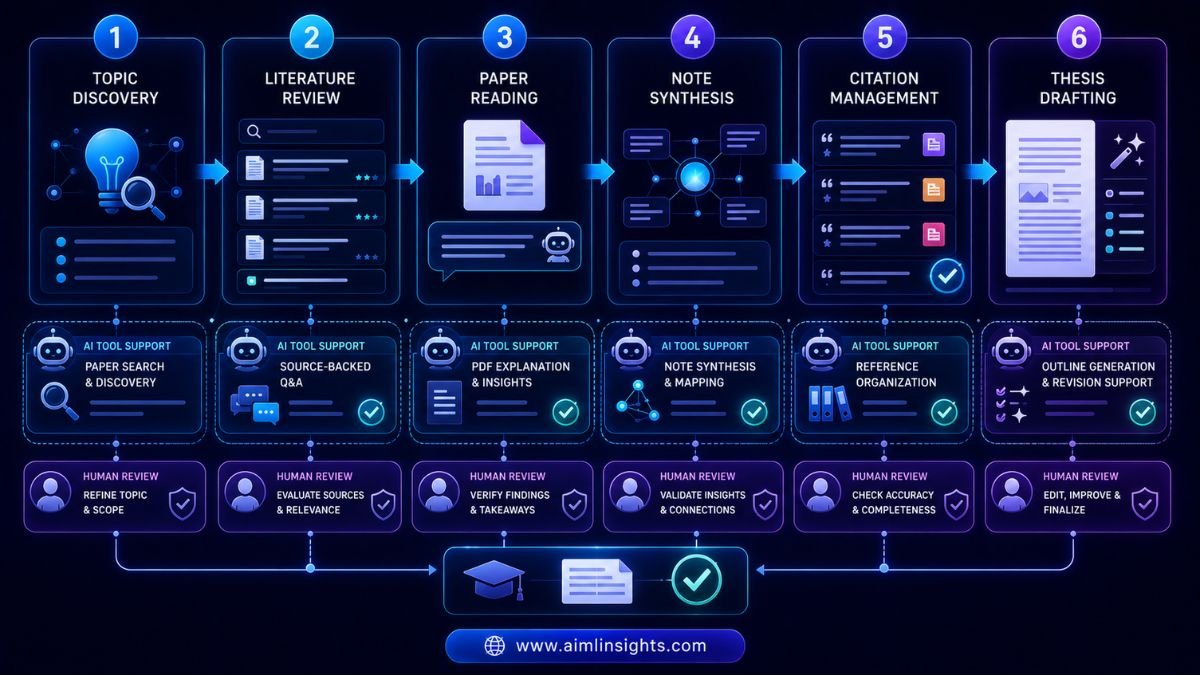
This layered workflow is safer than asking one AI tool to “write my thesis.”
Common Mistakes to Avoid
The biggest mistake is trusting AI summaries without reading the original source. AI can miss nuance, flatten disagreement, or make weak evidence sound stronger than it is.
The second mistake is using AI-generated citations without checking them. Citation errors can damage thesis credibility.
The third mistake is ignoring university policy. Some universities allow AI for editing or research support but restrict AI-generated writing. Always check your department’s rules.
The fourth mistake is letting AI decide your argument. Your thesis must show your own research judgment, not just a polished AI-generated structure.
Recent research on AI-assisted literature reviews warns that AI can help expand coverage but may also introduce selection bias, shallow synthesis, and overconfident writing if the researcher does not actively verify the literature.
Suggested Read:
- Best AI Tools for Beginners in 2026
- Best AI Tools for Students
- Best AI Tools for Research and Writing
- ChatGPT vs Perplexity vs Claude for Research Tasks
- AI Tools With Free Plans Worth Using in 2026
- Best Prompt Templates for Summarization and Research
- What Is a Large Language Model? Explained Simply
- Why LLMs Hallucinate and How to Reduce It
FAQ: Best AI Tools for Thesis Writing in 2026
What are the best AI tools for thesis writing?
The best AI tools for thesis writing include Elicit for literature screening, Consensus for evidence-backed search, SciSpace for paper explanation, NotebookLM for source-grounded notes, Semantic Scholar for paper discovery, Zotero for references, and ChatGPT or Claude for outlining and revision.
Can AI tools help with a thesis literature review?
Yes, AI tools can help with thesis literature review tasks such as finding papers, screening abstracts, summarizing PDFs, extracting themes, and organizing notes. They should support your review, not replace your reading and judgment.
Which AI tool is best for academic research?
For academic research, Elicit, Consensus, SciSpace, Semantic Scholar, and NotebookLM are strong choices depending on the task. Elicit is useful for screening, Consensus for evidence questions, SciSpace for paper understanding, and NotebookLM for source-grounded synthesis.
Are AI tools allowed for thesis writing?
It depends on your university, department, and supervisor. Many institutions allow AI for brainstorming, grammar support, or organization, but restrict undisclosed AI-generated writing. Always check your academic integrity policy.
Can AI write my thesis for me?
No. AI should not write your thesis for you. It can help with research support, summaries, outlines, editing, and organization, but the argument, analysis, interpretation, and final responsibility must remain yours.
Which AI tools help with citations and references?
Zotero is best for reference management. Scite helps with citation context. Some AI research tools can suggest sources, but you should always verify citation details against the original paper or publisher page.
Final Takeaway
The best AI tools for thesis work are not magic writing machines. They are workflow tools. Use Elicit, Consensus, SciSpace, NotebookLM, Semantic Scholar, Scite, Research Rabbit, Zotero, and careful general AI assistants together.
For the strongest results, build a workflow that keeps sources visible, citations verified, and human judgment at the center. Start with discovery, move into reading, organize references, synthesize from trusted sources, and use AI only to make your own thesis work clearer and more manageable.