Vikash P

Vikash Pal is an AI/ML Engineer at ScholarEase and Editor for AIML Insights, focusing on machine learning, applied AI workflows, and practical implementation.

LLM Interview Questions: Top AI Job Prep Guide

LLM interview questions guide: LLM interview preparation visual showing AI job questions, coding tests, skills, and career readiness

LLM Interview Questions: Top 50 Questions & Answers for 2026 Jobs Large Language Models (LLMs) have created new job roles across AI engineering, product development, prompt engineering, research support, and enterprise automation. As hiring grows, interviews now test more than machine learning theory. Employers want candidates who understand how to build useful AI systems. This […]

LLM Interview Questions: Top AI Job Prep Guide Read More »

Reranking in RAG: Improve AI Retrieval and Accuracy

Reranking in RAG visual showing semantic retrieval, AI reranking models, vector databases, and contextual relevance scoring

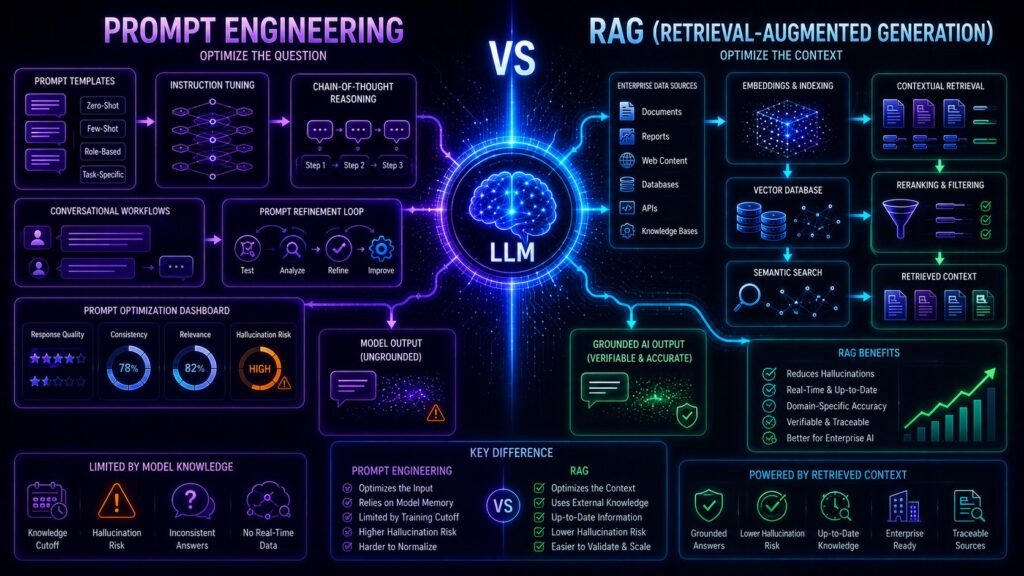
Reranking in RAG: How AI Retrieval Systems Improve Search Accuracy Retrieval-Augmented Generation (RAG) systems have become foundational infrastructure for modern Artificial Intelligence applications. Enterprises increasingly use RAG-powered AI assistants, enterprise search systems, customer support copilots, legal AI platforms, and document intelligence systems to improve AI accuracy and reduce hallucinations. However, even advanced semantic retrieval systems

Reranking in RAG: Improve AI Retrieval and Accuracy Read More »

Semantic Search vs RAG: Key AI Retrieval Differences

Semantic search vs RAG visual showing embeddings, semantic retrieval, vector databases, and grounded AI response generation

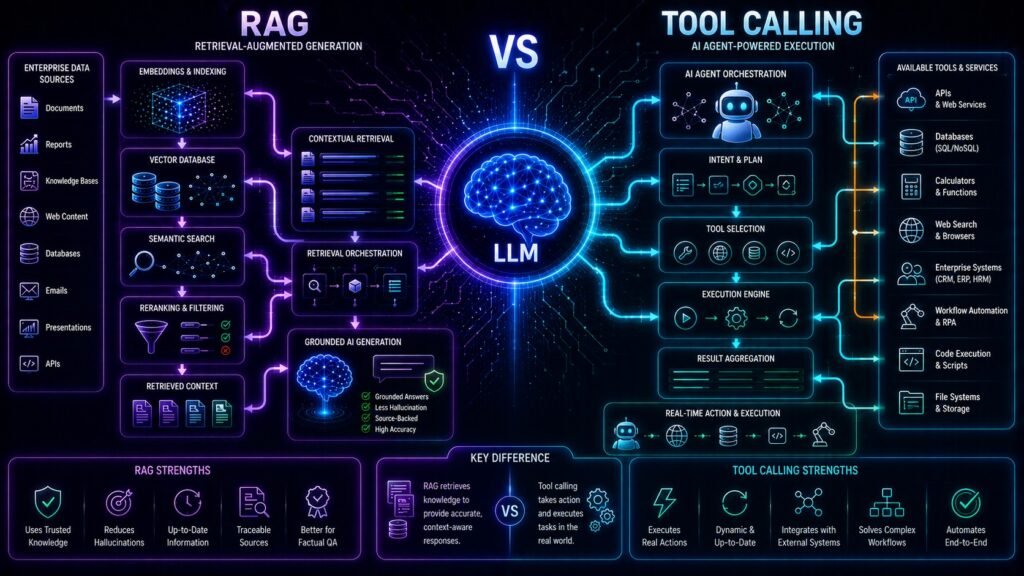
Semantic Search vs RAG: Understanding the Key Differences in AI Retrieval Modern Artificial Intelligence systems increasingly depend on retrieval technologies to improve accuracy, contextual understanding, and enterprise knowledge access. As AI assistants, enterprise copilots, semantic search systems, and document intelligence platforms continue to evolve, two technologies appear repeatedly in modern AI discussions: Semantic Search and

Semantic Search vs RAG: Key AI Retrieval Differences Read More »

Hybrid Search in RAG: Semantic and Keyword Retrieval

Hybrid search in RAG visual showing semantic retrieval, keyword search, embeddings, vector databases, and AI retrieval pipelines

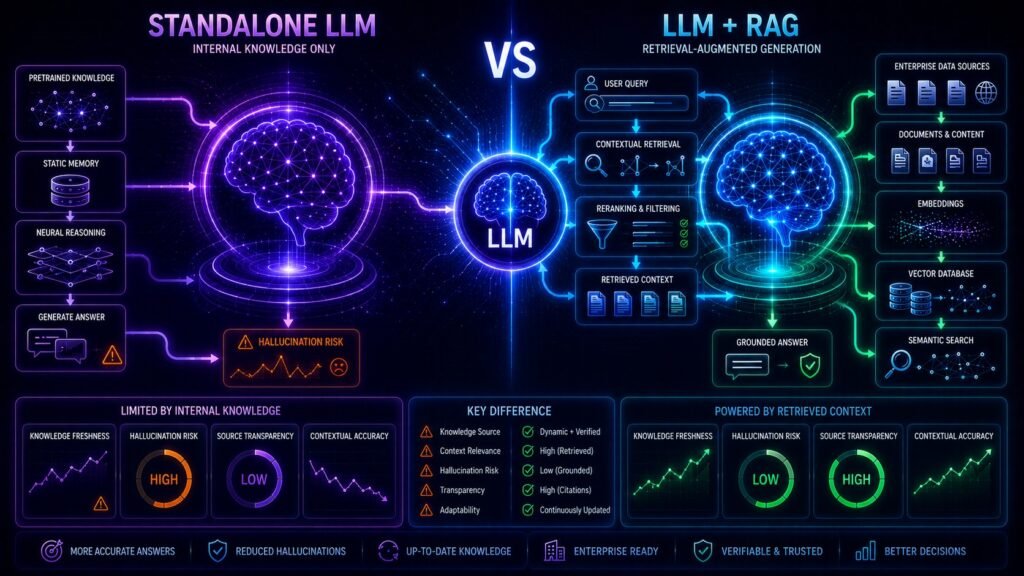
Hybrid Search in RAG: How AI Combines Semantic and Keyword Retrieval Retrieval-Augmented Generation (RAG) systems have transformed modern Artificial Intelligence applications by enabling Large Language Models (LLMs) to retrieve external knowledge before generating responses. This retrieval layer dramatically improves factual grounding, reduces hallucinations, and enables enterprise AI systems to work with real-time information. However, retrieval

Hybrid Search in RAG: Semantic and Keyword Retrieval Read More »

LLM Roadmap for Beginners: Skills and Career Guide

LLM roadmap for beginners: LLM roadmap for beginners showing AI skills, learning milestones, projects, and career growth path

LLM Roadmap for Beginners: Step-by-Step Career Guide in 2026 Large Language Models (LLMs) are creating new opportunities across AI, software, product development, automation, and enterprise technology. Companies need people who understand how to build, use, evaluate, and deploy LLM systems. The good news: you do not need a PhD to start learning. This guide gives

LLM Roadmap for Beginners: Skills and Career Guide Read More »

Vector Database for RAG: Semantic Search Explained

Vector database for RAG visual showing semantic search, embeddings storage, AI retrieval systems, and vector indexing

Vector Database for RAG: How AI Retrieval Systems Store and Search Knowledge Retrieval-Augmented Generation (RAG) has become one of the most important architectures in modern Artificial Intelligence systems. Enterprises increasingly rely on RAG-powered AI assistants, semantic enterprise search platforms, document retrieval systems, and intelligent chatbots to deliver more accurate and grounded responses. But behind nearly

Vector Database for RAG: Semantic Search Explained Read More »

Embeddings for RAG: Semantic Search and AI Retrieval

Embeddings for RAG visual showing semantic search, vector embeddings, AI retrieval systems, and contextual document retrieval

Embeddings for RAG: How AI Retrieval Systems Understand Meaning Retrieval-Augmented Generation (RAG) has become one of the most important architectures in modern Artificial Intelligence systems. Enterprises increasingly rely on RAG-powered AI assistants, enterprise search systems, document retrieval platforms, and intelligent chatbots to deliver more accurate and grounded responses. But one core technology powers nearly every

Embeddings for RAG: Semantic Search and AI Retrieval Read More »

LLM Truthfulness Evaluation: Metrics and Testing Guide

llm truthfulness evaluation explained: LLM truthfulness evaluation dashboard showing fact checking, accuracy metrics, verified sources, and hallucination detection

LLM Truthfulness Evaluation: How to Measure Honest AI Outputs in 2026 Large Language Models (LLMs) can generate fluent answers in seconds, but fluency does not always equal truth. A response may sound confident while containing false facts, invented sources, or misleading reasoning. That is why LLM truthfulness evaluation has become a major priority for AI

LLM Truthfulness Evaluation: Metrics and Testing Guide Read More »

LLM Monitoring Guide: Track AI Performance Better

LLM monitoring dashboard: LLM monitoring dashboard tracking cost, quality, latency, hallucinations, token usage, and production health

LLM Monitoring Explained: How to Track AI Performance in 2026 Launching a Large Language Model (LLM) application is only the beginning. Once users start interacting with your AI system, performance can change quickly. Costs may rise. Responses may slow down. Hallucinations may increase. User satisfaction may drop. That is why LLM monitoring is essential. This

LLM Monitoring Guide: Track AI Performance Better Read More »

Scroll to Top